Equity Volatility Trading:
Diversified Proprietary Strategies for Alpha Generation & Portfolio Hedging

Contact:
David Hamilton
t: 212.217.1556 m: 917.499.7331

davidehamil@gmail.com
Strategy Defined
Volatility Arbitrage is designed to produce absolute, market-neutral returns.
• Strategy continually looks to exploit pricing inefficiencies in various
options classes to generate consistent profits.
• Trade duration might vary from a few weeks to a few months.
• Strategy uses only exchange-listed options on US stocks.
• Strict execution and oversight guidelines ensures:
– Reduced transaction costs and market impact (Proprietary trading
technology utilizes all available liquidity to ensure positions are initiated and
closed in the most efficient manner possible).
– Increased speed and effectiveness of Risk Management
(Proprietary tools also designed to identify and rapidly reduce risk across both
strategies).
2
Relative Value Arbitrage (1 Month Maturity)
10-Year Backtested Returns, Jan 2002-Jan 2012

Average (vols x 100)
Sharpe
Stdev

2002-2011 2010-2011
0.0300
0.0151
2.2601
1.3197
0.0459
0.0395

Bin Frequency
-0.06
5
-0.04
5
-0.02
15
0
30
0.02
50
0.04
40
0.06
42
0.08
25
> 0.08
28

3
Relative Value Arbitrage (3 Month Maturity)
10-Year Backtested Returns, Jan 2002-Jan 2012

2002-2011 2010-2011
Average (vols x 100) 0.0283
0.0286
Sharpe
1.8259
1.9300
Stdev
0.0537
0.0513

Bin Frequency
-0.06
6
-0.04
13
-0.02
21
0
28
0.02
39
0.04
38
0.06
30
0.08
25
> 0.08
31

4
Strategy Defined
Portfolio Insurance is a vitally important, yet often overlooked, element of
traditional and quantitative Long/Short equity strategies employed by
hedge funds.
When used properly, it should serve as a key component of the risk
management process, seeking to preserve investor capital by locking in
gains and preventing/minimizing any potential drawdowns.

Design and use of Portfolio Insurance can be outlined in the following steps:
• Identify Hedging Needs
• Hedge Valuation/Optimization
• Hedge Implementation

5
Hedge Identification
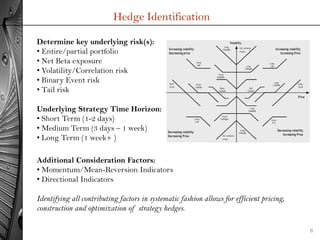
Determine key underlying risk(s):
• Entire/partial portfolio
• Net Beta exposure
• Volatility/Correlation risk
• Binary Event risk
• Tail risk
Underlying Strategy Time Horizon:
• Short Term (1-2 days)
• Medium Term (3 days – 1 week)
• Long Term (1 week+ )
Additional Consideration Factors:
• Momentum/Mean-Reversion Indicators
• Directional Indicators
Identifying all contributing factors in systematic fashion allows for efficient pricing,
construction and optimization of strategy hedges.
6
Hedge Valuation/Optimization
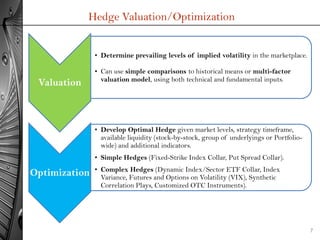
• Determine prevailing levels of implied volatility in the marketplace.

Valuation

• Can use simple comparisons to historical means or multi-factor
valuation model, using both technical and fundamental inputs.

• Develop Optimal Hedge given market levels, strategy timeframe,
available liquidity (stock-by-stock, group of underlyings or Portfoliowide) and additional indicators.
• Simple Hedges (Fixed-Strike Index Collar, Put Spread Collar).

Optimization

• Complex Hedges (Dynamic Index/Sector ETF Collar, Index
Variance, Futures and Options on Volatility (VIX), Synthetic
Correlation Plays, Customized OTC Instruments).

7
Hedge Implementation
Example – Ratio Collar on SPX
BUY: 1 6mo 98% Put
SELL: 1.5 1mo 101% Calls

BACKTEST PERIOD
Jan 1999 – Jan 2010

SPX Level at Start: 1,234.40
SPX Level at Finish: 1,150.23
PERFORMANCE
Avg. Return (monthly): 0.30%
Standard Dev. (monthly): 1.28%
Avg. Return (annualized): 3.60%
Sharpe: 0.81
TOP GRAPH:
Absolute returns, SPX + Collar v. SPX(in SPX points)
MIDDLE GRAPH:
Annualized volatility (SPX + Collar, SPX, Collar/SPX)
BOTTOM GRAPH:
Monthly returns, SPX + Collar v. SPX(in SPX points)

8

Relative Value Volatility & Dynamic Hedging

  • 1.
    Equity Volatility Trading: DiversifiedProprietary Strategies for Alpha Generation & Portfolio Hedging Contact: David Hamilton t: 212.217.1556 m: 917.499.7331 davidehamil@gmail.com
  • 2.
    Strategy Defined Volatility Arbitrageis designed to produce absolute, market-neutral returns. • Strategy continually looks to exploit pricing inefficiencies in various options classes to generate consistent profits. • Trade duration might vary from a few weeks to a few months. • Strategy uses only exchange-listed options on US stocks. • Strict execution and oversight guidelines ensures: – Reduced transaction costs and market impact (Proprietary trading technology utilizes all available liquidity to ensure positions are initiated and closed in the most efficient manner possible). – Increased speed and effectiveness of Risk Management (Proprietary tools also designed to identify and rapidly reduce risk across both strategies). 2
  • 3.
    Relative Value Arbitrage(1 Month Maturity) 10-Year Backtested Returns, Jan 2002-Jan 2012 Average (vols x 100) Sharpe Stdev 2002-2011 2010-2011 0.0300 0.0151 2.2601 1.3197 0.0459 0.0395 Bin Frequency -0.06 5 -0.04 5 -0.02 15 0 30 0.02 50 0.04 40 0.06 42 0.08 25 > 0.08 28 3
  • 4.
    Relative Value Arbitrage(3 Month Maturity) 10-Year Backtested Returns, Jan 2002-Jan 2012 2002-2011 2010-2011 Average (vols x 100) 0.0283 0.0286 Sharpe 1.8259 1.9300 Stdev 0.0537 0.0513 Bin Frequency -0.06 6 -0.04 13 -0.02 21 0 28 0.02 39 0.04 38 0.06 30 0.08 25 > 0.08 31 4
  • 5.
    Strategy Defined Portfolio Insuranceis a vitally important, yet often overlooked, element of traditional and quantitative Long/Short equity strategies employed by hedge funds. When used properly, it should serve as a key component of the risk management process, seeking to preserve investor capital by locking in gains and preventing/minimizing any potential drawdowns. Design and use of Portfolio Insurance can be outlined in the following steps: • Identify Hedging Needs • Hedge Valuation/Optimization • Hedge Implementation 5
  • 6.
    Hedge Identification Determine keyunderlying risk(s): • Entire/partial portfolio • Net Beta exposure • Volatility/Correlation risk • Binary Event risk • Tail risk Underlying Strategy Time Horizon: • Short Term (1-2 days) • Medium Term (3 days – 1 week) • Long Term (1 week+ ) Additional Consideration Factors: • Momentum/Mean-Reversion Indicators • Directional Indicators Identifying all contributing factors in systematic fashion allows for efficient pricing, construction and optimization of strategy hedges. 6
  • 7.
    Hedge Valuation/Optimization • Determineprevailing levels of implied volatility in the marketplace. Valuation • Can use simple comparisons to historical means or multi-factor valuation model, using both technical and fundamental inputs. • Develop Optimal Hedge given market levels, strategy timeframe, available liquidity (stock-by-stock, group of underlyings or Portfoliowide) and additional indicators. • Simple Hedges (Fixed-Strike Index Collar, Put Spread Collar). Optimization • Complex Hedges (Dynamic Index/Sector ETF Collar, Index Variance, Futures and Options on Volatility (VIX), Synthetic Correlation Plays, Customized OTC Instruments). 7
  • 8.
    Hedge Implementation Example –Ratio Collar on SPX BUY: 1 6mo 98% Put SELL: 1.5 1mo 101% Calls BACKTEST PERIOD Jan 1999 – Jan 2010 SPX Level at Start: 1,234.40 SPX Level at Finish: 1,150.23 PERFORMANCE Avg. Return (monthly): 0.30% Standard Dev. (monthly): 1.28% Avg. Return (annualized): 3.60% Sharpe: 0.81 TOP GRAPH: Absolute returns, SPX + Collar v. SPX(in SPX points) MIDDLE GRAPH: Annualized volatility (SPX + Collar, SPX, Collar/SPX) BOTTOM GRAPH: Monthly returns, SPX + Collar v. SPX(in SPX points) 8