Reinforced Concrete Design
Compressive Strength of Concrete
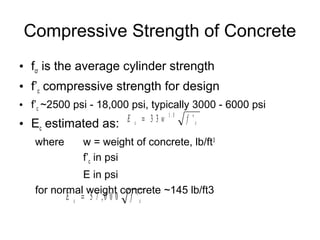
• fcr is the average cylinder strength
• f’c compressive strength for design
• f’c ~2500 psi - 18,000 psi, typically 3000 - 6000 psi
• Ec estimated as:
where w = weight of concrete, lb/ft3
f’c in psi
E in psi
for normal weight concrete ~145 lb/ft3
E w fc c= 3 3 1 5.
'
E fc c= 5 7 0 0 0, '
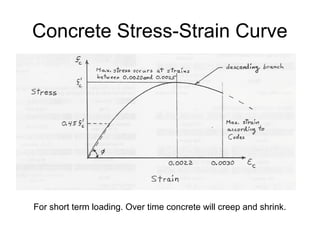
Concrete Stress-Strain Curve
For short term loading. Over time concrete will creep and shrink.
Concrete Strain
Strain in concrete will be caused by loading, creep,
shrinkage, and temperature change.
For scale, consider a 20’ section of concrete,
f’c = 4000 psi, under a stress, fc = 1800 psi.
Determine the change in length.
Tensile Strength of Concrete
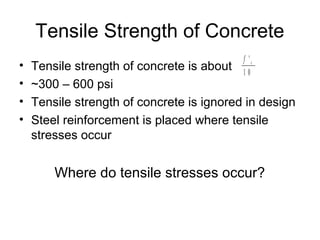
• Tensile strength of concrete is about
• ~300 – 600 psi
• Tensile strength of concrete is ignored in design
• Steel reinforcement is placed where tensile
stresses occur
Where do tensile stresses occur?
f c'
1 0
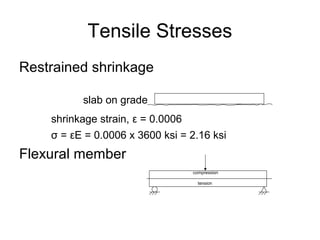
Tensile Stresses
Restrained shrinkage
slab on grade
shrinkage strain, ε = 0.0006
σ = εE = 0.0006 x 3600 ksi = 2.16 ksi
Flexural member
compression
tension
Reinforcing Steel
• Deformed steel reinforcing bars
• Welded wire fabric
• 7-strand wire (for pre-stressing)
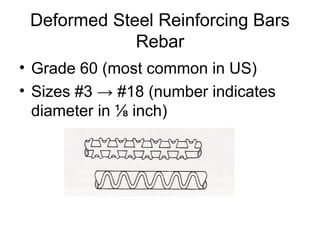
Deformed Steel Reinforcing Bars
Rebar
• Grade 60 (most common in US)
• Sizes #3 → #18 (number indicates
diameter in ⅛ inch)
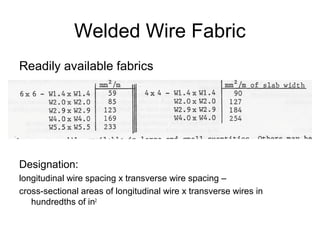
Welded Wire Fabric
Readily available fabrics
Designation:
longitudinal wire spacing x transverse wire spacing –
cross-sectional areas of longitudinal wire x transverse wires in
hundredths of in2
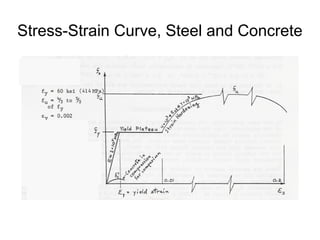
Stress-Strain Curve, Steel and Concrete
Reinforce Concrete Design
Two codes for reinforced concrete design:
• ACI 318 Building Code Requirements for
Structural Concrete
• AASHTO Specifications for Highway Bridges
We will design according to ACI 318 which is an
‘LRFD’ design. Load and resistance factors for
ACI 318 are given on page 7, notes.
Short Reinforced Concrete
Compression Members
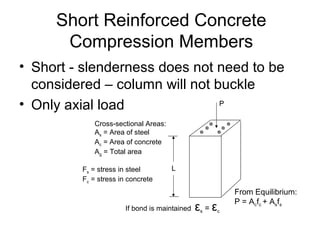
• Short - slenderness does not need to be
considered – column will not buckle
• Only axial load
L
Cross-sectional Areas:
As = Area of steel
Ac = Area of concrete
Ag = Total area
Fs = stress in steel
Fc = stress in concrete
From Equilibrium:
P = Acfc + Asfs
P
L
P
If bond is maintained εs = εc
Short Concrete Columns
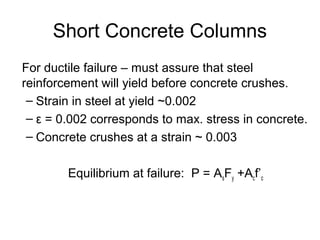
For ductile failure – must assure that steel
reinforcement will yield before concrete crushes.
– Strain in steel at yield ~0.002
– ε = 0.002 corresponds to max. stress in concrete.
– Concrete crushes at a strain ~ 0.003
Equilibrium at failure: P = AsFy +Acf’c
Reinforcement Ratio
• ρ = As/Ag
• ACI 318 limits on ρ for columns:
0.01≤ρ≤0.08 (practical ρmax = 0.06)
• Substitute ρ=As/Ag and Ag=As+Ac into
equilibrium equation:
P = Ag[ρfy +f’c(1- ρ)]
Short Concrete Columns
P = Ag[ρfy +f’c(1- ρ)]
Safety Factors
• Resistance factor, Ф = 0.65 (tied), Ф = 0.70 (spiral)
• When fc>0.85f’c, over time, concrete will collapse
• Stray moment factor for columns, K1
– K1=0.80 for tied reinforcement
– K1=0.85 for spiral reinforcement
ФPn = Ф K1 Ag[ρfy +0.85f’c(1- ρ)]
Short Column Design Equation
ФPn = Ф K1 Ag[ρfy +0.85f’c(1- ρ)]
for design, Pu ≤ ФPn








−
−
≥ c
g
u
cy
f
AK
P
ff
'85.0
)'85.0(
1
1φ
ρ
[ ])1('85.01 ρρφ −+
≥
cy
u
g
ffK
P
A
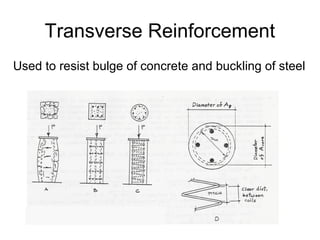
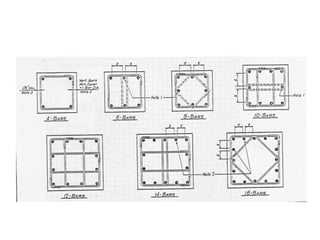
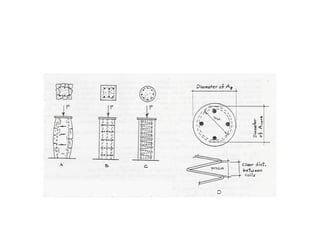
Transverse Reinforcement
Used to resist bulge of concrete and buckling of steel
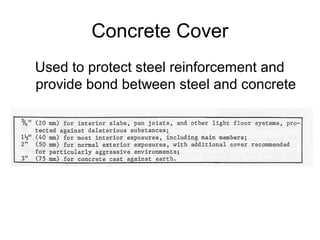
Concrete Cover
Used to protect steel reinforcement and
provide bond between steel and concrete
Short Concrete Column Example
Design a short, interior, column for a service dead
load of 220 kips and a service live load of 243
kips. Consider both a circular and a square cross
section. Assume that this column will be the
prototype for a number of columns of the same
size to take advantage of the economy to be
achieved through repetition of formwork. Also
assume that this column will be the most heavily
loaded (“worst first”). Available materials are
concrete with f’c = 4 ksi and grade 60 steel.
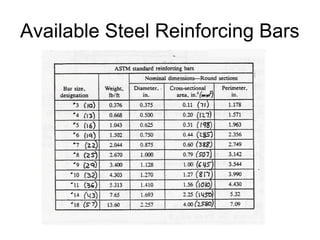
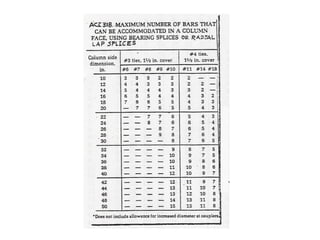
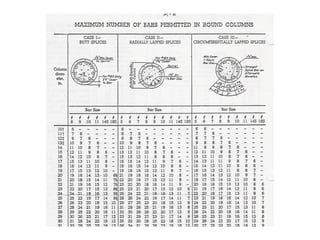
Available Steel Reinforcing Bars
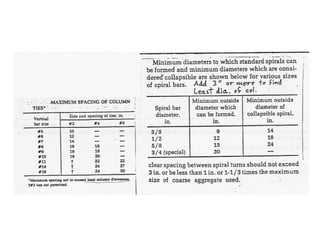
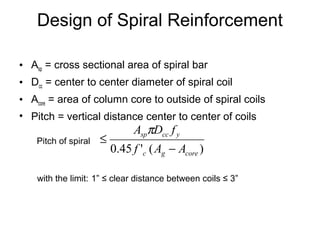
Design of Spiral Reinforcement
• Asp = cross sectional area of spiral bar
• Dcc = center to center diameter of spiral coil
• Acore = area of column core to outside of spiral coils
• Pitch = vertical distance center to center of coils
with the limit: 1” ≤ clear distance between coils ≤ 3”
)('45.0 coregc
yccsp
AAf
fDA
−
≤
π
Pitch of spiral
Reinforced Concrete Design (2)

Reinforced Concrete Design (2)

  • 1.
  • 2.
    Compressive Strength ofConcrete • fcr is the average cylinder strength • f’c compressive strength for design • f’c ~2500 psi - 18,000 psi, typically 3000 - 6000 psi • Ec estimated as: where w = weight of concrete, lb/ft3 f’c in psi E in psi for normal weight concrete ~145 lb/ft3 E w fc c= 3 3 1 5. ' E fc c= 5 7 0 0 0, '
  • 3.
    Concrete Stress-Strain Curve Forshort term loading. Over time concrete will creep and shrink.
  • 4.
    Concrete Strain Strain inconcrete will be caused by loading, creep, shrinkage, and temperature change. For scale, consider a 20’ section of concrete, f’c = 4000 psi, under a stress, fc = 1800 psi. Determine the change in length.
  • 5.
    Tensile Strength ofConcrete • Tensile strength of concrete is about • ~300 – 600 psi • Tensile strength of concrete is ignored in design • Steel reinforcement is placed where tensile stresses occur Where do tensile stresses occur? f c' 1 0
  • 6.
    Tensile Stresses Restrained shrinkage slabon grade shrinkage strain, ε = 0.0006 σ = εE = 0.0006 x 3600 ksi = 2.16 ksi Flexural member compression tension
  • 7.
    Reinforcing Steel • Deformedsteel reinforcing bars • Welded wire fabric • 7-strand wire (for pre-stressing)
  • 8.
    Deformed Steel ReinforcingBars Rebar • Grade 60 (most common in US) • Sizes #3 → #18 (number indicates diameter in ⅛ inch)
  • 9.
    Welded Wire Fabric Readilyavailable fabrics Designation: longitudinal wire spacing x transverse wire spacing – cross-sectional areas of longitudinal wire x transverse wires in hundredths of in2
  • 10.
  • 11.
    Reinforce Concrete Design Twocodes for reinforced concrete design: • ACI 318 Building Code Requirements for Structural Concrete • AASHTO Specifications for Highway Bridges We will design according to ACI 318 which is an ‘LRFD’ design. Load and resistance factors for ACI 318 are given on page 7, notes.
  • 12.
    Short Reinforced Concrete CompressionMembers • Short - slenderness does not need to be considered – column will not buckle • Only axial load L Cross-sectional Areas: As = Area of steel Ac = Area of concrete Ag = Total area Fs = stress in steel Fc = stress in concrete From Equilibrium: P = Acfc + Asfs P L P If bond is maintained εs = εc
  • 13.
    Short Concrete Columns Forductile failure – must assure that steel reinforcement will yield before concrete crushes. – Strain in steel at yield ~0.002 – ε = 0.002 corresponds to max. stress in concrete. – Concrete crushes at a strain ~ 0.003 Equilibrium at failure: P = AsFy +Acf’c
  • 14.
    Reinforcement Ratio • ρ= As/Ag • ACI 318 limits on ρ for columns: 0.01≤ρ≤0.08 (practical ρmax = 0.06) • Substitute ρ=As/Ag and Ag=As+Ac into equilibrium equation: P = Ag[ρfy +f’c(1- ρ)]
  • 15.
    Short Concrete Columns P= Ag[ρfy +f’c(1- ρ)] Safety Factors • Resistance factor, Ф = 0.65 (tied), Ф = 0.70 (spiral) • When fc>0.85f’c, over time, concrete will collapse • Stray moment factor for columns, K1 – K1=0.80 for tied reinforcement – K1=0.85 for spiral reinforcement ФPn = Ф K1 Ag[ρfy +0.85f’c(1- ρ)]
  • 16.
    Short Column DesignEquation ФPn = Ф K1 Ag[ρfy +0.85f’c(1- ρ)] for design, Pu ≤ ФPn         − − ≥ c g u cy f AK P ff '85.0 )'85.0( 1 1φ ρ [ ])1('85.01 ρρφ −+ ≥ cy u g ffK P A
  • 17.
    Transverse Reinforcement Used toresist bulge of concrete and buckling of steel
  • 18.
    Concrete Cover Used toprotect steel reinforcement and provide bond between steel and concrete
  • 19.
    Short Concrete ColumnExample Design a short, interior, column for a service dead load of 220 kips and a service live load of 243 kips. Consider both a circular and a square cross section. Assume that this column will be the prototype for a number of columns of the same size to take advantage of the economy to be achieved through repetition of formwork. Also assume that this column will be the most heavily loaded (“worst first”). Available materials are concrete with f’c = 4 ksi and grade 60 steel.
  • 20.
  • 25.
    Design of SpiralReinforcement • Asp = cross sectional area of spiral bar • Dcc = center to center diameter of spiral coil • Acore = area of column core to outside of spiral coils • Pitch = vertical distance center to center of coils with the limit: 1” ≤ clear distance between coils ≤ 3” )('45.0 coregc yccsp AAf fDA − ≤ π Pitch of spiral