The Dag Representation of Basic
Blocks
PRESENTED BY
A.SHABEEN TAJ
BP150518
CONTENTS
• Introduction
• A DAG with following labels on nodes
• Dag Construction
• Constructing a DAG
• Applications of Dags
• Arrays, Pointers and Procedure calls
• Rules
Introduction:
• Directed Acyclic Graphs (dags) are useful data
structures for implementing transformations on basic
blocks.
• A dag gives a picture of how the value computed by
each statement in a basic block is used in subsequent
statements of the block.
• Constructing a dag from three- address statements is a
good way of determining common sub expressions
within a block, determining which names are used
inside the block but evaluate outside the block, and
determining which statements of the block have their
computed value outside the block.
A dag with following labels on
nodes:
1. Levels are labeled by unique identifiers, either variable
names or constants.
2. Interior nodes are labeled by an operator symbol.
3. Nodes are also optionally given by a sequence of
identifiers for labels. The intention is that interior nodes
represent computed values, and the identifiers labeling a
node are deemed to have that value.
It is important not to confuse dags with flow
graphs. Each node of a flow graph can be
represented by a dag, since each node of the flow
graph stands for a basic block.
Dag Construction:
• To construct a dag: When we see a statement
of the form x:=y+z,
Y and z – leaves / interior nodes.
• When we create labeled + => has two children
• Y – left child and z- right child and its label is
x.
• If the another node has same value y+z,
instead of adding new node, existing node can
be used as label x.
Two details should be mentioned:
• First, if x had previously labeled some other
node, remove that label, since the “current”
value of x is the node created.
• Second, for assignment x:=y, do not create a
new node, but append x to the list of names on
the node for the “current” value of y.
Constructing a dag:
• Input: A basic block
• Output: It has following information,]
1. A label for each node. For leaves label is an identifier
(constants permitted) and for interior nodes, an
operator symbol.
2. For each node a list of attached identifiers(constants
not permitted).
• Method: Data structures are available to create nodes
with one or two children distinguishing left and right.
• To create a linked list of attached identifiers for each
node.
• The dag construction has the following
process: Initially assume, no nodes and nodes
is undefined for all arguments.
• Suppose “current” three address statements (i)
x:= y op z (ii) x:=op y (iii) x:=y.
• Treat a relational operator like if i<=20 goto
case (i), with x undefined.
1. If node(y) is undefined, create a leaf labeled
y, and let node(y) be this node. In case(i), If
node(z) is undefined, create a leaf labeled z,
and let the leaf node(z).
2. In case (i), determine if there is a node labeled op,
whose leaf child is node(y) and right child is
node(z). If not, create such a node and n be the node
found or created. In case (ii), determine whether ther
is node labeled op, whose lone child is node(y). If
not, create such a node and n be the node found or
created. In case(iii), let n be node(y)
3. Delete x from the list of attached identifiers for node
(x). Append x to list of attached identifiers for node
n found in (2) and set node(x) to n.
Applications of dags:
1. Automatically detect common sub
expressions.
2. Can determine which identifiers have their
values used in the block.
3. Can determine which statements compute
value that could be used outside the block.
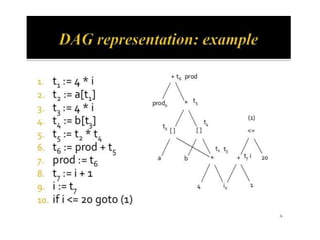
Example:9.10
• Let us reconstruct a basic block from the dag of
fig 9.16, ordering nodes in the same order as they
were created. So the first reconstructed statement
is,
t1:=4*I
• Second, statement constructed as,
t2:=a[t1]
• The next is labeled as t4,
t4:=b[t1]
• Then, t5 is constructed as,
t5:=t2*t4
• For label t6 and prod, like t3, temporary t6
disappears. So the generated statement is,
prod:=prod+t5
• Similarly, choose I rather than t7 to carry the vale
i+1. The last two statements generated are,
i:=i+1
if i<=20 goto (1)
• Reduced ten statements to seven using common
sub expression (dag advantage) and by
eliminating unnecessary assignments.
Arrays, Pointers and Procedure
Calls:
• Consider the block:
X:=a[i] a[j]:=y z:=a[i] (9.5)
• Construct dag a[i] would become common sub
expression and optimized as
X:=a[i] z:=x a[j]:=y (9.6)
However, (9.5)and (9.6) compute different
values for z in case i=j and y!=a[i].
Rules:
• Let us introduce certain edges n->m in dag that do
not indicate that m is an argument of n, but rather
that evaluation of n must follow evaluation of m
in any computation of the dag. The rules are:
1. Any evaluation of or assignment to an element
of array a must follow previous assignment to an
element of that array if there is one.
2. Any assignment to an element of array a must
follow previous evaluation of a.
3. Any use of any identifier must follow the
previous procedure call or indirect assignment
through a pointer if there is one.
4. Any procedure call or indirect assignment
through a pointer must follow all previous
evaluations of any identifier.
That is, when reordering code, uses of an
array a may not cross each other, and no
statement may cross a procedure call or an
assignment through a pointer.
Any Queries:
???
• Thank you

The dag representation of basic blocks

  • 1.
    The Dag Representationof Basic Blocks PRESENTED BY A.SHABEEN TAJ BP150518
  • 2.
    CONTENTS • Introduction • ADAG with following labels on nodes • Dag Construction • Constructing a DAG • Applications of Dags • Arrays, Pointers and Procedure calls • Rules
  • 3.
    Introduction: • Directed AcyclicGraphs (dags) are useful data structures for implementing transformations on basic blocks. • A dag gives a picture of how the value computed by each statement in a basic block is used in subsequent statements of the block. • Constructing a dag from three- address statements is a good way of determining common sub expressions within a block, determining which names are used inside the block but evaluate outside the block, and determining which statements of the block have their computed value outside the block.
  • 4.
    A dag withfollowing labels on nodes: 1. Levels are labeled by unique identifiers, either variable names or constants. 2. Interior nodes are labeled by an operator symbol. 3. Nodes are also optionally given by a sequence of identifiers for labels. The intention is that interior nodes represent computed values, and the identifiers labeling a node are deemed to have that value. It is important not to confuse dags with flow graphs. Each node of a flow graph can be represented by a dag, since each node of the flow graph stands for a basic block.
  • 6.
    Dag Construction: • Toconstruct a dag: When we see a statement of the form x:=y+z, Y and z – leaves / interior nodes. • When we create labeled + => has two children • Y – left child and z- right child and its label is x. • If the another node has same value y+z, instead of adding new node, existing node can be used as label x.
  • 7.
    Two details shouldbe mentioned: • First, if x had previously labeled some other node, remove that label, since the “current” value of x is the node created. • Second, for assignment x:=y, do not create a new node, but append x to the list of names on the node for the “current” value of y.
  • 8.
    Constructing a dag: •Input: A basic block • Output: It has following information,] 1. A label for each node. For leaves label is an identifier (constants permitted) and for interior nodes, an operator symbol. 2. For each node a list of attached identifiers(constants not permitted). • Method: Data structures are available to create nodes with one or two children distinguishing left and right. • To create a linked list of attached identifiers for each node.
  • 9.
    • The dagconstruction has the following process: Initially assume, no nodes and nodes is undefined for all arguments. • Suppose “current” three address statements (i) x:= y op z (ii) x:=op y (iii) x:=y. • Treat a relational operator like if i<=20 goto case (i), with x undefined. 1. If node(y) is undefined, create a leaf labeled y, and let node(y) be this node. In case(i), If node(z) is undefined, create a leaf labeled z, and let the leaf node(z).
  • 10.
    2. In case(i), determine if there is a node labeled op, whose leaf child is node(y) and right child is node(z). If not, create such a node and n be the node found or created. In case (ii), determine whether ther is node labeled op, whose lone child is node(y). If not, create such a node and n be the node found or created. In case(iii), let n be node(y) 3. Delete x from the list of attached identifiers for node (x). Append x to list of attached identifiers for node n found in (2) and set node(x) to n.
  • 11.
    Applications of dags: 1.Automatically detect common sub expressions. 2. Can determine which identifiers have their values used in the block. 3. Can determine which statements compute value that could be used outside the block.
  • 12.
    Example:9.10 • Let usreconstruct a basic block from the dag of fig 9.16, ordering nodes in the same order as they were created. So the first reconstructed statement is, t1:=4*I • Second, statement constructed as, t2:=a[t1] • The next is labeled as t4, t4:=b[t1]
  • 13.
    • Then, t5is constructed as, t5:=t2*t4 • For label t6 and prod, like t3, temporary t6 disappears. So the generated statement is, prod:=prod+t5 • Similarly, choose I rather than t7 to carry the vale i+1. The last two statements generated are, i:=i+1 if i<=20 goto (1) • Reduced ten statements to seven using common sub expression (dag advantage) and by eliminating unnecessary assignments.
  • 14.
    Arrays, Pointers andProcedure Calls: • Consider the block: X:=a[i] a[j]:=y z:=a[i] (9.5) • Construct dag a[i] would become common sub expression and optimized as X:=a[i] z:=x a[j]:=y (9.6) However, (9.5)and (9.6) compute different values for z in case i=j and y!=a[i].
  • 15.
    Rules: • Let usintroduce certain edges n->m in dag that do not indicate that m is an argument of n, but rather that evaluation of n must follow evaluation of m in any computation of the dag. The rules are: 1. Any evaluation of or assignment to an element of array a must follow previous assignment to an element of that array if there is one. 2. Any assignment to an element of array a must follow previous evaluation of a.
  • 16.
    3. Any useof any identifier must follow the previous procedure call or indirect assignment through a pointer if there is one. 4. Any procedure call or indirect assignment through a pointer must follow all previous evaluations of any identifier. That is, when reordering code, uses of an array a may not cross each other, and no statement may cross a procedure call or an assignment through a pointer.
  • 17.
  • 18.