REGION3–CENTRALLUZON
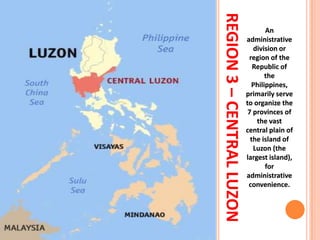
An
administrative
division or
region of the
Republic of
the
Philippines,
primarily serve
to organize the
7 provinces of
the vast
central plain of
the island of
Luzon (the
largest island),
for
administrative
convenience.
• The region contains the largest plain in the country and
produces most of the country's rice supply, earning itself
the nickname "Rice Granary of the Philippine” or “Rice Bowl
of the Philippines”.
• Central Luzon covers a total land area of 18,230.8 km2 and
occupies the central portion of the island of Luzon. The
region is landlocked by Pangasinan and Nueva Vizcaya on
the north; Metro Manila, Cavite and Rizal on the south;
Aurora and Dingalan Bay on the east and Palauig Bay and
Subic Bay on the west.
•Region 3 is bestowed with a combination of towering
mountains, extinct and active volcanoes, lush verdant
farmlands, and natural sea harbours.
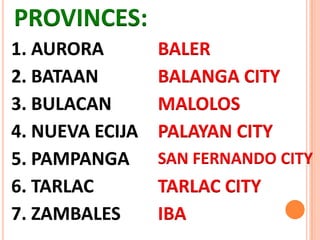
•Region 3 is composed of 7 provinces, 14 cities, 116
municipalities, and 3,102 barangays.
Languages: Tagalog, Kapampangan, Ilocano, Sambal,
English.
PROVINCES:
PALAYAN CITY
BALER
2. BATAAN BALANGA CITY
3. BULACAN MALOLOS
4. NUEVA ECIJA
1. AURORA
5. PAMPANGA SAN FERNANDO CITY
6. TARLAC TARLAC CITY
7. ZAMBALES IBA
OVERVIEW:
The City of San Fernando,
in Pampanga, is the
regional center.
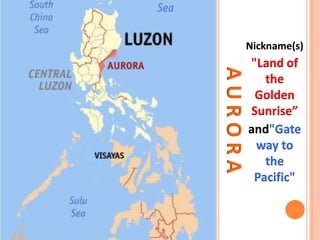
AURORA
Nickname(s)
"Land of
the
Golden
Sunrise”
and"Gate
way to
the
Pacific"
AURORA CAPITOL
• A province of the Philippines located in the
eastern part of Central Luzon region, facing the
Philippine Sea. Its capital is Baler and borders,
clockwise from the south, the provinces of Quezon,
Bulacan, Nueva Ecija, Nueva Vizcaya, Quirino, and
Isabela.
• Before 1979, Aurora was part of the province of
Quezon. Aurora was, in fact, named after Aurora
Aragon, the wife of Pres. Manuel L. Quezon, the
president of the Philippine Commonwealth, after
whom the mother province was named.
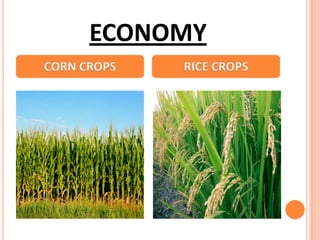
ECONOMY
CORN CROPS RICE CROPS
TOURIST ATTRACTIONS
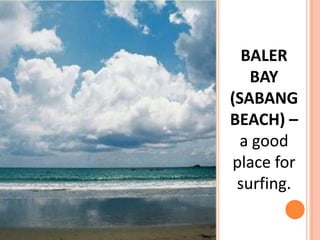
BALER
BAY
(SABANG
BEACH) –
a good
place for
surfing.
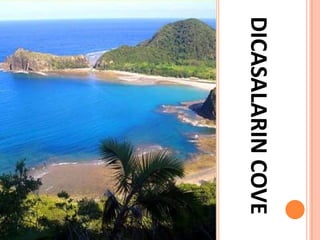
DICASALARINCOVE
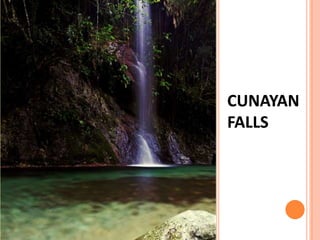
CUNAYAN
FALLS
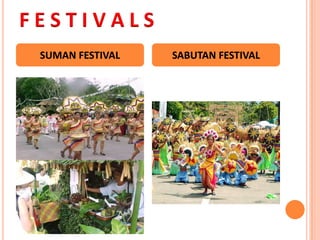
F E S T I V A L S
SUMAN FESTIVAL SABUTAN FESTIVAL
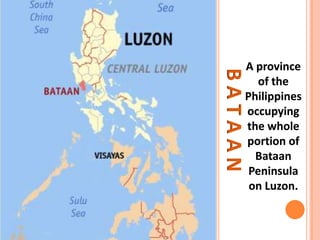
BATAAN
A province
of the
Philippines
occupying
the whole
portion of
Bataan
Peninsula
on Luzon.
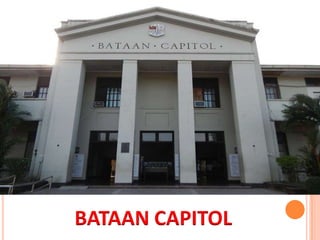
BATAAN CAPITOL
•The capital of Bataan is Balanga City and it is bordered
by the provinces of Zambales and Pampanga to the
north. The peninsula faces the South China Sea to the
west and Subic Bay to the north-west, and encloses
Manila Bay to the east.
•The Battle of Bataan is famous in history as one of the
last stands of American and Filipino soldiers before
they were overwhelmed by the Japanese forces in
World War II.
•The Bataan Death March was named for this province,
where the infamous march started. This is also the
location of the Bataan Nuclear Power Plant located in
the Municipality of Morong.
TOURIST ATTRACTION
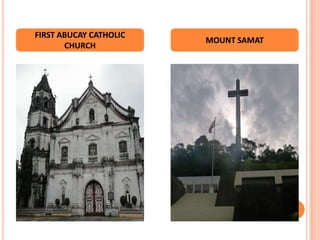
FIRST ABUCAY CATHOLIC
CHURCH
MOUNT SAMAT
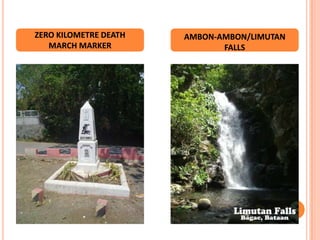
ZERO KILOMETRE DEATH
MARCH MARKER
AMBON-AMBON/LIMUTAN
FALLS
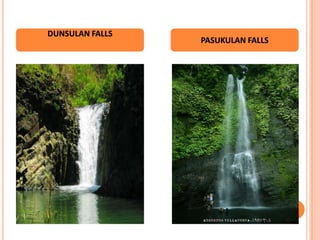
DUNSULAN FALLS
PASUKULAN FALLS
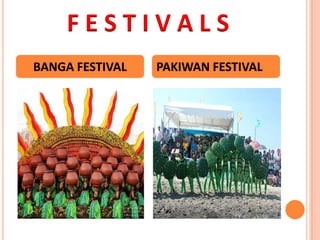
F E S T I V A L S
BANGA FESTIVAL PAKIWAN FESTIVAL
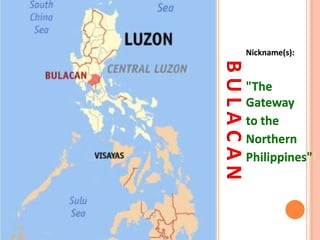
BULACAN
Nickname(s):
"The
Gateway
to the
Northern
Philippines"
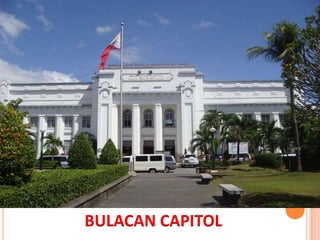
BULACAN CAPITOL
•A first class province of the Republic of the Philippines located
in the Central Luzon Region (Region 3) in the island of Luzon,
50 km north of Manila (the nation's capital), and part of the
Metro Luzon Urban Beltway Super Region. Bulacan was
established 15 August 1578.
•Bulacan prides itself on its rich history. The province figures
prominently in Philippine history. Many national heroes and
political figures were born in Bulacan. The province was also
one of the first to revolt against Spain.
•The province is honored as one of the 8 rays of the sun in the
national flag. It is the home of the "Three Republics." These
are the Republic of Real de Kakarong de Sili (1896) in Pandi,
the Republic of Biak-na-Bato (1897) and the First Philippine
Republic in Malolos (1899–1901).
•Today, Bulacan is among the most progressive provinces in
the Philippines. Its people — the Bulaqueños (or Bulakenyo in
Filipino) — are regarded as highly educated,enterprising and
industrious.
•It is well known for the following industries: Marble and
Marbleized Limestone, Jewelry, Pyrotechnics, Leather,
Aquaculture, Meat and Meat Products, Garments, Furniture,
High-Value Crops, and Sweets and Native Delicacies, and a
wide variety of high-quality native products.
•Several rivers irrigate the province of Bulacan; the largest one
is that of Angat.
C L I M A T E
• November to April is generally dry while wet
for the rest of the year. The northeast
monsoon (amihan) prevails from October to
January bringing in moderated and light rains.
From May to September the southwest
monsoon (habagat).
•The hottest month is May having an average
temperature of 29.7 C (85.5 F) while the
coldest is February with an average
temperature of 25.1 C (77.2 F).
E C O N O M Y
1.Industries
2.Agribusiness &
Aquaculture
3.Banking and finance
4.Industrial estate and park
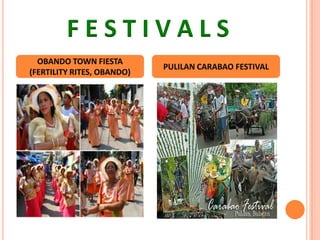
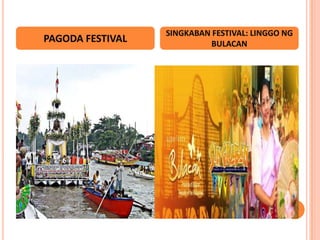
F E S T I V A L S
OBANDO TOWN FIESTA
(FERTILITY RITES, OBANDO)
PULILAN CARABAO FESTIVAL
PAGODA FESTIVAL
SINGKABAN FESTIVAL: LINGGO NG
BULACAN
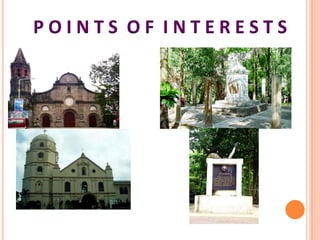
P O I N T S O F I N T E R E S T S
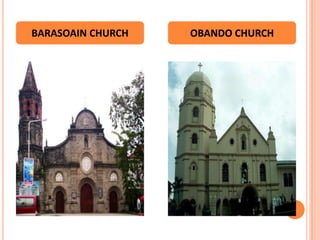
BARASOAIN CHURCH OBANDO CHURCH
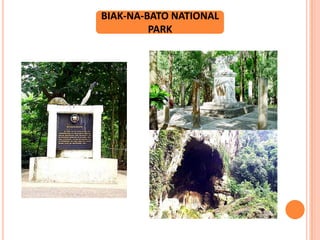
BIAK-NA-BATO NATIONAL
PARK
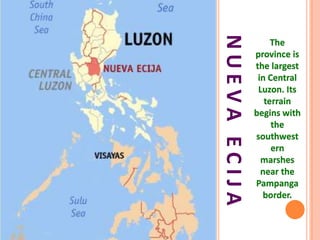
NUEVAECIJA
The
province is
the largest
in Central
Luzon. Its
terrain
begins with
the
southwest
ern
marshes
near the
Pampanga
border.
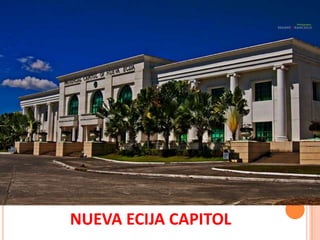
NUEVA ECIJA CAPITOL
•A landlocked province of the Philippines located in
the Central Luzon region. Its capital is Palayan City.
Nueva Ecija borders, from the south clockwise,
Bulacan, Pampanga, Tarlac, Pangasinan, Nueva
Vizcaya, and Aurora.
•Cry of Nueva Ecija is the 1896 revolutionary battle
led by General Mariano Llanera - Mariano Llanera,
manned and assisted by General Manuel Tinio of
Gapan City, Nueva Ecija and Colonel Alipio Tecson of
Cabiao, Nueva Ecija who later on became Brigadaire
General. The battle was fought in Cabiao, Nueva
Ecija. Alipio Tecson became Governadorcillo of
Cabiao, Nueva Ecija.
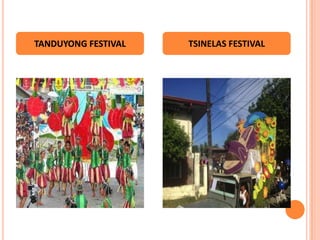
F E S T I V A L S
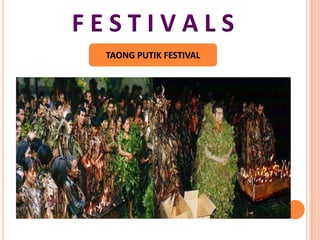
TAONG PUTIK FESTIVAL
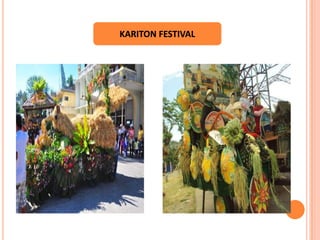
KARITON FESTIVAL
TANDUYONG FESTIVAL TSINELAS FESTIVAL
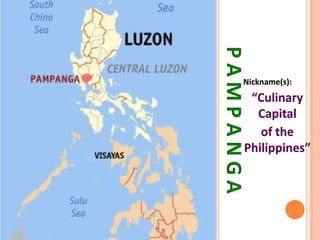
PAMPANGA
Nickname(s):
“Culinary
Capital
of the
Philippines”
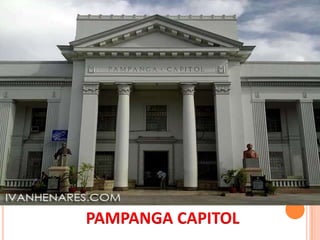
PAMPANGA CAPITOL
• A province of the Philippines located in the Central Luzon region. Its
capital is the City of San Fernando. Pampanga is bordered by the
provinces of Bataan and Zambales to the west, Tarlac and Nueva Ecija
to the north, and Bulacan to the southeast.
•The word pampang, from which the province's name originates,
means river bank.
•The province is home to two Philippine Air Force air bases, Basa Air
Base in Floridabalanca, and Clark Air Base.
•The inhabitants of Pampanga are generally referred to as
Kapampangans (alternatively spelled Capampañgan), Pampangos, or
Pampangueños.
•The population has produced two presidents, three chief justices, a
senate president, the first Filipino cardinal and many outstanding
personalities in public service, education, diplomacy, journalism, the
arts and sciences, entertainment and business.
C L I M A T E
The province of Pampanga has two distinct
climates, rainy and dry. The rainy or wet
season normally begins in May and runs
through October, while the rest of the year
is the dry season. The warmest period of
the year occurs between March and April,
while the coolest period is from December
through February.
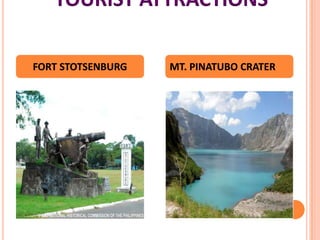
TOURIST ATTRACTIONS
FORT STOTSENBURG MT. PINATUBO CRATER
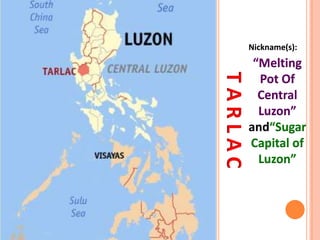
TARLAC
Nickname(s):
“Melting
Pot Of
Central
Luzon”
and“Sugar
Capital of
Luzon”
•Tarlac is subdivided into 17 municipalities and 1 city. These
divisions are further subdivided into 511 barangays. The
province comprises three congressional districts.
•The province is situated at the center of the central plains of
Luzon, landlocked by four provinces: Pampanga on the south,
Nueva Ecija on the east, Pangasinan on the north, and
Zambales on the west.
• In the southern half of the province Kapampangan is the
spoken language whereas Ilocano and Pangasinan dominate
the northern half. Tagalog, being the country's national
language, is widely understood throughout the province.
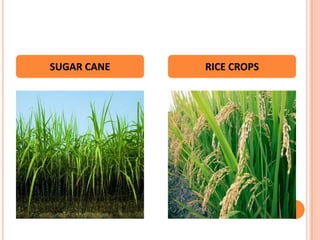
SUGAR CANE RICE CROPS
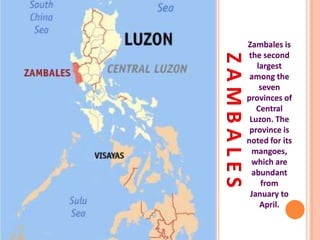
ZAMBALES
Zambales is
the second
largest
among the
seven
provinces of
Central
Luzon. The
province is
noted for its
mangoes,
which are
abundant
from
January to
April.
•Zambales is served by the Subic Bay International
Airport, which is located in Cubi Point in the Subic
Bay Freeport Zone. The Freeport Zone is host to
many tourist attractions which include casinos,
beach resorts, parks, beachside huts and cottages
and historical sites.
•The province's name came from the word zambal,
which is a Hispanized term for Sambali.
•Zambales Day is celebrated every August 30.
Zambales has two pronounced seasons: dry from
October to June, and wet from July to September.
Sambal, Tagalog, and Ilocano are the three main
languages of Zambales.
Zambales is a rich source of Nickel & mountain.
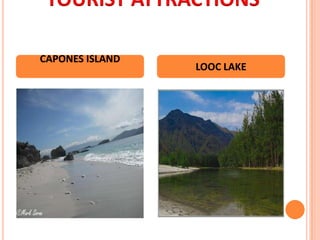
TOURIST ATTRACTIONS
CAPONES ISLAND
LOOC LAKE
THE END!!!!

Region 3 central luzon

  • 1.
    REGION3–CENTRALLUZON An administrative division or region ofthe Republic of the Philippines, primarily serve to organize the 7 provinces of the vast central plain of the island of Luzon (the largest island), for administrative convenience.
  • 2.
    • The regioncontains the largest plain in the country and produces most of the country's rice supply, earning itself the nickname "Rice Granary of the Philippine” or “Rice Bowl of the Philippines”. • Central Luzon covers a total land area of 18,230.8 km2 and occupies the central portion of the island of Luzon. The region is landlocked by Pangasinan and Nueva Vizcaya on the north; Metro Manila, Cavite and Rizal on the south; Aurora and Dingalan Bay on the east and Palauig Bay and Subic Bay on the west. •Region 3 is bestowed with a combination of towering mountains, extinct and active volcanoes, lush verdant farmlands, and natural sea harbours. •Region 3 is composed of 7 provinces, 14 cities, 116 municipalities, and 3,102 barangays. Languages: Tagalog, Kapampangan, Ilocano, Sambal, English.
  • 3.
    PROVINCES: PALAYAN CITY BALER 2. BATAANBALANGA CITY 3. BULACAN MALOLOS 4. NUEVA ECIJA 1. AURORA 5. PAMPANGA SAN FERNANDO CITY 6. TARLAC TARLAC CITY 7. ZAMBALES IBA
  • 4.
    OVERVIEW: The City ofSan Fernando, in Pampanga, is the regional center.
  • 5.
  • 6.
  • 7.
    • A provinceof the Philippines located in the eastern part of Central Luzon region, facing the Philippine Sea. Its capital is Baler and borders, clockwise from the south, the provinces of Quezon, Bulacan, Nueva Ecija, Nueva Vizcaya, Quirino, and Isabela. • Before 1979, Aurora was part of the province of Quezon. Aurora was, in fact, named after Aurora Aragon, the wife of Pres. Manuel L. Quezon, the president of the Philippine Commonwealth, after whom the mother province was named.
  • 8.
  • 9.
  • 10.
  • 11.
  • 12.
  • 13.
    F E ST I V A L S SUMAN FESTIVAL SABUTAN FESTIVAL
  • 14.
    BATAAN A province of the Philippines occupying thewhole portion of Bataan Peninsula on Luzon.
  • 15.
  • 16.
    •The capital ofBataan is Balanga City and it is bordered by the provinces of Zambales and Pampanga to the north. The peninsula faces the South China Sea to the west and Subic Bay to the north-west, and encloses Manila Bay to the east. •The Battle of Bataan is famous in history as one of the last stands of American and Filipino soldiers before they were overwhelmed by the Japanese forces in World War II. •The Bataan Death March was named for this province, where the infamous march started. This is also the location of the Bataan Nuclear Power Plant located in the Municipality of Morong.
  • 17.
  • 18.
  • 19.
    ZERO KILOMETRE DEATH MARCHMARKER AMBON-AMBON/LIMUTAN FALLS
  • 20.
  • 21.
    F E ST I V A L S BANGA FESTIVAL PAKIWAN FESTIVAL
  • 22.
  • 23.
  • 24.
    •A first classprovince of the Republic of the Philippines located in the Central Luzon Region (Region 3) in the island of Luzon, 50 km north of Manila (the nation's capital), and part of the Metro Luzon Urban Beltway Super Region. Bulacan was established 15 August 1578. •Bulacan prides itself on its rich history. The province figures prominently in Philippine history. Many national heroes and political figures were born in Bulacan. The province was also one of the first to revolt against Spain. •The province is honored as one of the 8 rays of the sun in the national flag. It is the home of the "Three Republics." These are the Republic of Real de Kakarong de Sili (1896) in Pandi, the Republic of Biak-na-Bato (1897) and the First Philippine Republic in Malolos (1899–1901).
  • 25.
    •Today, Bulacan isamong the most progressive provinces in the Philippines. Its people — the Bulaqueños (or Bulakenyo in Filipino) — are regarded as highly educated,enterprising and industrious. •It is well known for the following industries: Marble and Marbleized Limestone, Jewelry, Pyrotechnics, Leather, Aquaculture, Meat and Meat Products, Garments, Furniture, High-Value Crops, and Sweets and Native Delicacies, and a wide variety of high-quality native products. •Several rivers irrigate the province of Bulacan; the largest one is that of Angat.
  • 26.
    C L IM A T E • November to April is generally dry while wet for the rest of the year. The northeast monsoon (amihan) prevails from October to January bringing in moderated and light rains. From May to September the southwest monsoon (habagat). •The hottest month is May having an average temperature of 29.7 C (85.5 F) while the coldest is February with an average temperature of 25.1 C (77.2 F).
  • 27.
    E C ON O M Y 1.Industries 2.Agribusiness & Aquaculture 3.Banking and finance 4.Industrial estate and park
  • 28.
    F E ST I V A L S OBANDO TOWN FIESTA (FERTILITY RITES, OBANDO) PULILAN CARABAO FESTIVAL
  • 29.
  • 30.
    P O IN T S O F I N T E R E S T S
  • 31.
  • 32.
  • 33.
    NUEVAECIJA The province is the largest inCentral Luzon. Its terrain begins with the southwest ern marshes near the Pampanga border.
  • 34.
  • 35.
    •A landlocked provinceof the Philippines located in the Central Luzon region. Its capital is Palayan City. Nueva Ecija borders, from the south clockwise, Bulacan, Pampanga, Tarlac, Pangasinan, Nueva Vizcaya, and Aurora. •Cry of Nueva Ecija is the 1896 revolutionary battle led by General Mariano Llanera - Mariano Llanera, manned and assisted by General Manuel Tinio of Gapan City, Nueva Ecija and Colonel Alipio Tecson of Cabiao, Nueva Ecija who later on became Brigadaire General. The battle was fought in Cabiao, Nueva Ecija. Alipio Tecson became Governadorcillo of Cabiao, Nueva Ecija.
  • 36.
    F E ST I V A L S TAONG PUTIK FESTIVAL
  • 37.
  • 38.
  • 39.
  • 40.
  • 41.
    • A provinceof the Philippines located in the Central Luzon region. Its capital is the City of San Fernando. Pampanga is bordered by the provinces of Bataan and Zambales to the west, Tarlac and Nueva Ecija to the north, and Bulacan to the southeast. •The word pampang, from which the province's name originates, means river bank. •The province is home to two Philippine Air Force air bases, Basa Air Base in Floridabalanca, and Clark Air Base. •The inhabitants of Pampanga are generally referred to as Kapampangans (alternatively spelled Capampañgan), Pampangos, or Pampangueños. •The population has produced two presidents, three chief justices, a senate president, the first Filipino cardinal and many outstanding personalities in public service, education, diplomacy, journalism, the arts and sciences, entertainment and business.
  • 42.
    C L IM A T E The province of Pampanga has two distinct climates, rainy and dry. The rainy or wet season normally begins in May and runs through October, while the rest of the year is the dry season. The warmest period of the year occurs between March and April, while the coolest period is from December through February.
  • 43.
  • 44.
  • 45.
    •Tarlac is subdividedinto 17 municipalities and 1 city. These divisions are further subdivided into 511 barangays. The province comprises three congressional districts. •The province is situated at the center of the central plains of Luzon, landlocked by four provinces: Pampanga on the south, Nueva Ecija on the east, Pangasinan on the north, and Zambales on the west. • In the southern half of the province Kapampangan is the spoken language whereas Ilocano and Pangasinan dominate the northern half. Tagalog, being the country's national language, is widely understood throughout the province.
  • 46.
  • 47.
    ZAMBALES Zambales is the second largest amongthe seven provinces of Central Luzon. The province is noted for its mangoes, which are abundant from January to April.
  • 48.
    •Zambales is servedby the Subic Bay International Airport, which is located in Cubi Point in the Subic Bay Freeport Zone. The Freeport Zone is host to many tourist attractions which include casinos, beach resorts, parks, beachside huts and cottages and historical sites. •The province's name came from the word zambal, which is a Hispanized term for Sambali. •Zambales Day is celebrated every August 30.
  • 49.
    Zambales has twopronounced seasons: dry from October to June, and wet from July to September. Sambal, Tagalog, and Ilocano are the three main languages of Zambales. Zambales is a rich source of Nickel & mountain.
  • 50.
  • 51.