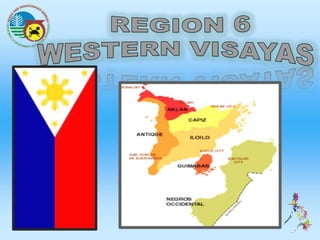
 Is one of the regions of the Philippines,
designated as Region VI.
 It consists of 6 province and 16 cities making
it the region with the highest number of
cities.
 Iloilo City is the regional center.
 Is composed of six provinces and the highly
urbanized cities of Bacolod and Iloilo.
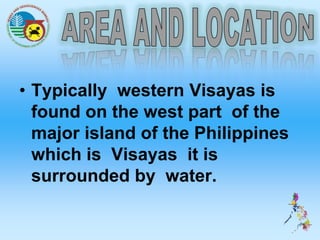
• Typically western Visayas is
found on the west part of the
major island of the Philippines
which is Visayas it is
surrounded by water.
Provinces Capital
1. Aklan - Kalibo
2. Antique - San Jose
3. Capiz - Roxas City
4. Guimaras - Jordan
5. Iloilo - Iloilo City
6. Negros Occidental - Bacolod City
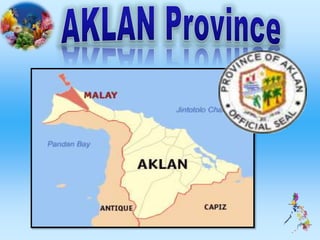
Its capital is Kalibo.
Queen of the Philippine
Fabrics
Rambutan Center of Asia
Originally known as “Minuro
it Akean”
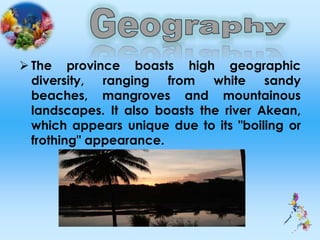
 The province boasts high geographic
diversity, ranging from white sandy
beaches, mangroves and mountainous
landscapes. It also boasts the river Akean,
which appears unique due to its "boiling or
frothing" appearance.
 The province of Aklan is designated as a first class
province.
 Innovations were made out of this fabric to suit the
demanding supply of the fashion market. Dyed
abaca cloths are made into place mats. bags, wall
decors, fans, etc.
Beyond Boracay and the Ati-atihan, one can also
find a dream possession in the province - the Piña
cloth, considered as the "Queen of the Philippine
Fabrics," and other fineries made from it.
The Piña cloth is considered a prime produce of Kalibo, weaved from its
unique crude wooden or bamboo handloom that changed little from
eight centuries ago.
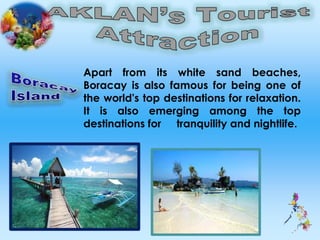
Apart from its white sand beaches,
Boracay is also famous for being one of
the world's top destinations for relaxation.
It is also emerging among the top
destinations for tranquility and nightlife.
Is a feast held annually
in January in honor of
the Santo Niño
concluding on the third
Sunday, in the island
and town of Kalibo,
Aklan in the Philippines.
The name "Ati-Atihan"
means "to be like Aetas"
or "make believe Ati's."
Locally known as Elephant Cave due to its appearance. Beautiful
limestone formation of stalagmites, stalactites and other crystalline forms
abound. It has a skylight in one of its chamber that lets in a soft glow of
light in noon time.
Ignito Cave, Barauanga
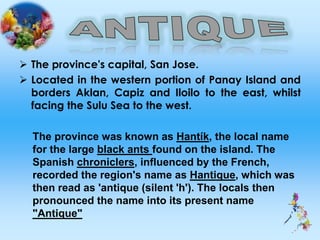
 The province's capital, San Jose.
 Located in the western portion of Panay Island and
borders Aklan, Capiz and Iloilo to the east, whilst
facing the Sulu Sea to the west.
The province was known as Hantík, the local name
for the large black ants found on the island. The
Spanish chroniclers, influenced by the French,
recorded the region's name as Hantique, which was
then read as 'antique (silent 'h'). The locals then
pronounced the name into its present name
"Antique"
Historians believe that the earliest
people who settled on the island of
Panay were tribal Negritos or Atis.
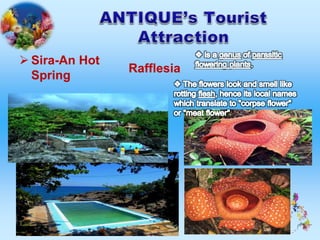
 Sira-An Hot
Spring
Rafflesia
Tibiao has the
Bugtong Bato Falls
and the Fish SPA
Bugang River
 declared the cleanest body of
water in the whole—where rafting
and river boating can be
experienced. This is the most
developed tourism area with a tour
package. Libertad is famous for its
bariw mat and bag weaving.
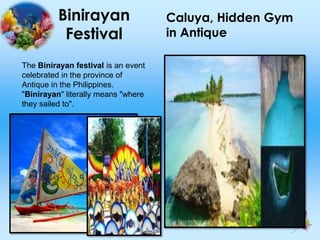
Binirayan
Festival
Caluya, Hidden Gym
in Antique
The Binirayan festival is an event
celebrated in the province of
Antique in the Philippines.
"Binirayan" literally means "where
they sailed to".
 Its capital is Roxas City
 Capiz is known for the Placuna
placenta oyster shell that has
the same name locally and is
used for decoration, and for
making lampshades, trays,
window doors.
 The province is known as the
Seafood Capital of the
Philippines.
 The birth place of former
President Roxas.
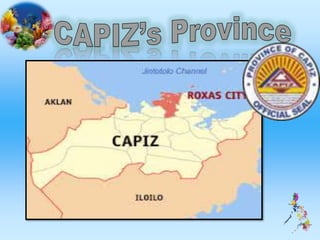
 Located at the northeastern portion of Panay Island,
bordering Aklan and Antique to the west, and Iloilo
to the south. Capiz faces the Sibuyan Sea to the
north.
 Dubbed as the “Seafood Capital of the Philippines”,
Capiz boasts of its 80-kilometer coastline and wide
expanse of swampy lands easily converted into
fishponds. It holds one of the richest fishing grounds
and a major contributor in the aquamarine industry
of the Philippines.
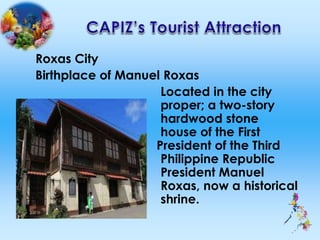
Roxas City
Birthplace of Manuel Roxas
Located in the city
proper; a two-story
hardwood stone
house of the First
President of the Third
Philippine Republic
President Manuel
Roxas, now a historical
shrine.
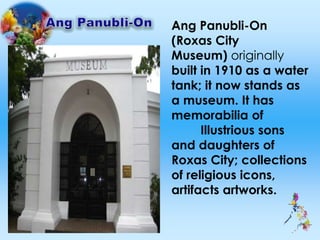
Ang Panubli-On
(Roxas City
Museum) originally
built in 1910 as a water
tank; it now stands as
a museum. It has
memorabilia of
Illustrious sons
and daughters of
Roxas City; collections
of religious icons,
artifacts artworks.
People's Park (La
Playa de Roxas)
Santa Monica
Parish Church
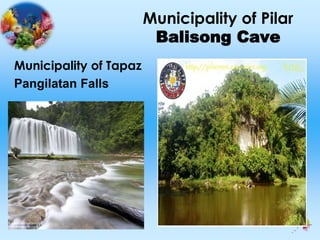
Municipality of Pilar
Balisong Cave
Municipality of Tapaz
Pangilatan Falls
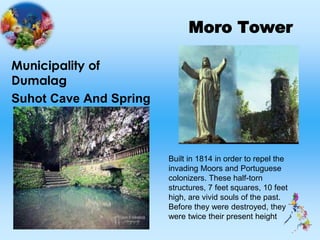
Moro Tower
Municipality of
Dumalag
Suhot Cave And Spring
Built in 1814 in order to repel the
invading Moors and Portuguese
colonizers. These half-torn
structures, 7 feet squares, 10 feet
high, are vivid souls of the past.
Before they were destroyed, they
were twice their present height
Among the smallest provinces, its
capital is Jordan
The island is located in the Panay
Gulf, between the islands of Panay
and Negros. To the northwest is the
province of Iloilo and to the
southeast is Negros Occidental.
 The province is basically agricultural with
palay, coconut, mango, vegetables, livestock,
poultry and fishing as major products. Its major
industries are tourism, fruit processing, coconut
processing, fish farming, handicrafts making,
mining, quarrying and lime production.
 Guimaras is well known for its agricultural
crops, particularly mangoes, where some
50,000 of these trees are planted. The Guimaras
Island is famous for producing some of the
sweetest mangoes in the world.
Mango
Mango jam and other products
are available at the Trappist
Monastery.
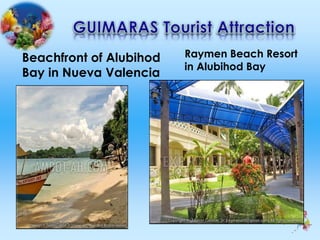
Beachfront of Alubihod
Bay in Nueva Valencia
Raymen Beach Resort
in Alubihod Bay
View of Guisi Beach from a nearby hill
where an 18th century lighthouse rests.
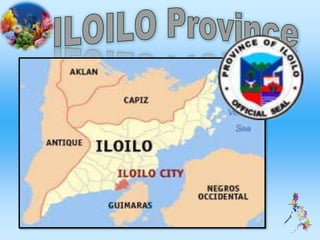
• Iloilo's capital is Iloilo City though the city itself
is independent and not governed by the
provincial government of Iloilo.
• Iloilo is a province of the Philippines located in
the Western Visayas region. Iloilo occupies the
southeast portion of Panay Island and is
bordered by province of Antique to the west
and province of Capiz and the Jintotolo
Channel to the north. Just off Iloilo's southeast
coast is the island province Guimaras, once
part of Iloilo but now an independent province.
 is an Austronesian language spoken
in Western Visayas in the Philippines.
Hiligaynon is concentrated in the city of
Iloilo and westside of Negros Occidental
province.
The Iloilo Dinagyang Festival is a showcase of the rich
heritage, colorful history, passionate devotion, and fun-
loving spirit of the Ilonggo people. The festival traces its
roots as a thanksgiving.
Dinagyang
Festival
Jaro Metropolitan
CathedralThe National Shrine of Our Lady of the Candles
commonly known as Jaro Cathedral, the seat
of the Archdiocese of Jaro, has two stairs
attached to its façade leading to the
miraculous image of the patron saint enclosed
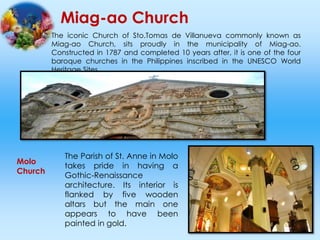
Miag-ao Church
The iconic Church of Sto.Tomas de Villanueva commonly known as
Miag-ao Church, sits proudly in the municipality of Miag-ao.
Constructed in 1787 and completed 10 years after, it is one of the four
baroque churches in the Philippines inscribed in the UNESCO World
Heritage Sites.
Molo
Church
The Parish of St. Anne in Molo
takes pride in having a
Gothic-Renaissance
architecture. Its interior is
flanked by five wooden
altars but the main one
appears to have been
painted in gold.
San Joaquin Church
What makes San Joaquin Church unique is its
striking pediment adorned by military relief
motif featuring the triumph of Spanish Army
of Africa over the Moroccan Army during the
Battle of Tetuan in 1860. Sitting on an
elevated hill near the shoreline, it was built
out of limestone from the mountains of
Igbaras and white corals from San Joaquin in
1869. San Joaquin Church was declared in
1974 as a National Cultural Treasure by the
National Historical Institute.
Iloilo Beaches and
Islands
Like most destinations in the
Pacific, Iloilo is blessed with
beautiful coastlines and islands
teeming with scenic seascapes
and diverse marine life.
 Its capital is Bacolod City
 Sugarbowl of the Philippines because,
Negros Occidental produces more than half
the nation's sugar output.
 Negros Occidental is rich in structures and
buildings that are remnants of a once
affluent lifestyle. The Palacio Episcopal
(1930), San Sebastian Cathedral (1876), and
the Capitol Building (1931) are popular
landmarks.
 It occupies the northwestern half of
Negros Island; Negros Oriental is at the
southeastern half. Across the Panay Gulf
and the Guimaras Strait to the northwest
is the island-province of Guimaras and
the province of Iloilo on Panay island.
 Agriculture, Sugarcane, Corn
 fishing industry
 One of the country's largest copper mines is
located in Sipalay City
 It is also the Business Process Outsourcing
(BPO) hub of the Western Visayas Region of
the Philippines
• Negros Island was originally known to the
natives as "Buglas". When the Spaniards
arrived in April 1565, they named it "Negros"
because of the dark-skinned natives they
found. Two of the earliest native settlements
were Binalbagan and Ilog which later became
towns in 1572 and 1584, respectively.
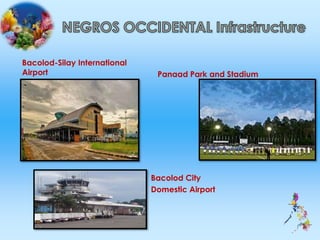
Bacolod-Silay International
Airport Panaad Park and Stadium
Bacolod City
Domestic Airport
Capitol Park and Lagoon
Negros Occidental, in the Philippines. One of the landmarks of the park
is the carabao (water buffalo) being pulled by a woman. This carabao
is located at the northern end of the lagoon. On the other end, there is
also another carabao sculpture but the figure is being pulled by a man.
Maskarra
Festival
San Sebastian
Cathedral
Is a late 19th-century
church in Bacolod
City, Negros
Occidental in the
Philippines. It is the
seat of the Roman
Catholic Diocese of
Bacolod.
Ancestral home of the
late Don Generoso
Villanueva Home of the late Don
Mariano Ramos
The Ruins
The Ruins in Talisay City, Negros
Occidental is what remained of
the grand mansion that Don
Mariano Lacson built, following
the death of his first wife, Maria
Braga.
Today, it is a tourist attraction for
its romantic, yet strong structures.
Many interesting tales and facts
lie within the walls and posts that
remained of the Ruins.
Mt. Kanlaon
Reported by : Jocelyn
Alcalde

region 6

  • 2.
     Is oneof the regions of the Philippines, designated as Region VI.  It consists of 6 province and 16 cities making it the region with the highest number of cities.  Iloilo City is the regional center.  Is composed of six provinces and the highly urbanized cities of Bacolod and Iloilo.
  • 3.
    • Typically westernVisayas is found on the west part of the major island of the Philippines which is Visayas it is surrounded by water.
  • 4.
    Provinces Capital 1. Aklan- Kalibo 2. Antique - San Jose 3. Capiz - Roxas City 4. Guimaras - Jordan 5. Iloilo - Iloilo City 6. Negros Occidental - Bacolod City
  • 6.
    Its capital isKalibo. Queen of the Philippine Fabrics Rambutan Center of Asia Originally known as “Minuro it Akean”
  • 7.
     The provinceboasts high geographic diversity, ranging from white sandy beaches, mangroves and mountainous landscapes. It also boasts the river Akean, which appears unique due to its "boiling or frothing" appearance.
  • 8.
     The provinceof Aklan is designated as a first class province.  Innovations were made out of this fabric to suit the demanding supply of the fashion market. Dyed abaca cloths are made into place mats. bags, wall decors, fans, etc. Beyond Boracay and the Ati-atihan, one can also find a dream possession in the province - the Piña cloth, considered as the "Queen of the Philippine Fabrics," and other fineries made from it.
  • 9.
    The Piña clothis considered a prime produce of Kalibo, weaved from its unique crude wooden or bamboo handloom that changed little from eight centuries ago.
  • 10.
    Apart from itswhite sand beaches, Boracay is also famous for being one of the world's top destinations for relaxation. It is also emerging among the top destinations for tranquility and nightlife.
  • 11.
    Is a feastheld annually in January in honor of the Santo Niño concluding on the third Sunday, in the island and town of Kalibo, Aklan in the Philippines. The name "Ati-Atihan" means "to be like Aetas" or "make believe Ati's."
  • 13.
    Locally known asElephant Cave due to its appearance. Beautiful limestone formation of stalagmites, stalactites and other crystalline forms abound. It has a skylight in one of its chamber that lets in a soft glow of light in noon time. Ignito Cave, Barauanga
  • 15.
     The province'scapital, San Jose.  Located in the western portion of Panay Island and borders Aklan, Capiz and Iloilo to the east, whilst facing the Sulu Sea to the west. The province was known as Hantík, the local name for the large black ants found on the island. The Spanish chroniclers, influenced by the French, recorded the region's name as Hantique, which was then read as 'antique (silent 'h'). The locals then pronounced the name into its present name "Antique"
  • 16.
    Historians believe thatthe earliest people who settled on the island of Panay were tribal Negritos or Atis.
  • 17.
  • 18.
    Tibiao has the BugtongBato Falls and the Fish SPA Bugang River  declared the cleanest body of water in the whole—where rafting and river boating can be experienced. This is the most developed tourism area with a tour package. Libertad is famous for its bariw mat and bag weaving.
  • 19.
    Binirayan Festival Caluya, Hidden Gym inAntique The Binirayan festival is an event celebrated in the province of Antique in the Philippines. "Binirayan" literally means "where they sailed to".
  • 21.
     Its capitalis Roxas City  Capiz is known for the Placuna placenta oyster shell that has the same name locally and is used for decoration, and for making lampshades, trays, window doors.  The province is known as the Seafood Capital of the Philippines.  The birth place of former President Roxas.
  • 22.
     Located atthe northeastern portion of Panay Island, bordering Aklan and Antique to the west, and Iloilo to the south. Capiz faces the Sibuyan Sea to the north.  Dubbed as the “Seafood Capital of the Philippines”, Capiz boasts of its 80-kilometer coastline and wide expanse of swampy lands easily converted into fishponds. It holds one of the richest fishing grounds and a major contributor in the aquamarine industry of the Philippines.
  • 23.
    Roxas City Birthplace ofManuel Roxas Located in the city proper; a two-story hardwood stone house of the First President of the Third Philippine Republic President Manuel Roxas, now a historical shrine.
  • 24.
    Ang Panubli-On (Roxas City Museum)originally built in 1910 as a water tank; it now stands as a museum. It has memorabilia of Illustrious sons and daughters of Roxas City; collections of religious icons, artifacts artworks.
  • 25.
    People's Park (La Playade Roxas) Santa Monica Parish Church
  • 26.
    Municipality of Pilar BalisongCave Municipality of Tapaz Pangilatan Falls
  • 27.
    Moro Tower Municipality of Dumalag SuhotCave And Spring Built in 1814 in order to repel the invading Moors and Portuguese colonizers. These half-torn structures, 7 feet squares, 10 feet high, are vivid souls of the past. Before they were destroyed, they were twice their present height
  • 29.
    Among the smallestprovinces, its capital is Jordan The island is located in the Panay Gulf, between the islands of Panay and Negros. To the northwest is the province of Iloilo and to the southeast is Negros Occidental.
  • 30.
     The provinceis basically agricultural with palay, coconut, mango, vegetables, livestock, poultry and fishing as major products. Its major industries are tourism, fruit processing, coconut processing, fish farming, handicrafts making, mining, quarrying and lime production.  Guimaras is well known for its agricultural crops, particularly mangoes, where some 50,000 of these trees are planted. The Guimaras Island is famous for producing some of the sweetest mangoes in the world.
  • 31.
    Mango Mango jam andother products are available at the Trappist Monastery.
  • 32.
    Beachfront of Alubihod Bayin Nueva Valencia Raymen Beach Resort in Alubihod Bay
  • 33.
    View of GuisiBeach from a nearby hill where an 18th century lighthouse rests.
  • 35.
    • Iloilo's capitalis Iloilo City though the city itself is independent and not governed by the provincial government of Iloilo. • Iloilo is a province of the Philippines located in the Western Visayas region. Iloilo occupies the southeast portion of Panay Island and is bordered by province of Antique to the west and province of Capiz and the Jintotolo Channel to the north. Just off Iloilo's southeast coast is the island province Guimaras, once part of Iloilo but now an independent province.
  • 36.
     is anAustronesian language spoken in Western Visayas in the Philippines. Hiligaynon is concentrated in the city of Iloilo and westside of Negros Occidental province.
  • 37.
    The Iloilo DinagyangFestival is a showcase of the rich heritage, colorful history, passionate devotion, and fun- loving spirit of the Ilonggo people. The festival traces its roots as a thanksgiving. Dinagyang Festival Jaro Metropolitan CathedralThe National Shrine of Our Lady of the Candles commonly known as Jaro Cathedral, the seat of the Archdiocese of Jaro, has two stairs attached to its façade leading to the miraculous image of the patron saint enclosed
  • 38.
    Miag-ao Church The iconicChurch of Sto.Tomas de Villanueva commonly known as Miag-ao Church, sits proudly in the municipality of Miag-ao. Constructed in 1787 and completed 10 years after, it is one of the four baroque churches in the Philippines inscribed in the UNESCO World Heritage Sites. Molo Church The Parish of St. Anne in Molo takes pride in having a Gothic-Renaissance architecture. Its interior is flanked by five wooden altars but the main one appears to have been painted in gold.
  • 39.
    San Joaquin Church Whatmakes San Joaquin Church unique is its striking pediment adorned by military relief motif featuring the triumph of Spanish Army of Africa over the Moroccan Army during the Battle of Tetuan in 1860. Sitting on an elevated hill near the shoreline, it was built out of limestone from the mountains of Igbaras and white corals from San Joaquin in 1869. San Joaquin Church was declared in 1974 as a National Cultural Treasure by the National Historical Institute. Iloilo Beaches and Islands Like most destinations in the Pacific, Iloilo is blessed with beautiful coastlines and islands teeming with scenic seascapes and diverse marine life.
  • 41.
     Its capitalis Bacolod City  Sugarbowl of the Philippines because, Negros Occidental produces more than half the nation's sugar output.  Negros Occidental is rich in structures and buildings that are remnants of a once affluent lifestyle. The Palacio Episcopal (1930), San Sebastian Cathedral (1876), and the Capitol Building (1931) are popular landmarks.
  • 42.
     It occupiesthe northwestern half of Negros Island; Negros Oriental is at the southeastern half. Across the Panay Gulf and the Guimaras Strait to the northwest is the island-province of Guimaras and the province of Iloilo on Panay island.  Agriculture, Sugarcane, Corn  fishing industry  One of the country's largest copper mines is located in Sipalay City  It is also the Business Process Outsourcing (BPO) hub of the Western Visayas Region of the Philippines
  • 43.
    • Negros Islandwas originally known to the natives as "Buglas". When the Spaniards arrived in April 1565, they named it "Negros" because of the dark-skinned natives they found. Two of the earliest native settlements were Binalbagan and Ilog which later became towns in 1572 and 1584, respectively.
  • 44.
    Bacolod-Silay International Airport PanaadPark and Stadium Bacolod City Domestic Airport
  • 45.
    Capitol Park andLagoon Negros Occidental, in the Philippines. One of the landmarks of the park is the carabao (water buffalo) being pulled by a woman. This carabao is located at the northern end of the lagoon. On the other end, there is also another carabao sculpture but the figure is being pulled by a man.
  • 46.
    Maskarra Festival San Sebastian Cathedral Is alate 19th-century church in Bacolod City, Negros Occidental in the Philippines. It is the seat of the Roman Catholic Diocese of Bacolod.
  • 47.
    Ancestral home ofthe late Don Generoso Villanueva Home of the late Don Mariano Ramos
  • 49.
    The Ruins The Ruinsin Talisay City, Negros Occidental is what remained of the grand mansion that Don Mariano Lacson built, following the death of his first wife, Maria Braga. Today, it is a tourist attraction for its romantic, yet strong structures. Many interesting tales and facts lie within the walls and posts that remained of the Ruins.
  • 50.
  • 51.
    Reported by :Jocelyn Alcalde