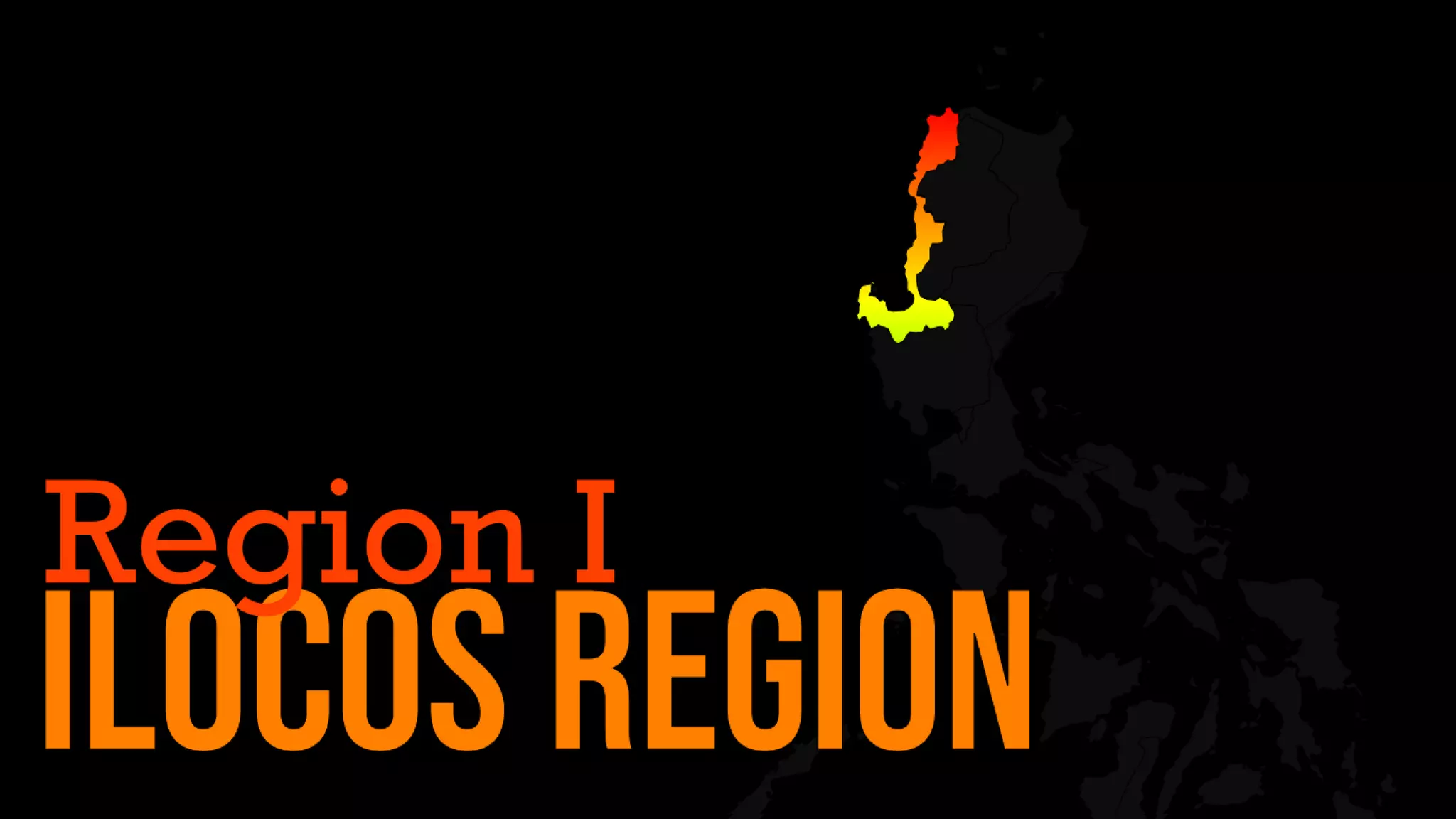
Region I
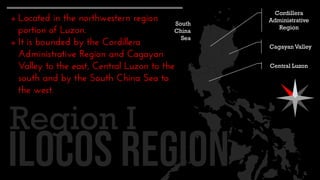
 Located in the northwestern region
portion of Luzon.
 It is bounded by the Cordillera
Administrative Region and Cagayan
Valley to the east, Central Luzon to the
south and by the South China Sea to
the west.
Region I
Cordillera
Administrative
Region
Cagayan Valley
Central Luzon
South
China
Sea
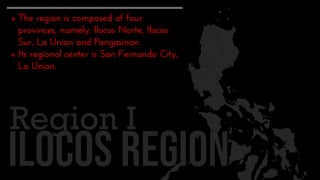
 The region is composed of four
provinces, namely: Ilocos Norte, Ilocos
Sur, La Union and Pangasinan.
 Its regional center is San Fernando City,
La Union.
Region I
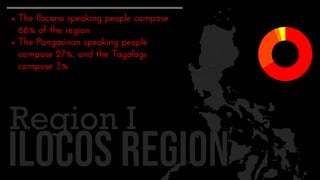
 The Ilocano speaking people compose
66% of the region
 The Pangasinan speaking people
compose 27%, and the Tagalogs
compose 3%.
Region I
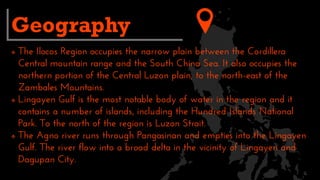
 The Ilocos Region occupies the narrow plain between the Cordillera
Central mountain range and the South China Sea. It also occupies the
northern portion of the Central Luzon plain, to the north-east of the
Zambales Mountains.
 Lingayen Gulf is the most notable body of water in the region and it
contains a number of islands, including the Hundred Islands National
Park. To the north of the region is Luzon Strait.
 The Agno river runs through Pangasinan and empties into the Lingayen
Gulf. The river flow into a broad delta in the vicinity of Lingayen and
Dagupan City.
Geography
Ilocano
Pangasinan
Bolinao
Filipino
English is generally understood
and spoken regionwide
Dagupan Bangus Festival
 Dagupan City, Pangasinan
 April 16 - May 4
 Features Street Dancing , variety shows, trade
fairs, beauty contests, sports fest, cookfest,
medical mission, visual arts, band concerts, dog
shows, fluvial parade, sand castle making and
beach party.
 Highlight of the festival is the Longest Bangus
Grill along downtown stretching up to two (2)
kilometers, a record of which is included in the
Guinness Book of World Records.
Pamulinawen Festival
 Laoag City, Ilocos Norte
 February 2-10
 The word means "Ilocano Maiden", a festival
showcasing Ilocano Customs and Virtues.
Activities include street pageantry, Calesa
Festival, Komedya Ilocano, Balikbayan Nights,
Search for Miss Laoag.
Viva Vigan Festival of the Arts
 Vigan City, Ilocos Sur
 1st week of May
 A festival in a setting replete with historyand
heritage, cultural treasures and reminiscences,
the Viva Vigan Festival of the Arts has
become one of the biggest cultural events in
the North. Scene stealers are the Caleza
Parade, Santacruzan, Inabel Fashion Show,
Ramada Contest, Traditional Games and
concerts.
Paoay Lake National Park
 The landlocked lake located 3 kilometers
away from the sea in Suba, Paoay has an
area of 470 hectares. Declared as a National
Park under Republic Act 5631 on June 21,
1969, its environs has been turned into a
sports complex.
Bangui Windmills
 Fifteen towering windmills lined up the shore
of Bangui
Bangui-Pagudpud Beach
 This stretch of beaches in the two
municipalities are earmarked for
development as tourism estates.
St.William’s Cathedral
 The Augustinians built the church of Italian
Renaissance design in 1612. Its unique 2-storey
facade is held by four pairs of coupled
columns. The deeply recessed niche shows
the image of the Patron Saint of Laoag City.
Sta. Monica Church
 Built facing the river in Sarrat, approximately
7 kilometers east of Laoag, this century-old
church is of Neo-classical and Baroque
architecture.Beside it is a ruin of an old
building & a museum.
Sinking Belltower
 Located almost a hundred meters away
from the St. William’s Cathedral, the tower
has sunk to the ground and leans slightly to
the north.
Bangui Windmills
 Fifteen towering windmills lined up the shore
of Bangui
 Although the economy in the southern portion of the
region, esp. Pangasinan, is anchored on agro-industrial and
service industry, the economy in the northern portion of the
region is anchored in the agricultural sector. The economy
in Pangasinan is driven by agro-industrial businesses , such
as milkfish (bangus) cultivation and processing, livestock
raising, fish paste processing (bagoong), and others. At the
same time the importance of trading, financial services, and
educational services in the economy cannot be denied.
Income in the Ilocos provinces or northern portion mostly
come from cultivating rice, tobacco, corn, sugarcane, and
fruits; raising livestock such as pigs, chicken, goats, and
carabaos (water buffalos).
Economy
 The distribution of the economic activity in the region may
be seen from the collection of tax revenue of the national
government. The bulk of the collections come from
Pangasinan, which posted 61% of the total.
 The service and light manufacturing industries are
concentrated in the cities. Dagupan City is mostly driven by
its local entrepreneurs, which have started to expand its
network up to the national level. San Fernando City in La
Union also has an active shipping port and Laoag City in
Ilocos Norte has an international airport.
Economy
 The tourism industry, driven by local airlines and land
transportation firms in the area like Farinas Transit
Company and Partas, focuses on the coastal beaches and on
eco-tourism. There are fine sands stretching along Bauang,
La Union and the rest of the region. Opportunities to
engage in other water sports and activities abound.
Eco-tourism takes advantage of the marine and forest
resources in the region and displays the natural beauty of
the Region I.
 The region is also rich in crafts, with renowned blanket-
weaving and pottery.The Ilocanos' burnay pottery is well
known for its dark colored clay.
Economy
• Abel Weaving
• Alaminos Longganisa
• Bagnet
• Bagoong
• Bangus
• Calamansi
• Chicharon
• Coffee
• Dragon Fruit
• E-Bamboo(Engineered
Bamboo)
• Empanada
• Romana Peanut Brittle
• Sukang Iloco
• Tupig
• Veggie Noodle
• Vigan Logganisa
• Wearables and Homestyle
Industrial Profiles and Products
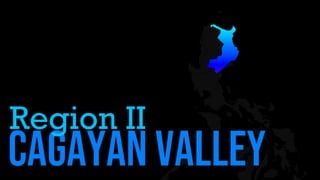
Region II
Region II
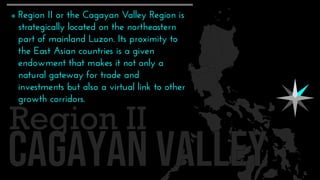
 Region II or the Cagayan Valley Region is
strategically located on the northeastern
part of mainland Luzon. Its proximity to
the East Asian countries is a given
endowment that makes it not only a
natural gateway for trade and
investments but also a virtual link to other
growth corridors.
Region II
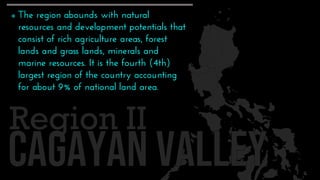
 The region abounds with natural
resources and development potentials that
consist of rich agriculture areas, forest
lands and grass lands, minerals and
marine resources. It is the fourth (4th)
largest region of the country accounting
for about 9% of national land area.
Region II
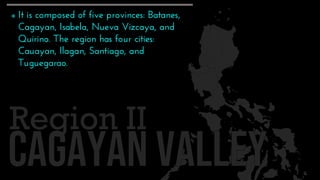
 It is composed of five provinces: Batanes,
Cagayan, Isabela, Nueva Vizcaya, and
Quirino. The region has four cities:
Cauayan, Ilagan, Santiago, and
Tuguegarao.
Region II
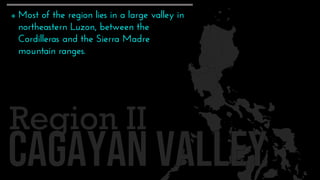
 Most of the region lies in a large valley in
northeastern Luzon, between the
Cordilleras and the Sierra Madre
mountain ranges.
Region II
 The eponymous Cagayan River, the
country's largest and second longest, runs
through its center and flows out from its
source in the Caraballo Mountains in the
south to the Luzon Strait in the north, in
the town of Aparri, Cagayan. The region
encompasses the outlying islands of the
Babuyan and Batanes to the north.
Region II
 Cagayan Valley is the second largest
region of the Philippines in terms of land
area, second only to MIMAROPA.
 Cagayan Valley is the large mass of land in the northeastern region of
Luzon, comprising the provinces of Cagayan, Isabela, Nueva Vizcaya,
Quirino, and the Batanes group of islands. It is bordered to the west by
the Cordillera mountain range, to the east by the Sierra Madre, to the
south by the Caraballo Mountains, and to the north by the Luzon Strait.
Geography
 The region contains two landlocked provinces, Quirino and Nueva
Vizcaya, which are ruggedly mountainous and heavily forested. Nueva
Vizcaya is the remnant of the southern province created when Cagayan
Province was divided in two in 1839. They are ethnically and
linguistically diverse, with a substrate of Agtas, Negritos who are food-
gatherers with no fixed abodes, overlaid by Ilongots and others in a
number of tribes, some of whom were fierce head-hunters (they have
given up the practice), with the latest but largest element of the
population being the Ilocanos, closely followed by the Ibanags.
Geography
Ilocano
Ybanag
Ytawes
Filipino
In Batanes, the people speak
Ivatan.
English is generally understood
and spoken regionwide
Fluvial Parade
 Aparri, Cagayan
 May 10
 It is a local festival featuring a fluvial
procession of about a hundred boats of
different size and shape in thanksgiving to
their Patron Saint, St. Peter Thelmo. Aparri
town is about 102 kilometers from
Tuguegarao City.
Semana Santa
 Iguig Calvary Hills
 Held in observance of the passion and death
of Jesus Christ thru the larger-than-life size
concrete 14 Stations of the Cross spread on an
11-hectare rolling terrain. Iguig town is about 16
kilometers from Tuguegarao.
Bambanti (scarecrow) Festival
 May 10
 In celebration of a bountiful harvest of rice
and corn and other agricultural products with
street dances and float parade
 Feast of Our Lady of the Visitacion of
Guibang every July 2
Panagyaman Festival
 Also known as Nueva Vizcaya Day
 May 19- 24
 Celebrated with parades, beauty pageant,
trade shows and agro-industrial fairs, among
others.
Citrus Festival
 Malabing Valley, Kasibu
 Month of August
 Visitors are allowed to pick-and-pay in the
citrus farms.
Jackpot Cave
 Sitio Tumallo, Barangay Quibal in Peablanca.
 At 115 meters, it is the second deepest cave in
the Philippines. The cave has a walking size
passage, shafts and drops of varying depths
that provide for a lot of rope works.
Meandering streams and pools of varying
size abound inside the cave. A sump of
undetermined depth backs up on wet season
flooding the lower section of the cave to the
roof as evidenced by large logs jammed in
the roof of the cave.
Northern Sierra Madre Natural Park
Bonsai Forest
Dibulo Falls
Aguinaldo Park/Shrine
Digoyo Cave
Dicangrayan Falls
Dominalno Lake
Disadsad Falls
Hagdan na Bato
Culasi Beach
Bicobian Cove
Honeymoon Island ˇ
 The province of Isabela and the city of Santiago are
notably the most progressive province and city in the
region, respectively. Isabela was the 10th richest province in
the Philippines in 2011, being the only province of northern
Luzon to be included in the list.
Economy
 The city of Tuguegarao is the center of excellence in
education, commerce, trade and culture and as the
economic center of the region, the city continuously aims
for outstanding performance and competence in
administration, citizen participation, community and
economic development, cultural arts, education, fiscal
management, infrastructure, intergovernmental cooperation,
planning, public safety, recreation and leisure services, social
services, and technology. Its economy gradually shifted
from agriculture to secondary/tertiary economic activities
such as trading, commerce and services. The shift was
ushered by city's role as the Regional Government Center
and Center of Commerce in Northern Luzon.
Economy
 Cauayan is a component city in the province of Isabela. It is
dubbed as the Ideal City of the North and the host city for
the proposed Isabela Special Economic Zone and the
Regional Agro-Industrial Growth Center. It is the home of
Cosmos Bottling Corporation, now acquired by the giant
multinational business conglomerate San Miguel
Corporation manufactures soft drinks in the area and the
Mega Asia Bottling Corporation with its newly built plant
for RC Cola brand. It is also here where the regional sales
offices of several multi-national companies are located. As a
young city, it has enormous potential for small to large
enterprises and its real estate industry is just beginning.
Medium size commercial centers or subdivisions are the
appropriate ventures to put up.
Economy
 Ilagan is a component city and the capital of the province
of Isabela. The city is the Corn Capital of the Philippines
and has been considered as the Primary Growth Center of
Region 2. Most of the industries in the city are agri-based.
Over the past decades, there has been a great number of
local investments in poultry and hog raising. There are
several poultry contract growers and small and medium
scale hog raisers in the city. Other support facilities,
warehouses and small and big rice mills, strategically
located in the different barangays of the city to address the
storage needs of farmers during the harvest season. Of all
cities in the country, Ilagan ranks as the top producer of
corn. As an agriculture-based city, it produces ample supply
of corn, rice, vegetables and legumes. Fruits like the banana
Economy
 Solano is a first class municipality and the main commercial
and financial center of the province of Nueva Vizcaya. It
also has the most number of fast food restaurants chains
and the most number of banks among the municipalities in
the entire region. According to the 2016 Cities and
Municipalities Competitiveness Index conducted by the
National Competitiveness Council, Solano took the 25th
spot overall and ranked 30th among the first class and
second class municipalities in the Philippines. This further
solidified the status of Solano as the undisputed premier
town of Cagayan Valley being the premier town in Nueva
Vizcaya and the fastest-growing municipality in the region.
Economy
 Cagayan has several attractions which include beaches,
swimming, snorkeling, skin-diving, fishing in the river and
the sea, hiking in primeval forest, mountain-climbing,
archaeological sites, the collection of the provincial museum,
the Callao Caves, and many churches. The Cagayan
Economic Zone Authority (CEZA) is situated in Santa
Ana, Cagayan.
Economy
 Quirino is the youngest province in the region. With its
agricultural based nature, the vast vegetative agricultural
covers reveal the major source of living of the people.
Farming has been the main industry in the province, with
rice and corn as major crops as with other provinces in the
region. Virgin forest and wealthy bodies of water have
been great contributors in its development. Small scale
industries like furniture making, basketry, rattan craft, and
dried/fossilized flower production, where the province was
famously known, are prevalent. Banana products also sold
in and out the province and also for export purposes. The
small scale business and associations also make their own
products like banana chips, peanuts, patupats and others.
The province also produces a substantial amount of
Economy
 The province of Nueva Vizcaya has basically an
agricultural economy with commerce, trade, and industry
contributing to its growth and development. Among other
major economic activities are farming and cattle and swine
raising. Primary crops are palay and corn. The province
produces quality onions and vegetables often sold in Metro
Manila. Oranges and mangoes are now major crops being
exported fresh to other Asian countries; earning its title as
the Citrus Capital of the Philippines
Economy
 Batanes is the northernmost and smallest province in the
region as well as in the whole Philippines. It is the only
province located outside the mainland Cagayan Valley. Due
to its geographical location, fishing is considered as a major
industry and source of livelihood for the people. Garlic and
cattle are major export crops. Ivatans also plant camote
(sweet potato), cassava, gabi or tuber and a unique variety
of white uvi. Sugarcane is raised to produce palek, a kind
of native wine, and vinegar. Tourism also contributes to the
province's thriving economy.
Economy
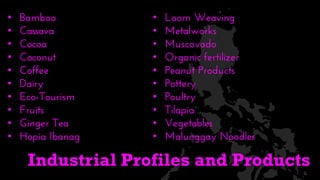
• Bamboo
• Cassava
• Cocoa
• Coconut
• Coffee
• Dairy
• Eco-Tourism
• Fruits
• Ginger Tea
• Hopia Ibanag
• Loom Weaving
• Metalworks
• Muscovado
• Organic fertilizer
• Peanut Products
• Pottery
• Poultry
• Tilapia
• Vegetables
• Malunggay Noodles
Industrial Profiles and Products

Regions 1 and 2

  • 1.
  • 2.
     Located inthe northwestern region portion of Luzon.  It is bounded by the Cordillera Administrative Region and Cagayan Valley to the east, Central Luzon to the south and by the South China Sea to the west. Region I Cordillera Administrative Region Cagayan Valley Central Luzon South China Sea
  • 3.
     The regionis composed of four provinces, namely: Ilocos Norte, Ilocos Sur, La Union and Pangasinan.  Its regional center is San Fernando City, La Union. Region I
  • 4.
     The Ilocanospeaking people compose 66% of the region  The Pangasinan speaking people compose 27%, and the Tagalogs compose 3%. Region I
  • 5.
     The IlocosRegion occupies the narrow plain between the Cordillera Central mountain range and the South China Sea. It also occupies the northern portion of the Central Luzon plain, to the north-east of the Zambales Mountains.  Lingayen Gulf is the most notable body of water in the region and it contains a number of islands, including the Hundred Islands National Park. To the north of the region is Luzon Strait.  The Agno river runs through Pangasinan and empties into the Lingayen Gulf. The river flow into a broad delta in the vicinity of Lingayen and Dagupan City. Geography
  • 6.
  • 7.
    Dagupan Bangus Festival Dagupan City, Pangasinan  April 16 - May 4  Features Street Dancing , variety shows, trade fairs, beauty contests, sports fest, cookfest, medical mission, visual arts, band concerts, dog shows, fluvial parade, sand castle making and beach party.  Highlight of the festival is the Longest Bangus Grill along downtown stretching up to two (2) kilometers, a record of which is included in the Guinness Book of World Records.
  • 8.
    Pamulinawen Festival  LaoagCity, Ilocos Norte  February 2-10  The word means "Ilocano Maiden", a festival showcasing Ilocano Customs and Virtues. Activities include street pageantry, Calesa Festival, Komedya Ilocano, Balikbayan Nights, Search for Miss Laoag.
  • 9.
    Viva Vigan Festivalof the Arts  Vigan City, Ilocos Sur  1st week of May  A festival in a setting replete with historyand heritage, cultural treasures and reminiscences, the Viva Vigan Festival of the Arts has become one of the biggest cultural events in the North. Scene stealers are the Caleza Parade, Santacruzan, Inabel Fashion Show, Ramada Contest, Traditional Games and concerts.
  • 10.
    Paoay Lake NationalPark  The landlocked lake located 3 kilometers away from the sea in Suba, Paoay has an area of 470 hectares. Declared as a National Park under Republic Act 5631 on June 21, 1969, its environs has been turned into a sports complex. Bangui Windmills  Fifteen towering windmills lined up the shore of Bangui
  • 11.
    Bangui-Pagudpud Beach  Thisstretch of beaches in the two municipalities are earmarked for development as tourism estates. St.William’s Cathedral  The Augustinians built the church of Italian Renaissance design in 1612. Its unique 2-storey facade is held by four pairs of coupled columns. The deeply recessed niche shows the image of the Patron Saint of Laoag City.
  • 12.
    Sta. Monica Church Built facing the river in Sarrat, approximately 7 kilometers east of Laoag, this century-old church is of Neo-classical and Baroque architecture.Beside it is a ruin of an old building & a museum. Sinking Belltower  Located almost a hundred meters away from the St. William’s Cathedral, the tower has sunk to the ground and leans slightly to the north.
  • 13.
    Bangui Windmills  Fifteentowering windmills lined up the shore of Bangui
  • 14.
     Although theeconomy in the southern portion of the region, esp. Pangasinan, is anchored on agro-industrial and service industry, the economy in the northern portion of the region is anchored in the agricultural sector. The economy in Pangasinan is driven by agro-industrial businesses , such as milkfish (bangus) cultivation and processing, livestock raising, fish paste processing (bagoong), and others. At the same time the importance of trading, financial services, and educational services in the economy cannot be denied. Income in the Ilocos provinces or northern portion mostly come from cultivating rice, tobacco, corn, sugarcane, and fruits; raising livestock such as pigs, chicken, goats, and carabaos (water buffalos). Economy
  • 15.
     The distributionof the economic activity in the region may be seen from the collection of tax revenue of the national government. The bulk of the collections come from Pangasinan, which posted 61% of the total.  The service and light manufacturing industries are concentrated in the cities. Dagupan City is mostly driven by its local entrepreneurs, which have started to expand its network up to the national level. San Fernando City in La Union also has an active shipping port and Laoag City in Ilocos Norte has an international airport. Economy
  • 16.
     The tourismindustry, driven by local airlines and land transportation firms in the area like Farinas Transit Company and Partas, focuses on the coastal beaches and on eco-tourism. There are fine sands stretching along Bauang, La Union and the rest of the region. Opportunities to engage in other water sports and activities abound. Eco-tourism takes advantage of the marine and forest resources in the region and displays the natural beauty of the Region I.  The region is also rich in crafts, with renowned blanket- weaving and pottery.The Ilocanos' burnay pottery is well known for its dark colored clay. Economy
  • 17.
    • Abel Weaving •Alaminos Longganisa • Bagnet • Bagoong • Bangus • Calamansi • Chicharon • Coffee • Dragon Fruit • E-Bamboo(Engineered Bamboo) • Empanada • Romana Peanut Brittle • Sukang Iloco • Tupig • Veggie Noodle • Vigan Logganisa • Wearables and Homestyle Industrial Profiles and Products
  • 18.
  • 19.
    Region II  RegionII or the Cagayan Valley Region is strategically located on the northeastern part of mainland Luzon. Its proximity to the East Asian countries is a given endowment that makes it not only a natural gateway for trade and investments but also a virtual link to other growth corridors.
  • 20.
    Region II  Theregion abounds with natural resources and development potentials that consist of rich agriculture areas, forest lands and grass lands, minerals and marine resources. It is the fourth (4th) largest region of the country accounting for about 9% of national land area.
  • 21.
    Region II  Itis composed of five provinces: Batanes, Cagayan, Isabela, Nueva Vizcaya, and Quirino. The region has four cities: Cauayan, Ilagan, Santiago, and Tuguegarao.
  • 22.
    Region II  Mostof the region lies in a large valley in northeastern Luzon, between the Cordilleras and the Sierra Madre mountain ranges.
  • 23.
    Region II  Theeponymous Cagayan River, the country's largest and second longest, runs through its center and flows out from its source in the Caraballo Mountains in the south to the Luzon Strait in the north, in the town of Aparri, Cagayan. The region encompasses the outlying islands of the Babuyan and Batanes to the north.
  • 24.
    Region II  CagayanValley is the second largest region of the Philippines in terms of land area, second only to MIMAROPA.
  • 25.
     Cagayan Valleyis the large mass of land in the northeastern region of Luzon, comprising the provinces of Cagayan, Isabela, Nueva Vizcaya, Quirino, and the Batanes group of islands. It is bordered to the west by the Cordillera mountain range, to the east by the Sierra Madre, to the south by the Caraballo Mountains, and to the north by the Luzon Strait. Geography
  • 26.
     The regioncontains two landlocked provinces, Quirino and Nueva Vizcaya, which are ruggedly mountainous and heavily forested. Nueva Vizcaya is the remnant of the southern province created when Cagayan Province was divided in two in 1839. They are ethnically and linguistically diverse, with a substrate of Agtas, Negritos who are food- gatherers with no fixed abodes, overlaid by Ilongots and others in a number of tribes, some of whom were fierce head-hunters (they have given up the practice), with the latest but largest element of the population being the Ilocanos, closely followed by the Ibanags. Geography
  • 27.
    Ilocano Ybanag Ytawes Filipino In Batanes, thepeople speak Ivatan. English is generally understood and spoken regionwide
  • 28.
    Fluvial Parade  Aparri,Cagayan  May 10  It is a local festival featuring a fluvial procession of about a hundred boats of different size and shape in thanksgiving to their Patron Saint, St. Peter Thelmo. Aparri town is about 102 kilometers from Tuguegarao City.
  • 29.
    Semana Santa  IguigCalvary Hills  Held in observance of the passion and death of Jesus Christ thru the larger-than-life size concrete 14 Stations of the Cross spread on an 11-hectare rolling terrain. Iguig town is about 16 kilometers from Tuguegarao.
  • 30.
    Bambanti (scarecrow) Festival May 10  In celebration of a bountiful harvest of rice and corn and other agricultural products with street dances and float parade  Feast of Our Lady of the Visitacion of Guibang every July 2
  • 31.
    Panagyaman Festival  Alsoknown as Nueva Vizcaya Day  May 19- 24  Celebrated with parades, beauty pageant, trade shows and agro-industrial fairs, among others.
  • 32.
    Citrus Festival  MalabingValley, Kasibu  Month of August  Visitors are allowed to pick-and-pay in the citrus farms.
  • 33.
    Jackpot Cave  SitioTumallo, Barangay Quibal in Peablanca.  At 115 meters, it is the second deepest cave in the Philippines. The cave has a walking size passage, shafts and drops of varying depths that provide for a lot of rope works. Meandering streams and pools of varying size abound inside the cave. A sump of undetermined depth backs up on wet season flooding the lower section of the cave to the roof as evidenced by large logs jammed in the roof of the cave.
  • 34.
    Northern Sierra MadreNatural Park Bonsai Forest Dibulo Falls Aguinaldo Park/Shrine Digoyo Cave Dicangrayan Falls Dominalno Lake Disadsad Falls Hagdan na Bato Culasi Beach Bicobian Cove Honeymoon Island ˇ
  • 35.
     The provinceof Isabela and the city of Santiago are notably the most progressive province and city in the region, respectively. Isabela was the 10th richest province in the Philippines in 2011, being the only province of northern Luzon to be included in the list. Economy
  • 36.
     The cityof Tuguegarao is the center of excellence in education, commerce, trade and culture and as the economic center of the region, the city continuously aims for outstanding performance and competence in administration, citizen participation, community and economic development, cultural arts, education, fiscal management, infrastructure, intergovernmental cooperation, planning, public safety, recreation and leisure services, social services, and technology. Its economy gradually shifted from agriculture to secondary/tertiary economic activities such as trading, commerce and services. The shift was ushered by city's role as the Regional Government Center and Center of Commerce in Northern Luzon. Economy
  • 37.
     Cauayan isa component city in the province of Isabela. It is dubbed as the Ideal City of the North and the host city for the proposed Isabela Special Economic Zone and the Regional Agro-Industrial Growth Center. It is the home of Cosmos Bottling Corporation, now acquired by the giant multinational business conglomerate San Miguel Corporation manufactures soft drinks in the area and the Mega Asia Bottling Corporation with its newly built plant for RC Cola brand. It is also here where the regional sales offices of several multi-national companies are located. As a young city, it has enormous potential for small to large enterprises and its real estate industry is just beginning. Medium size commercial centers or subdivisions are the appropriate ventures to put up. Economy
  • 38.
     Ilagan isa component city and the capital of the province of Isabela. The city is the Corn Capital of the Philippines and has been considered as the Primary Growth Center of Region 2. Most of the industries in the city are agri-based. Over the past decades, there has been a great number of local investments in poultry and hog raising. There are several poultry contract growers and small and medium scale hog raisers in the city. Other support facilities, warehouses and small and big rice mills, strategically located in the different barangays of the city to address the storage needs of farmers during the harvest season. Of all cities in the country, Ilagan ranks as the top producer of corn. As an agriculture-based city, it produces ample supply of corn, rice, vegetables and legumes. Fruits like the banana Economy
  • 39.
     Solano isa first class municipality and the main commercial and financial center of the province of Nueva Vizcaya. It also has the most number of fast food restaurants chains and the most number of banks among the municipalities in the entire region. According to the 2016 Cities and Municipalities Competitiveness Index conducted by the National Competitiveness Council, Solano took the 25th spot overall and ranked 30th among the first class and second class municipalities in the Philippines. This further solidified the status of Solano as the undisputed premier town of Cagayan Valley being the premier town in Nueva Vizcaya and the fastest-growing municipality in the region. Economy
  • 40.
     Cagayan hasseveral attractions which include beaches, swimming, snorkeling, skin-diving, fishing in the river and the sea, hiking in primeval forest, mountain-climbing, archaeological sites, the collection of the provincial museum, the Callao Caves, and many churches. The Cagayan Economic Zone Authority (CEZA) is situated in Santa Ana, Cagayan. Economy
  • 41.
     Quirino isthe youngest province in the region. With its agricultural based nature, the vast vegetative agricultural covers reveal the major source of living of the people. Farming has been the main industry in the province, with rice and corn as major crops as with other provinces in the region. Virgin forest and wealthy bodies of water have been great contributors in its development. Small scale industries like furniture making, basketry, rattan craft, and dried/fossilized flower production, where the province was famously known, are prevalent. Banana products also sold in and out the province and also for export purposes. The small scale business and associations also make their own products like banana chips, peanuts, patupats and others. The province also produces a substantial amount of Economy
  • 42.
     The provinceof Nueva Vizcaya has basically an agricultural economy with commerce, trade, and industry contributing to its growth and development. Among other major economic activities are farming and cattle and swine raising. Primary crops are palay and corn. The province produces quality onions and vegetables often sold in Metro Manila. Oranges and mangoes are now major crops being exported fresh to other Asian countries; earning its title as the Citrus Capital of the Philippines Economy
  • 43.
     Batanes isthe northernmost and smallest province in the region as well as in the whole Philippines. It is the only province located outside the mainland Cagayan Valley. Due to its geographical location, fishing is considered as a major industry and source of livelihood for the people. Garlic and cattle are major export crops. Ivatans also plant camote (sweet potato), cassava, gabi or tuber and a unique variety of white uvi. Sugarcane is raised to produce palek, a kind of native wine, and vinegar. Tourism also contributes to the province's thriving economy. Economy
  • 44.
    • Bamboo • Cassava •Cocoa • Coconut • Coffee • Dairy • Eco-Tourism • Fruits • Ginger Tea • Hopia Ibanag • Loom Weaving • Metalworks • Muscovado • Organic fertilizer • Peanut Products • Pottery • Poultry • Tilapia • Vegetables • Malunggay Noodles Industrial Profiles and Products