REGION V:
Bicol Region
GEOGRAPHY
 The Bicol Region is located in the
southernmost tip of Luzon Island, the
largest island in the Philippine
archipelago. The region is bounded
by Lamon Bay to the north, Pacific
Ocean to the east, and Sibuyan
Sea and Ragay Gulf to the west. The
northernmost province, Camarines
Norte, is bordered to the north by the
province of Quezon, connecting the
region to the rest of Luzon.
Pre-History
 The Bicol region was known as Ibalon,
variously interpreted to derive form ibalio,
"to bring to the other side"; ibalon, "people
from the other side" or "people who are
hospitable and give visitors gifts to bring
home"; or as a corruption of Gibal-ong, a
sitio of Magallanes, Sorsogon where the
Spaniards first landed in 1567 . The Bicol
River was first mentioned in Spanish
Documents in 1572. The region was also
called "Los Camarines" after the huts
found by the Spaniards in Camalig, Albay.
Spanish Occupation
 The Spanish influence in Bicol resulted
mainly from the efforts of Augustinian
and Franciscan Spanish missionaries.
The first churches in Bicol, the San
Francisco Church, and the Naga
Cathedral, both in Naga City , along with
the Holy Cross Parish in Nabua,
Camarines Sur are instituted by the Holy
Order of the Franciscans. of the oldest
dioceses in the Philippines, the
Archdiocese of Caceres, was also
Political Division
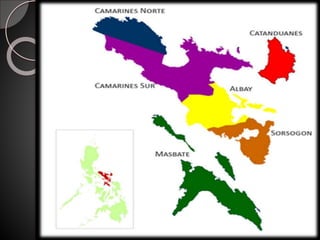
 The region is composed of six provinces,
namely, Albay, Camarines Norte, Camarines
Sur, Catanduanes, Masbate, and Sorsogon.
It has one independent component city, Naga
City, and six component cities - Iriga,
Legazpi, Ligao, Masbate City, Sorsogon City,
and Tabaco. Masbate City and Sorsogon City
are cities within their namesake provinces.
The regional centers are Legazpi, the political
and administrative center; and Naga City, the
cultural and religious center. Together with
Sorsogon City, they are the leading cities in
the region in terms of urbanization and the
hub of the economic activity.
Language
 The people of the Bicol region, called Bicolanos,
speak any of the several languages of the Bikol
macrolanguage, also called Bikolano, an
Austronesian language closely related to other
Central Philippine languages such as Cebuano
and Tagalog. Bicol languages include the Inland
Bikol of Bikol-Rinconada (Rinconada area),
Bikol-Albay (Buhi, Cam. Sur; Libon, Oas,
Daraga, Albay and Donsol, Sorsogon), Bikol-
Pandan (Northern Catanduanes). Standard
Bikol is based from the coastal Bikol language of
the dialect of Legazpi City and is understood
widely throughout the region even though they
Religion
 Fiestas (Feast day of saints) are annual
celebrations of parishes, from a simple barrio
fiesta honoring a patron associated for good
harvest, to a town fiesta honoring a
miraculous saint, or a regional one such as
the Our Lady of Peñafrancia Fiesta, a week-
long celebration to honor the Virgin Mary,
dubbed as the "Queen Patroness of
Bicolandia". It is widely acknowledged that in
Luzon, it is Bicol Region that holds the most
number of men entering the seminary for
Catholic priesthood, or women entering the
religious life to become Catholic nuns.
Economy
 Bicol Region has a large amount of rich
flat land, and agriculture is the largest
component of the economy with close to
50% depending their livelihood on the
industry. Coconuts, abaca, banana, coffee
and jackfruit are the top five permanent
crops in the region. Rice and maize are
among the chief seasonal crops of the
region. Commercial fishing is also
important with thirteen major fishing
grounds supplying fish markets in places
Tourism
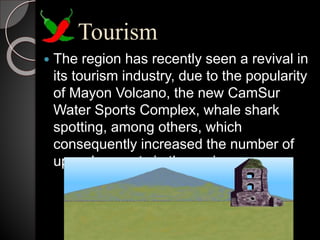
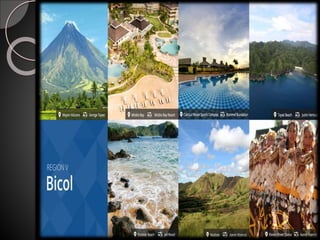
 The region has recently seen a revival in
its tourism industry, due to the popularity
of Mayon Volcano, the new CamSur
Water Sports Complex, whale shark
spotting, among others, which
consequently increased the number of
upscale resorts in the region.
Foods
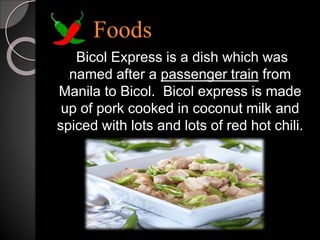
Bicol Express is a dish which was
named after a passenger train from
Manila to Bicol. Bicol express is made
up of pork cooked in coconut milk and
spiced with lots and lots of red hot chili.
Foods
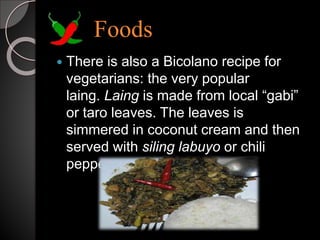
 There is also a Bicolano recipe for
vegetarians: the very popular
laing. Laing is made from local “gabi”
or taro leaves. The leaves is
simmered in coconut cream and then
served with siling labuyo or chili
pepper.
Foods
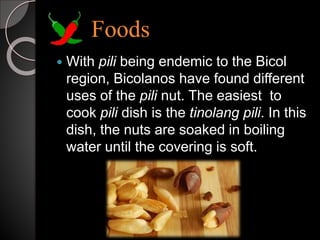
 With pili being endemic to the Bicol
region, Bicolanos have found different
uses of the pili nut. The easiest to
cook pili dish is the tinolang pili. In this
dish, the nuts are soaked in boiling
water until the covering is soft.
Thank You for
Listening!!! 
Prepared by: Edison Vi Sacramento

Region V Bicol region

  • 1.
  • 2.
    GEOGRAPHY  The BicolRegion is located in the southernmost tip of Luzon Island, the largest island in the Philippine archipelago. The region is bounded by Lamon Bay to the north, Pacific Ocean to the east, and Sibuyan Sea and Ragay Gulf to the west. The northernmost province, Camarines Norte, is bordered to the north by the province of Quezon, connecting the region to the rest of Luzon.
  • 3.
    Pre-History  The Bicolregion was known as Ibalon, variously interpreted to derive form ibalio, "to bring to the other side"; ibalon, "people from the other side" or "people who are hospitable and give visitors gifts to bring home"; or as a corruption of Gibal-ong, a sitio of Magallanes, Sorsogon where the Spaniards first landed in 1567 . The Bicol River was first mentioned in Spanish Documents in 1572. The region was also called "Los Camarines" after the huts found by the Spaniards in Camalig, Albay.
  • 4.
    Spanish Occupation  TheSpanish influence in Bicol resulted mainly from the efforts of Augustinian and Franciscan Spanish missionaries. The first churches in Bicol, the San Francisco Church, and the Naga Cathedral, both in Naga City , along with the Holy Cross Parish in Nabua, Camarines Sur are instituted by the Holy Order of the Franciscans. of the oldest dioceses in the Philippines, the Archdiocese of Caceres, was also
  • 5.
    Political Division  Theregion is composed of six provinces, namely, Albay, Camarines Norte, Camarines Sur, Catanduanes, Masbate, and Sorsogon. It has one independent component city, Naga City, and six component cities - Iriga, Legazpi, Ligao, Masbate City, Sorsogon City, and Tabaco. Masbate City and Sorsogon City are cities within their namesake provinces. The regional centers are Legazpi, the political and administrative center; and Naga City, the cultural and religious center. Together with Sorsogon City, they are the leading cities in the region in terms of urbanization and the hub of the economic activity.
  • 7.
    Language  The peopleof the Bicol region, called Bicolanos, speak any of the several languages of the Bikol macrolanguage, also called Bikolano, an Austronesian language closely related to other Central Philippine languages such as Cebuano and Tagalog. Bicol languages include the Inland Bikol of Bikol-Rinconada (Rinconada area), Bikol-Albay (Buhi, Cam. Sur; Libon, Oas, Daraga, Albay and Donsol, Sorsogon), Bikol- Pandan (Northern Catanduanes). Standard Bikol is based from the coastal Bikol language of the dialect of Legazpi City and is understood widely throughout the region even though they
  • 8.
    Religion  Fiestas (Feastday of saints) are annual celebrations of parishes, from a simple barrio fiesta honoring a patron associated for good harvest, to a town fiesta honoring a miraculous saint, or a regional one such as the Our Lady of Peñafrancia Fiesta, a week- long celebration to honor the Virgin Mary, dubbed as the "Queen Patroness of Bicolandia". It is widely acknowledged that in Luzon, it is Bicol Region that holds the most number of men entering the seminary for Catholic priesthood, or women entering the religious life to become Catholic nuns.
  • 9.
    Economy  Bicol Regionhas a large amount of rich flat land, and agriculture is the largest component of the economy with close to 50% depending their livelihood on the industry. Coconuts, abaca, banana, coffee and jackfruit are the top five permanent crops in the region. Rice and maize are among the chief seasonal crops of the region. Commercial fishing is also important with thirteen major fishing grounds supplying fish markets in places
  • 10.
    Tourism  The regionhas recently seen a revival in its tourism industry, due to the popularity of Mayon Volcano, the new CamSur Water Sports Complex, whale shark spotting, among others, which consequently increased the number of upscale resorts in the region.
  • 12.
    Foods Bicol Express isa dish which was named after a passenger train from Manila to Bicol. Bicol express is made up of pork cooked in coconut milk and spiced with lots and lots of red hot chili.
  • 13.
    Foods  There isalso a Bicolano recipe for vegetarians: the very popular laing. Laing is made from local “gabi” or taro leaves. The leaves is simmered in coconut cream and then served with siling labuyo or chili pepper.
  • 14.
    Foods  With pilibeing endemic to the Bicol region, Bicolanos have found different uses of the pili nut. The easiest to cook pili dish is the tinolang pili. In this dish, the nuts are soaked in boiling water until the covering is soft.
  • 15.
    Thank You for Listening!!! Prepared by: Edison Vi Sacramento