Refrigeration Cycle &
Pressure Enthalpy
Berg’s School of Cool
The Refrigeration Cycle
The refrigeration cycle removes unwanted heat from
one place and discharges it into another.
It is based on the long-known principal that a
liquid expanding into a gas extracts heat from the
surrounding substance or area.
Let’s Break It Down
If you were to dip your finger into
a glass of water and hold it up…
You’d immediately notice that
your finger would begin to feel
cooler than the others (especially
if there is good air flow).
This is because the liquid on your finger is evaporating.
As the liquid evaporates it removes heat from the skin
and from the air around it.
How does this apply to
Mechanical Refrigeration?
Refrigerants evaporate at
a much lower temperature
than water, which allows
them to extract heat at a
more rapid rate than the
water on your finger.
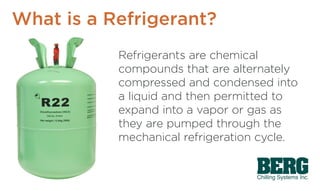
What is a Refrigerant?
Refrigerants are chemical
compounds that are alternately
compressed and condensed into
a liquid and then permitted to
expand into a vapor or gas as
they are pumped through the
mechanical refrigeration cycle.
Enthalpy:
the total heat content
of a system
The Pressure-Enthalpy
The pressure-
enthalpy relationships
of refrigerants are
mapped along the
polygon A to G.
The Pressure-Enthalpy is a pressure-
heat diagram used to describe the
interaction of heat, pressure, temperature,
heat content, and cooling capacity of a
vapour-compression system.
The hot vapour has
been compressed in the
compressor and is at
its maximum pressure
temperature (and enthalpy)
Without losing pressure the vapour enters the
condenser and begins to lose the latent heat of
condensation. The condenser pressure remains
constant while the refrigerant loses heat.
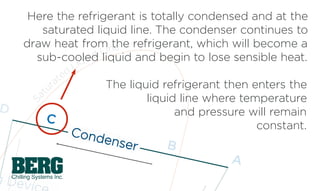
Here the refrigerant is totally condensed and at the
saturated liquid line. The condenser continues to
draw heat from the refrigerant, which will become a
sub-cooled liquid and begin to lose sensible heat.
The liquid refrigerant then enters the
liquid line where temperature
and pressure will remain
constant.
At the metering device
pressure falls as the
refrigerant enters the
Saturated Liquid Line
curve and entering the
evaporator.
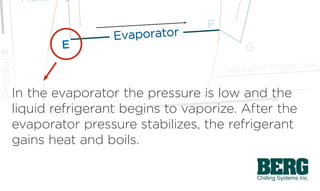
In the evaporator the pressure is low and the
liquid refrigerant begins to vaporize. After the
evaporator pressure stabilizes, the refrigerant
gains heat and boils.
At this stage the refrigerant is vaporized. The
vapour begins to superheat in the suction line
until it reaches the compressor.
The compressor squeezes
the refrigerant to raise
pressure, temperature,
and enthalpy. The cycle
repeats as the refrigerant
returns to stage A.
Learn more about
refrigeration
Berg Chilling Systems Inc.
51 Nantucket Blvd.
Toronto, On, M1P2N5
416-755-2221
bergsales@berg-group.com
berg-group.com

Refrigeration cycle & Pressure Enthalpy

  • 1.
    Refrigeration Cycle & PressureEnthalpy Berg’s School of Cool
  • 2.
    The Refrigeration Cycle Therefrigeration cycle removes unwanted heat from one place and discharges it into another. It is based on the long-known principal that a liquid expanding into a gas extracts heat from the surrounding substance or area.
  • 3.
    Let’s Break ItDown If you were to dip your finger into a glass of water and hold it up… You’d immediately notice that your finger would begin to feel cooler than the others (especially if there is good air flow).
  • 4.
    This is becausethe liquid on your finger is evaporating. As the liquid evaporates it removes heat from the skin and from the air around it.
  • 5.
    How does thisapply to Mechanical Refrigeration? Refrigerants evaporate at a much lower temperature than water, which allows them to extract heat at a more rapid rate than the water on your finger.
  • 6.
    What is aRefrigerant? Refrigerants are chemical compounds that are alternately compressed and condensed into a liquid and then permitted to expand into a vapor or gas as they are pumped through the mechanical refrigeration cycle.
  • 7.
    Enthalpy: the total heatcontent of a system
  • 8.
    The Pressure-Enthalpy The pressure- enthalpyrelationships of refrigerants are mapped along the polygon A to G.
  • 9.
    The Pressure-Enthalpy isa pressure- heat diagram used to describe the interaction of heat, pressure, temperature, heat content, and cooling capacity of a vapour-compression system.
  • 10.
    The hot vapourhas been compressed in the compressor and is at its maximum pressure temperature (and enthalpy)
  • 11.
    Without losing pressurethe vapour enters the condenser and begins to lose the latent heat of condensation. The condenser pressure remains constant while the refrigerant loses heat.
  • 12.
    Here the refrigerantis totally condensed and at the saturated liquid line. The condenser continues to draw heat from the refrigerant, which will become a sub-cooled liquid and begin to lose sensible heat. The liquid refrigerant then enters the liquid line where temperature and pressure will remain constant.
  • 13.
    At the meteringdevice pressure falls as the refrigerant enters the Saturated Liquid Line curve and entering the evaporator.
  • 14.
    In the evaporatorthe pressure is low and the liquid refrigerant begins to vaporize. After the evaporator pressure stabilizes, the refrigerant gains heat and boils.
  • 15.
    At this stagethe refrigerant is vaporized. The vapour begins to superheat in the suction line until it reaches the compressor.
  • 16.
    The compressor squeezes therefrigerant to raise pressure, temperature, and enthalpy. The cycle repeats as the refrigerant returns to stage A.
  • 17.
    Learn more about refrigeration BergChilling Systems Inc. 51 Nantucket Blvd. Toronto, On, M1P2N5 416-755-2221 bergsales@berg-group.com berg-group.com