Paraxial geometrical opticsParaxial geometrical optics
and relevant clinical issuesand relevant clinical issues
in refractive surgeryin refractive surgery
Definition: Paraxial and Marginal RaysDefinition: Paraxial and Marginal Rays
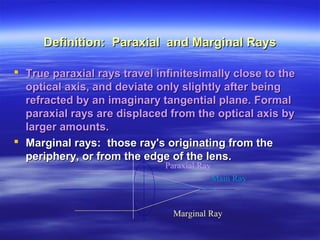
 True paraxial rays travel infinitesimally close to theTrue paraxial rays travel infinitesimally close to the
optical axis, and deviate only slightly after beingoptical axis, and deviate only slightly after being
refracted by an imaginary tangential plane. Formalrefracted by an imaginary tangential plane. Formal
paraxial rays are displaced from the optical axis byparaxial rays are displaced from the optical axis by
larger amounts.larger amounts.
 Marginal rays:Marginal rays: those ray's originating from thethose ray's originating from the
periphery, or from the edge of the lens.periphery, or from the edge of the lens.
Marginal Ray
Main Ray
Paraxial Ray
Definitions: AperturesDefinitions: Apertures
 Aperture:Aperture: any opening in an optical systemany opening in an optical system
that allows light to pass.that allows light to pass.
 Pupils are the beam-limiting apertures ofPupils are the beam-limiting apertures of
the human visual system.the human visual system.
Definitions: PupilsDefinitions: Pupils
 Entrance pupil:Entrance pupil: image of the physical pupilimage of the physical pupil
generated by the corneagenerated by the cornea
 Exit pupil:Exit pupil: image of the physical pupilimage of the physical pupil
generated by the crystalline lensgenerated by the crystalline lens
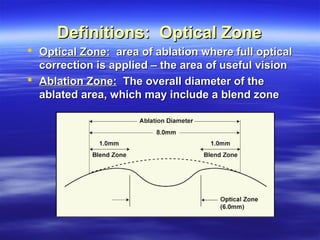
Definitions: Optical ZoneDefinitions: Optical Zone
 Optical Zone:Optical Zone: area of ablation where full opticalarea of ablation where full optical
correction is applied – the area of useful visioncorrection is applied – the area of useful vision
 Ablation Zone:Ablation Zone: The overall diameter of theThe overall diameter of the
ablated area, which may include a blend zoneablated area, which may include a blend zone
AberrationsAberrations
Most optical aberrations after keratorefractive surgeryMost optical aberrations after keratorefractive surgery
depend upon the “optical stop” of the ocular systemdepend upon the “optical stop” of the ocular system
—the pupillary diameter.—the pupillary diameter.
The center of the line of sight must be positionedThe center of the line of sight must be positioned
inside the (entrance) pupil. For that reason, when theinside the (entrance) pupil. For that reason, when the
pupillary diameter is reducedpupillary diameter is reduced, the center of the line, the center of the line
of sight and the geometric center of the pupil mustof sight and the geometric center of the pupil must
virtually coincide.virtually coincide.
Aberrations with pinhole pupilAberrations with pinhole pupil
At the pinhole level, aberrations become increasinglyAt the pinhole level, aberrations become increasingly
insignificant.insignificant.
Clinically, a pupil of approximately 1.8 mm in diameterClinically, a pupil of approximately 1.8 mm in diameter
mimics a pinhole.mimics a pinhole.
CenteringCentering treatment andtreatment and
maximizing visual functionmaximizing visual function
Clearly, centering the ablation on the apex of theClearly, centering the ablation on the apex of the
cornea without regard to the pupil is ill conceived. Incornea without regard to the pupil is ill conceived. In
order to maximize visual function, the ablation mustorder to maximize visual function, the ablation must
be concentric with the pupil.be concentric with the pupil.
Because the center of the visual axis and the middle ofBecause the center of the visual axis and the middle of
thethe miotic pupilmiotic pupil coincide, the central light rayscoincide, the central light rays
through the central region of the pupil are treated asthrough the central region of the pupil are treated as
though they are entering a pinhole system, that is tothough they are entering a pinhole system, that is to
say, without deviation. This relationship does notsay, without deviation. This relationship does not
cause aberrations. The optical zone/pupilcause aberrations. The optical zone/pupil
relationship is of supreme importance.relationship is of supreme importance.
Method of locating center ofMethod of locating center of
ablationablation
The most accurate method of centering an ablation isThe most accurate method of centering an ablation is
to create a miotic pupil (using 1% pilocarpine) andto create a miotic pupil (using 1% pilocarpine) and
manually center the ablation in the middle of a smallmanually center the ablation in the middle of a small
pupil. This technique creates an excellentpupil. This technique creates an excellent
ablation/pupil relationship. If the pupil is 2 mm wide,ablation/pupil relationship. If the pupil is 2 mm wide,
for example, then the margin of error probablyfor example, then the margin of error probably
ranges from 0.1 to 0.2 mm. In addition, the laserranges from 0.1 to 0.2 mm. In addition, the laser
beam is perpendicular to the cornea at all times andbeam is perpendicular to the cornea at all times and
therefore unaffected by parallax, as in the case oftherefore unaffected by parallax, as in the case of
eye trackers.eye trackers.
Decentration can erase anyDecentration can erase any
benefit of customized ablationbenefit of customized ablation
 Also, if customized corneal ablations are to succeed,Also, if customized corneal ablations are to succeed,
and if changes in treatment location of 10 to 20 µmand if changes in treatment location of 10 to 20 µm
are important, then how can a decentration of 300 toare important, then how can a decentration of 300 to
500 µm be acceptable? This degree of decentration500 µm be acceptable? This degree of decentration
would seem to undercut the aims of customizedwould seem to undercut the aims of customized
corneal treatments.corneal treatments.
Clinical examplesClinical examples
Case 1: decentered myopicCase 1: decentered myopic
AblationAblation
 26 you WF26 you WF
 S/P LASIK OU 8/99S/P LASIK OU 8/99
with enhancementswith enhancements
OU in 2000OU in 2000
 Pre-Op: -6.50,Pre-Op: -6.50,
20/2020/20
 Postop:Postop:
––1.75+0.50 x 145,1.75+0.50 x 145,
20/25, with20/25, with
glare/haloglare/halo
Case 2: Decentered myopia ablationCase 2: Decentered myopia ablation
 19 yo male19 yo male
 PreOP:PreOP:
-7.50+2.50 x 65-7.50+2.50 x 65
(20/20);(20/20);
 Postop:Postop:
-0.50+0.75x80-0.50+0.75x80
(20/25);(20/25);
 Interestingly, thisInterestingly, this
patient has nopatient has no
complaints ofcomplaints of
glare, halos orglare, halos or
decreased visualdecreased visual
quality.quality.
Case 3: Hyperopic LASIKCase 3: Hyperopic LASIK
resulting in small optical zoneresulting in small optical zone
 55 yoWF55 yoWF
 H-L for monovisionH-L for monovision
OSOS
 Pre-Op: +2.75D withPre-Op: +2.75D with
LII +0.25+1.25x180LII +0.25+1.25x180
 Postop: –2.00+0.75 xPostop: –2.00+0.75 x
09 (reduced BSCVA09 (reduced BSCVA
to 20/40 with nightto 20/40 with night
vision problem)vision problem)
Case 4: Irregular cornea s/p M-LCase 4: Irregular cornea s/p M-L
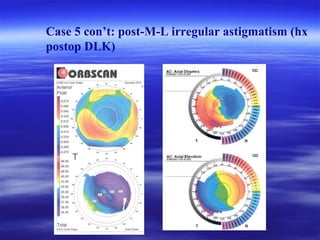
Case 5: irregular cornea s/p M-LCase 5: irregular cornea s/p M-L
 29 yo WF29 yo WF
 -3.50 DS, 20/20 PreOp-3.50 DS, 20/20 PreOp
 Grade 3 DLK S/P LASIKGrade 3 DLK S/P LASIK
with folds centrallywith folds centrally
 Irregular astigmatismIrregular astigmatism
 +1.00, 20/30 BVA @ 2+1.00, 20/30 BVA @ 2
mosmos
Case 5 con’t: post-M-L irregular astigmatism (hx
postop DLK)
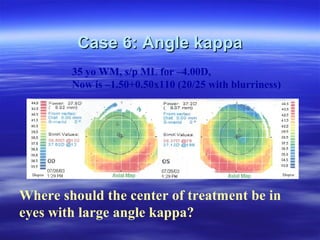
Case 6: Angle kappaCase 6: Angle kappa
35 yo WM, s/p ML for –4.00D,
Now is –1.50+0.50x110 (20/25 with blurriness)
Where should the center of treatment be in
eyes with large angle kappa?
Take-home message ofTake-home message of
paraxial geometric optics and relevantparaxial geometric optics and relevant
issues in refractive surgeryissues in refractive surgery
 Ablation centerAblation center should be the center of myopicshould be the center of myopic
(less than 1.8mm) pupil;(less than 1.8mm) pupil;
 DecentrationDecentration is clinically important and mayis clinically important and may
abolish any benefit of higher order aberrationabolish any benefit of higher order aberration
treatment;treatment;
 Optical zone sizeOptical zone size and its relationship to pupil canand its relationship to pupil can
affect visual function;affect visual function;

Refractive optics

  • 1.
    Paraxial geometrical opticsParaxialgeometrical optics and relevant clinical issuesand relevant clinical issues in refractive surgeryin refractive surgery
  • 2.
    Definition: Paraxial andMarginal RaysDefinition: Paraxial and Marginal Rays  True paraxial rays travel infinitesimally close to theTrue paraxial rays travel infinitesimally close to the optical axis, and deviate only slightly after beingoptical axis, and deviate only slightly after being refracted by an imaginary tangential plane. Formalrefracted by an imaginary tangential plane. Formal paraxial rays are displaced from the optical axis byparaxial rays are displaced from the optical axis by larger amounts.larger amounts.  Marginal rays:Marginal rays: those ray's originating from thethose ray's originating from the periphery, or from the edge of the lens.periphery, or from the edge of the lens. Marginal Ray Main Ray Paraxial Ray
  • 3.
    Definitions: AperturesDefinitions: Apertures Aperture:Aperture: any opening in an optical systemany opening in an optical system that allows light to pass.that allows light to pass.  Pupils are the beam-limiting apertures ofPupils are the beam-limiting apertures of the human visual system.the human visual system.
  • 4.
    Definitions: PupilsDefinitions: Pupils Entrance pupil:Entrance pupil: image of the physical pupilimage of the physical pupil generated by the corneagenerated by the cornea  Exit pupil:Exit pupil: image of the physical pupilimage of the physical pupil generated by the crystalline lensgenerated by the crystalline lens
  • 5.
    Definitions: Optical ZoneDefinitions:Optical Zone  Optical Zone:Optical Zone: area of ablation where full opticalarea of ablation where full optical correction is applied – the area of useful visioncorrection is applied – the area of useful vision  Ablation Zone:Ablation Zone: The overall diameter of theThe overall diameter of the ablated area, which may include a blend zoneablated area, which may include a blend zone
  • 6.
    AberrationsAberrations Most optical aberrationsafter keratorefractive surgeryMost optical aberrations after keratorefractive surgery depend upon the “optical stop” of the ocular systemdepend upon the “optical stop” of the ocular system —the pupillary diameter.—the pupillary diameter. The center of the line of sight must be positionedThe center of the line of sight must be positioned inside the (entrance) pupil. For that reason, when theinside the (entrance) pupil. For that reason, when the pupillary diameter is reducedpupillary diameter is reduced, the center of the line, the center of the line of sight and the geometric center of the pupil mustof sight and the geometric center of the pupil must virtually coincide.virtually coincide.
  • 7.
    Aberrations with pinholepupilAberrations with pinhole pupil At the pinhole level, aberrations become increasinglyAt the pinhole level, aberrations become increasingly insignificant.insignificant. Clinically, a pupil of approximately 1.8 mm in diameterClinically, a pupil of approximately 1.8 mm in diameter mimics a pinhole.mimics a pinhole.
  • 8.
    CenteringCentering treatment andtreatmentand maximizing visual functionmaximizing visual function Clearly, centering the ablation on the apex of theClearly, centering the ablation on the apex of the cornea without regard to the pupil is ill conceived. Incornea without regard to the pupil is ill conceived. In order to maximize visual function, the ablation mustorder to maximize visual function, the ablation must be concentric with the pupil.be concentric with the pupil. Because the center of the visual axis and the middle ofBecause the center of the visual axis and the middle of thethe miotic pupilmiotic pupil coincide, the central light rayscoincide, the central light rays through the central region of the pupil are treated asthrough the central region of the pupil are treated as though they are entering a pinhole system, that is tothough they are entering a pinhole system, that is to say, without deviation. This relationship does notsay, without deviation. This relationship does not cause aberrations. The optical zone/pupilcause aberrations. The optical zone/pupil relationship is of supreme importance.relationship is of supreme importance.
  • 9.
    Method of locatingcenter ofMethod of locating center of ablationablation The most accurate method of centering an ablation isThe most accurate method of centering an ablation is to create a miotic pupil (using 1% pilocarpine) andto create a miotic pupil (using 1% pilocarpine) and manually center the ablation in the middle of a smallmanually center the ablation in the middle of a small pupil. This technique creates an excellentpupil. This technique creates an excellent ablation/pupil relationship. If the pupil is 2 mm wide,ablation/pupil relationship. If the pupil is 2 mm wide, for example, then the margin of error probablyfor example, then the margin of error probably ranges from 0.1 to 0.2 mm. In addition, the laserranges from 0.1 to 0.2 mm. In addition, the laser beam is perpendicular to the cornea at all times andbeam is perpendicular to the cornea at all times and therefore unaffected by parallax, as in the case oftherefore unaffected by parallax, as in the case of eye trackers.eye trackers.
  • 10.
    Decentration can eraseanyDecentration can erase any benefit of customized ablationbenefit of customized ablation  Also, if customized corneal ablations are to succeed,Also, if customized corneal ablations are to succeed, and if changes in treatment location of 10 to 20 µmand if changes in treatment location of 10 to 20 µm are important, then how can a decentration of 300 toare important, then how can a decentration of 300 to 500 µm be acceptable? This degree of decentration500 µm be acceptable? This degree of decentration would seem to undercut the aims of customizedwould seem to undercut the aims of customized corneal treatments.corneal treatments.
  • 11.
    Clinical examplesClinical examples Case1: decentered myopicCase 1: decentered myopic AblationAblation  26 you WF26 you WF  S/P LASIK OU 8/99S/P LASIK OU 8/99 with enhancementswith enhancements OU in 2000OU in 2000  Pre-Op: -6.50,Pre-Op: -6.50, 20/2020/20  Postop:Postop: ––1.75+0.50 x 145,1.75+0.50 x 145, 20/25, with20/25, with glare/haloglare/halo
  • 12.
    Case 2: Decenteredmyopia ablationCase 2: Decentered myopia ablation  19 yo male19 yo male  PreOP:PreOP: -7.50+2.50 x 65-7.50+2.50 x 65 (20/20);(20/20);  Postop:Postop: -0.50+0.75x80-0.50+0.75x80 (20/25);(20/25);  Interestingly, thisInterestingly, this patient has nopatient has no complaints ofcomplaints of glare, halos orglare, halos or decreased visualdecreased visual quality.quality.
  • 13.
    Case 3: HyperopicLASIKCase 3: Hyperopic LASIK resulting in small optical zoneresulting in small optical zone  55 yoWF55 yoWF  H-L for monovisionH-L for monovision OSOS  Pre-Op: +2.75D withPre-Op: +2.75D with LII +0.25+1.25x180LII +0.25+1.25x180  Postop: –2.00+0.75 xPostop: –2.00+0.75 x 09 (reduced BSCVA09 (reduced BSCVA to 20/40 with nightto 20/40 with night vision problem)vision problem)
  • 14.
    Case 4: Irregularcornea s/p M-LCase 4: Irregular cornea s/p M-L
  • 15.
    Case 5: irregularcornea s/p M-LCase 5: irregular cornea s/p M-L  29 yo WF29 yo WF  -3.50 DS, 20/20 PreOp-3.50 DS, 20/20 PreOp  Grade 3 DLK S/P LASIKGrade 3 DLK S/P LASIK with folds centrallywith folds centrally  Irregular astigmatismIrregular astigmatism  +1.00, 20/30 BVA @ 2+1.00, 20/30 BVA @ 2 mosmos
  • 16.
    Case 5 con’t:post-M-L irregular astigmatism (hx postop DLK)
  • 17.
    Case 6: AnglekappaCase 6: Angle kappa 35 yo WM, s/p ML for –4.00D, Now is –1.50+0.50x110 (20/25 with blurriness) Where should the center of treatment be in eyes with large angle kappa?
  • 18.
    Take-home message ofTake-homemessage of paraxial geometric optics and relevantparaxial geometric optics and relevant issues in refractive surgeryissues in refractive surgery  Ablation centerAblation center should be the center of myopicshould be the center of myopic (less than 1.8mm) pupil;(less than 1.8mm) pupil;  DecentrationDecentration is clinically important and mayis clinically important and may abolish any benefit of higher order aberrationabolish any benefit of higher order aberration treatment;treatment;  Optical zone sizeOptical zone size and its relationship to pupil canand its relationship to pupil can affect visual function;affect visual function;

Editor's Notes

  • #17 Ann’s orb and astromax: irreg due to DLK