Umesh Belbase
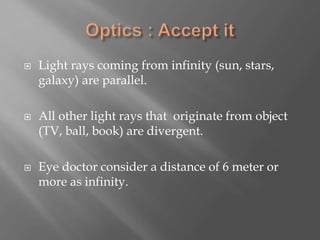
 Light rays coming from infinity (sun, stars,
galaxy) are parallel.
 All other light rays that originate from object
(TV, ball, book) are divergent.
 Eye doctor consider a distance of 6 meter or
more as infinity.
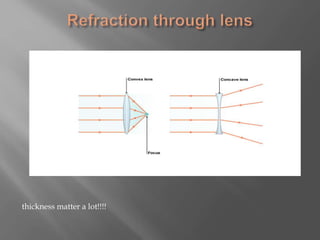
 Covex lenses converge light.
 Concave lens diverge light.
 Thicker the lens - greater the convergence /
divergence.
thickness matter a lot!!!!
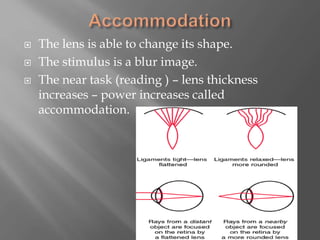
 The lens is able to change its shape.
 The stimulus is a blur image.
 The near task (reading ) – lens thickness
increases – power increases called
accommodation.
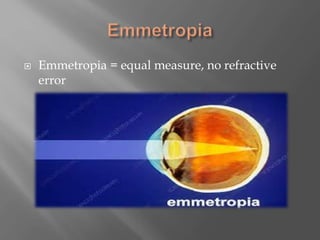
 Emmetropia = equal measure, no refractive
error
 A fault in the mechanism of refraction.
 Produce a blur image on retina.
 Can be for far (>6m) as well as for near (<6m).
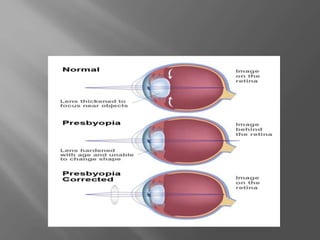
Presbyopia
 An age related phenomena.
 Weakness in ciliary muscle.
 Lens cant accommodate properly.
 Thus cant focus for near objects.
 Become worse with advancing age.
 All error are defined with following condition.
1. Light rays are parallel (coming from distance)
2. The eye is at rest (no accommodation)
3. The error is defined where the light focuses.
front- myopia.
behind – hypermetropia.
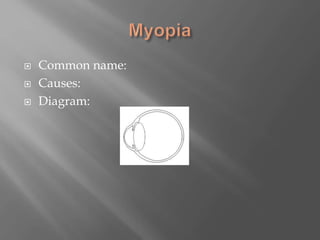
 Common name:
 Causes:
 Diagram:
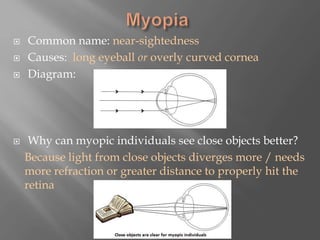
 Common name: near-sightedness
 Causes: long eyeball or overly curved cornea
 Diagram:
 Why can myopic individuals see close objects better?
Because light from close objects diverges more / needs
more refraction or greater distance to properly hit the
retina
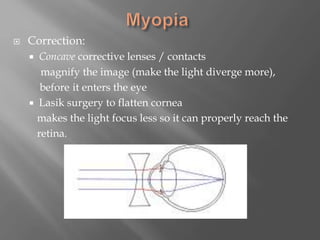
 Correction:
 Concave corrective lenses / contacts
magnify the image (make the light diverge more),
before it enters the eye
 Lasik surgery to flatten cornea
makes the light focus less so it can properly reach the
retina.
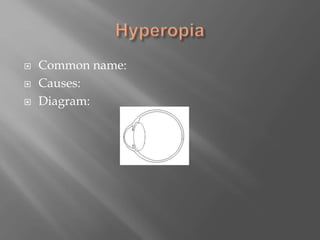
 Common name:
 Causes:
 Diagram:
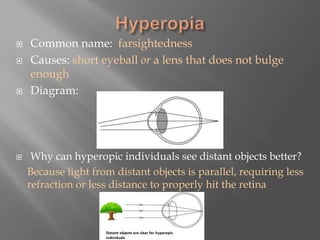
 Common name: farsightedness
 Causes: short eyeball or a lens that does not bulge
enough
 Diagram:
 Why can hyperopic individuals see distant objects better?
Because light from distant objects is parallel, requiring less
refraction or less distance to properly hit the retina
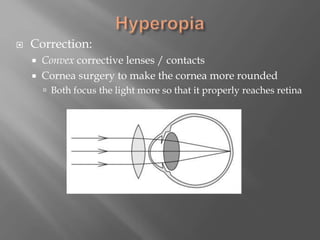
 Correction:
 Convex corrective lenses / contacts
 Cornea surgery to make the cornea more rounded
 Both focus the light more so that it properly reaches retina
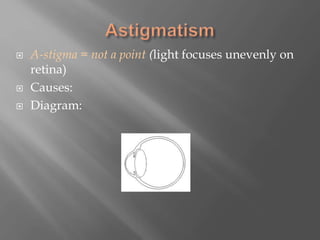
 A-stigma = not a point (light focuses unevenly on
retina)
 Causes:
 Diagram:
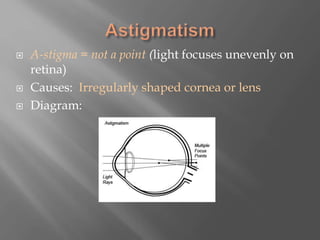
 A-stigma = not a point (light focuses unevenly on
retina)
 Causes: Irregularly shaped cornea or lens
 Diagram:
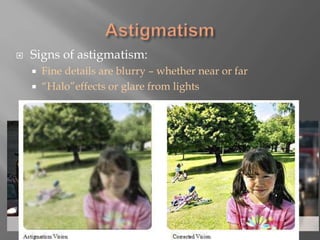
 Signs of astigmatism:
 Fine details are blurry – whether near or far
 “Halo”effects or glare from lights
 Correction
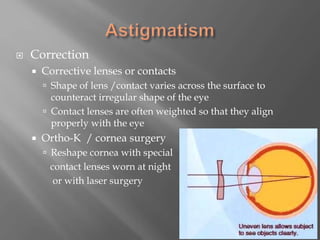
 Corrective lenses or contacts
 Shape of lens /contact varies across the surface to
counteract irregular shape of the eye
 Contact lenses are often weighted so that they align
properly with the eye
 Ortho-K / cornea surgery
 Reshape cornea with special
contact lenses worn at night
or with laser surgery
Refractive errors

Refractive errors

  • 1.
  • 3.
     Light rayscoming from infinity (sun, stars, galaxy) are parallel.  All other light rays that originate from object (TV, ball, book) are divergent.  Eye doctor consider a distance of 6 meter or more as infinity.
  • 4.
     Covex lensesconverge light.  Concave lens diverge light.  Thicker the lens - greater the convergence / divergence.
  • 5.
  • 7.
     The lensis able to change its shape.  The stimulus is a blur image.  The near task (reading ) – lens thickness increases – power increases called accommodation.
  • 8.
     Emmetropia =equal measure, no refractive error
  • 9.
     A faultin the mechanism of refraction.  Produce a blur image on retina.  Can be for far (>6m) as well as for near (<6m).
  • 10.
    Presbyopia  An agerelated phenomena.  Weakness in ciliary muscle.  Lens cant accommodate properly.  Thus cant focus for near objects.  Become worse with advancing age.
  • 12.
     All errorare defined with following condition. 1. Light rays are parallel (coming from distance) 2. The eye is at rest (no accommodation) 3. The error is defined where the light focuses. front- myopia. behind – hypermetropia.
  • 13.
     Common name: Causes:  Diagram:
  • 14.
     Common name:near-sightedness  Causes: long eyeball or overly curved cornea  Diagram:  Why can myopic individuals see close objects better? Because light from close objects diverges more / needs more refraction or greater distance to properly hit the retina
  • 15.
     Correction:  Concavecorrective lenses / contacts magnify the image (make the light diverge more), before it enters the eye  Lasik surgery to flatten cornea makes the light focus less so it can properly reach the retina.
  • 16.
     Common name: Causes:  Diagram:
  • 17.
     Common name:farsightedness  Causes: short eyeball or a lens that does not bulge enough  Diagram:  Why can hyperopic individuals see distant objects better? Because light from distant objects is parallel, requiring less refraction or less distance to properly hit the retina
  • 18.
     Correction:  Convexcorrective lenses / contacts  Cornea surgery to make the cornea more rounded  Both focus the light more so that it properly reaches retina
  • 19.
     A-stigma =not a point (light focuses unevenly on retina)  Causes:  Diagram:
  • 20.
     A-stigma =not a point (light focuses unevenly on retina)  Causes: Irregularly shaped cornea or lens  Diagram:
  • 21.
     Signs ofastigmatism:  Fine details are blurry – whether near or far  “Halo”effects or glare from lights
  • 22.
     Correction  Correctivelenses or contacts  Shape of lens /contact varies across the surface to counteract irregular shape of the eye  Contact lenses are often weighted so that they align properly with the eye  Ortho-K / cornea surgery  Reshape cornea with special contact lenses worn at night or with laser surgery