Optics of the eye
BY
ANSIYA PRASAD
Objectives :
 Eye and its components.
 Axis and visual angles of eye .
 Describe the properties of light .
 Differentiate between convex and concave lenses.
 Describe Accommodation.
 Describe how the eye focuses light.
 Differentiate between presbyopia , Myopia , hyperopia
and astigmatism.
Eye as a camera :
 Eyelids – shuttter .
 Cornea – focusing system.
 Lens – focusing system.
 Iris – diaphragm .
 Choroid – dark chamber.
 Retina – light sensitive film.
Cornea :
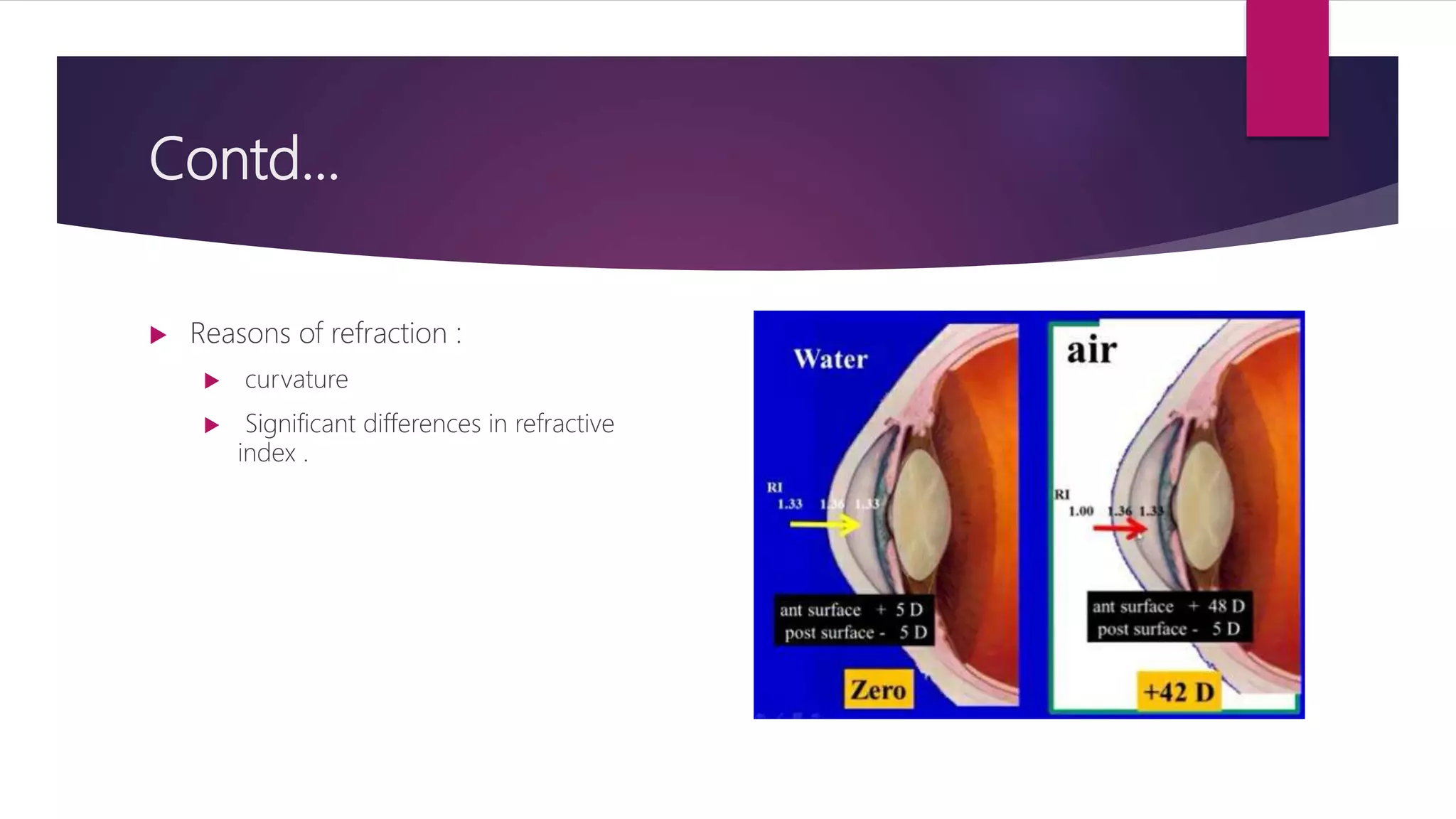
 Cornea is a plus lens of +42D
 Radius of curvature of ant.surface =
7.8mm
 post.surface = 6.8mm
 Diameter about 11.5mm and thickness of
0.5 – 0.6mm in centre and 0.6 – 0.8mm
periphery.
 An average horizontal diameter = 11.7
mm
 vertical diameter = 11mm.
Contd...
 Reasons of refraction :
 curvature
 Significant differences in refractive
index .
Crystalline lens :
 Lens accounts for about one-third of refraction of
eye.
 accomodation
 provides a mechanism of focusing at different diatances.
 Radius of curvature
 ant.surface = 10mm
 post.surface = 6mm
 Refractive index
 nucleus- 1.41
 pole – 1.385
 cortex – 1.38
 Total power – 15 -18 D.
Anterior chamber :
 Is a cavity between cornea and iris .
 Filled with aqueous humour .
 Refractive index of aqueous humour is
1.336.
 depth of aqueous chamber is 2.5 -
4.00mm
 change in anterior chamber depth ,
change the total power.
Iris and pupil :
 Regulates the amount of Light entering
the eye.
 at 2.4mm Pupil size, best retinal image
obtained, as abberation and diffraction
are balanced.
 pupil size varies 2-4mm in diameter in
bright light
 4-8mm in diameter in dim light .
Vitreous humour :
 Is a transparent ,colorless ,gelatinous
mass that fills the space in between lens
and the retina .
 is 8-9mm in diameter.
 Refractive index of vitreous humour is
1.337.
Retina :
 Maximum resolving power is at fovea
 light sensitive film.
 Concave spherical surface with radius of 12mm.
 22mm in diameter .
 contains about 7 million cones and 75- 150 million rods.
 Advantages of curvature of retina is that
 Curved images formed by the optical system Is brought in the right order.
 A much wider field of view Is covered by the steeply curved retina .
Axis and visual angles of eye :
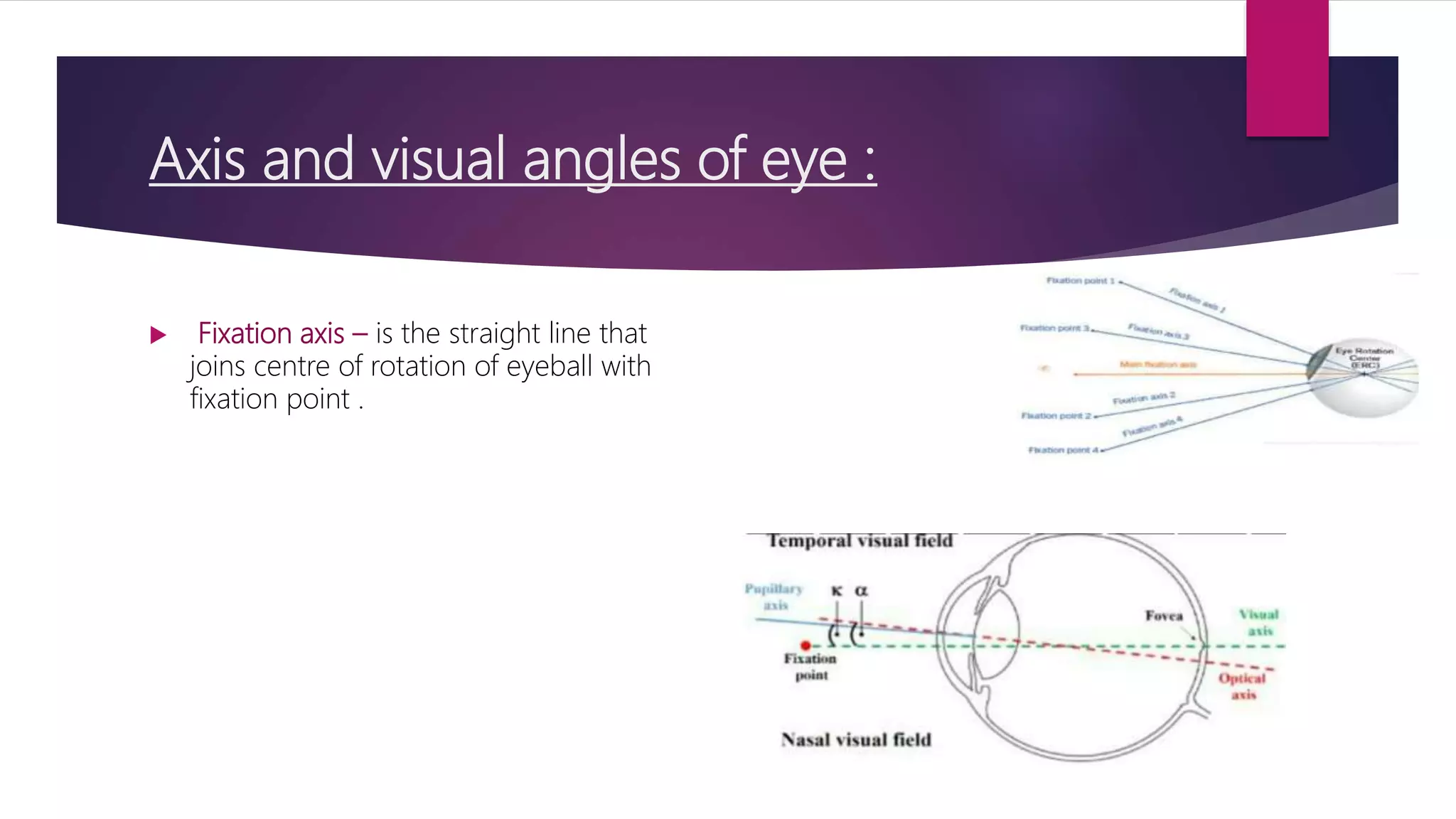
 Optical axis – the line passing through
the centre of cornea and centre of lens
and meets the retina on the nasal side of
the fovea.
 Visual axis – is the line joining the
fixation point , nodal point and the fovea.
Axis and visual angles of eye :
 Fixation axis – is the straight line that
joins centre of rotation of eyeball with
fixation point .
Visual angles :
 Angle alpha – angle formed between
visual axis and optical axis at nodal point.
 Angle gamma – angle between optic
axis and fixation axis .
 Angle kappa – angle formed between
pupillary line and visual axis .
Properties of light
 Electromagnetic radiation
 Visible light
 Wavelength of 400- 700nm
 Violet- short wavelength , highest energy .
 Red- long wavelength , lowest energy.
Properties of light
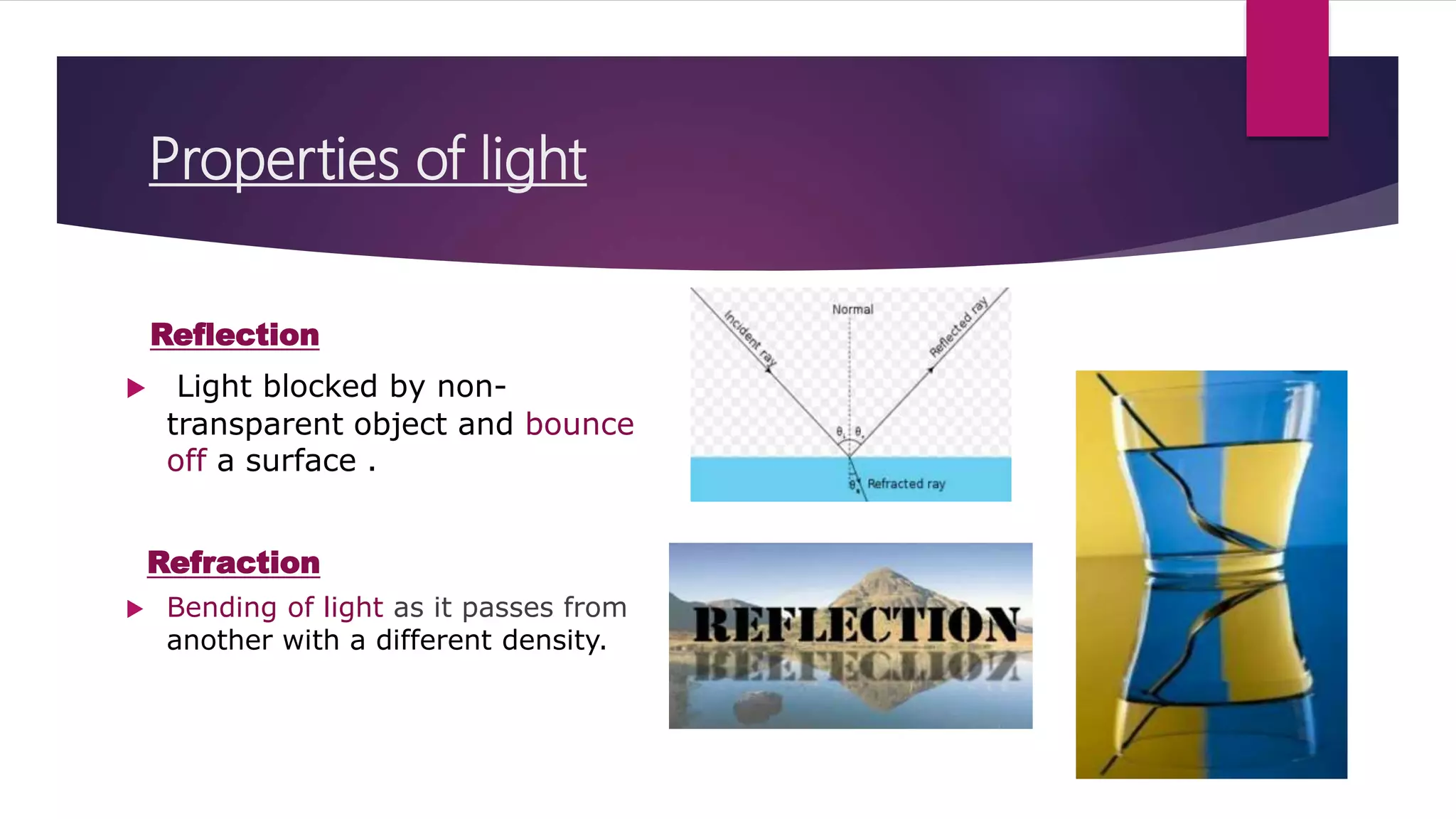
Reflection
 Light blocked by non-
transparent object and bounce
off a surface .
Refraction
 Bending of light as it passes from
another with a different density.
Focusing light on the retina :
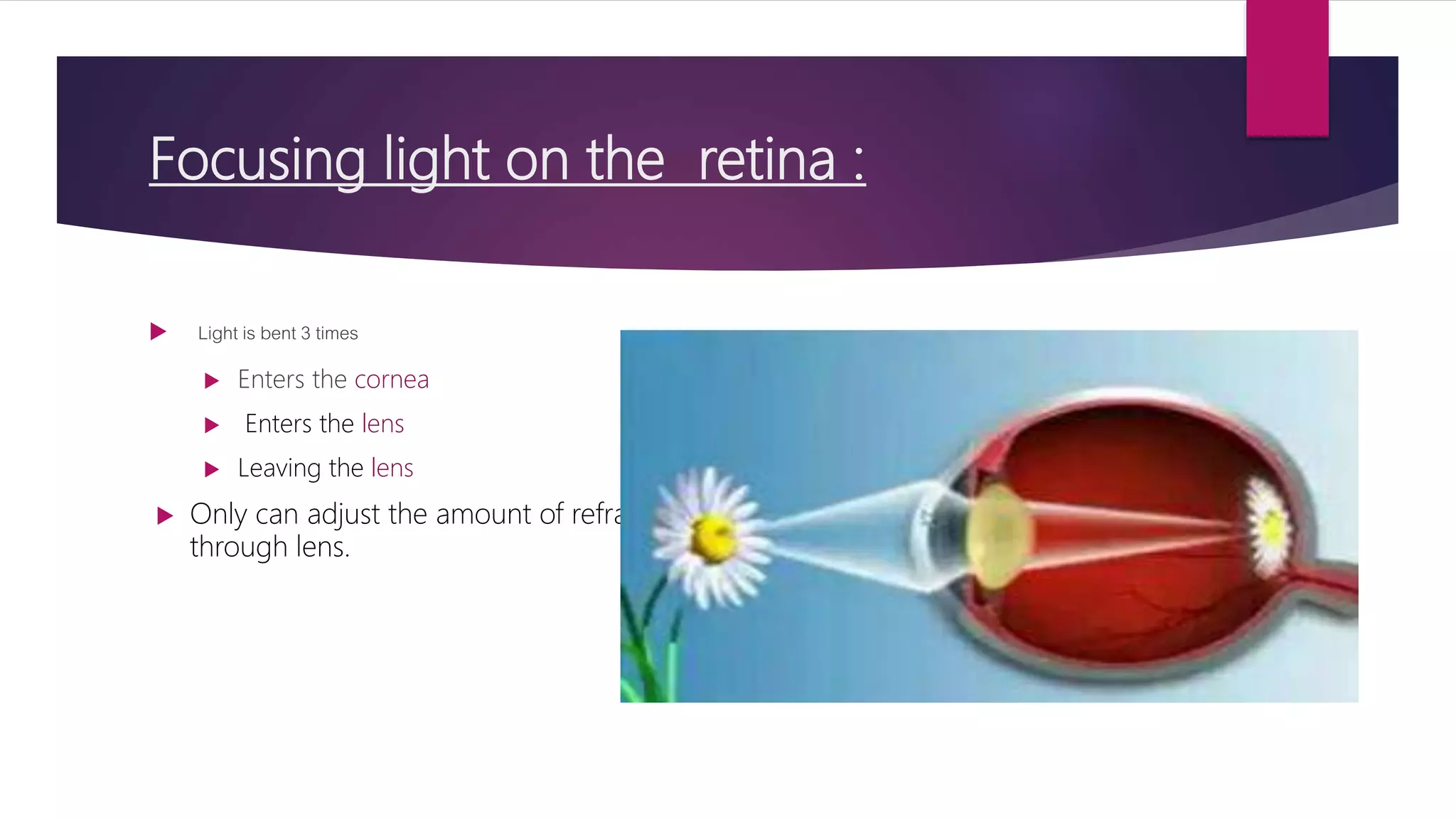
 Light is bent 3 times
 Enters the cornea
 Enters the lens
 Leaving the lens
 Only can adjust the amount of refraction
through lens.
Convex And concave lenses :
Convex lenses
 Light converges as it passes through.
 Converge to single point = focal point
 A thick lens causes more refraction and therefore
shorter focal point .
 A thin lenses causes less refraction and therefore
longer focal point..
 Results in image being upside down and
reversed at focal point.
Convex and concave lenses
Concave lenses
 Diverge ( spreads out the light rays that
have been refracted through it )Light .
Changing the thickness of lens :
Ciliary muscles
Emmetropic eye
 Distance
 Light coming to eye as parallel rays
 Dont need to bend light as much
 Ciliary muscles are relaxed
Emmetropic eye
 Near vision
 Light coming in as a divergent rays .
 Need to thicken the lens .
 ciliary muscles contracted.
Focusing for close vision
 Accommodation Of lenses
 its the ability of eye to change its focus from distant to near objects ,
this process is achieved by the lens changing its shape .
 Ciliary muscles contract so lens can thicken.
 Far point of vision = Farthest point till where we can see.
 That distance in which no accommodation Is needed ( 6m Or 20ft ).
 near point of vision= the nearest point
 Closest point on which we can focus clearly ( lens cant get any fatter )
Contd...
 Constriction of pupils
 Prevents the most divergent light rays from entering
the eye .
 convergence of eyeballs
 Keeps object focus on fovea .
 getting cross eyed.
Myopia :
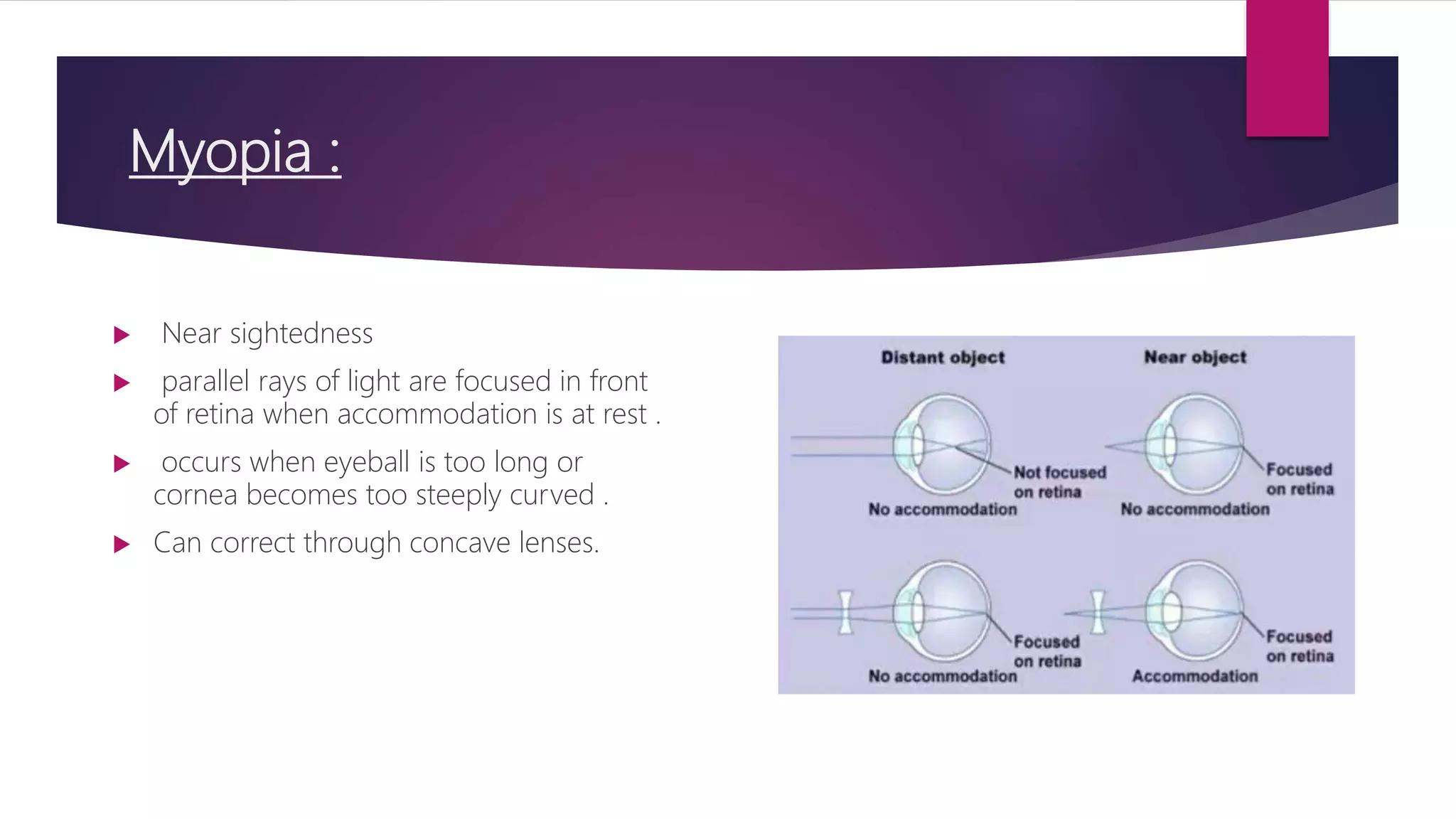
 Near sightedness
 parallel rays of light are focused in front
of retina when accommodation is at rest .
 occurs when eyeball is too long or
cornea becomes too steeply curved .
 Can correct through concave lenses.
Hyperopia:
 Long sightedness.
 parallel rays of light coming from infinity
are focused behind the retina with
accommodation being at rest.
 Occur if eye is too short
 can correct through convex lens .
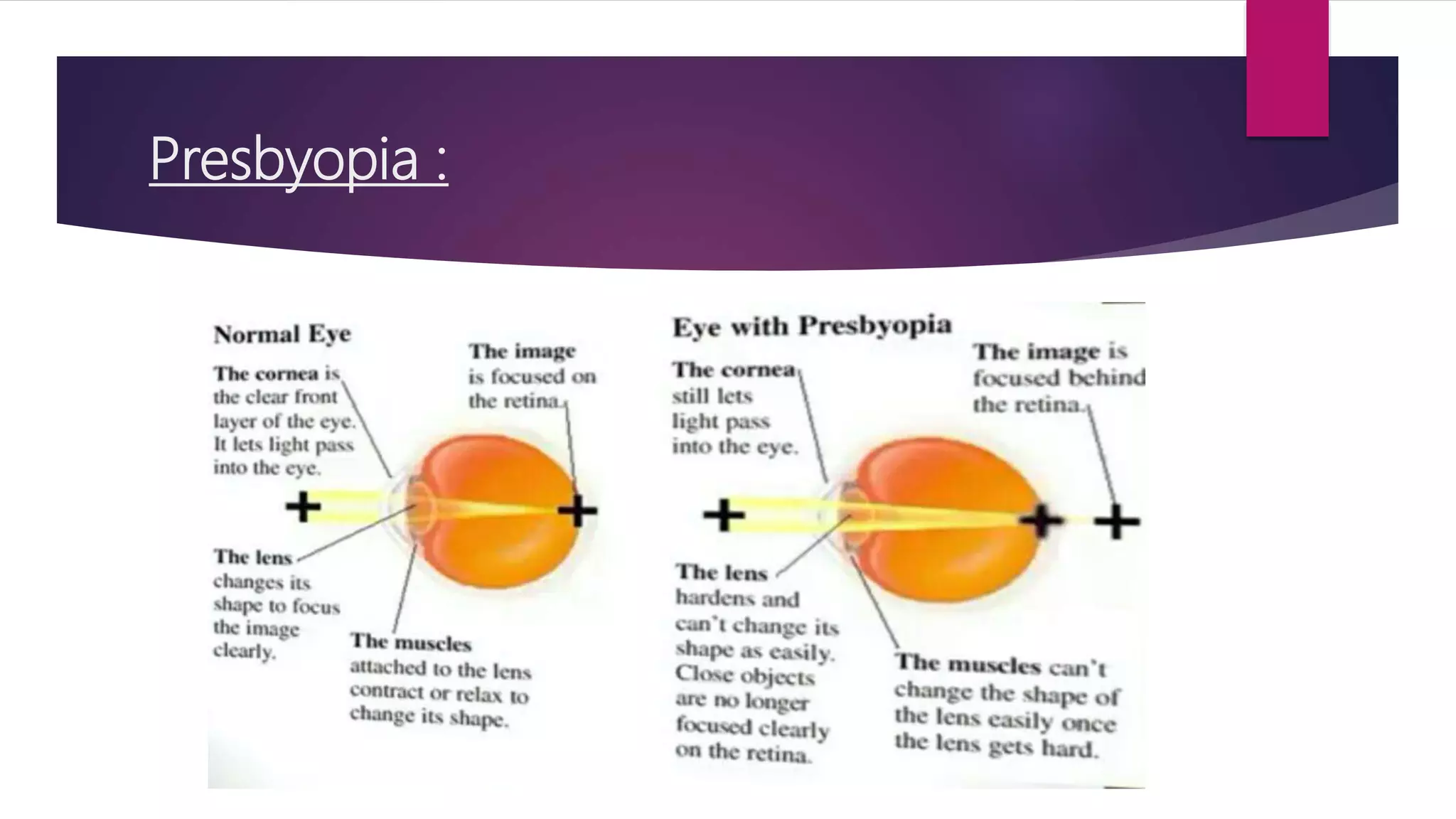
Presbyopia :
Astigmatism :
Thank you

Optics of eye

  • 1.
    Optics of theeye BY ANSIYA PRASAD
  • 2.
    Objectives :  Eyeand its components.  Axis and visual angles of eye .  Describe the properties of light .  Differentiate between convex and concave lenses.  Describe Accommodation.  Describe how the eye focuses light.  Differentiate between presbyopia , Myopia , hyperopia and astigmatism.
  • 3.
    Eye as acamera :  Eyelids – shuttter .  Cornea – focusing system.  Lens – focusing system.  Iris – diaphragm .  Choroid – dark chamber.  Retina – light sensitive film.
  • 4.
    Cornea :  Corneais a plus lens of +42D  Radius of curvature of ant.surface = 7.8mm  post.surface = 6.8mm  Diameter about 11.5mm and thickness of 0.5 – 0.6mm in centre and 0.6 – 0.8mm periphery.  An average horizontal diameter = 11.7 mm  vertical diameter = 11mm.
  • 5.
    Contd...  Reasons ofrefraction :  curvature  Significant differences in refractive index .
  • 6.
    Crystalline lens : Lens accounts for about one-third of refraction of eye.  accomodation  provides a mechanism of focusing at different diatances.  Radius of curvature  ant.surface = 10mm  post.surface = 6mm  Refractive index  nucleus- 1.41  pole – 1.385  cortex – 1.38  Total power – 15 -18 D.
  • 7.
    Anterior chamber : Is a cavity between cornea and iris .  Filled with aqueous humour .  Refractive index of aqueous humour is 1.336.  depth of aqueous chamber is 2.5 - 4.00mm  change in anterior chamber depth , change the total power.
  • 8.
    Iris and pupil:  Regulates the amount of Light entering the eye.  at 2.4mm Pupil size, best retinal image obtained, as abberation and diffraction are balanced.  pupil size varies 2-4mm in diameter in bright light  4-8mm in diameter in dim light .
  • 9.
    Vitreous humour : Is a transparent ,colorless ,gelatinous mass that fills the space in between lens and the retina .  is 8-9mm in diameter.  Refractive index of vitreous humour is 1.337.
  • 10.
    Retina :  Maximumresolving power is at fovea  light sensitive film.  Concave spherical surface with radius of 12mm.  22mm in diameter .  contains about 7 million cones and 75- 150 million rods.  Advantages of curvature of retina is that  Curved images formed by the optical system Is brought in the right order.  A much wider field of view Is covered by the steeply curved retina .
  • 11.
    Axis and visualangles of eye :  Optical axis – the line passing through the centre of cornea and centre of lens and meets the retina on the nasal side of the fovea.  Visual axis – is the line joining the fixation point , nodal point and the fovea.
  • 12.
    Axis and visualangles of eye :  Fixation axis – is the straight line that joins centre of rotation of eyeball with fixation point .
  • 13.
    Visual angles : Angle alpha – angle formed between visual axis and optical axis at nodal point.  Angle gamma – angle between optic axis and fixation axis .  Angle kappa – angle formed between pupillary line and visual axis .
  • 14.
    Properties of light Electromagnetic radiation  Visible light  Wavelength of 400- 700nm  Violet- short wavelength , highest energy .  Red- long wavelength , lowest energy.
  • 15.
    Properties of light Reflection Light blocked by non- transparent object and bounce off a surface . Refraction  Bending of light as it passes from another with a different density.
  • 16.
    Focusing light onthe retina :  Light is bent 3 times  Enters the cornea  Enters the lens  Leaving the lens  Only can adjust the amount of refraction through lens.
  • 17.
    Convex And concavelenses : Convex lenses  Light converges as it passes through.  Converge to single point = focal point  A thick lens causes more refraction and therefore shorter focal point .  A thin lenses causes less refraction and therefore longer focal point..  Results in image being upside down and reversed at focal point.
  • 18.
    Convex and concavelenses Concave lenses  Diverge ( spreads out the light rays that have been refracted through it )Light .
  • 19.
    Changing the thicknessof lens : Ciliary muscles
  • 20.
    Emmetropic eye  Distance Light coming to eye as parallel rays  Dont need to bend light as much  Ciliary muscles are relaxed
  • 21.
    Emmetropic eye  Nearvision  Light coming in as a divergent rays .  Need to thicken the lens .  ciliary muscles contracted.
  • 22.
    Focusing for closevision  Accommodation Of lenses  its the ability of eye to change its focus from distant to near objects , this process is achieved by the lens changing its shape .  Ciliary muscles contract so lens can thicken.  Far point of vision = Farthest point till where we can see.  That distance in which no accommodation Is needed ( 6m Or 20ft ).  near point of vision= the nearest point  Closest point on which we can focus clearly ( lens cant get any fatter )
  • 23.
    Contd...  Constriction ofpupils  Prevents the most divergent light rays from entering the eye .  convergence of eyeballs  Keeps object focus on fovea .  getting cross eyed.
  • 24.
    Myopia :  Nearsightedness  parallel rays of light are focused in front of retina when accommodation is at rest .  occurs when eyeball is too long or cornea becomes too steeply curved .  Can correct through concave lenses.
  • 25.
    Hyperopia:  Long sightedness. parallel rays of light coming from infinity are focused behind the retina with accommodation being at rest.  Occur if eye is too short  can correct through convex lens .
  • 26.
  • 27.
  • 28.