DELIVERY OF COMMUNITY HEALTHSERVICES
(REFEERALSYSTEM)
PREPARED BY,
MRS,M.JOSEPHIDAYANA,
TUTOR.
OBJECTIVES
At the end of the class students
are able to
 Define referral system.
 Reason for referral.
 Rationale for referral.
 Characteristics of referral system.
 Levels of referral system.
 List the types of referral system
 Components, perspectives and issues ,
responsibilities.
DEFINITION
A referral system is a mechanism that
enables a patient’s health needs to be
comprehensively managed using
resources beyond those available at the
location they access care from, be it in a
community unit, dispensary, health centre
or a higher level facility
REASONS FOR REFERRAL
 To seek expert opinion.
 To seek additional or different services.
 To seek admission and management
 To seek use of diagnostic& therapeutic
tools
 For continuity of care
CHARECTERISTICS
 Patient should be given optimal care at
the right level, right time and right cost.
 Optimal and cost efficient utilization of
health care system.
 Optimal and appropriate utilization of
specialist services for needy persons
 Optimal utilization of primary health care
services.

RATONALE OF REFERRAL
SYSTEM
 Most common, most complicated and
life threatening diseases requires
different levels.
 Maximize limited resources & avoid
duplication of services.
 Ensures a close relationship between
all levels of the health system.
 Helps people receive the best possible
care closes to home
Cont…
 Support primary health centers.
 Helps to build capacity.
 Reduce the high proportion of
customers seen at the outpatient
clinics at 2nd facilities.
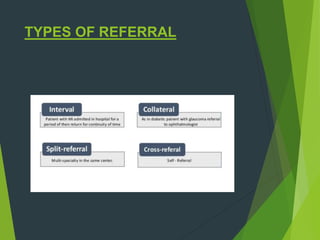
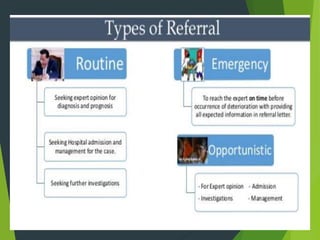
TYPES OF REFERRAL
LEVELS OF REFERRAL SYSTEM
Primary level of care:(PHC)
 Developed to urban and rural areas
 Referral site for the village health worker
& basic health units
 Usually is the 1st contact level between
community & other levels of health
facility.
 Provide management for common &
minor alignment requiring simple
uncomlicated intervention.
Secondary level of care:(District Hospital)
 Referral site for the primary care facilities
 Given by physicians with basic health training.
 Usually given in health facilities either private
owned or government operated
 Rural hospitals, state general hospital, out-
patient department are main sites of care.
 Rendered by specialists in health facilities.
Tertiary level of care: (Superspecality Hospitals)
 Referral site for the secondary care facilities.
 Can be medical centers, regional, provincial
hospitals and specialized hospitals.
 Provide care for complicated, uncommon and
serious diseases requiring highly specialized or
high technology interventions.
REFERRAL SYSTEM IN INDIA
 Sub centres(SC)
 Primary Health Centres(PHC)
 Community Health Centres(CHC)
 Sub District Hospitals
 District Hospitals
 Tertiary Level Facilities In Medical
College Hospitals
 Super Speciality Hospitals In India
COMPONENTS
 Can be adjusted relevant to the local
situation.
 Components can include:
 health system
 Referral process at the 1st level of care
 Referral activities
 Referral process at 2nd or tertiary level
 Supervision and capacity building
PERSPECTIVES & ISSUES OF
ESTABLISHING REFFERAL
 HEALTH SYSTEM ISSUES
 Service providers & quality of care.
 Performance expectations &
involvement of organization.
 All service providers are expected.
 Follow the agreed protocols of care.
REFERRAL PROCESS AT 1ST LEVEL:
 During visits of H.C, it is important that the
health worker
 For proper performance the health workers
 Protocols need to include
 Making decision to refer comes after the
gathering and analyzing relevant information
using protocols as a guide
 Deciding to refer dose not mean that the health
workers is inadequate or bad.
REFERRAL ACTIVITES
 adoption of standardized referral forms to
ensure equality whenever a referral is
initiated
 patients referred out should be
accompanied.
 Carefully filled referral card cab helps to get
timely attention at the receiving facility.
REFERRAL PROCESS AT 2ND OR 3RD
LEVEL:
 The receiving facility
 The supervisor
SUPERVISION AND CAPACITY BUILDING:
 Facility managers & supervisors at all
levels should monitor all referrals to &
from facilities.
 Supervisors should discuss referred
cases.
RESPONSIBLITIES OF NURSE
 Informed consent
 Selection of consultant
 Acceptance
 Task performance
 Feedback
BIBLIOGRAPHY
 Kamalam. S, “ESSENTIALS IN
COMMUNITY HEALTH NURSING
PRACTICE”, 1st edition, 2008 jaypee
brothers, new Delhi, page no, 105-110
 B. T. Basavanthappa “COMMUNITY
HEALTH NURSING”, 1st edition, 2008
jaypee brothers, Mumbai, page no 30-
35
 Kasturi sundar rao, “community health
nursing”, BI publications;265-270

CHN-II REFEERAL SYSTEM.pptx

  • 1.
    DELIVERY OF COMMUNITYHEALTHSERVICES (REFEERALSYSTEM) PREPARED BY, MRS,M.JOSEPHIDAYANA, TUTOR.
  • 2.
    OBJECTIVES At the endof the class students are able to  Define referral system.  Reason for referral.  Rationale for referral.  Characteristics of referral system.  Levels of referral system.  List the types of referral system  Components, perspectives and issues , responsibilities.
  • 3.
    DEFINITION A referral systemis a mechanism that enables a patient’s health needs to be comprehensively managed using resources beyond those available at the location they access care from, be it in a community unit, dispensary, health centre or a higher level facility
  • 4.
    REASONS FOR REFERRAL To seek expert opinion.  To seek additional or different services.  To seek admission and management  To seek use of diagnostic& therapeutic tools  For continuity of care
  • 5.
    CHARECTERISTICS  Patient shouldbe given optimal care at the right level, right time and right cost.  Optimal and cost efficient utilization of health care system.  Optimal and appropriate utilization of specialist services for needy persons  Optimal utilization of primary health care services. 
  • 6.
    RATONALE OF REFERRAL SYSTEM Most common, most complicated and life threatening diseases requires different levels.  Maximize limited resources & avoid duplication of services.  Ensures a close relationship between all levels of the health system.  Helps people receive the best possible care closes to home
  • 7.
    Cont…  Support primaryhealth centers.  Helps to build capacity.  Reduce the high proportion of customers seen at the outpatient clinics at 2nd facilities.
  • 8.
  • 11.
    LEVELS OF REFERRALSYSTEM Primary level of care:(PHC)  Developed to urban and rural areas  Referral site for the village health worker & basic health units  Usually is the 1st contact level between community & other levels of health facility.  Provide management for common & minor alignment requiring simple uncomlicated intervention.
  • 12.
    Secondary level ofcare:(District Hospital)  Referral site for the primary care facilities  Given by physicians with basic health training.  Usually given in health facilities either private owned or government operated  Rural hospitals, state general hospital, out- patient department are main sites of care.  Rendered by specialists in health facilities.
  • 13.
    Tertiary level ofcare: (Superspecality Hospitals)  Referral site for the secondary care facilities.  Can be medical centers, regional, provincial hospitals and specialized hospitals.  Provide care for complicated, uncommon and serious diseases requiring highly specialized or high technology interventions.
  • 14.
    REFERRAL SYSTEM ININDIA  Sub centres(SC)  Primary Health Centres(PHC)  Community Health Centres(CHC)  Sub District Hospitals  District Hospitals  Tertiary Level Facilities In Medical College Hospitals  Super Speciality Hospitals In India
  • 15.
    COMPONENTS  Can beadjusted relevant to the local situation.  Components can include:  health system  Referral process at the 1st level of care  Referral activities  Referral process at 2nd or tertiary level  Supervision and capacity building
  • 16.
    PERSPECTIVES & ISSUESOF ESTABLISHING REFFERAL  HEALTH SYSTEM ISSUES  Service providers & quality of care.  Performance expectations & involvement of organization.  All service providers are expected.  Follow the agreed protocols of care.
  • 17.
    REFERRAL PROCESS AT1ST LEVEL:  During visits of H.C, it is important that the health worker  For proper performance the health workers  Protocols need to include  Making decision to refer comes after the gathering and analyzing relevant information using protocols as a guide  Deciding to refer dose not mean that the health workers is inadequate or bad.
  • 18.
    REFERRAL ACTIVITES  adoptionof standardized referral forms to ensure equality whenever a referral is initiated  patients referred out should be accompanied.  Carefully filled referral card cab helps to get timely attention at the receiving facility.
  • 19.
    REFERRAL PROCESS AT2ND OR 3RD LEVEL:  The receiving facility  The supervisor SUPERVISION AND CAPACITY BUILDING:  Facility managers & supervisors at all levels should monitor all referrals to & from facilities.  Supervisors should discuss referred cases.
  • 20.
    RESPONSIBLITIES OF NURSE Informed consent  Selection of consultant  Acceptance  Task performance  Feedback
  • 21.
    BIBLIOGRAPHY  Kamalam. S,“ESSENTIALS IN COMMUNITY HEALTH NURSING PRACTICE”, 1st edition, 2008 jaypee brothers, new Delhi, page no, 105-110  B. T. Basavanthappa “COMMUNITY HEALTH NURSING”, 1st edition, 2008 jaypee brothers, Mumbai, page no 30- 35  Kasturi sundar rao, “community health nursing”, BI publications;265-270