Johan Eltes Callista Enterprise AB [email_address] http://www.callista.se/enterprise The Reference Architecture - a foundation for successful projects
 
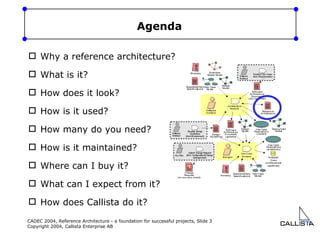
Agenda Why a reference architecture? What is it? How does it look? How is it used? How many do you need? How is it maintained? Where can I buy it? What can I expect from it? How does Callista do it?
Why a reference architecture? Some areas where a RA may contribute: Reduce project set-up time Minimize architectural and technical re-factoring Reduce cost / time of application development Increase product quality Secure operations characteristics of application Reduce cost for maintenance
Example from AstraZeneca Ordering system for automated chemical store 5 developers - all from previous J2EE projects within AZ 2 years, 4 releases Technically challenging Complex business rules (store optimization) Exceptional transaction throughput requirements (events generated by high-speed robots 24x7) Applied RUP and test-driven development External (Volvo IT) Reference Architecture was applied A review was conducted (Questionnaire) close to project closure
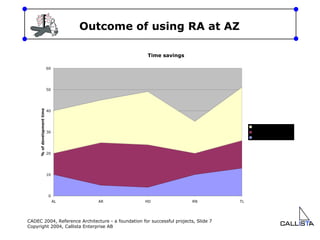
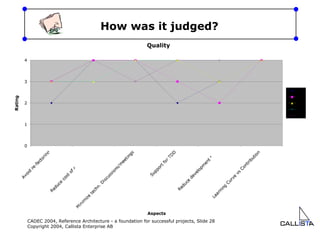
Outcome of using RA at AZ How much time did we gain, in terms of reduced architectural and technical re-factoring (%)? How much time did we gain, by reducing the time spent discussing J2EE design issues (%)?  How much time did we gain, by cutting development time (%)?
Outcome of using RA at AZ
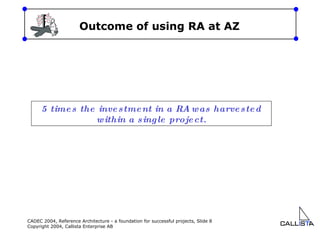
Outcome of using RA at AZ 5 times the investment in a RA was harvested within a single project.
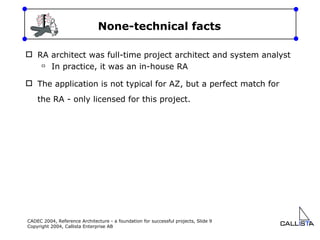
None-technical facts RA architect was full-time project architect and system analyst In practice, it was an in-house RA The application is not typical for AZ, but a perfect match for the RA - only licensed for this project.
What is it - Rational? “ A Reference Architecture is, in essence, a predefined architectural pattern, or set of patterns, possibly partially or completely instantiated, designed and proven for use in particular business and technical contexts, together with supporting artifacts to enable their use. Often, these artifacts are harvested from previous projects”
What is it - OMG? “ The principles and the means to most effectively achieve a design vision”
What is it - in practice? A defined set of architectural guidelines to be shared across applications and systems A standardized terminology (component, application, system, service etc) It is a vehicle to support technical decision making Preferably divided into External and Internal RA…
What is it - External RA? The architectural principles that defines the structure of the system portfolio Rules for inter-system integration Defines “macro architecture” - also called “city planning” Should our portfolio comply to… Loosely coupled Autonomous Systems (“VBS”)?.. or Process-oriented applications using domain services (“SOA” - compare to IRM)? How is the support organization tied into the concept of systems or domains?
What is it - Internal RA? Rules for partitioning of systems into subsystems Rules for partitioning subsystems into layers A compatible selection of design patterns to define how the architecture is to be realized in practice Tooling to automate the creation of code from design patterns (e.g.MDA tools) Standards and guidelines for one or more technical platforms Code framework to help the programmer adhere to guidelines and patterns. Standardized set of components for common mechanisms (logging, database access etc)
How does it look? Example: Jeeves RA developed at Volvo IT Details on the Jeeves project (formerly Japp)  http://www.callista.se/enterprise/resources/japp_neodeveloper_2002.pdf External architecture: “ Autonomous system” Not elaborated by Jeeves project.
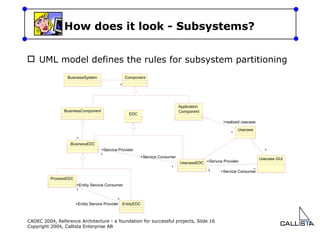
How does it look - Subsystems? UML model defines the rules for subsystem partitioning
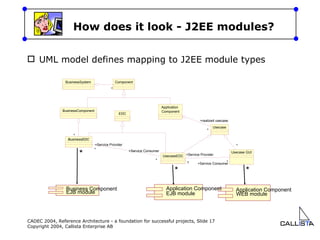
How does it look - J2EE modules? UML model defines mapping to J2EE module types Application Component  WEB module Application Component  EJB module Business Component  EJB module * * *
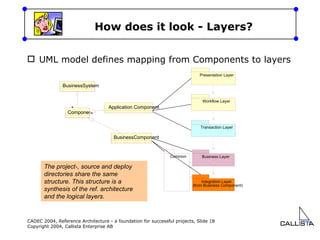
How does it look - Layers? UML model defines mapping from Components to layers The project-, source and deploy directories share the same structure. This structure is a synthesis of the ref. architecture and the logical layers. Business Layer Transaction Layer Integration Layer (from Business Component) Workflow Layer Presentation Layer Common BusinessSystem Component * * Application Component BusinessComponent
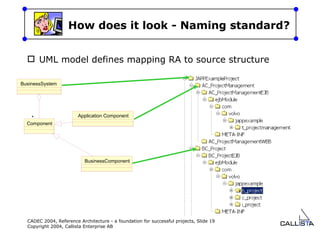
How does it look - Naming standard? UML model defines mapping RA to source structure BusinessSystem Component * * Application Component BusinessComponent
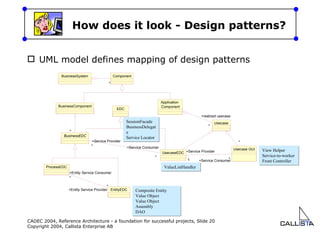
How does it look - Design patterns? UML model defines mapping of design patterns View Helper Service-to-worker Front Controller Composite Entity Value Object Value Object Assembly DAO SessionFacade BusinessDelegate Service Locator ValueListHandler
How does it look - RA specification? 50-page document defines the RA
How does it look - RA specification? A document for each pattern defines implementation strategy only The pattern itself is already documented by Sun
How is it used? How did the RA affect various roles at AZ project? Software Architect Systems Analyst Designer Programmer / Unit tester
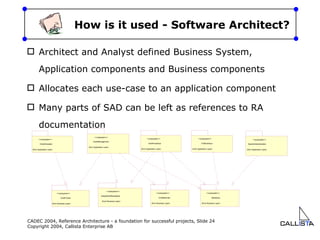
How is it used - Software Architect? Architect and Analyst defined Business System, Application components and Business components Allocates each use-case to an application component Many parts of SAD can be left as references to RA documentation
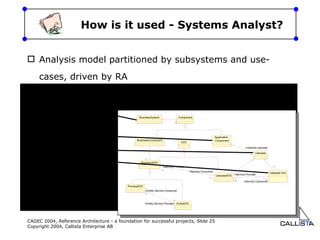
How is it used - Systems Analyst? Analysis model partitioned by subsystems and use-cases, driven by RA
How is it used - Designer? Generates code for various patterns from analysis model, according to RA Composite Entity, DAO, DAO Factory, Value Object Assembly patterns Transforms analysis classes into interfaces and implementation classes according to RA mapping of J2EE modules and layers
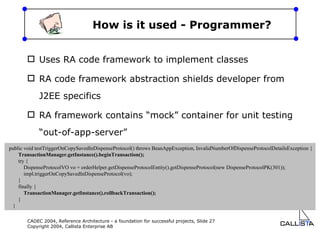
How is it used - Programmer? Uses RA code framework to implement classes RA code framework abstraction shields developer from J2EE specifics RA framework contains “mock” container for unit testing “out-of-app-server” public void testTriggerOnCopySavedInDispenseProtocol() throws BeanAppException, InvalidNumberOfDispenseProtocolDetailsException { TransactionManager.getInstance().beginTransaction(); try { DispenseProtocolVO vo = orderHelper.getDispenseProtocolEntity().getDispenseProtocol(new DispenseProtocolPK(301)); impl.triggerOnCopySavedInDispenseProtocol(vo); } finally { TransactionManager.getInstance().rollbackTransaction(); } }
How was it judged?
Three most important “features”
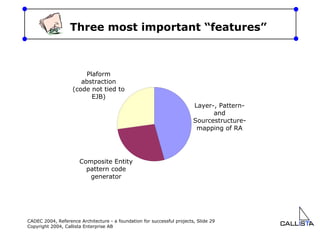
How is it used - Questionnaire Designer: applying J2EE  design patterns  and layering model time saved with persistent entities/value objects when model changes (JE: using model-driven  code generator ) promotes a common design despite several designers Designer/programmer: The RA rules and realizations of common  design patterns  minimise time and effort spent on creating them (again and again.)… Code generation  saves lots of time and provides reliable code when entity model is growing/being modified Out-of-container support  is truly a must to provide and simplify testing during development, providing a higher quality, and then greatly reduce time spent on localisation of the errors that occurs. “ What are the three most significant advantages achieved by using the reference architecture and supporting tools?”
How is it used - Questionnaire… Designer/programmer: The support of  running an application without a container . The RA reduces the amount of time for  discussion  topics, (i.e. where to place code, logging, etc).  Designer/Programmer Very explicit guidance in matters like: where do that functionality belong? what should we name that  component/layer ? etc Hides/takes care of a lot of “ugly” J2EE-matters that needs to be solved anyway, e.g.  transactions Proven design and implementation of RA makes it possible for non-experts (i.e. people who haven’t memorized the J2EE (EJB, JMS, ...) specs) to  concentrate on solving business problems  instead of infrastructure problems Programmer: The  code structure . You know where to put your code and where to find it.  The  code generator .  That all value objects and edc queries are generated is a cost/time saver.
How many do I need? Possibly only one outer RA Likely a set of inner RA variants to cover different classes of applications ERP type of applications (core systems of transactional nature mixing online and batch) E-Business and Portals Document management Data analysis and reporting At the detailed level, you will need to provide platform specific sections (Net, J2EE)
How is it maintained? External RA belongs to portfolio / enterprise architect Structural changes occur very rarely - “every second year” Internal architecture could be owned by group of project architects Structural changes (UML model) happen rarely - “once a year”  Structural changes should be governed by a formal (slow) process. This is the toughest and most critical part! Don’t be buzz-word - or feature-driven - better be too slow than too fast Continuous (not slow) improvements at the tooling and code framework level Establish a change control process with CCB
Where can I buy it? Should I buy it? Depends on your culture Taking a “complete” solution from outside is hard to anchor and to implement Get inspired by others work SAP and other large ERP vendors have invested heavily in their RA Look at others efforts as a quality assessment Decide what is important to you and start from there “ It is easier to interpret the bible when you’ve written it your self”
What can I expect from it? Improved quality of projects and their deliverables Makes life easier for maintenance organization Significant cut of development time Affective harvesting and sharing of knowledge and hard-earned experience.
How does Callista do it? Seminars (like expansions of this one) Workshops to get started Architectural consulting to assist your RA harvesting team Technical management and mentoring for patterns and model-driven development Project architects and mentors to secure a successful career of your RA

Reference Architecture

  • 1.
    Johan Eltes CallistaEnterprise AB [email_address] http://www.callista.se/enterprise The Reference Architecture - a foundation for successful projects
  • 2.
  • 3.
    Agenda Why areference architecture? What is it? How does it look? How is it used? How many do you need? How is it maintained? Where can I buy it? What can I expect from it? How does Callista do it?
  • 4.
    Why a referencearchitecture? Some areas where a RA may contribute: Reduce project set-up time Minimize architectural and technical re-factoring Reduce cost / time of application development Increase product quality Secure operations characteristics of application Reduce cost for maintenance
  • 5.
    Example from AstraZenecaOrdering system for automated chemical store 5 developers - all from previous J2EE projects within AZ 2 years, 4 releases Technically challenging Complex business rules (store optimization) Exceptional transaction throughput requirements (events generated by high-speed robots 24x7) Applied RUP and test-driven development External (Volvo IT) Reference Architecture was applied A review was conducted (Questionnaire) close to project closure
  • 6.
    Outcome of usingRA at AZ How much time did we gain, in terms of reduced architectural and technical re-factoring (%)? How much time did we gain, by reducing the time spent discussing J2EE design issues (%)? How much time did we gain, by cutting development time (%)?
  • 7.
  • 8.
    Outcome of usingRA at AZ 5 times the investment in a RA was harvested within a single project.
  • 9.
    None-technical facts RAarchitect was full-time project architect and system analyst In practice, it was an in-house RA The application is not typical for AZ, but a perfect match for the RA - only licensed for this project.
  • 10.
    What is it- Rational? “ A Reference Architecture is, in essence, a predefined architectural pattern, or set of patterns, possibly partially or completely instantiated, designed and proven for use in particular business and technical contexts, together with supporting artifacts to enable their use. Often, these artifacts are harvested from previous projects”
  • 11.
    What is it- OMG? “ The principles and the means to most effectively achieve a design vision”
  • 12.
    What is it- in practice? A defined set of architectural guidelines to be shared across applications and systems A standardized terminology (component, application, system, service etc) It is a vehicle to support technical decision making Preferably divided into External and Internal RA…
  • 13.
    What is it- External RA? The architectural principles that defines the structure of the system portfolio Rules for inter-system integration Defines “macro architecture” - also called “city planning” Should our portfolio comply to… Loosely coupled Autonomous Systems (“VBS”)?.. or Process-oriented applications using domain services (“SOA” - compare to IRM)? How is the support organization tied into the concept of systems or domains?
  • 14.
    What is it- Internal RA? Rules for partitioning of systems into subsystems Rules for partitioning subsystems into layers A compatible selection of design patterns to define how the architecture is to be realized in practice Tooling to automate the creation of code from design patterns (e.g.MDA tools) Standards and guidelines for one or more technical platforms Code framework to help the programmer adhere to guidelines and patterns. Standardized set of components for common mechanisms (logging, database access etc)
  • 15.
    How does itlook? Example: Jeeves RA developed at Volvo IT Details on the Jeeves project (formerly Japp) http://www.callista.se/enterprise/resources/japp_neodeveloper_2002.pdf External architecture: “ Autonomous system” Not elaborated by Jeeves project.
  • 16.
    How does itlook - Subsystems? UML model defines the rules for subsystem partitioning
  • 17.
    How does itlook - J2EE modules? UML model defines mapping to J2EE module types Application Component WEB module Application Component EJB module Business Component EJB module * * *
  • 18.
    How does itlook - Layers? UML model defines mapping from Components to layers The project-, source and deploy directories share the same structure. This structure is a synthesis of the ref. architecture and the logical layers. Business Layer Transaction Layer Integration Layer (from Business Component) Workflow Layer Presentation Layer Common BusinessSystem Component * * Application Component BusinessComponent
  • 19.
    How does itlook - Naming standard? UML model defines mapping RA to source structure BusinessSystem Component * * Application Component BusinessComponent
  • 20.
    How does itlook - Design patterns? UML model defines mapping of design patterns View Helper Service-to-worker Front Controller Composite Entity Value Object Value Object Assembly DAO SessionFacade BusinessDelegate Service Locator ValueListHandler
  • 21.
    How does itlook - RA specification? 50-page document defines the RA
  • 22.
    How does itlook - RA specification? A document for each pattern defines implementation strategy only The pattern itself is already documented by Sun
  • 23.
    How is itused? How did the RA affect various roles at AZ project? Software Architect Systems Analyst Designer Programmer / Unit tester
  • 24.
    How is itused - Software Architect? Architect and Analyst defined Business System, Application components and Business components Allocates each use-case to an application component Many parts of SAD can be left as references to RA documentation
  • 25.
    How is itused - Systems Analyst? Analysis model partitioned by subsystems and use-cases, driven by RA
  • 26.
    How is itused - Designer? Generates code for various patterns from analysis model, according to RA Composite Entity, DAO, DAO Factory, Value Object Assembly patterns Transforms analysis classes into interfaces and implementation classes according to RA mapping of J2EE modules and layers
  • 27.
    How is itused - Programmer? Uses RA code framework to implement classes RA code framework abstraction shields developer from J2EE specifics RA framework contains “mock” container for unit testing “out-of-app-server” public void testTriggerOnCopySavedInDispenseProtocol() throws BeanAppException, InvalidNumberOfDispenseProtocolDetailsException { TransactionManager.getInstance().beginTransaction(); try { DispenseProtocolVO vo = orderHelper.getDispenseProtocolEntity().getDispenseProtocol(new DispenseProtocolPK(301)); impl.triggerOnCopySavedInDispenseProtocol(vo); } finally { TransactionManager.getInstance().rollbackTransaction(); } }
  • 28.
    How was itjudged?
  • 29.
    Three most important“features”
  • 30.
    How is itused - Questionnaire Designer: applying J2EE design patterns and layering model time saved with persistent entities/value objects when model changes (JE: using model-driven code generator ) promotes a common design despite several designers Designer/programmer: The RA rules and realizations of common design patterns minimise time and effort spent on creating them (again and again.)… Code generation saves lots of time and provides reliable code when entity model is growing/being modified Out-of-container support is truly a must to provide and simplify testing during development, providing a higher quality, and then greatly reduce time spent on localisation of the errors that occurs. “ What are the three most significant advantages achieved by using the reference architecture and supporting tools?”
  • 31.
    How is itused - Questionnaire… Designer/programmer: The support of running an application without a container . The RA reduces the amount of time for discussion topics, (i.e. where to place code, logging, etc). Designer/Programmer Very explicit guidance in matters like: where do that functionality belong? what should we name that component/layer ? etc Hides/takes care of a lot of “ugly” J2EE-matters that needs to be solved anyway, e.g. transactions Proven design and implementation of RA makes it possible for non-experts (i.e. people who haven’t memorized the J2EE (EJB, JMS, ...) specs) to concentrate on solving business problems instead of infrastructure problems Programmer: The code structure . You know where to put your code and where to find it. The code generator . That all value objects and edc queries are generated is a cost/time saver.
  • 32.
    How many doI need? Possibly only one outer RA Likely a set of inner RA variants to cover different classes of applications ERP type of applications (core systems of transactional nature mixing online and batch) E-Business and Portals Document management Data analysis and reporting At the detailed level, you will need to provide platform specific sections (Net, J2EE)
  • 33.
    How is itmaintained? External RA belongs to portfolio / enterprise architect Structural changes occur very rarely - “every second year” Internal architecture could be owned by group of project architects Structural changes (UML model) happen rarely - “once a year” Structural changes should be governed by a formal (slow) process. This is the toughest and most critical part! Don’t be buzz-word - or feature-driven - better be too slow than too fast Continuous (not slow) improvements at the tooling and code framework level Establish a change control process with CCB
  • 34.
    Where can Ibuy it? Should I buy it? Depends on your culture Taking a “complete” solution from outside is hard to anchor and to implement Get inspired by others work SAP and other large ERP vendors have invested heavily in their RA Look at others efforts as a quality assessment Decide what is important to you and start from there “ It is easier to interpret the bible when you’ve written it your self”
  • 35.
    What can Iexpect from it? Improved quality of projects and their deliverables Makes life easier for maintenance organization Significant cut of development time Affective harvesting and sharing of knowledge and hard-earned experience.
  • 36.
    How does Callistado it? Seminars (like expansions of this one) Workshops to get started Architectural consulting to assist your RA harvesting team Technical management and mentoring for patterns and model-driven development Project architects and mentors to secure a successful career of your RA