Università degli Studi dell’Aquila


L04: SA Styles
                                        Henry Muccini
 Dipartimento di Ingegneria, Scienze dell’Informazione e
           Matematica, University of L’Aquila
        henry.muccini@univaq.it, @henrymuccini
The material in these slides may be freely reproduced
and distributed, partially or totally, as far as an explicit
reference or acknowledge to the material author is
preserved.


                           Henry Muccini
Intro to SA        Intro to Software Testing
SA Case study      Structural Testing
SA style           Model-based Testing
ADLs               Architecture-based Testing
Design Decisions
                   Lab
Views/Viewpoints


UML                Non Functional S.E.
UML Profiling      Performance modeling
Lab                Performance analysis
Prescriptive vs descriptive use of an architectural
language
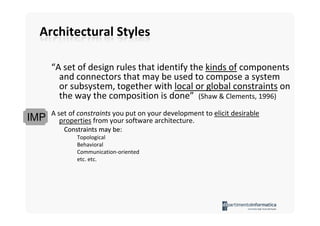
“A set of design rules that identify the kinds of components
        and connectors that may be used to compose a system
        or subsystem, together with local or global constraints on
        the way the composition is done” (Shaw & Clements, 1996)
      A set of constraints you put on your development to elicit desirable
IMP      properties from your software architecture.

              Topological
              Behavioral
              Communication-oriented
              etc. etc.
Architectural styles typically determine four kinds of properties [AAG93]:


IMP
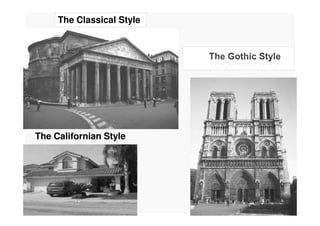
The Classical Style


The Californian Style
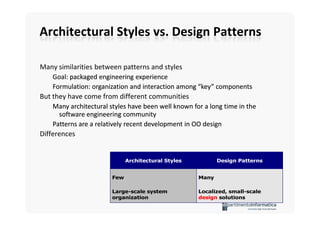
Many similarities between patterns and styles


But they have come from different communities


Differences


                            Architectural Styles          Design Patterns


                      Few                          Many

                      Large-scale system           Localized, small-scale
                      organization                 design solutions
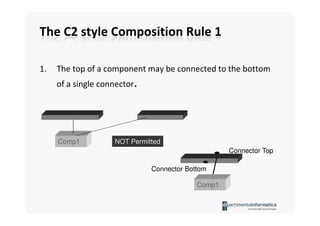
1.   The top of a component may be connected to the bottom
     of a single connector.


     Comp1          NOT Permitted
                                                   Connector Top

                              Connector Bottom

                                           Comp1
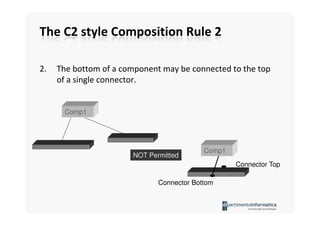
2.   The bottom of a component may be connected to the top
     of a single connector.


      Comp1


                                           Comp1
                       NOT Permitted
                                                   Connector Top

                              Connector Bottom
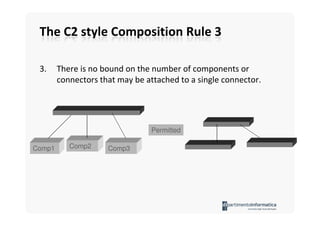
3.     There is no bound on the number of components or
        connectors that may be attached to a single connector.


                                 Permitted

Comp1      Comp2     Comp3
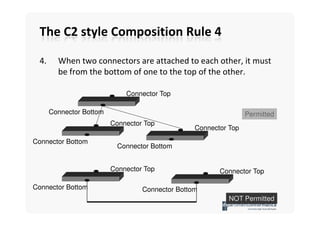
4.     When two connectors are attached to each other, it must
        be from the bottom of one to the top of the other.

                             Connector Top

      Connector Bottom                                           Permitted
                         Connector Top
                                                 Connector Top

Connector Bottom
                           Connector Bottom


                         Connector Top                  Connector Top

Connector Bottom                  Connector Bottom
                                                           NOT Permitted
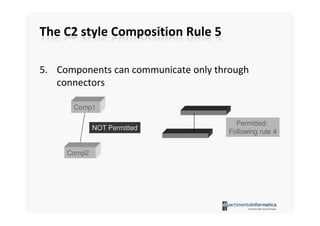
5. Components can communicate only through
   connectors

      Comp1

                                       Permitted:
             NOT Permitted
                                     Following rule 4


     Comp2
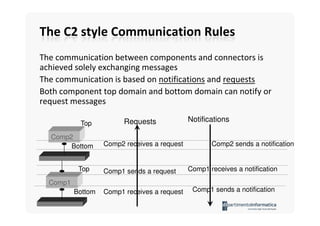
The communication between components and connectors is
achieved solely exchanging messages
The communication is based on notifications and requests
Both component top domain and bottom domain can notify or
request messages

                         Requests             Notifications
           Top

  Comp2
       Bottom      Comp2 receives a request          Comp2 sends a notification


           Top     Comp1 sends a request      Comp1 receives a notification

  Comp1
          Bottom   Comp1 receives a request    Comp1 sends a notification
ADL           TOOLS             DATE                 SUPPORT FOR ARCHITECTURAL STYLES
                                                              Descrizione di proprietà ed interfacce relative a componenti
  AADL             Osate            2001                                                      +
                                                                          configurazioni di intercambio XML/XMI

  ACME       Acme Studio+Armani     1995                    Interscambio architetturale prevalentemente a livello strutturale


 ArchiTrio        Trident           1990         Unisce lo stile delle notazioni standard UML 2.0 ai formalismi logico-temporali di TRIO


 ArchJava      AcmeArchJava         2002                 Supporta uno stile di programmazione flessibile orientato agli oggetti

                CommUnity
CommUnity                           2002                           Linguaggio che si rispecchia negli stili UNITY ed IP
                WorkBench

 DARWIN       LTSA-WS + SAA         1991      Architetture di sistemi distribuiti il cui dinamismo è guidato da un supporto severo e formale


EAST-ADL        AutoFocus2        2001/2004           La descrizione degli elementi del linguaggio è suddivisa in sei parti (domini)


Ménage/xAD
           ArchStudio+Ménage        2000                     Introduce la distinzione tra prescription e description della SA
    L

 PRISMA         PrismaCase          2002                  Definizione di elementi architetturali a due diversi livelli di astrazione


xArch/xAcm                                    Versione recente del linguaggio Acme che ne mantiene le caratteristiche di base, specificate
                Acme Studio         2001
     e                                                                              però in XML


xArch/xADL   ArchStudio+Apigen      2000                     Introduce la distinzione tra prescription e description della SA
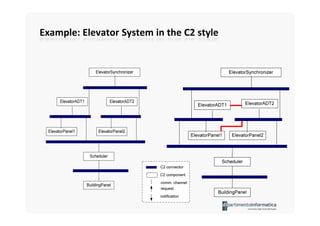
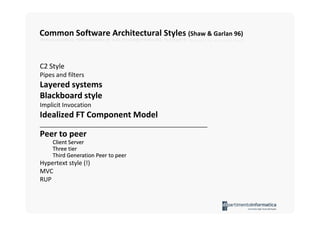
C2 Style
Pipes and filters
Layered systems
Blackboard style
Implicit Invocation
Idealized FT Component Model
_________________________________________________
Peer to peer


Hypertext style (!)
MVC
RUP
For each style, we will identify:
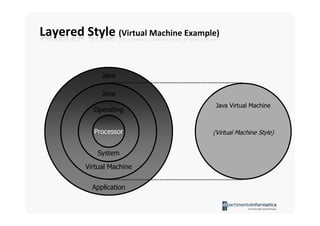
Layered Style


            Java

            Java
                          Java Virtual Machine
         Operating


         Processor       (Virtual Machine Style)


          System

       Virtual Machine

         Application
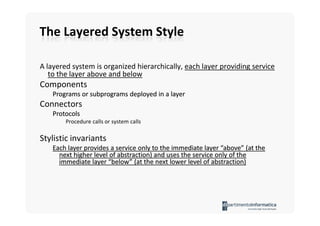
The Layered System Style

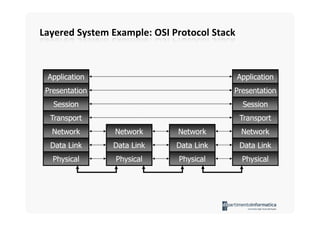
A layered system is organized hierarchically, each layer providing service
   to the layer above and below
Components

Connectors
        Procedure calls or system calls

Stylistic invariants
Application                            Application
Presentation                           Presentation
  Session                                Session
 Transport                              Transport
 Network       Network     Network      Network
 Data Link     Data Link   Data Link    Data Link
  Physical     Physical    Physical      Physical
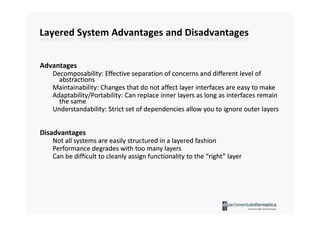
Advantages


Disadvantages
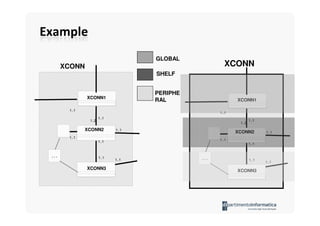
GLOBAL
    XCONN                                         XCONN
                                  SHELF


                                  PERIPHE
            XCONN1
                                  RAL                  XCONN1

     1..1
                                                1..1
                    1..1
             1..2                                              1..1
                                                        1..2

            XCONN2         1..1
                                                       XCONN2         1..1
     1..1
                                                1..1
                    1..1
                                                               1..1


…                   1..1
                           1..1             …                  1..1
                                                                      1..1
            XCONN3
                                                       XCONN3
Blackboad style
1..*                Controller

  KS
1..*
                  Blackboard
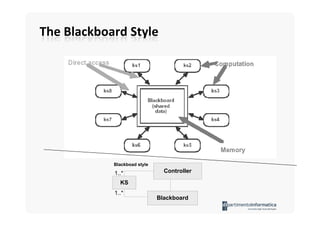
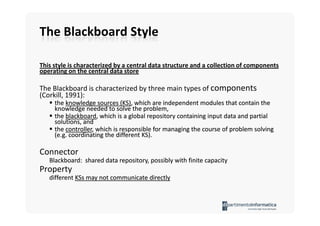
The Blackboard Style

This style is characterized by a central data structure and a collection of components
operating on the central data store

The Blackboard is characterized by three main types of components
(Corkill, 1991):


Connector
Property
Advantages


Disadvantages
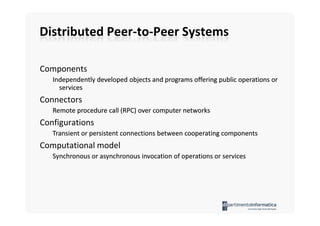
Distributed Peer-to-Peer Systems

Components


Connectors

Configurations

Computational model
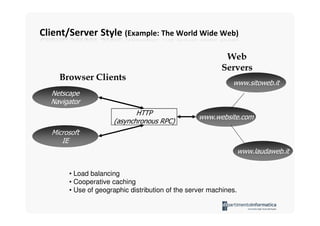
Web
                                                       Servers
  Browser Clients
                                                           www.sitoweb.it
Netscape
Navigator
                          HTTP
                                                www.website.com
                   (asynchronous RPC)
Microsoft
   IE
                                                                www.laudaweb.it


     • Load balancing
     • Cooperative caching
     • Use of geographic distribution of the server machines.
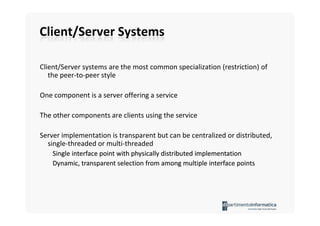
Client/Server Systems

Client/Server systems are the most common specialization (restriction) of
   the peer-to-peer style

One component is a server offering a service

The other components are clients using the service

Server implementation is transparent but can be centralized or distributed,
  single-threaded or multi-threaded
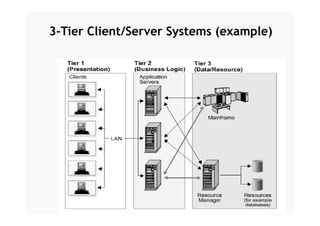
3-Tier Client/Server Systems (example)
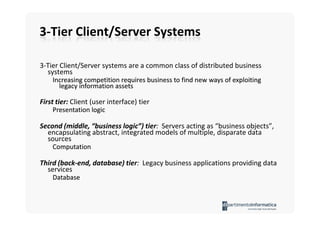
3-Tier Client/Server Systems

3-Tier Client/Server systems are a common class of distributed business
  systems


First tier: Client (user interface) tier


Second (middle, “business logic”) tier: Servers acting as “business objects”,
  encapsulating abstract, integrated models of multiple, disparate data
  sources


Third (back-end, database) tier: Legacy business applications providing data
  services
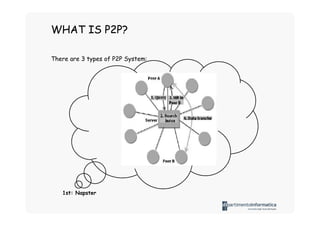
WHAT IS P2P?

There are 3 types of P2P System:


   1st: Napster
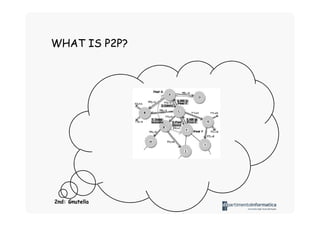
WHAT IS P2P?


2nd: Gnutella
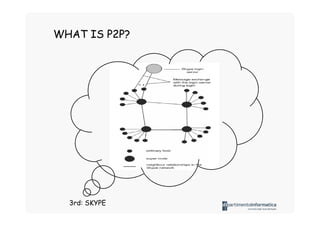
WHAT IS P2P?


  3rd: SKYPE
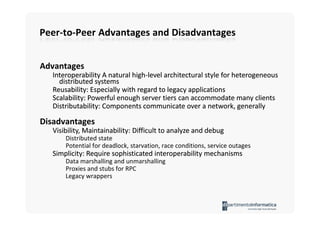
Advantages


Disadvantages
      Distributed state
      Potential for deadlock, starvation, race conditions, service outages

      Data marshalling and unmarshalling
      Proxies and stubs for RPC
      Legacy wrappers
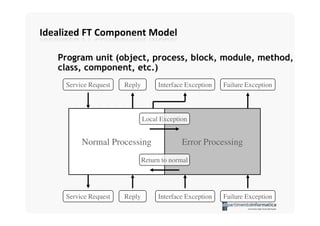
Program unit (object, process, block, module, method,
class, component, etc.)
 Service Request   Reply        Interface Exception   Failure Exception


                           Local Exception


      Normal Processing                 Error Processing
                           Return to normal


 Service Request   Reply        Interface Exception   Failure Exception
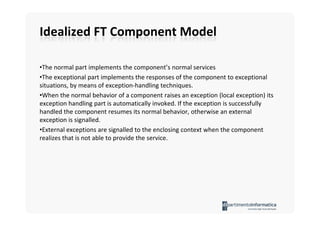
•The normal part implements the component’s normal services
•The exceptional part implements the responses of the component to exceptional
situations, by means of exception-handling techniques.
•When the normal behavior of a component raises an exception (local exception) its
exception handling part is automatically invoked. If the exception is successfully
handled the component resumes its normal behavior, otherwise an external
exception is signalled.
•External exceptions are signalled to the enclosing context when the component
realizes that is not able to provide the service.
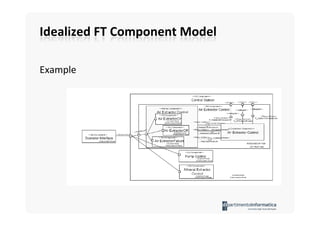
Example
Let us take into consideration the Fire System
      example.
      Let us consider the:
IMP
What you shall have learned

You shall:
       Layered systems
       Blackboard style
       Peer to peer
       …

Software Architecture: Styles

  • 1.
    Università degli Studidell’Aquila L04: SA Styles Henry Muccini Dipartimento di Ingegneria, Scienze dell’Informazione e Matematica, University of L’Aquila henry.muccini@univaq.it, @henrymuccini
  • 2.
    The material inthese slides may be freely reproduced and distributed, partially or totally, as far as an explicit reference or acknowledge to the material author is preserved. Henry Muccini
  • 3.
    Intro to SA Intro to Software Testing SA Case study Structural Testing SA style Model-based Testing ADLs Architecture-based Testing Design Decisions Lab Views/Viewpoints UML Non Functional S.E. UML Profiling Performance modeling Lab Performance analysis
  • 4.
    Prescriptive vs descriptiveuse of an architectural language
  • 5.
    “A set ofdesign rules that identify the kinds of components and connectors that may be used to compose a system or subsystem, together with local or global constraints on the way the composition is done” (Shaw & Clements, 1996) A set of constraints you put on your development to elicit desirable IMP properties from your software architecture. Topological Behavioral Communication-oriented etc. etc.
  • 6.
    Architectural styles typicallydetermine four kinds of properties [AAG93]: IMP
  • 7.
    The Classical Style TheCalifornian Style
  • 8.
    Many similarities betweenpatterns and styles But they have come from different communities Differences Architectural Styles Design Patterns Few Many Large-scale system Localized, small-scale organization design solutions
  • 10.
    1. The top of a component may be connected to the bottom of a single connector. Comp1 NOT Permitted Connector Top Connector Bottom Comp1
  • 11.
    2. The bottom of a component may be connected to the top of a single connector. Comp1 Comp1 NOT Permitted Connector Top Connector Bottom
  • 12.
    3. There is no bound on the number of components or connectors that may be attached to a single connector. Permitted Comp1 Comp2 Comp3
  • 13.
    4. When two connectors are attached to each other, it must be from the bottom of one to the top of the other. Connector Top Connector Bottom Permitted Connector Top Connector Top Connector Bottom Connector Bottom Connector Top Connector Top Connector Bottom Connector Bottom NOT Permitted
  • 14.
    5. Components cancommunicate only through connectors Comp1 Permitted: NOT Permitted Following rule 4 Comp2
  • 15.
    The communication betweencomponents and connectors is achieved solely exchanging messages The communication is based on notifications and requests Both component top domain and bottom domain can notify or request messages Requests Notifications Top Comp2 Bottom Comp2 receives a request Comp2 sends a notification Top Comp1 sends a request Comp1 receives a notification Comp1 Bottom Comp1 receives a request Comp1 sends a notification
  • 16.
    ADL TOOLS DATE SUPPORT FOR ARCHITECTURAL STYLES Descrizione di proprietà ed interfacce relative a componenti AADL Osate 2001 + configurazioni di intercambio XML/XMI ACME Acme Studio+Armani 1995 Interscambio architetturale prevalentemente a livello strutturale ArchiTrio Trident 1990 Unisce lo stile delle notazioni standard UML 2.0 ai formalismi logico-temporali di TRIO ArchJava AcmeArchJava 2002 Supporta uno stile di programmazione flessibile orientato agli oggetti CommUnity CommUnity 2002 Linguaggio che si rispecchia negli stili UNITY ed IP WorkBench DARWIN LTSA-WS + SAA 1991 Architetture di sistemi distribuiti il cui dinamismo è guidato da un supporto severo e formale EAST-ADL AutoFocus2 2001/2004 La descrizione degli elementi del linguaggio è suddivisa in sei parti (domini) Ménage/xAD ArchStudio+Ménage 2000 Introduce la distinzione tra prescription e description della SA L PRISMA PrismaCase 2002 Definizione di elementi architetturali a due diversi livelli di astrazione xArch/xAcm Versione recente del linguaggio Acme che ne mantiene le caratteristiche di base, specificate Acme Studio 2001 e però in XML xArch/xADL ArchStudio+Apigen 2000 Introduce la distinzione tra prescription e description della SA
  • 17.
    C2 Style Pipes andfilters Layered systems Blackboard style Implicit Invocation Idealized FT Component Model _________________________________________________ Peer to peer Hypertext style (!) MVC RUP
  • 18.
    For each style,we will identify:
  • 19.
    Layered Style Java Java Java Virtual Machine Operating Processor (Virtual Machine Style) System Virtual Machine Application
  • 20.
    The Layered SystemStyle A layered system is organized hierarchically, each layer providing service to the layer above and below Components Connectors Procedure calls or system calls Stylistic invariants
  • 21.
    Application Application Presentation Presentation Session Session Transport Transport Network Network Network Network Data Link Data Link Data Link Data Link Physical Physical Physical Physical
  • 23.
  • 24.
    GLOBAL XCONN XCONN SHELF PERIPHE XCONN1 RAL XCONN1 1..1 1..1 1..1 1..2 1..1 1..2 XCONN2 1..1 XCONN2 1..1 1..1 1..1 1..1 1..1 … 1..1 1..1 … 1..1 1..1 XCONN3 XCONN3
  • 25.
    Blackboad style 1..* Controller KS 1..* Blackboard
  • 26.
    The Blackboard Style Thisstyle is characterized by a central data structure and a collection of components operating on the central data store The Blackboard is characterized by three main types of components (Corkill, 1991): Connector Property
  • 27.
  • 29.
  • 30.
    Web Servers Browser Clients www.sitoweb.it Netscape Navigator HTTP www.website.com (asynchronous RPC) Microsoft IE www.laudaweb.it • Load balancing • Cooperative caching • Use of geographic distribution of the server machines.
  • 31.
    Client/Server Systems Client/Server systemsare the most common specialization (restriction) of the peer-to-peer style One component is a server offering a service The other components are clients using the service Server implementation is transparent but can be centralized or distributed, single-threaded or multi-threaded
  • 32.
  • 33.
    3-Tier Client/Server Systems 3-TierClient/Server systems are a common class of distributed business systems First tier: Client (user interface) tier Second (middle, “business logic”) tier: Servers acting as “business objects”, encapsulating abstract, integrated models of multiple, disparate data sources Third (back-end, database) tier: Legacy business applications providing data services
  • 34.
    WHAT IS P2P? Thereare 3 types of P2P System: 1st: Napster
  • 35.
  • 36.
    WHAT IS P2P? 3rd: SKYPE
  • 37.
    Advantages Disadvantages Distributed state Potential for deadlock, starvation, race conditions, service outages Data marshalling and unmarshalling Proxies and stubs for RPC Legacy wrappers
  • 38.
    Program unit (object,process, block, module, method, class, component, etc.) Service Request Reply Interface Exception Failure Exception Local Exception Normal Processing Error Processing Return to normal Service Request Reply Interface Exception Failure Exception
  • 39.
    •The normal partimplements the component’s normal services •The exceptional part implements the responses of the component to exceptional situations, by means of exception-handling techniques. •When the normal behavior of a component raises an exception (local exception) its exception handling part is automatically invoked. If the exception is successfully handled the component resumes its normal behavior, otherwise an external exception is signalled. •External exceptions are signalled to the enclosing context when the component realizes that is not able to provide the service.
  • 40.
  • 41.
    Let us takeinto consideration the Fire System example. Let us consider the: IMP
  • 42.
    What you shallhave learned You shall: Layered systems Blackboard style Peer to peer …