Enterprise Reference Architecture
Addressing key challenges facing EA and enterprise-wide adoption
of SOA
Ahmed Fattah, Executive IT Architect, IBM Australia
This paper relates my experience in developing and applying an approach that successfully
uses Reference Architecture to bridge the gap between Enterprise Architecture and Projectlevel Architecture. Although there is a huge amount of information about Reference
Architecture, there is considerable confusion about what it is and how it can be used
effectively. I have analysed and positioned various types of Reference Architectures within a
simple classification scheme that tries to clear up some of this confusion. The scheme
delineates a category of Reference Architecture which I refer to as Enterprise Reference
Architecture (ERA). The paper discusses how ERA can be used to address some of the
challenges facing EA including the enterprise-wide adoption of SOA.

Reference Architecture (RA) classification scheme
Although I have used Reference Architectures for a long time, I was surprised when I reviewed
the staggering range of usage of the term recently. Because I knew what I meant by the term,
I assumed that some of these usages must be erroneous. However, I realised that this was not
the case, at least for the many instances I have surveyed, but that the culprit is the
malleability of the term ‘architecture’ itself. This means that anything you can think of can
have an architecture and by extension a RA. So I tried to find a way to classify this huge
number of 'things' that are called Reference Architecture. I found they can be classified along
two dimensions:
•

Coverage

•

Level of abstraction

Coverage
Coverage or applicability indicates the area where a RA can be useful. Some RAs cover only
presentation, integration or security aspects of solutions, whereas others cover an end-to-end
enterprise solution. So this dimension extends from very low coverage (or applicability) to full
end-to-end coverage. When I questioned what would lie at the extremes of this dimension, the
answer was, at the narrow one, an Architecture Pattern which is consistent with the view that
a RA is an aggregation of Architecture Patterns. At the other, we should expect end-to-end
architecture that covers both business and IT aspects.

October 2010

1
Architecture Pattern
(MVC, f or example)

Partial Ref erence Architecture covering specif ic
subsystem such as presentation, integration or
security

End-to-end
Technical
Ref erence
Architecture
covering only
IT aspects of a
solution

End-to-end
coverage

Narrow
coverage

Patterns

End-to-end
Ref erence
Architecture
covering
business and IT
aspect of a
solution

End-­‐to-­‐end	
   Reference	
  
Architecture

Partial	
  Reference	
  Architecture

Figure 1: Reference Architectures coverage can range from very narrow (Architecture Pattern)
to full end-to-end that includes both business and IT aspects of a solution
Abstract,
conceptual
generic

Level of abstraction
Level of Abstraction reflects how concrete or specific a
given RA is. It indicates ultimately the gap between the RA
and a Solution Architecture based on it. It is a qualitative
measure but very valuable in assessing the usefulness of a
given RA for the task of developing an implementable
solution. I believe that one source of confusion about RAs
is that some IT practitioners view all RAs as the same.
Because of this, they form a negative impression about the
value of RAs in general based on an encounter with a
particular RA.
As with Coverage, it is useful to examine the extremes of
this dimension. It is easy to identify the concrete end
because a fully implemented solution is as concrete as you
can get. It is not as easy to define the other because it
seems there is no limit of how abstract, conceptual or
generic a RA can be before it is not called a RA1. This is
unfortunate because it would be handy if there were a cutoff point where we stop calling an artefact a RA, similar to
the Coverage dimension where there is a clear demarcation
between a RA and an Architectural Pattern.

Few Architectural
Decision have been
made

Conceptual

Generic

Industry

Enterprise

More Architectural
Decision have been
made
Concrete,

A f ully instantiated Solution

Architecture
Another useful way to think about this dimension is in
specif ic
terms of Architectural Decisions. At the concrete/specific
extreme, 'all' the Architectural Decisions have been
made. At the other, very few Architectural Decisions are Figure 2: Reference Architecture can be
likely to have been made. Architectural Decisions are in defined at varying levels of abstraction
from the conceptual and generic to the
a way degrees of freedom. With few decisions being
concrete and specific.
made there are many degrees of freedom or
possibilities that the architecture can take and purposes it can serve. With more Architecture
Decisions being made the architecture becomes more specific and concrete [Zimmerman,
2007].

1

Some of the RAs at this end of the dimension tend to use the term Reference Model but this
is not universal.

October 2010

2
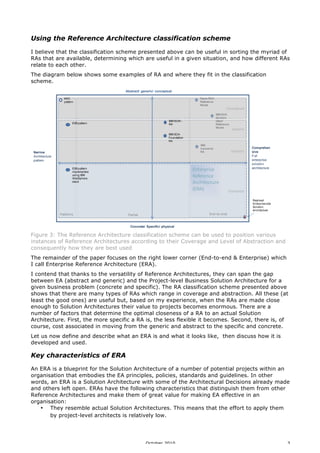
Using the Reference Architecture classification scheme
I believe that the classification scheme presented above can be useful in sorting the myriad of
RAs that are available, determining which are useful in a given situation, and how different RAs
relate to each other.
The diagram below shows some examples of RA and where they fit in the classification
scheme.
Abstract/ generic/ conceptual
Oasis SOA
Reference
Model

MVC
pattern

IBM SOAI RA

ESB pattern

Conceptual
IBM SOA
Solution
Stack
Reference
Model

Generic

IBM SOA
Foundation
RA
IBM
Insurance
RA

Narrow
Architecture
pattern

Industry

Enterprise
Enterprise
Reference
Reference
Architecture
Architecture
(ERA)
Enterprise

ESB pattern
implemented
using IBM
WebSphere
stack

Comprehen
sive
Full
enterprise
solution
architecture

(ERA)

Patterns

End-­‐to-­‐end
End-­‐to-­‐end

Partial

Realised
Enterprise e2e
Solution
Architecture

Concrete/ Specific/ physical

Figure 3: The Reference Architecture classification scheme can be used to position various
instances of Reference Architectures according to their Coverage and Level of Abstraction and
consequently how they are best used
The remainder of the paper focuses on the right lower corner (End-to-end & Enterprise) which
I call Enterprise Reference Architecture (ERA).
I contend that thanks to the versatility of Reference Architectures, they can span the gap
between EA (abstract and generic) and the Project-level Business Solution Architecture for a
given business problem (concrete and specific). The RA classification scheme presented above
shows that there are many types of RAs which range in coverage and abstraction. All these (at
least the good ones) are useful but, based on my experience, when the RAs are made close
enough to Solution Architectures their value to projects becomes enormous. There are a
number of factors that determine the optimal closeness of a RA to an actual Solution
Architecture. First, the more specific a RA is, the less flexible it becomes. Second, there is, of
course, cost associated in moving from the generic and abstract to the specific and concrete.
Let us now define and describe what an ERA is and what it looks like, then discuss how it is
developed and used.

Key characteristics of ERA
An ERA is a blueprint for the Solution Architecture of a number of potential projects within an
organisation that embodies the EA principles, policies, standards and guidelines. In other
words, an ERA is a Solution Architecture with some of the Architectural Decisions already made
and others left open. ERAs have the following characteristics that distinguish them from other
Reference Architectures and make them of great value for making EA effective in an
organisation:
• They resemble actual Solution Architectures. This means that the effort to apply them
by project-level architects is relatively low.

October 2010

3
•

They are applicable to a number of potential business solutions within the organisation.
As mentioned earlier there is a trade-off between making an ERA close enough to an
actual solution to lower the effort in applying it, and the number of business solutions
where it is applicable. This tension combined with the cost of developing the ERAs
provides the balance that determines the optimal Level of Abstraction and Coverage of
an ERA within an organisation.

•

Ideally, the development of an ERA should be funded directly by the business to
address specific business objectives. This is a crucial aspect of ERA that can make or
break the whole approach. It is possible to apply the approach discussed here by
funding it from regular EA funds

•

However, funding the effort of developing an ERA directly by the business for specific
business objective as I did in another case study can profoundly transform the way
architecture is practiced in the organisation. I refer to this as Program-level
Architecture discussed in the next section.

•

One key source of knowledge, experience and reusable components for the
development and construction of ERAs must come from existing projects by way of
harvesting suitable proven components and patterns.

•

Architects who develop the ERAs are the best people who can adapt these ERAs for use
in projects. This is key in changing the not-very-healthy typical dynamics of the
relationship between EA and projects where projects view EA not as help but an
obstacle to go around. By providing the ERA’s architects as a paid-for resources from
the EA to projects, or alternatively by seconding Solution Architects to the EA group to
develop ERAs, the relationship between projects and the EA group can be greatly
improved.

Program-level and Project-level Architecture
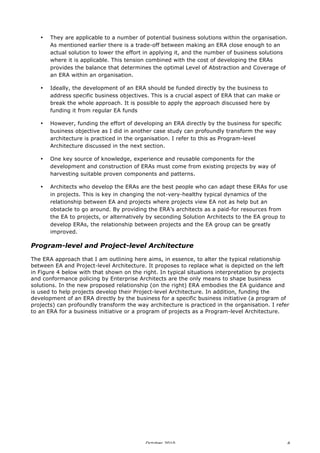
The ERA approach that I am outlining here aims, in essence, to alter the typical relationship
between EA and Project-level Architecture. It proposes to replace what is depicted on the left
in Figure 4 below with that shown on the right. In typical situations interpretation by projects
and conformance policing by Enterprise Architects are the only means to shape business
solutions. In the new proposed relationship (on the right) ERA embodies the EA guidance and
is used to help projects develop their Project-level Architecture. In addition, funding the
development of an ERA directly by the business for a specific business initiative (a program of
projects) can profoundly transform the way architecture is practiced in the organisation. I refer
to an ERA for a business initiative or a program of projects as a Program-level Architecture.

October 2010

4
Enterprise Architecture

Interpretation
and
conformance
policing is
difficult, time
consuming and
error prone.

Enterprise wide
policies,
standards,
principles and
guidelines.

Enterprise Architecture

Program-level

In

The missing link
between EA and
project-level
Architecture.

Architecture
(Enterprise Reference Architecture)
One Programlevel Architecture
covers a number
of project-level
Architecture

Project-level
Architecture
Business Solution Architecture

Each solution
project must
deliver a
distinctive
business value
while advancing
the enterprise
capabilities
whenever
possible.

Project-level

Architecture
Business Solution Architecture

Figure 4: Typical and new relationship between Enterprise Architecture and project-level
architecture

Service Oriented ERA

Subsystem Reference Architecture

Although the ERA approach proposed in
paper applies to all architecture styles, it's
more compelling and easier to apply with
SOA because of SOA’s emphasis on
standardisation and reuse. One can
actually find that all (or at least the
majority of) the operational applications
within an enterprise can be covered with a
single Service Oriented ERA. Another
positive contribution of SOA is the
expansion of ERAs to cover both business
IT. The business aspects of an ERA should
cover business processes (and of course
Business Services), organisation and
business information architecture.
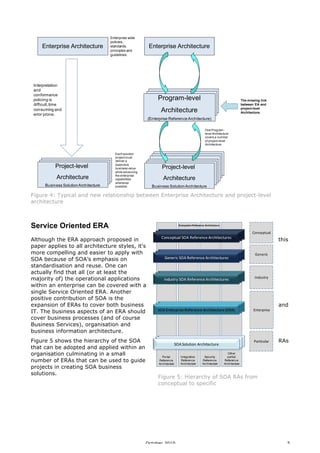
Figure 5 shows the hierarchy of the SOA
that can be adopted and applied within an
organisation culminating in a small
number of ERAs that can be used to guide
projects in creating SOA business
solutions.

Conceptual	
  SOA	
  Reference	
  Architectures

Generic	
  SOA	
  Reference	
  Architectures

Conceptual

this
Generic

Industry	
  SOA	
  Reference	
  Architectures

Industry

SOA	
  Enterprise	
  Reference	
  Architecture	
  (ERA)

Enterprise

Particular

SOA	
  Solution	
  Architecture
Portal
Reference
Architecture

Integration
Reference
Architecture

Security
Reference
Architecture

and

RAs

Other
partial
Reference
Architecture

Figure 5: Hierarchy of SOA RAs from
conceptual to specific	
  

October 2010

5
Conclusions and next steps
The paper discussed an approach for enhancing the effectiveness of EA practices with the use
of Enterprise Reference Architecture (ERA).
ERAs are Reference Architectures that embody the principles, policies, standards and
guidelines of the enterprise in a form that is easily applicable to a set of business solutions.
ERAs are ideally developed with large business initiatives.
The approach described here was developed and has been applied successfully in a number of
practical situations.
I hope that some readers find the whole approach or some aspects of it useful for their
organisations or clients. I welcome all feedback regarding the structure, contents or
experiences related to applying the concepts discussed in the paper.
I am presently enhancing the approach and the concept of ERA based on a number of
customer situations that I am currently involved in.

Acknowledgement
I would like to thank James Ward, Peter Budimir, Glenn Altern, Kathryn Kennedy, Kenny van
Tong and Brian Kent for their input, provided through many discussions and/or reviews of
earlier versions of this paper.

References
[Zimmerman, 2007] Reusable Architectural Decision Models for Enterprise Application
Development, Olaf Zimmermann et al, Software Architectures, Components, and Applications,
2007, http://www.springerlink.com/content/e4j1473502644438/

October 2010

6

Enterprise reference architecture v1.2

  • 1.
    Enterprise Reference Architecture Addressingkey challenges facing EA and enterprise-wide adoption of SOA Ahmed Fattah, Executive IT Architect, IBM Australia This paper relates my experience in developing and applying an approach that successfully uses Reference Architecture to bridge the gap between Enterprise Architecture and Projectlevel Architecture. Although there is a huge amount of information about Reference Architecture, there is considerable confusion about what it is and how it can be used effectively. I have analysed and positioned various types of Reference Architectures within a simple classification scheme that tries to clear up some of this confusion. The scheme delineates a category of Reference Architecture which I refer to as Enterprise Reference Architecture (ERA). The paper discusses how ERA can be used to address some of the challenges facing EA including the enterprise-wide adoption of SOA. Reference Architecture (RA) classification scheme Although I have used Reference Architectures for a long time, I was surprised when I reviewed the staggering range of usage of the term recently. Because I knew what I meant by the term, I assumed that some of these usages must be erroneous. However, I realised that this was not the case, at least for the many instances I have surveyed, but that the culprit is the malleability of the term ‘architecture’ itself. This means that anything you can think of can have an architecture and by extension a RA. So I tried to find a way to classify this huge number of 'things' that are called Reference Architecture. I found they can be classified along two dimensions: • Coverage • Level of abstraction Coverage Coverage or applicability indicates the area where a RA can be useful. Some RAs cover only presentation, integration or security aspects of solutions, whereas others cover an end-to-end enterprise solution. So this dimension extends from very low coverage (or applicability) to full end-to-end coverage. When I questioned what would lie at the extremes of this dimension, the answer was, at the narrow one, an Architecture Pattern which is consistent with the view that a RA is an aggregation of Architecture Patterns. At the other, we should expect end-to-end architecture that covers both business and IT aspects. October 2010 1
  • 2.
    Architecture Pattern (MVC, for example) Partial Ref erence Architecture covering specif ic subsystem such as presentation, integration or security End-to-end Technical Ref erence Architecture covering only IT aspects of a solution End-to-end coverage Narrow coverage Patterns End-to-end Ref erence Architecture covering business and IT aspect of a solution End-­‐to-­‐end   Reference   Architecture Partial  Reference  Architecture Figure 1: Reference Architectures coverage can range from very narrow (Architecture Pattern) to full end-to-end that includes both business and IT aspects of a solution Abstract, conceptual generic Level of abstraction Level of Abstraction reflects how concrete or specific a given RA is. It indicates ultimately the gap between the RA and a Solution Architecture based on it. It is a qualitative measure but very valuable in assessing the usefulness of a given RA for the task of developing an implementable solution. I believe that one source of confusion about RAs is that some IT practitioners view all RAs as the same. Because of this, they form a negative impression about the value of RAs in general based on an encounter with a particular RA. As with Coverage, it is useful to examine the extremes of this dimension. It is easy to identify the concrete end because a fully implemented solution is as concrete as you can get. It is not as easy to define the other because it seems there is no limit of how abstract, conceptual or generic a RA can be before it is not called a RA1. This is unfortunate because it would be handy if there were a cutoff point where we stop calling an artefact a RA, similar to the Coverage dimension where there is a clear demarcation between a RA and an Architectural Pattern. Few Architectural Decision have been made Conceptual Generic Industry Enterprise More Architectural Decision have been made Concrete, A f ully instantiated Solution Architecture Another useful way to think about this dimension is in specif ic terms of Architectural Decisions. At the concrete/specific extreme, 'all' the Architectural Decisions have been made. At the other, very few Architectural Decisions are Figure 2: Reference Architecture can be likely to have been made. Architectural Decisions are in defined at varying levels of abstraction from the conceptual and generic to the a way degrees of freedom. With few decisions being concrete and specific. made there are many degrees of freedom or possibilities that the architecture can take and purposes it can serve. With more Architecture Decisions being made the architecture becomes more specific and concrete [Zimmerman, 2007]. 1 Some of the RAs at this end of the dimension tend to use the term Reference Model but this is not universal. October 2010 2
  • 3.
    Using the ReferenceArchitecture classification scheme I believe that the classification scheme presented above can be useful in sorting the myriad of RAs that are available, determining which are useful in a given situation, and how different RAs relate to each other. The diagram below shows some examples of RA and where they fit in the classification scheme. Abstract/ generic/ conceptual Oasis SOA Reference Model MVC pattern IBM SOAI RA ESB pattern Conceptual IBM SOA Solution Stack Reference Model Generic IBM SOA Foundation RA IBM Insurance RA Narrow Architecture pattern Industry Enterprise Enterprise Reference Reference Architecture Architecture (ERA) Enterprise ESB pattern implemented using IBM WebSphere stack Comprehen sive Full enterprise solution architecture (ERA) Patterns End-­‐to-­‐end End-­‐to-­‐end Partial Realised Enterprise e2e Solution Architecture Concrete/ Specific/ physical Figure 3: The Reference Architecture classification scheme can be used to position various instances of Reference Architectures according to their Coverage and Level of Abstraction and consequently how they are best used The remainder of the paper focuses on the right lower corner (End-to-end & Enterprise) which I call Enterprise Reference Architecture (ERA). I contend that thanks to the versatility of Reference Architectures, they can span the gap between EA (abstract and generic) and the Project-level Business Solution Architecture for a given business problem (concrete and specific). The RA classification scheme presented above shows that there are many types of RAs which range in coverage and abstraction. All these (at least the good ones) are useful but, based on my experience, when the RAs are made close enough to Solution Architectures their value to projects becomes enormous. There are a number of factors that determine the optimal closeness of a RA to an actual Solution Architecture. First, the more specific a RA is, the less flexible it becomes. Second, there is, of course, cost associated in moving from the generic and abstract to the specific and concrete. Let us now define and describe what an ERA is and what it looks like, then discuss how it is developed and used. Key characteristics of ERA An ERA is a blueprint for the Solution Architecture of a number of potential projects within an organisation that embodies the EA principles, policies, standards and guidelines. In other words, an ERA is a Solution Architecture with some of the Architectural Decisions already made and others left open. ERAs have the following characteristics that distinguish them from other Reference Architectures and make them of great value for making EA effective in an organisation: • They resemble actual Solution Architectures. This means that the effort to apply them by project-level architects is relatively low. October 2010 3
  • 4.
    • They are applicableto a number of potential business solutions within the organisation. As mentioned earlier there is a trade-off between making an ERA close enough to an actual solution to lower the effort in applying it, and the number of business solutions where it is applicable. This tension combined with the cost of developing the ERAs provides the balance that determines the optimal Level of Abstraction and Coverage of an ERA within an organisation. • Ideally, the development of an ERA should be funded directly by the business to address specific business objectives. This is a crucial aspect of ERA that can make or break the whole approach. It is possible to apply the approach discussed here by funding it from regular EA funds • However, funding the effort of developing an ERA directly by the business for specific business objective as I did in another case study can profoundly transform the way architecture is practiced in the organisation. I refer to this as Program-level Architecture discussed in the next section. • One key source of knowledge, experience and reusable components for the development and construction of ERAs must come from existing projects by way of harvesting suitable proven components and patterns. • Architects who develop the ERAs are the best people who can adapt these ERAs for use in projects. This is key in changing the not-very-healthy typical dynamics of the relationship between EA and projects where projects view EA not as help but an obstacle to go around. By providing the ERA’s architects as a paid-for resources from the EA to projects, or alternatively by seconding Solution Architects to the EA group to develop ERAs, the relationship between projects and the EA group can be greatly improved. Program-level and Project-level Architecture The ERA approach that I am outlining here aims, in essence, to alter the typical relationship between EA and Project-level Architecture. It proposes to replace what is depicted on the left in Figure 4 below with that shown on the right. In typical situations interpretation by projects and conformance policing by Enterprise Architects are the only means to shape business solutions. In the new proposed relationship (on the right) ERA embodies the EA guidance and is used to help projects develop their Project-level Architecture. In addition, funding the development of an ERA directly by the business for a specific business initiative (a program of projects) can profoundly transform the way architecture is practiced in the organisation. I refer to an ERA for a business initiative or a program of projects as a Program-level Architecture. October 2010 4
  • 5.
    Enterprise Architecture Interpretation and conformance policing is difficult,time consuming and error prone. Enterprise wide policies, standards, principles and guidelines. Enterprise Architecture Program-level In The missing link between EA and project-level Architecture. Architecture (Enterprise Reference Architecture) One Programlevel Architecture covers a number of project-level Architecture Project-level Architecture Business Solution Architecture Each solution project must deliver a distinctive business value while advancing the enterprise capabilities whenever possible. Project-level Architecture Business Solution Architecture Figure 4: Typical and new relationship between Enterprise Architecture and project-level architecture Service Oriented ERA Subsystem Reference Architecture Although the ERA approach proposed in paper applies to all architecture styles, it's more compelling and easier to apply with SOA because of SOA’s emphasis on standardisation and reuse. One can actually find that all (or at least the majority of) the operational applications within an enterprise can be covered with a single Service Oriented ERA. Another positive contribution of SOA is the expansion of ERAs to cover both business IT. The business aspects of an ERA should cover business processes (and of course Business Services), organisation and business information architecture. Figure 5 shows the hierarchy of the SOA that can be adopted and applied within an organisation culminating in a small number of ERAs that can be used to guide projects in creating SOA business solutions. Conceptual  SOA  Reference  Architectures Generic  SOA  Reference  Architectures Conceptual this Generic Industry  SOA  Reference  Architectures Industry SOA  Enterprise  Reference  Architecture  (ERA) Enterprise Particular SOA  Solution  Architecture Portal Reference Architecture Integration Reference Architecture Security Reference Architecture and RAs Other partial Reference Architecture Figure 5: Hierarchy of SOA RAs from conceptual to specific   October 2010 5
  • 6.
    Conclusions and nextsteps The paper discussed an approach for enhancing the effectiveness of EA practices with the use of Enterprise Reference Architecture (ERA). ERAs are Reference Architectures that embody the principles, policies, standards and guidelines of the enterprise in a form that is easily applicable to a set of business solutions. ERAs are ideally developed with large business initiatives. The approach described here was developed and has been applied successfully in a number of practical situations. I hope that some readers find the whole approach or some aspects of it useful for their organisations or clients. I welcome all feedback regarding the structure, contents or experiences related to applying the concepts discussed in the paper. I am presently enhancing the approach and the concept of ERA based on a number of customer situations that I am currently involved in. Acknowledgement I would like to thank James Ward, Peter Budimir, Glenn Altern, Kathryn Kennedy, Kenny van Tong and Brian Kent for their input, provided through many discussions and/or reviews of earlier versions of this paper. References [Zimmerman, 2007] Reusable Architectural Decision Models for Enterprise Application Development, Olaf Zimmermann et al, Software Architectures, Components, and Applications, 2007, http://www.springerlink.com/content/e4j1473502644438/ October 2010 6