Asynchronous Services - The key to enterprise SOA Johan Eltes Callista Enterprise AB
Agenda Why asynchronous services are important Asynchronous Message Exchange Quality-of-service Web-Service technology Interoperability of asynchronous web services Deploying SOA integrations to an ESB Summary Q&A
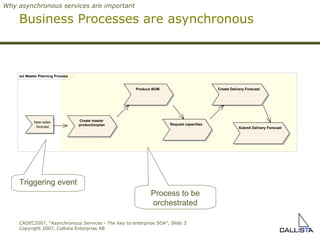
Business Processes are asynchronous Why asynchronous services are important Triggering event Process to be orchestrated act Master Planning Process Create master productionplan Produce BOM Request capacities Create Delivery Forecast Submit Delivery Forecast New sales  forecast
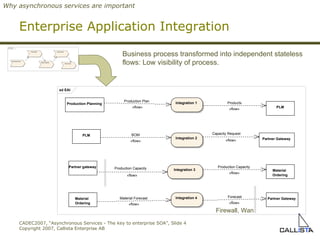
Enterprise Application Integration Business process transformed into independent stateless flows: Low visibility of process. Firewall, Wan Why asynchronous services are important sd EAI Production Planning PLM PLM Partner Gateway Material  Ordering Partner gateway Partner Gateway Material  Ordering Integration 1 Integration 2 Integration 3 Integration 4 Production Plan «flow» Products «flow» BOM «flow» Capacity Request «flow» Production Capacity «flow» Production Capacity «flow» Material Forecast «flow» Forecast «flow» act Process Get Production Plan Produce BOM Request capacities Create Forecast Send Forecast
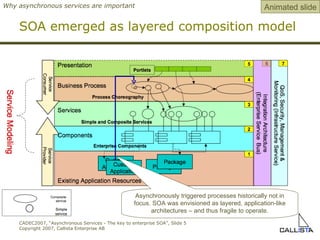
SOA emerged as  layered   composition  model Why asynchronous services are important Animated slide Asynchronous ly triggered  processes historically not in focus. SOA was envisioned as layered, application-like architectures  – and thus fragile to operate.
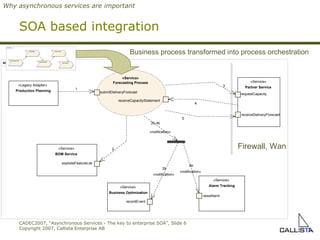
SOA based integration Firewall, Wan Business process transformed into process orchestration Why asynchronous services are important sd SOA «Service» Partner Service receiveDeliveryForecast requestCapacity «Service» Forecasting Process receiveCapacityStatement submitDeliveryForecast «Service» BOM Service explodeFeatureList «Legacy Adapter» Production Planning «Service» Alarm Tracking raiseAlarm «Service» Business Optimization recordEvent 2b «notification» 4b «notification» 1 3 2b,4b «notification» 2 4 5 act Process Get Production Plan Produce BOM Request capacities Create Forecast Send Forecast
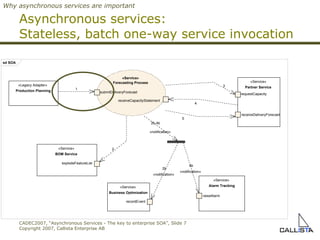
Asynchronous services:  Stateless, batch one-way service invocation Why asynchronous services are important sd SOA «Service» Partner Service receiveDeliveryForecast requestCapacity «Service» Forecasting Process receiveCapacityStatement submitDeliveryForecast «Service» BOM Service explodeFeatureList «Legacy Adapter» Production Planning «Service» Alarm Tracking raiseAlarm «Service» Business Optimization recordEvent 2b «notification» 4b «notification» 1 3 2b,4b «notification» 2 4 5
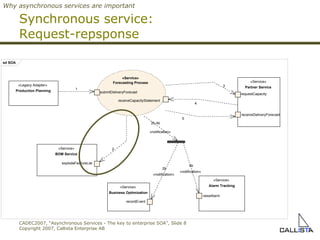
Synchronous service:  Request-rep sponse Why asynchronous services are important sd SOA «Service» Partner Service receiveDeliveryForecast requestCapacity «Service» Forecasting Process receiveCapacityStatement submitDeliveryForecast «Service» BOM Service explodeFeatureList «Legacy Adapter» Production Planning «Service» Alarm Tracking raiseAlarm «Service» Business Optimization recordEvent 2b «notification» 4b «notification» 1 3 2b,4b «notification» 2 4 5
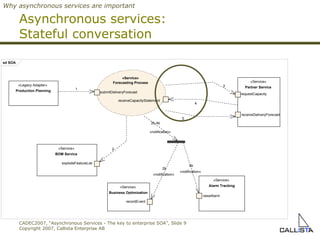
Asynchronous services:  Stateful conversation Why asynchronous services are important sd SOA «Service» Partner Service receiveDeliveryForecast requestCapacity «Service» Forecasting Process receiveCapacityStatement submitDeliveryForecast «Service» BOM Service explodeFeatureList «Legacy Adapter» Production Planning «Service» Alarm Tracking raiseAlarm «Service» Business Optimization recordEvent 2b «notification» 4b «notification» 1 3 2b,4b «notification» 2 4 5
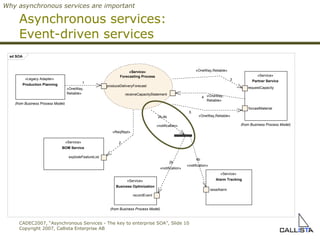
Asynchronous services:  Event-driven services Why asynchronous services are important sd SOA «Service» Partner Service (from Business Process Model) forcastMaterial requestCapacity «Service» Forecasting Process receiveCapacityStatement produceDeliveryForecast «Service» BOM Service explodeFeatureList «Legacy Adapter» Production Planning (from Business Process Model) «Service» Alarm Tracking raiseAlarm «Service» Business Optimization (from Business Process Model) recordEvent 2b «notification» 4b «notification» 1 «OneWay, Reliable» 3 «OneWay,Reliable» 2b,4b «notification» 2 «ReqRepl» 4 «OneWay, Reliable» 5 «OneWay,Reliable»
Why Asynchronous Services – Summary Business-to-Business over the internet Asynchronous by nature COTS B2B gateways to o  complex/expensive for smaller businesses (Rosetta net, edifact...) Event-driven architectures Asynchronous by nature (publish / subscribe) Unsolicited events for alarming and business process monitoring When (very) loose coupling is required Large, synchronous call stacks (”large service depth”) are fragile Different operations cycles and uptime requirements may require asynchronous de-coupling  Why asynchronous services are important
Asynchronous Message Exchange Why asynchronous services are important Asynchronous Message Exchange Quality-of-service Web-Service technology Interoperability of asynchronous web services Deploying SOA integrations to an ESB Summary Q&A
Asynchronous Message Exchange One-way R equest/ R e sponse  with callback Bi-directional with callback Message Correlation Stateful Conversations Mediation (intermediaries)
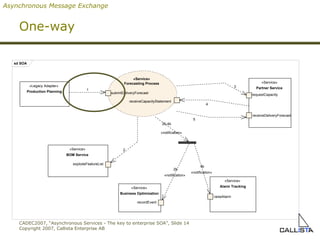
One-way 1 3 2b,4b «notification» 2 4 5 Asynchronous Message Exchange sd SOA «Service» Partner Service receiveDeliveryForecast requestCapacity «Service» Forecasting Process receiveCapacityStatement submitDeliveryForecast «Service» BOM Service explodeFeatureList «Legacy Adapter» Production Planning «Service» Alarm Tracking raiseAlarm «Service» Business Optimization recordEvent 2b «notification» 4b «notification»
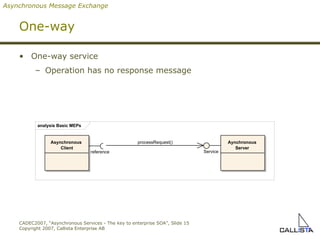
One-way One-way service Operation has no response message Asynchronous Message Exchange analysis Basic MEPs Aynchronous  Server Service Asynchronous  Client reference processRequest()
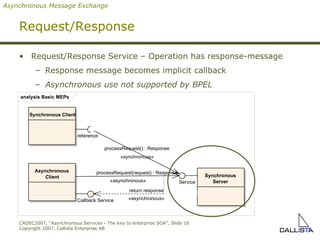
Request/ R e sponse Request /Response  Service –  Operation h as response-message Response message becomes implicit callback Asynchronous use not supported by BPEL Asynchronous Message Exchange analysis Basic MEPs Asynchronous  Client Callback Service Synchronous  Server Service Synchronous Client reference return response «asynchronous» processRequest( request ) : Response «asynchronous» processRequest() : Response «synchronous»
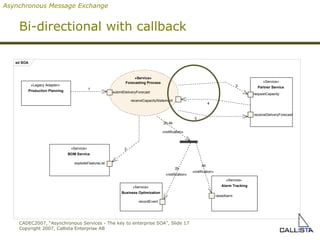
Bi-directional with callback Asynchronous Message Exchange sd SOA «Service» Partner Service receiveDeliveryForecast requestCapacity «Service» Forecasting Process receiveCapacityStatement submitDeliveryForecast «Service» BOM Service explodeFeatureList «Legacy Adapter» Production Planning «Service» Alarm Tracking raiseAlarm «Service» Business Optimization recordEvent 2b «notification» 4b «notification» 1 3 2b,4b «notification» 2 4 5
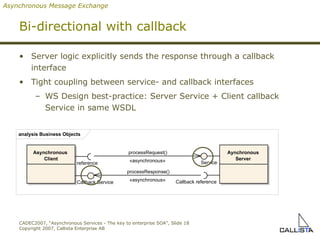
Bi-directional with callback Server logic explicitly sends the response through a callback interface Tight coupling between service- and callback interfaces WS Design best-practice: Server Service + Client callback Service in same WSDL Asynchronous Message Exchange analysis Business Objects Aynchronous  Server Service Callback reference Asynchronous  Client reference Callback Service processRequest() «asynchronous» processResponse() «asynchronous»
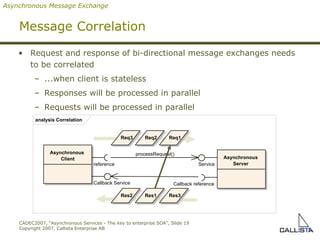
Message Correlation Request and response of bi-directional message exchanges needs to be correlated ...when client is stateless  Responses will be processed in parallel Requests will be processed in parallel Asynchronous Message Exchange analysis Correlation Asynchronous  Client Callback Service reference Asynchronous  Server Service Callback reference Req3 Req2 Req1 Res1 Res2 Res3 processRequest()
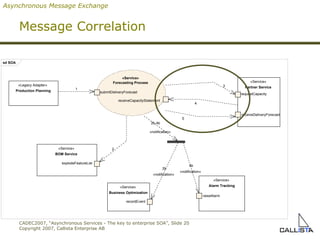
Message Correlation Asynchronous Message Exchange sd SOA «Service» Partner Service receiveDeliveryForecast requestCapacity «Service» Forecasting Process receiveCapacityStatement submitDeliveryForecast «Service» BOM Service explodeFeatureList «Legacy Adapter» Production Planning «Service» Alarm Tracking raiseAlarm «Service» Business Optimization recordEvent 2b «notification» 4b «notification» 1 3 2b,4b «notification» 2 4 5
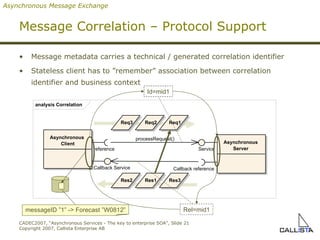
Message Correlation – Protocol Support Message metadata carries a technical / generated correlation identifier Stateless client has to ”remember” association between correlation identifier and business context Id=mid1 Rel=mid1 messageID ”1” -> Forecast ”W0812” Asynchronous Message Exchange analysis Correlation Asynchronous  Client Callback Service reference Asynchronous  Server Service Callback reference Req3 Req2 Req1 Res1 Res2 Res3 processRequest()
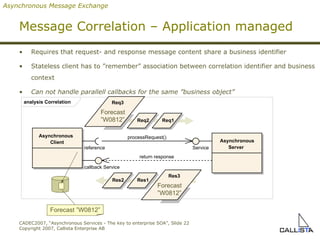
Message Correlation –  Application managed Requires that request- and response message content share a business identifier Stateless client has to ”remember” association between correlation identifier and business context Can not handle parallell callbacks for the same ”business object” analysis Correlation Asynchronous  Client callback Service reference Asynchronous  Server Service Req3 Req2 Req1 Res1 Res2 return response processRequest() Forecast ”W0812” Forecast ”W0812” Res3 Forecast ”W0812” Asynchronous Message Exchange
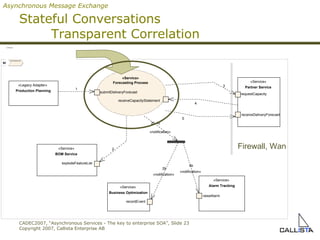
Stateful Conversations Transparent Correlation Firewall, Wan Asynchronous Message Exchange sd SOA «Service» Partner Service receiveDeliveryForecast requestCapacity «Service» Forecasting Process receiveCapacityStatement submitDeliveryForecast «Service» BOM Service explodeFeatureList «Legacy Adapter» Production Planning «Service» Alarm Tracking raiseAlarm «Service» Business Optimization recordEvent 2b «notification» 4b «notification» 1 3 2b,4b «notification» 2 4 5
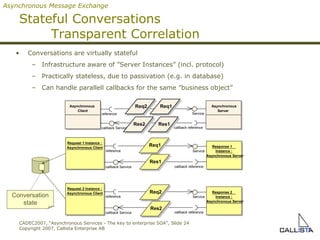
Stateful Conversations Transparent Correlation Conversations are virtually stateful Infrastructure aware of ”Server Instances” (incl.  p rotocol) Practically stateless, due to passivation (e.g. in database) Can handle parallell callbacks for the same ”business object” Asynchronous Message Exchange Asynchronous  Server Service callback reference Asynchronous  Client reference callback Service Request 1 Instance : Asynchronous Client callback Service reference Response 1  Instance : Asynchronous Server Service callback reference Request 2 Instance : Asynchronous Client callback Service reference Response 2  Instance : Asynchronous Server Service callback reference Req1 Res1 Req2 Res2 Conversation state Req2 Req1 Res1 Res2
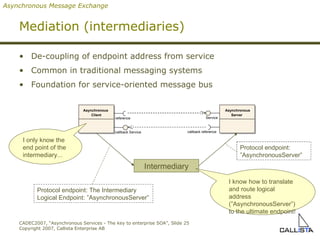
Mediation (intermediaries) De-coupling of endpoint address from service Common in traditional messaging systems Foundation for service-oriented message bus Asynchronous Message Exchange Asynchronous  Server Service callback reference Asynchronous  Client reference callback Service Intermediary Protocol endpoint: The Intermediary Logical  Endpoint :  ” AsynchronousServer ” I know how to translate and route logical address ( ” AsynchronousServer ” ) to the ultimate endpoint! I only know the end point of the intermediary... Protocol endpoint :  ” AsynchronousServer ”
Asynchronous Message Exchange Why asynchronous services are important Asynchronous Message Exchange Quality-of-service Web-Service technology Interoperability of asynchronous web services Deploying SOA integrations to an ESB Summary Q&A
Quality-of-service Typical QoS requirements for asynchronous messaging Reliable transmission of messages (requests and responses) Secure transmissions (out-of-scope for this presentation) Robust error handling Reliability requirements for message transmission Once and only once All messages have to arrive Requirements on transmission time In order arrive in same sequence as produced Transaction coordination Mainly for mediation activities – depends on underlying messaging system
Web-Service technology Why asynchronous services are important Asynchronous Message Exchange Quality-of-service Web-Service technology Interoperability of asynchronous web services Deploying SOA integrations to an ESB Summary Q&A
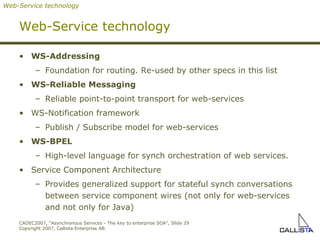
Web-Service technology WS-Addressing Foundation for routing. Re-used by other specs in this list WS-Reliable Messaging Reliable point-to-point transport for web-services WS-Notification framework Publish / Subscribe model for web-services WS-BPEL High-level language for synch orchestration of web services. Service Component Architecture Provides generalized support for stateful synch conversations between service component wires (not only for web-services and not only for Java) Web-Service technology
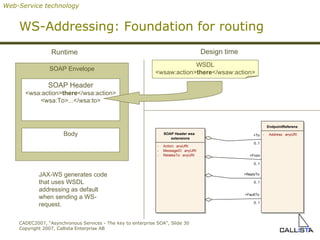
WS-Addressing: Foundation for routing Web-Service technology SOAP Envelope SOAP Header <wsa:action> there </wsa:action> <wsa:To>...</wsa:to> Body WSDL <wsaw:action> there </wsaw:action> Runtime Design time JAX-WS generates code that uses WSDL addressing as default when sending a WS-request. SOAP Header wsa  extensions -  Action:  anyURI -  MessageID:  anyURI -  RelatesTo:  anyURI EndpointReferens -  Address:  anyURI +To 0..1 +From 0..1 +ReplyTo 0..1 +FaultTo 0..1
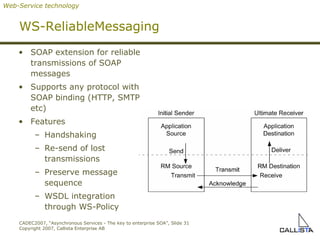
WS-ReliableMessaging SOAP extension for reliable transmissions of SOAP messages Supports any protocol with SOAP binding (HTTP, SMTP etc) Features Handshaking Re-send of lost transmissions Preserve message sequence WSDL integration through WS-Policy Web-Service technology
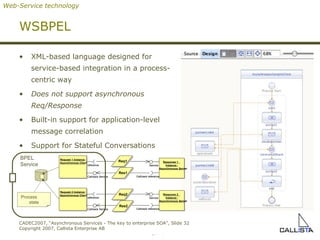
WSBPEL XML-based language designed for service-based integration in a process-centric way Does not support asynchronous Req/Response Built-in support for application-level message correlation Support for Stateful Conversations Web-Service technology BPEL Service Request 1 Instance : Asynchronous Client Call - back Service reference Response 1  Instance : Asynchronous Server Service Call - back reference Request 2 Instance : Asynchronous Client Call - back Service reference Response 2  Instance : Asynchronous Server Service Call - back reference Req1 Res1 Req2 Res2 Conversation  state Request 1 Instance : Asynchronous Client Call - back Service reference Response 1  Instance : Asynchronous Server Service Call - back reference Request 2 Instance : Asynchronous Client Call - back Service reference Response 2  Instance : Asynchronous Server Service Call - back reference Req1 Res1 Req2 Res2 Process   state
Summary:  WS- *  support for asynchronous SOA All message exchange patterns except re-use of synchronous services BPEL restriction Separation of transport address and logical address through ”intelligent messages” (WS-Addressing) Support for un-reliable  SOAP transports (WS-ReliableMessaging) Support for message sequence and re-send  (WS-ReliableMessaging) Dedicated language ( BPEL ) for orchestration of   business process es Web-Service technology
Interoperability of asynchronous web services Why asynchronous services are important Asynchronous Message Exchange Quality-of-service Web-Service technology Interoperability of asynchronous web services Deploying SOA integrations to an ESB Summary Q&A
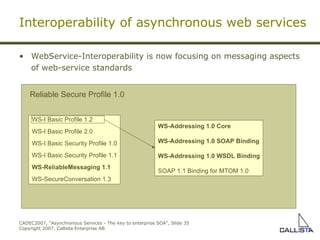
Interoperability of asynchronous web services WebService-Interoperability is now focusing on messaging aspects of web-service standards WS-I Basic Profile 1.2 WS-I Basic Profile 2.0 WS-I Basic Security Profile 1.0 WS-I Basic Security Profile 1.1 WS-ReliableMessaging 1.1 WS-SecureConversation 1.3 Reliable Secure Profile 1.0  WS-Addressing 1.0 Core WS-Addressing 1.0 SOAP Binding WS-Addressing 1.0 WSDL Binding SOAP 1.1 Binding for MTOM 1.0
Deploying SOA integrations to an ESB Why asynchronous services are important Asynchronous Message Exchange Quality-of-service Web-Service technology Interoperability of asynchronous web services Deploying SOA integrations to an ESB Summary Q&A
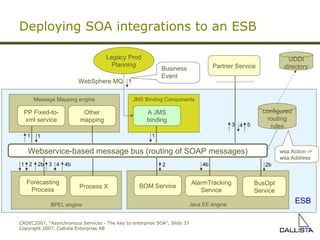
Deploying SOA integrations to an ESB Webservice-based message bus (routing of SOAP messages) configured routing rules UDDI directory BPEL engine Forecasting Process Process X Java EE engine BOM Service AlarmTracking Service BusOpt Service Message Mapping engine PP Fixed-to-xml service Other mapping JMS Binding Components A JMS binding Legacy Prod Planning WebSphere MQ Partner Service ESB Business Event wsa:Action -> wsa:Address 1 1 2 2 2b 2b 3 3 4 5 4 4b 4b 1 1 1
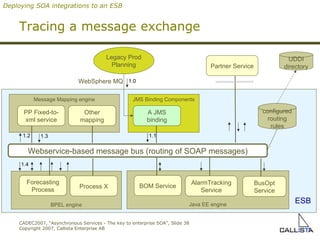
Tracing a message exchange Webservice-based message bus (routing of SOAP messages) configured routing rules UDDI directory BPEL engine Forecasting Process Process X Java EE engine BOM Service AlarmTracking Service BusOpt Service Message Mapping engine PP Fixed-to-xml service Other mapping JMS Binding Components A JMS binding Legacy Prod Planning WebSphere MQ Partner Service ESB Deploying SOA integrations to an ESB 1.0 1.4 1.1 1.2 1.3
Summary Why asynchronous services are important Asynchronous Message Exchange Quality-of-service Web-Service technology Interoperability of asynchronous web services Deploying SOA integrations to an ESB Summary Q&A
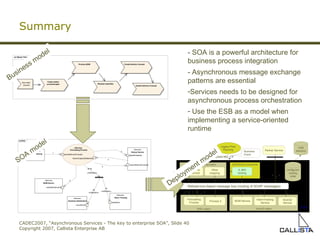
Summary - SOA is a powerful architecture for business process integration  - Asynchronous message exchange patterns are essential Services needs to be designed for  asynchronous  process orchestration Use the ESB as a model when implementing a service-oriented runtime Business model SOA model Deployment model act Master Planning Process Create master productionplan Produce BOM Request capacities Create Delivery Forecast Submit Delivery Forecast New sales  forecast sd SOA «Service» Partner Service receiveDeliveryForecast requestCapacity «Service» Forecasting Process receiveCapacityStatement submitDeliveryForecast «Service» BOM Service explodeFeatureList «Legacy Adapter» Production Planning «Service» Alarm Tracking raiseAlarm «Service» Business Optimization recordEvent 2b «notification» 4b «notification» 1 3 2b,4b «notification» 2 4 5
Q & A

Asynch Soa

  • 1.
    Asynchronous Services -The key to enterprise SOA Johan Eltes Callista Enterprise AB
  • 2.
    Agenda Why asynchronousservices are important Asynchronous Message Exchange Quality-of-service Web-Service technology Interoperability of asynchronous web services Deploying SOA integrations to an ESB Summary Q&A
  • 3.
    Business Processes areasynchronous Why asynchronous services are important Triggering event Process to be orchestrated act Master Planning Process Create master productionplan Produce BOM Request capacities Create Delivery Forecast Submit Delivery Forecast New sales forecast
  • 4.
    Enterprise Application IntegrationBusiness process transformed into independent stateless flows: Low visibility of process. Firewall, Wan Why asynchronous services are important sd EAI Production Planning PLM PLM Partner Gateway Material Ordering Partner gateway Partner Gateway Material Ordering Integration 1 Integration 2 Integration 3 Integration 4 Production Plan «flow» Products «flow» BOM «flow» Capacity Request «flow» Production Capacity «flow» Production Capacity «flow» Material Forecast «flow» Forecast «flow» act Process Get Production Plan Produce BOM Request capacities Create Forecast Send Forecast
  • 5.
    SOA emerged as layered composition model Why asynchronous services are important Animated slide Asynchronous ly triggered processes historically not in focus. SOA was envisioned as layered, application-like architectures – and thus fragile to operate.
  • 6.
    SOA based integrationFirewall, Wan Business process transformed into process orchestration Why asynchronous services are important sd SOA «Service» Partner Service receiveDeliveryForecast requestCapacity «Service» Forecasting Process receiveCapacityStatement submitDeliveryForecast «Service» BOM Service explodeFeatureList «Legacy Adapter» Production Planning «Service» Alarm Tracking raiseAlarm «Service» Business Optimization recordEvent 2b «notification» 4b «notification» 1 3 2b,4b «notification» 2 4 5 act Process Get Production Plan Produce BOM Request capacities Create Forecast Send Forecast
  • 7.
    Asynchronous services: Stateless, batch one-way service invocation Why asynchronous services are important sd SOA «Service» Partner Service receiveDeliveryForecast requestCapacity «Service» Forecasting Process receiveCapacityStatement submitDeliveryForecast «Service» BOM Service explodeFeatureList «Legacy Adapter» Production Planning «Service» Alarm Tracking raiseAlarm «Service» Business Optimization recordEvent 2b «notification» 4b «notification» 1 3 2b,4b «notification» 2 4 5
  • 8.
    Synchronous service: Request-rep sponse Why asynchronous services are important sd SOA «Service» Partner Service receiveDeliveryForecast requestCapacity «Service» Forecasting Process receiveCapacityStatement submitDeliveryForecast «Service» BOM Service explodeFeatureList «Legacy Adapter» Production Planning «Service» Alarm Tracking raiseAlarm «Service» Business Optimization recordEvent 2b «notification» 4b «notification» 1 3 2b,4b «notification» 2 4 5
  • 9.
    Asynchronous services: Stateful conversation Why asynchronous services are important sd SOA «Service» Partner Service receiveDeliveryForecast requestCapacity «Service» Forecasting Process receiveCapacityStatement submitDeliveryForecast «Service» BOM Service explodeFeatureList «Legacy Adapter» Production Planning «Service» Alarm Tracking raiseAlarm «Service» Business Optimization recordEvent 2b «notification» 4b «notification» 1 3 2b,4b «notification» 2 4 5
  • 10.
    Asynchronous services: Event-driven services Why asynchronous services are important sd SOA «Service» Partner Service (from Business Process Model) forcastMaterial requestCapacity «Service» Forecasting Process receiveCapacityStatement produceDeliveryForecast «Service» BOM Service explodeFeatureList «Legacy Adapter» Production Planning (from Business Process Model) «Service» Alarm Tracking raiseAlarm «Service» Business Optimization (from Business Process Model) recordEvent 2b «notification» 4b «notification» 1 «OneWay, Reliable» 3 «OneWay,Reliable» 2b,4b «notification» 2 «ReqRepl» 4 «OneWay, Reliable» 5 «OneWay,Reliable»
  • 11.
    Why Asynchronous Services– Summary Business-to-Business over the internet Asynchronous by nature COTS B2B gateways to o complex/expensive for smaller businesses (Rosetta net, edifact...) Event-driven architectures Asynchronous by nature (publish / subscribe) Unsolicited events for alarming and business process monitoring When (very) loose coupling is required Large, synchronous call stacks (”large service depth”) are fragile Different operations cycles and uptime requirements may require asynchronous de-coupling Why asynchronous services are important
  • 12.
    Asynchronous Message ExchangeWhy asynchronous services are important Asynchronous Message Exchange Quality-of-service Web-Service technology Interoperability of asynchronous web services Deploying SOA integrations to an ESB Summary Q&A
  • 13.
    Asynchronous Message ExchangeOne-way R equest/ R e sponse with callback Bi-directional with callback Message Correlation Stateful Conversations Mediation (intermediaries)
  • 14.
    One-way 1 32b,4b «notification» 2 4 5 Asynchronous Message Exchange sd SOA «Service» Partner Service receiveDeliveryForecast requestCapacity «Service» Forecasting Process receiveCapacityStatement submitDeliveryForecast «Service» BOM Service explodeFeatureList «Legacy Adapter» Production Planning «Service» Alarm Tracking raiseAlarm «Service» Business Optimization recordEvent 2b «notification» 4b «notification»
  • 15.
    One-way One-way serviceOperation has no response message Asynchronous Message Exchange analysis Basic MEPs Aynchronous Server Service Asynchronous Client reference processRequest()
  • 16.
    Request/ R esponse Request /Response Service – Operation h as response-message Response message becomes implicit callback Asynchronous use not supported by BPEL Asynchronous Message Exchange analysis Basic MEPs Asynchronous Client Callback Service Synchronous Server Service Synchronous Client reference return response «asynchronous» processRequest( request ) : Response «asynchronous» processRequest() : Response «synchronous»
  • 17.
    Bi-directional with callbackAsynchronous Message Exchange sd SOA «Service» Partner Service receiveDeliveryForecast requestCapacity «Service» Forecasting Process receiveCapacityStatement submitDeliveryForecast «Service» BOM Service explodeFeatureList «Legacy Adapter» Production Planning «Service» Alarm Tracking raiseAlarm «Service» Business Optimization recordEvent 2b «notification» 4b «notification» 1 3 2b,4b «notification» 2 4 5
  • 18.
    Bi-directional with callbackServer logic explicitly sends the response through a callback interface Tight coupling between service- and callback interfaces WS Design best-practice: Server Service + Client callback Service in same WSDL Asynchronous Message Exchange analysis Business Objects Aynchronous Server Service Callback reference Asynchronous Client reference Callback Service processRequest() «asynchronous» processResponse() «asynchronous»
  • 19.
    Message Correlation Requestand response of bi-directional message exchanges needs to be correlated ...when client is stateless Responses will be processed in parallel Requests will be processed in parallel Asynchronous Message Exchange analysis Correlation Asynchronous Client Callback Service reference Asynchronous Server Service Callback reference Req3 Req2 Req1 Res1 Res2 Res3 processRequest()
  • 20.
    Message Correlation AsynchronousMessage Exchange sd SOA «Service» Partner Service receiveDeliveryForecast requestCapacity «Service» Forecasting Process receiveCapacityStatement submitDeliveryForecast «Service» BOM Service explodeFeatureList «Legacy Adapter» Production Planning «Service» Alarm Tracking raiseAlarm «Service» Business Optimization recordEvent 2b «notification» 4b «notification» 1 3 2b,4b «notification» 2 4 5
  • 21.
    Message Correlation –Protocol Support Message metadata carries a technical / generated correlation identifier Stateless client has to ”remember” association between correlation identifier and business context Id=mid1 Rel=mid1 messageID ”1” -> Forecast ”W0812” Asynchronous Message Exchange analysis Correlation Asynchronous Client Callback Service reference Asynchronous Server Service Callback reference Req3 Req2 Req1 Res1 Res2 Res3 processRequest()
  • 22.
    Message Correlation – Application managed Requires that request- and response message content share a business identifier Stateless client has to ”remember” association between correlation identifier and business context Can not handle parallell callbacks for the same ”business object” analysis Correlation Asynchronous Client callback Service reference Asynchronous Server Service Req3 Req2 Req1 Res1 Res2 return response processRequest() Forecast ”W0812” Forecast ”W0812” Res3 Forecast ”W0812” Asynchronous Message Exchange
  • 23.
    Stateful Conversations TransparentCorrelation Firewall, Wan Asynchronous Message Exchange sd SOA «Service» Partner Service receiveDeliveryForecast requestCapacity «Service» Forecasting Process receiveCapacityStatement submitDeliveryForecast «Service» BOM Service explodeFeatureList «Legacy Adapter» Production Planning «Service» Alarm Tracking raiseAlarm «Service» Business Optimization recordEvent 2b «notification» 4b «notification» 1 3 2b,4b «notification» 2 4 5
  • 24.
    Stateful Conversations TransparentCorrelation Conversations are virtually stateful Infrastructure aware of ”Server Instances” (incl. p rotocol) Practically stateless, due to passivation (e.g. in database) Can handle parallell callbacks for the same ”business object” Asynchronous Message Exchange Asynchronous Server Service callback reference Asynchronous Client reference callback Service Request 1 Instance : Asynchronous Client callback Service reference Response 1 Instance : Asynchronous Server Service callback reference Request 2 Instance : Asynchronous Client callback Service reference Response 2 Instance : Asynchronous Server Service callback reference Req1 Res1 Req2 Res2 Conversation state Req2 Req1 Res1 Res2
  • 25.
    Mediation (intermediaries) De-couplingof endpoint address from service Common in traditional messaging systems Foundation for service-oriented message bus Asynchronous Message Exchange Asynchronous Server Service callback reference Asynchronous Client reference callback Service Intermediary Protocol endpoint: The Intermediary Logical Endpoint : ” AsynchronousServer ” I know how to translate and route logical address ( ” AsynchronousServer ” ) to the ultimate endpoint! I only know the end point of the intermediary... Protocol endpoint : ” AsynchronousServer ”
  • 26.
    Asynchronous Message ExchangeWhy asynchronous services are important Asynchronous Message Exchange Quality-of-service Web-Service technology Interoperability of asynchronous web services Deploying SOA integrations to an ESB Summary Q&A
  • 27.
    Quality-of-service Typical QoSrequirements for asynchronous messaging Reliable transmission of messages (requests and responses) Secure transmissions (out-of-scope for this presentation) Robust error handling Reliability requirements for message transmission Once and only once All messages have to arrive Requirements on transmission time In order arrive in same sequence as produced Transaction coordination Mainly for mediation activities – depends on underlying messaging system
  • 28.
    Web-Service technology Whyasynchronous services are important Asynchronous Message Exchange Quality-of-service Web-Service technology Interoperability of asynchronous web services Deploying SOA integrations to an ESB Summary Q&A
  • 29.
    Web-Service technology WS-AddressingFoundation for routing. Re-used by other specs in this list WS-Reliable Messaging Reliable point-to-point transport for web-services WS-Notification framework Publish / Subscribe model for web-services WS-BPEL High-level language for synch orchestration of web services. Service Component Architecture Provides generalized support for stateful synch conversations between service component wires (not only for web-services and not only for Java) Web-Service technology
  • 30.
    WS-Addressing: Foundation forrouting Web-Service technology SOAP Envelope SOAP Header <wsa:action> there </wsa:action> <wsa:To>...</wsa:to> Body WSDL <wsaw:action> there </wsaw:action> Runtime Design time JAX-WS generates code that uses WSDL addressing as default when sending a WS-request. SOAP Header wsa extensions - Action: anyURI - MessageID: anyURI - RelatesTo: anyURI EndpointReferens - Address: anyURI +To 0..1 +From 0..1 +ReplyTo 0..1 +FaultTo 0..1
  • 31.
    WS-ReliableMessaging SOAP extensionfor reliable transmissions of SOAP messages Supports any protocol with SOAP binding (HTTP, SMTP etc) Features Handshaking Re-send of lost transmissions Preserve message sequence WSDL integration through WS-Policy Web-Service technology
  • 32.
    WSBPEL XML-based languagedesigned for service-based integration in a process-centric way Does not support asynchronous Req/Response Built-in support for application-level message correlation Support for Stateful Conversations Web-Service technology BPEL Service Request 1 Instance : Asynchronous Client Call - back Service reference Response 1 Instance : Asynchronous Server Service Call - back reference Request 2 Instance : Asynchronous Client Call - back Service reference Response 2 Instance : Asynchronous Server Service Call - back reference Req1 Res1 Req2 Res2 Conversation state Request 1 Instance : Asynchronous Client Call - back Service reference Response 1 Instance : Asynchronous Server Service Call - back reference Request 2 Instance : Asynchronous Client Call - back Service reference Response 2 Instance : Asynchronous Server Service Call - back reference Req1 Res1 Req2 Res2 Process state
  • 33.
    Summary: WS-* support for asynchronous SOA All message exchange patterns except re-use of synchronous services BPEL restriction Separation of transport address and logical address through ”intelligent messages” (WS-Addressing) Support for un-reliable SOAP transports (WS-ReliableMessaging) Support for message sequence and re-send (WS-ReliableMessaging) Dedicated language ( BPEL ) for orchestration of business process es Web-Service technology
  • 34.
    Interoperability of asynchronousweb services Why asynchronous services are important Asynchronous Message Exchange Quality-of-service Web-Service technology Interoperability of asynchronous web services Deploying SOA integrations to an ESB Summary Q&A
  • 35.
    Interoperability of asynchronousweb services WebService-Interoperability is now focusing on messaging aspects of web-service standards WS-I Basic Profile 1.2 WS-I Basic Profile 2.0 WS-I Basic Security Profile 1.0 WS-I Basic Security Profile 1.1 WS-ReliableMessaging 1.1 WS-SecureConversation 1.3 Reliable Secure Profile 1.0 WS-Addressing 1.0 Core WS-Addressing 1.0 SOAP Binding WS-Addressing 1.0 WSDL Binding SOAP 1.1 Binding for MTOM 1.0
  • 36.
    Deploying SOA integrationsto an ESB Why asynchronous services are important Asynchronous Message Exchange Quality-of-service Web-Service technology Interoperability of asynchronous web services Deploying SOA integrations to an ESB Summary Q&A
  • 37.
    Deploying SOA integrationsto an ESB Webservice-based message bus (routing of SOAP messages) configured routing rules UDDI directory BPEL engine Forecasting Process Process X Java EE engine BOM Service AlarmTracking Service BusOpt Service Message Mapping engine PP Fixed-to-xml service Other mapping JMS Binding Components A JMS binding Legacy Prod Planning WebSphere MQ Partner Service ESB Business Event wsa:Action -> wsa:Address 1 1 2 2 2b 2b 3 3 4 5 4 4b 4b 1 1 1
  • 38.
    Tracing a messageexchange Webservice-based message bus (routing of SOAP messages) configured routing rules UDDI directory BPEL engine Forecasting Process Process X Java EE engine BOM Service AlarmTracking Service BusOpt Service Message Mapping engine PP Fixed-to-xml service Other mapping JMS Binding Components A JMS binding Legacy Prod Planning WebSphere MQ Partner Service ESB Deploying SOA integrations to an ESB 1.0 1.4 1.1 1.2 1.3
  • 39.
    Summary Why asynchronousservices are important Asynchronous Message Exchange Quality-of-service Web-Service technology Interoperability of asynchronous web services Deploying SOA integrations to an ESB Summary Q&A
  • 40.
    Summary - SOAis a powerful architecture for business process integration - Asynchronous message exchange patterns are essential Services needs to be designed for asynchronous process orchestration Use the ESB as a model when implementing a service-oriented runtime Business model SOA model Deployment model act Master Planning Process Create master productionplan Produce BOM Request capacities Create Delivery Forecast Submit Delivery Forecast New sales forecast sd SOA «Service» Partner Service receiveDeliveryForecast requestCapacity «Service» Forecasting Process receiveCapacityStatement submitDeliveryForecast «Service» BOM Service explodeFeatureList «Legacy Adapter» Production Planning «Service» Alarm Tracking raiseAlarm «Service» Business Optimization recordEvent 2b «notification» 4b «notification» 1 3 2b,4b «notification» 2 4 5
  • 41.