Standard Costing
Accounting
 Objectives
01
Compute the direct materials Quantity and price
variances and explain their significance.
02
Compute the direct labor efficiency and rate variances
and explain their significance.
03
Compute their variable manufacturing over head
efficiency and rate variances and explain their
significance
04
(Appendix 10A)Compute and interpret the fixed
overhead volume and budget variances.

05 (Appendix 10B) record variance analysis
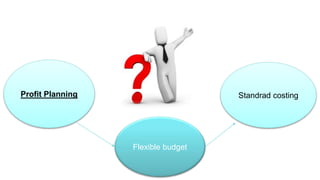
Introduction
Profit Planning
Flexible budget
Standrad costing
Welcome!!
Insert the title of your subtitle Here
Get a modern PowerPoint
Presentation that is beautifully
designed.
Planning
 Planning involves developing goals and preparin
g various budget to achieve these goals.
Flexible Budget
In the last chapter we explored how
budgets are developed before period
begins.
Flexible budget is a budget that
adjusts or flexes for changes in the
volume of activity.
Standard costing
Flexible
budget
• In the last chapter we investigated flexible
budget variance. These variances provide
feedback concerning how well an org.
performed in relation to its budget.
Standard
costing
• A standard is a bench mark for
measuring performance. Standard are
found everywhere.
 Manufacturing , services, food, and n
ot-for-profit organizations all make us
e of standards to some extent.
WHO USES STANDARD COSTS?
 Functions of standard
costing system
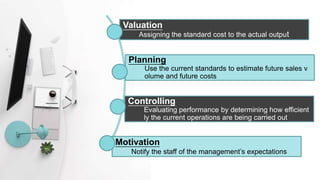
Valuation
Assigning the standard cost to the actual output
Planning
Use the current standards to estimate future sales v
olume and future costs
Controlling
Evaluating performance by determining how efficient
ly the current operations are being carried out
Motivation
Notify the staff of the management’s expectations
Variance
• What is variance
• Variance analysis is the
quantitative investigation of
the difference between
actual and planned
behavior. This analysis is
used to maintain control
over a business.
Why we do variance
variance analysis helps
maintain control over a
project's expenses by
monitoring planned versus
actual costs.
Effective variance analysis
can help a company to move
your company toward success.
 A variance is the difference bet
ween the standards and the act
ual performance
 When the actual results are bett
er than the expected results, th
ere will be a favorable variance
(F)
 If the actual results are worse th
an the expected results, there
will be unfavorable (u).
Variance
Our Services
Insert the title of your subtitle Here
01
03
02
04
You can simply impress your audience
and add a unique zing and appeal to
your Presentations. Easy to change
colors, photos and Text.
Your Text Here
You can simply impress your audience
and add a unique zing and appeal to
your Presentations. Easy to change
colors, photos and Text.
Your Text Here
You can simply impress your audience
and add a unique zing and appeal to
your Presentations. Easy to change
colors, photos and Text.
Your Text Here
You can simply impress your audience
and add a unique zing and appeal to
your Presentations. Easy to change
colors, photos and Text.
Your Text Here
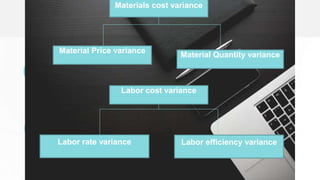
Materials cost variance
Material Price variance
Material Quantity variance
Labor rate variance Labor efficiency variance
Labor cost variance
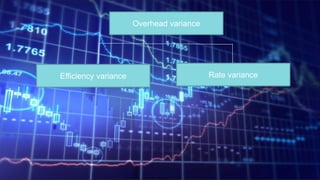
Overhead variance
Efficiency variance Rate variance
Objective(1)
Compute the direct materials Quantity and price variance explain their significance.
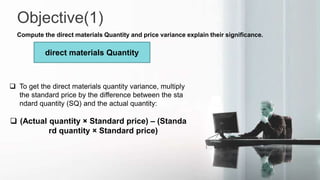
direct materials Quantity
 To get the direct materials quantity variance, multiply
the standard price by the difference between the sta
ndard quantity (SQ) and the actual quantity:
 (Actual quantity × Standard price) – (Standa
rd quantity × Standard price)
Compute the direct materials Quantity and price variance explain their significance.
price vareince
 If the actual price is higher then the standard p
rice, it would result is un- favourable price vari
ance and if the actual price is lower then stand
ard price, the result is favorable price variance
(Actual quantity × Actual price) – (Actual quantity × Stan
dard price)
02 Compute the direct labor efficiency and rate
variances.
Objective
2
Labor efficiency variance
 It is the difference between the standard time and the actu
al time spent multiplied by standard wage rate.
(Actual hours worked × Standard rate) –
(Standard hours × Standard rate)
Labor rate variance
This is that portion of labour cost variance which is the cost varian
ce which is caused by the use of actual wage rate other then pred
etermined.
(Actual hours × Actual rate) – (Actual hour
s × Standard rate)
Objective
3
The variable overhead efficiency variance is the di
fference between the actual and budgeted hours
worked, which are then applied to the standard va
riable overhead rate per hour. The formula is:
(Actual hours × Actual rate) – (Actual hours × St
andard rate)
= Variable overhead efficiency variance
Overhead efficiency variance
Overhead Rate variance
The variable overhead rate variance
is the difference between the actual
and budgeted rate of spending on v
ariable overhead.
(Actual hours × Actual rate) – (Actu
al hours × Standard rate)
 Compute and interpret the
fixed overhead volume and
budget variances.
Objective 4
.
fixed overhead volume
The fixed overhead volume variance is th
e difference between budgeted fixed manuf
acturing overhead and fixed manufacturing
overhead applied to work in process during
the period
The difference between the actual fixed
overhead incurred and the amount of fi
xed overhead that had been budgeted.
fixed overhead budget
variances
 Objective
5
record variance analysis
Variances
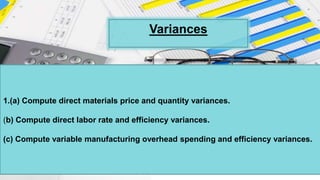
1.(a) Compute direct materials price and quantity variances.
(b) Compute direct labor rate and efficiency variances.
(c) Compute variable manufacturing overhead spending and efficiency variances.

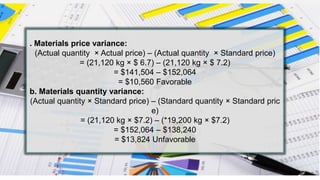
. Materials price variance:
(Actual quantity × Actual price) – (Actual quantity × Standard price)
= (21,120 kg × $ 6.7) – (21,120 kg × $ 7.2)
= $141,504 – $152,064
= $10,560 Favorable
b. Materials quantity variance:
(Actual quantity × Standard price) – (Standard quantity × Standard pric
e)
= (21,120 kg × $7.2) – (*19,200 kg × $7.2)
= $152,064 – $138,240
= $13,824 Unfavorable
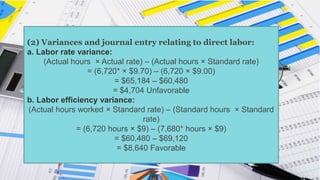
(2) Variances and journal entry relating to direct labor:
a. Labor rate variance:
(Actual hours × Actual rate) – (Actual hours × Standard rate)
= (6,720* × $9.70) – (6,720 × $9.00)
= $65,184 – $60,480
= $4,704 Unfavorable
b. Labor efficiency variance:
(Actual hours worked × Standard rate) – (Standard hours × Standard
rate)
= (6,720 hours × $9) – (7,680* hours × $9)
= $60,480 – $69,120
= $8,640 Favorable
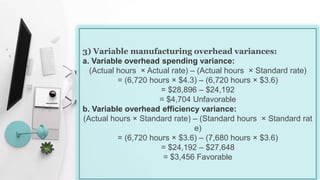
3) Variable manufacturing overhead variances:
a. Variable overhead spending variance:
(Actual hours × Actual rate) – (Actual hours × Standard rate)
= (6,720 hours × $4.3) – (6,720 hours × $3.6)
= $28,896 – $24,192
= $4,704 Unfavorable
b. Variable overhead efficiency variance:
(Actual hours × Standard rate) – (Standard hours × Standard rat
e)
= (6,720 hours × $3.6) – (7,680 hours × $3.6)
= $24,192 – $27,648
= $3,456 Favorable
Standard costing

Standard costing

  • 1.
  • 2.
     Objectives 01 Compute thedirect materials Quantity and price variances and explain their significance. 02 Compute the direct labor efficiency and rate variances and explain their significance. 03 Compute their variable manufacturing over head efficiency and rate variances and explain their significance
  • 3.
    04 (Appendix 10A)Compute andinterpret the fixed overhead volume and budget variances. 05 (Appendix 10B) record variance analysis
  • 4.
  • 5.
  • 6.
    Welcome!! Insert the titleof your subtitle Here Get a modern PowerPoint Presentation that is beautifully designed. Planning  Planning involves developing goals and preparin g various budget to achieve these goals.
  • 7.
    Flexible Budget In thelast chapter we explored how budgets are developed before period begins. Flexible budget is a budget that adjusts or flexes for changes in the volume of activity.
  • 8.
    Standard costing Flexible budget • Inthe last chapter we investigated flexible budget variance. These variances provide feedback concerning how well an org. performed in relation to its budget. Standard costing • A standard is a bench mark for measuring performance. Standard are found everywhere.
  • 9.
     Manufacturing ,services, food, and n ot-for-profit organizations all make us e of standards to some extent. WHO USES STANDARD COSTS?
  • 10.
     Functions ofstandard costing system
  • 11.
    Valuation Assigning the standardcost to the actual output Planning Use the current standards to estimate future sales v olume and future costs Controlling Evaluating performance by determining how efficient ly the current operations are being carried out Motivation Notify the staff of the management’s expectations
  • 12.
  • 13.
    • What isvariance • Variance analysis is the quantitative investigation of the difference between actual and planned behavior. This analysis is used to maintain control over a business. Why we do variance variance analysis helps maintain control over a project's expenses by monitoring planned versus actual costs. Effective variance analysis can help a company to move your company toward success.
  • 14.
     A varianceis the difference bet ween the standards and the act ual performance  When the actual results are bett er than the expected results, th ere will be a favorable variance (F)  If the actual results are worse th an the expected results, there will be unfavorable (u). Variance
  • 15.
    Our Services Insert thetitle of your subtitle Here 01 03 02 04 You can simply impress your audience and add a unique zing and appeal to your Presentations. Easy to change colors, photos and Text. Your Text Here You can simply impress your audience and add a unique zing and appeal to your Presentations. Easy to change colors, photos and Text. Your Text Here You can simply impress your audience and add a unique zing and appeal to your Presentations. Easy to change colors, photos and Text. Your Text Here You can simply impress your audience and add a unique zing and appeal to your Presentations. Easy to change colors, photos and Text. Your Text Here Materials cost variance Material Price variance Material Quantity variance Labor rate variance Labor efficiency variance Labor cost variance
  • 16.
  • 17.
    Objective(1) Compute the directmaterials Quantity and price variance explain their significance. direct materials Quantity  To get the direct materials quantity variance, multiply the standard price by the difference between the sta ndard quantity (SQ) and the actual quantity:  (Actual quantity × Standard price) – (Standa rd quantity × Standard price)
  • 18.
    Compute the directmaterials Quantity and price variance explain their significance. price vareince  If the actual price is higher then the standard p rice, it would result is un- favourable price vari ance and if the actual price is lower then stand ard price, the result is favorable price variance (Actual quantity × Actual price) – (Actual quantity × Stan dard price)
  • 19.
    02 Compute thedirect labor efficiency and rate variances. Objective 2
  • 20.
    Labor efficiency variance It is the difference between the standard time and the actu al time spent multiplied by standard wage rate. (Actual hours worked × Standard rate) – (Standard hours × Standard rate)
  • 21.
    Labor rate variance Thisis that portion of labour cost variance which is the cost varian ce which is caused by the use of actual wage rate other then pred etermined. (Actual hours × Actual rate) – (Actual hour s × Standard rate)
  • 22.
  • 23.
    The variable overheadefficiency variance is the di fference between the actual and budgeted hours worked, which are then applied to the standard va riable overhead rate per hour. The formula is: (Actual hours × Actual rate) – (Actual hours × St andard rate) = Variable overhead efficiency variance Overhead efficiency variance
  • 24.
    Overhead Rate variance Thevariable overhead rate variance is the difference between the actual and budgeted rate of spending on v ariable overhead. (Actual hours × Actual rate) – (Actu al hours × Standard rate)
  • 25.
     Compute andinterpret the fixed overhead volume and budget variances. Objective 4
  • 26.
    . fixed overhead volume Thefixed overhead volume variance is th e difference between budgeted fixed manuf acturing overhead and fixed manufacturing overhead applied to work in process during the period
  • 27.
    The difference betweenthe actual fixed overhead incurred and the amount of fi xed overhead that had been budgeted. fixed overhead budget variances
  • 28.
  • 29.
    Variances 1.(a) Compute directmaterials price and quantity variances. (b) Compute direct labor rate and efficiency variances. (c) Compute variable manufacturing overhead spending and efficiency variances.
  • 30.
    . Materials pricevariance: (Actual quantity × Actual price) – (Actual quantity × Standard price) = (21,120 kg × $ 6.7) – (21,120 kg × $ 7.2) = $141,504 – $152,064 = $10,560 Favorable b. Materials quantity variance: (Actual quantity × Standard price) – (Standard quantity × Standard pric e) = (21,120 kg × $7.2) – (*19,200 kg × $7.2) = $152,064 – $138,240 = $13,824 Unfavorable
  • 31.
    (2) Variances andjournal entry relating to direct labor: a. Labor rate variance: (Actual hours × Actual rate) – (Actual hours × Standard rate) = (6,720* × $9.70) – (6,720 × $9.00) = $65,184 – $60,480 = $4,704 Unfavorable b. Labor efficiency variance: (Actual hours worked × Standard rate) – (Standard hours × Standard rate) = (6,720 hours × $9) – (7,680* hours × $9) = $60,480 – $69,120 = $8,640 Favorable
  • 32.
    3) Variable manufacturingoverhead variances: a. Variable overhead spending variance: (Actual hours × Actual rate) – (Actual hours × Standard rate) = (6,720 hours × $4.3) – (6,720 hours × $3.6) = $28,896 – $24,192 = $4,704 Unfavorable b. Variable overhead efficiency variance: (Actual hours × Standard rate) – (Standard hours × Standard rat e) = (6,720 hours × $3.6) – (7,680 hours × $3.6) = $24,192 – $27,648 = $3,456 Favorable