Faculty Development for  Core Outcomes Lynda Milne POD Network Conference Reno, Nevada  October 25, 2008
Acknowledgements Stacy Wells, Century College Julia Curtiss, Metropolitan State University Contact Lynda Milne Center for Teaching & Learning [email_address] 651-649-5741
Study Background Past discussions on the role of liberal arts, liberal education  2010 conversations Minnesota Transfer Curriculum Oversight Committee discussion on “educated Minnesotan” National press for accountability Leadership Council, Nov 2006: study, not more conversations
Study  Summary Study purpose: collect data on all 32 system institutions’ institution-level core learning outcomes Definition / detailed competencies Dissemination to campus community Integration throughout curricula Assessment Ongoing evaluation, revision processes All institutions responded 26 have core institution-level outcomes 4 have “only program-level outcomes” 2 have “not yet detailed outcomes” Few have fully defined, disseminated, integrated, and assess outcomes Common Communication Thinking Technology, information literacy Diversity, ethics
National Studies AAC&U Report, January 2007 College Learning for the New Global Century “Near-total public silence about what contemporary college graduates need to know and be able to do.” Essential Learning Outcomes Wabash National Study  of Liberal Arts Education, Fall 2006 7 outcomes associated with undergraduate education
Institutional Studies Alverno  College Eight Abilities (since 1970s) Indiana University Purdue University Indianapolis Six principles of undergraduate learning Moraine Park Technical College  (Wisconsin) 7 Core Abilities promoted to all students from registration through graduation Portland Community College  (Oregon) 6 Core Outcomes, including self-reflection on learning at graduation Bowling Green State University  (Ohio) 3 categories of University Learning Outcomes, in addition to mastery of the learning outcomes of a field of study
Study Summary Study purpose: collect data on all 32 system institutions’ institution-level core learning outcomes Definition / detailed competencies Dissemination to campus community Integration throughout curricula Assessment Ongoing evaluation, revision processes All institutions responded 26 have core institution-level outcomes 4 have “only program-level outcomes” 2 have “not yet detailed outcomes” Few have fully defined, disseminated, integrated, and assess outcomes Common Communication Thinking Technology, information literacy Diversity, ethics
Let’s Talk Manila handout questions Many of them ask about how your center can help. Ignore those questions for now. Take about 5 minutes to write answers about core outcomes at your college or university. Get as far as you can, and then take another 10 minutes to discuss with one other person
Universal Outcomes Communication Often embracing many other outcomes (group interaction, diversity, writing, computer literacy) Thinking Usually including problem-solving and critical thinking, but also including creativity, aesthetic appreciation, decision-making
Common Outcomes Technology and Information Literacy From keyboarding to presentation of information Diversity, Culture, Global Awareness Sometimes separate goals; sometimes including citizenship Ethics and Social Responsibility Often mirrors MnTC, but may include citizenship, diversity, team work, decision-making, personal values Social Interaction, Cooperation Distinct goal at six 2-year colleges
Common Outcomes Personal Goals, Lifelong Learning At 11 institutions Mathematics Sometimes as logical reasoning, problem-solving Citizenship Again, may include respect for diversity, social responsibility Attitudinal/developmental  Professional attitude, readiness for career, take pride in work; balance
Unique Outcomes Actively engage in creative/performing arts Learn to use the resources of the college’s academic community and its urban context for learning
Processes Related to accreditation Related to institutional mission changes Some involve faculty, staff, students; some include community or program advisory committees Some engaged external consultants  Several have plans for ongoing review and revision
Assessment Several institutions have direct ties between course learning outcomes and their institutional core outcomes Several are using rubrics, WIDS One considered student and institutional portfolios Several institutions are using—or contemplating using—standardized tests at or near graduation Collegiate Assessment of Academic Proficiency, California Critical Thinking Skills Test, California Critical Thinking Dispositions Test—soon:  Voluntary System of Accountability (all 7 universities)
Integration Commonly cited communication methods Web site, catalog, student handbook Integration into curriculum  development  common Information for students less common and visible A few provide information for students at orientation; one administers an annual assessment of students
Surprises Differences among our institutions—even within sectors Science and math not universally defined as core outcomes Variations on  Minnesota Transfer Curriculum  (statewide agreement on 10 common goals for student learning by time of transfer from two-year college to university: http://mntransfer.org)
Responses to Date: CAOs / Deans Maintain Web site Permits institutions to learn from one another  Add ways for institutions to update information  Provide additional resources for institutions Examples of assessments Process details (faculty conversations…) Do not share with Board…yet
Core Learning Outcomes and Teaching Centers Suggest…or get involved in…the conversation Get appointed to a key committee Decide how your CTL Work Plan can support efforts to: Define goals and competencies Disseminate and educate Integrate goals into course and curriculum goals Help faculty with assessment  Ask faculty and administrative leadership to determine how the center can support coordinated, informed efforts across the institution.
Questions for Leadership How can we begin to articulate common goals across the college or university— without  creating new mandates? AACU/CHEA “ New Leadership for Student Learning and Accountability ” “ Each college and university…should develop ambitious, specific, and clearly stated goals for student learning appropriate to its mission, resources, tradition, student body, and community setting.” How can upcoming accreditation processes encourage work in this area?
Benefits for Centers A focus on student learning outcomes and helping faculty define, detail, and assess them can… Give centers a  core strategic focus Clarify the rationale for many of our programs Assist in institutional development Put us positively at the  center  of efforts related to accreditation and accountability
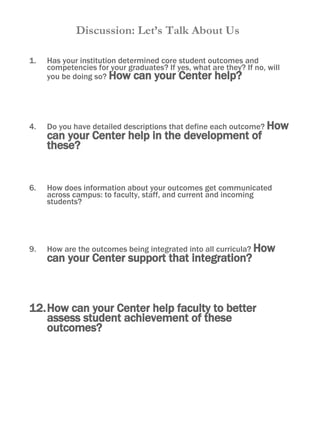
Discussion: Let’s Talk About Us Has your institution determined core student outcomes and competencies for your graduates? If yes, what are they? If no, will you be doing so?  How can your Center help? Do you have detailed descriptions that define each outcome?  How can your Center help in the development of these? How does information about your outcomes get communicated across campus: to faculty, staff, and current and incoming students?  How are the outcomes being integrated into all curricula?  How can your Center support that integration? How can your Center help faculty to better assess student achievement of these outcomes?

MnSCU Core Outcomes Study

  • 1.
    Faculty Development for Core Outcomes Lynda Milne POD Network Conference Reno, Nevada October 25, 2008
  • 2.
    Acknowledgements Stacy Wells,Century College Julia Curtiss, Metropolitan State University Contact Lynda Milne Center for Teaching & Learning [email_address] 651-649-5741
  • 3.
    Study Background Pastdiscussions on the role of liberal arts, liberal education 2010 conversations Minnesota Transfer Curriculum Oversight Committee discussion on “educated Minnesotan” National press for accountability Leadership Council, Nov 2006: study, not more conversations
  • 4.
    Study SummaryStudy purpose: collect data on all 32 system institutions’ institution-level core learning outcomes Definition / detailed competencies Dissemination to campus community Integration throughout curricula Assessment Ongoing evaluation, revision processes All institutions responded 26 have core institution-level outcomes 4 have “only program-level outcomes” 2 have “not yet detailed outcomes” Few have fully defined, disseminated, integrated, and assess outcomes Common Communication Thinking Technology, information literacy Diversity, ethics
  • 5.
    National Studies AAC&UReport, January 2007 College Learning for the New Global Century “Near-total public silence about what contemporary college graduates need to know and be able to do.” Essential Learning Outcomes Wabash National Study of Liberal Arts Education, Fall 2006 7 outcomes associated with undergraduate education
  • 6.
    Institutional Studies Alverno College Eight Abilities (since 1970s) Indiana University Purdue University Indianapolis Six principles of undergraduate learning Moraine Park Technical College (Wisconsin) 7 Core Abilities promoted to all students from registration through graduation Portland Community College (Oregon) 6 Core Outcomes, including self-reflection on learning at graduation Bowling Green State University (Ohio) 3 categories of University Learning Outcomes, in addition to mastery of the learning outcomes of a field of study
  • 7.
    Study Summary Studypurpose: collect data on all 32 system institutions’ institution-level core learning outcomes Definition / detailed competencies Dissemination to campus community Integration throughout curricula Assessment Ongoing evaluation, revision processes All institutions responded 26 have core institution-level outcomes 4 have “only program-level outcomes” 2 have “not yet detailed outcomes” Few have fully defined, disseminated, integrated, and assess outcomes Common Communication Thinking Technology, information literacy Diversity, ethics
  • 8.
    Let’s Talk Manilahandout questions Many of them ask about how your center can help. Ignore those questions for now. Take about 5 minutes to write answers about core outcomes at your college or university. Get as far as you can, and then take another 10 minutes to discuss with one other person
  • 9.
    Universal Outcomes CommunicationOften embracing many other outcomes (group interaction, diversity, writing, computer literacy) Thinking Usually including problem-solving and critical thinking, but also including creativity, aesthetic appreciation, decision-making
  • 10.
    Common Outcomes Technologyand Information Literacy From keyboarding to presentation of information Diversity, Culture, Global Awareness Sometimes separate goals; sometimes including citizenship Ethics and Social Responsibility Often mirrors MnTC, but may include citizenship, diversity, team work, decision-making, personal values Social Interaction, Cooperation Distinct goal at six 2-year colleges
  • 11.
    Common Outcomes PersonalGoals, Lifelong Learning At 11 institutions Mathematics Sometimes as logical reasoning, problem-solving Citizenship Again, may include respect for diversity, social responsibility Attitudinal/developmental Professional attitude, readiness for career, take pride in work; balance
  • 12.
    Unique Outcomes Activelyengage in creative/performing arts Learn to use the resources of the college’s academic community and its urban context for learning
  • 13.
    Processes Related toaccreditation Related to institutional mission changes Some involve faculty, staff, students; some include community or program advisory committees Some engaged external consultants Several have plans for ongoing review and revision
  • 14.
    Assessment Several institutionshave direct ties between course learning outcomes and their institutional core outcomes Several are using rubrics, WIDS One considered student and institutional portfolios Several institutions are using—or contemplating using—standardized tests at or near graduation Collegiate Assessment of Academic Proficiency, California Critical Thinking Skills Test, California Critical Thinking Dispositions Test—soon: Voluntary System of Accountability (all 7 universities)
  • 15.
    Integration Commonly citedcommunication methods Web site, catalog, student handbook Integration into curriculum development common Information for students less common and visible A few provide information for students at orientation; one administers an annual assessment of students
  • 16.
    Surprises Differences amongour institutions—even within sectors Science and math not universally defined as core outcomes Variations on Minnesota Transfer Curriculum (statewide agreement on 10 common goals for student learning by time of transfer from two-year college to university: http://mntransfer.org)
  • 17.
    Responses to Date:CAOs / Deans Maintain Web site Permits institutions to learn from one another Add ways for institutions to update information Provide additional resources for institutions Examples of assessments Process details (faculty conversations…) Do not share with Board…yet
  • 18.
    Core Learning Outcomesand Teaching Centers Suggest…or get involved in…the conversation Get appointed to a key committee Decide how your CTL Work Plan can support efforts to: Define goals and competencies Disseminate and educate Integrate goals into course and curriculum goals Help faculty with assessment Ask faculty and administrative leadership to determine how the center can support coordinated, informed efforts across the institution.
  • 19.
    Questions for LeadershipHow can we begin to articulate common goals across the college or university— without creating new mandates? AACU/CHEA “ New Leadership for Student Learning and Accountability ” “ Each college and university…should develop ambitious, specific, and clearly stated goals for student learning appropriate to its mission, resources, tradition, student body, and community setting.” How can upcoming accreditation processes encourage work in this area?
  • 20.
    Benefits for CentersA focus on student learning outcomes and helping faculty define, detail, and assess them can… Give centers a core strategic focus Clarify the rationale for many of our programs Assist in institutional development Put us positively at the center of efforts related to accreditation and accountability
  • 21.
    Discussion: Let’s TalkAbout Us Has your institution determined core student outcomes and competencies for your graduates? If yes, what are they? If no, will you be doing so? How can your Center help? Do you have detailed descriptions that define each outcome? How can your Center help in the development of these? How does information about your outcomes get communicated across campus: to faculty, staff, and current and incoming students? How are the outcomes being integrated into all curricula? How can your Center support that integration? How can your Center help faculty to better assess student achievement of these outcomes?

Editor's Notes

  • #2 Good afternoon. Welcome. Hope you had a good morning, got some GIFTS, and also got out for some fresh air on an expedition or even a walk over to the Victorian Mall. I’m Lynda Milne, from… Our session has three focuses: Review and talk about the importance of core institutional outcomes for students—the outcomes that we state as our common goals for all students. Review a study from our system—in which we looked at how 32 colleges and universities reported where they are on setting forth and evaluating how they’re doing on these core outcomes. Discuss how centers and faculty developers can get involved in focus on core outcomes, and what the benefits might be for them and their centers.