CIRCLE
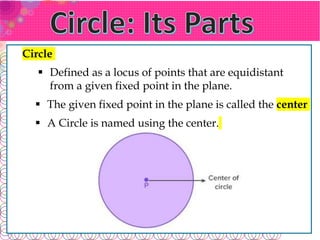
Circle
 Defined as a locus of points that are equidistant
from a given fixed point in the plane.
 The given fixed point in the plane is called the center
 A Circle is named using the center.
Circle (Basics)
O
=
=
=
A
C D
B
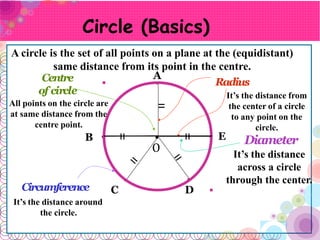
A circle is the set of all points on a plane at the (equidistant)
same distance from its point in the centre.
Radius
It’s the distance from
the center of a circle
to any point on the
circle.
E
Centre
of circle
All points on the circle are
at same distance from the
centre point.
Circumference
It’s the distance around
the circle.
Diameter
It’s the distance
across a circle
through the center.
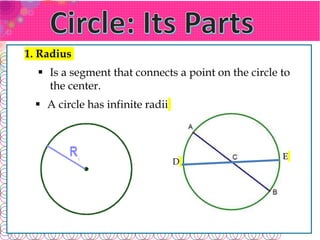
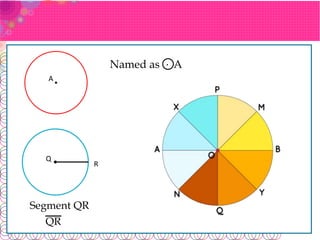
1. Radius
 Is a segment that connects a point on the circle to
the center.
 A circle has infinite radii
D
E
A
Named as A
.
Q
R
Segment QR
QR
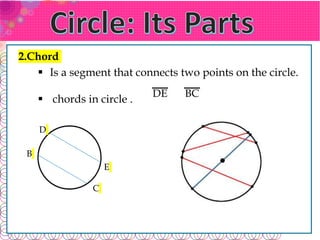
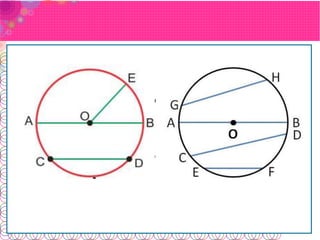
2.Chord
 Is a segment that connects two points on the circle.
D
E
DE
 chords in circle .
B
C
BC
Chord
O
A
E
B
Chord Chord
Diameter,
the biggest chord
Interior of
the circle
Exterior of the circle
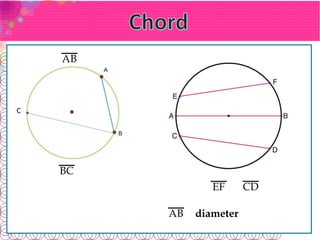
A chord of a circle is a line segment whose endpoints are points
on the circle.
AB
C
BC
EF
AB
CD
diameter
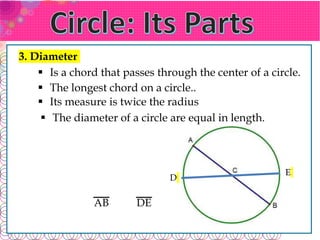
3. Diameter
 Is a chord that passes through the center of a circle.
 The longest chord on a circle..
D
E
AB DE
 Its measure is twice the radius
 The diameter of a circle are equal in length.
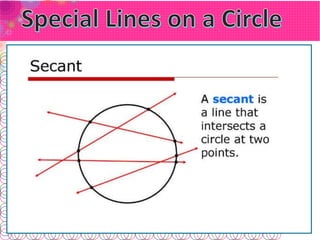
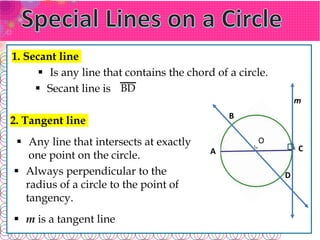
1. Secant line
 Is any line that contains the chord of a circle.
A C
O
B
D
 Secant line is BD
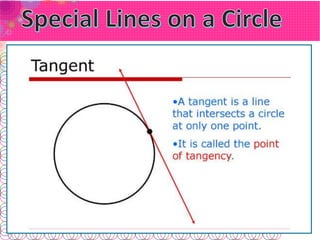
2. Tangent line
 Any line that intersects at exactly
one point on the circle.
 Always perpendicular to the
radius of a circle to the point of
tangency.
m
 m is a tangent line
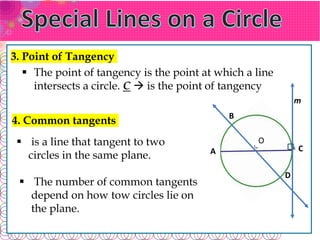
3. Point of Tangency
 The point of tangency is the point at which a line
intersects a circle. C  is the point of tangency
A C
O
B
D
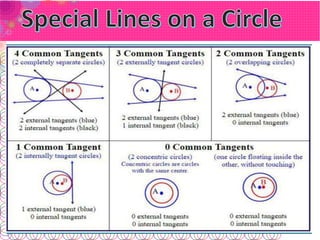
4. Common tangents
 is a line that tangent to two
circles in the same plane.
m
 The number of common tangents
depend on how tow circles lie on
the plane.
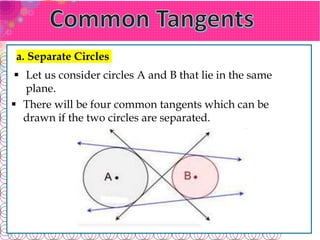
a. Separate Circles
 Let us consider circles A and B that lie in the same
plane.
 There will be four common tangents which can be
drawn if the two circles are separated.
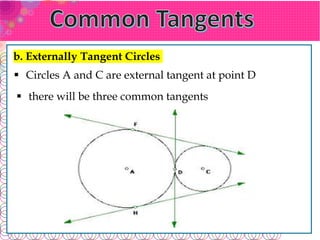
b. Externally Tangent Circles
 Circles A and C are external tangent at point D
 there will be three common tangents
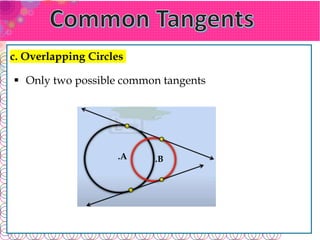
c. Overlapping Circles
 Only two possible common tangents
.A .B
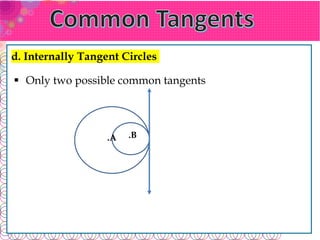
d. Internally Tangent Circles
 Only two possible common tangents
.A .B
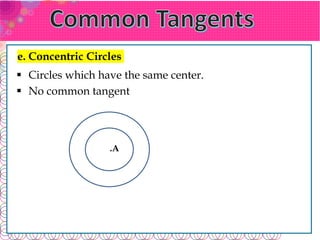
e. Concentric Circles
 Circles which have the same center.
.A
 No common tangent
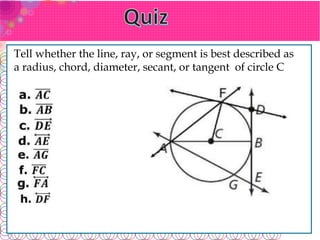
Tell whether the line, ray, or segment is best described as
a radius, chord, diameter, secant, or tangent of circle C
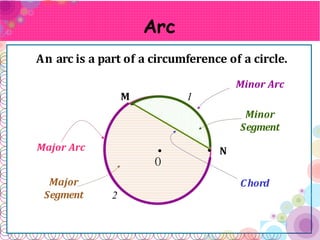
Arc
O
N
Chord
Major Arc
Major
Segment
An arc is a part of a circumference of a circle.
Minor Arc
M 1
Minor
Segment
2
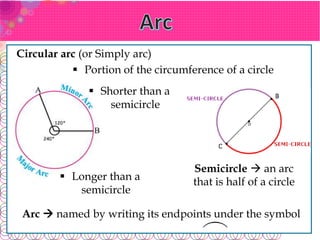
Circular arc (or Simply arc)
 Portion of the circumference of a circle
 Shorter than a
semicircle
 Longer than a
semicircle
Semicircle  an arc
that is half of a circle
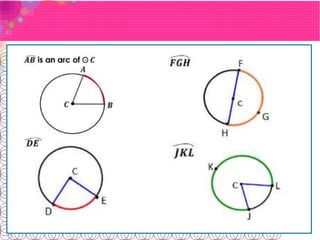
Arc  named by writing its endpoints under the symbol
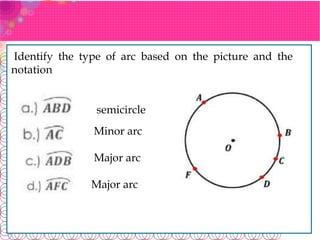
Identify the type of arc based on the picture and the
notation
semicircle
Minor arc
Major arc
Major arc
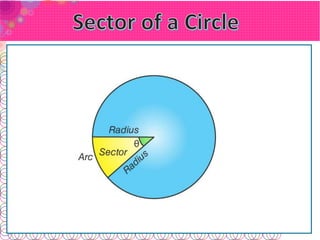
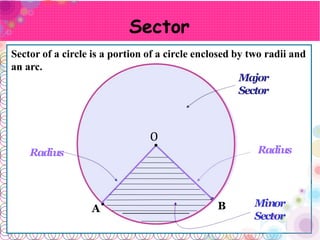
Sector
A B
Radius Radius
Minor
Sector
Sector of a circle is a portion of a circle enclosed by two radii and
an arc.
Major
Sector
O
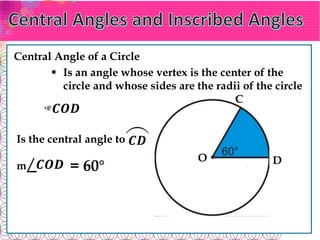
Central Angle of a Circle
 Is an angle whose vertex is the center of the
circle and whose sides are the radii of the circle
C
D
O
Is the central angle to 𝑪𝑫
𝑪𝑶𝑫
m = 60°
𝑪𝑶𝑫
A
E
O
B
D
arc
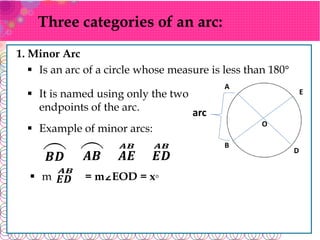
Three categories of an arc:
1. Minor Arc
 Is an arc of a circle whose measure is less than 180°
 It is named using only the two
endpoints of the arc.
 Example of minor arcs:
𝑩𝑫 𝑨𝑩 𝑨𝑬 𝑬𝑫
 m = m∠EOD = x◦
𝑬𝑫
A
E
O
B
D
arc
Three categories of an arc:
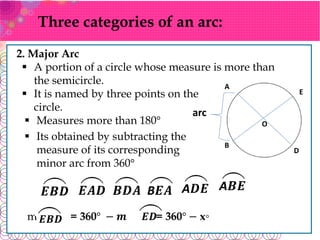
2. Major Arc
 A portion of a circle whose measure is more than
the semicircle.
 It is named by three points on the
circle.
𝑬𝑩𝑫 𝑬𝑨𝑫 𝑩𝑫𝑨 B𝑬𝑨
m = 360° − 𝒎 = 360° − x◦
𝑬𝑩𝑫
 Measures more than 180°
 Its obtained by subtracting the
measure of its corresponding
minor arc from 360°
A𝑫𝑬 A𝑩𝑬
𝑬𝑫
A
E
O
B
D
arc
Three categories of an arc:
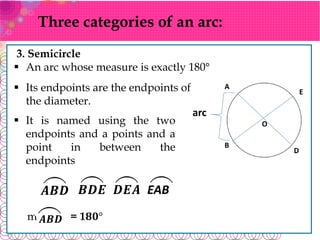
3. Semicircle
 An arc whose measure is exactly 180°
 Its endpoints are the endpoints of
the diameter.
𝑨𝑩𝑫 𝑩𝑫𝑬 𝑫𝑬𝑨 EAB
m = 1𝟖𝟎°
𝑨𝑩𝑫
 It is named using the two
endpoints and a points and a
point in between the
endpoints
𝑬𝑮
𝑬𝑹𝑮
𝑬𝑮
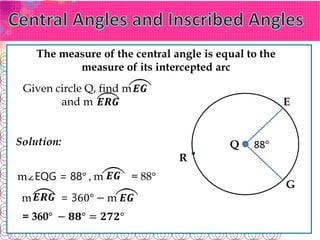
The measure of the central angle is equal to the
measure of its intercepted arc
88°
E
G
Q
R
𝑬𝑹𝑮
𝑬𝑮
Given circle Q, find m
and m
Solution:
m∠EQG = 88° , m = 88°
m = 360° − m
= 360° − 𝟖𝟖° = 𝟐𝟕𝟐°
𝑩𝑬𝑪
𝑫𝑬𝑪
𝑩𝑫
𝑫𝑪
𝑩𝑪
𝑫𝑩
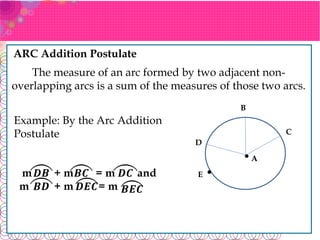
ARC Addition Postulate
The measure of an arc formed by two adjacent non-
overlapping arcs is a sum of the measures of those two arcs.
A
B
C
D
E
m + m = m and
m + m = m
Example: By the Arc Addition
Postulate
Example:
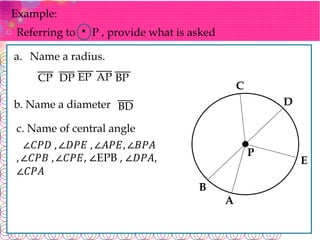
Referring to P , provide what is asked
.
a. Name a radius.
C
D
E
A
B
P
CP DP EP AP BP
b. Name a diameter BD
c. Name of central angle
∠𝐶𝑃𝐷 , ∠𝐷𝑃𝐸 , ∠𝐴𝑃𝐸, ∠𝐵𝑃𝐴
, ∠𝐶𝑃𝐵 , ∠𝐶𝑃𝐸, ∠EPB , ∠𝐷𝑃𝐴,
∠𝐶𝑃𝐴
Example:
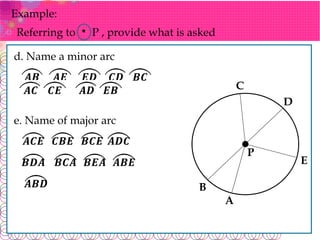
Referring to P , provide what is asked
.
d. Name a minor arc
C
D
E
A
B
P
e. Name of major arc
𝑨𝑩 𝑨𝑬 𝑬𝑫 𝑪𝑫 𝑩𝑪
𝑨𝑪 𝑪𝑬 𝑨𝑫 𝑬𝑩
𝑨𝑪𝑬 𝑪𝑩𝑬 𝑩𝑪𝑬 𝑨𝑫𝑪
𝑩𝑫𝑨 𝑩𝑪𝑨 𝑩𝑬𝑨 𝑨𝑩𝑬
𝑨𝑩𝑫
Example:
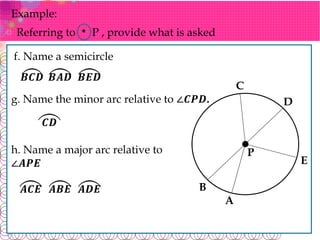
Referring to P , provide what is asked
.
f. Name a semicircle
C
D
E
A
B
P
g. Name the minor arc relative to ∠𝑪𝑷𝑫.
𝑩𝑪𝑫 𝑩𝑨𝑫 𝑩𝑬𝑫
𝑪𝑫
h. Name a major arc relative to
∠𝑨𝑷𝑬
𝑨𝑪𝑬 𝑨𝑩𝑬 𝑨𝑫𝑬
𝑩𝑬𝑫
Example:
Referring to P , provide what is asked
.
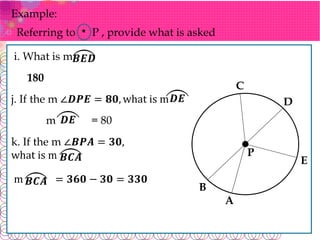
i. What is m
C
D
E
A
B
P
𝑫𝑬
j. If the m ∠𝑫𝑷𝑬 = 𝟖𝟎, what is m
180
𝑫𝑬
m = 80
k. If the m ∠𝑩𝑷𝑨 = 𝟑𝟎,
what is m 𝑩𝑪𝑨
𝑩𝑪𝑨
m = 𝟑𝟔𝟎 − 𝟑𝟎 = 𝟑𝟑𝟎
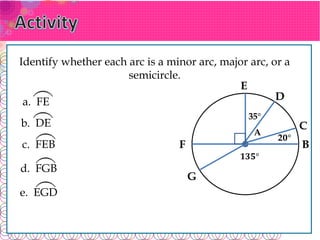
Identify whether each arc is a minor arc, major arc, or a
semicircle.
D
A
F B
a. FE
C
E
G
35°
2𝟎°
1𝟑𝟓°
b. DE
c. FEB
d. FGB
e. EGD
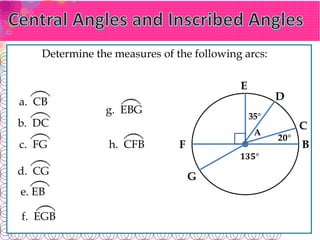
Determine the measures of the following arcs:
D
A
F B
a. CB
C
E
G
35°
2𝟎°
1𝟑𝟓°
b. DC
e. EB
f. EGB
g. EBG
h. CFB
c. FG
d. CG
Grade 10_Math-Chapter 3_Lesson 3-1 Central Angles and Inscribed Angles a.pptx

Grade 10_Math-Chapter 3_Lesson 3-1 Central Angles and Inscribed Angles a.pptx

  • 2.
  • 3.
    Circle  Defined asa locus of points that are equidistant from a given fixed point in the plane.  The given fixed point in the plane is called the center  A Circle is named using the center.
  • 4.
    Circle (Basics) O = = = A C D B Acircle is the set of all points on a plane at the (equidistant) same distance from its point in the centre. Radius It’s the distance from the center of a circle to any point on the circle. E Centre of circle All points on the circle are at same distance from the centre point. Circumference It’s the distance around the circle. Diameter It’s the distance across a circle through the center.
  • 5.
    1. Radius  Isa segment that connects a point on the circle to the center.  A circle has infinite radii D E
  • 6.
  • 7.
    2.Chord  Is asegment that connects two points on the circle. D E DE  chords in circle . B C BC
  • 8.
    Chord O A E B Chord Chord Diameter, the biggestchord Interior of the circle Exterior of the circle A chord of a circle is a line segment whose endpoints are points on the circle.
  • 9.
  • 10.
    3. Diameter  Isa chord that passes through the center of a circle.  The longest chord on a circle.. D E AB DE  Its measure is twice the radius  The diameter of a circle are equal in length.
  • 14.
    1. Secant line Is any line that contains the chord of a circle. A C O B D  Secant line is BD 2. Tangent line  Any line that intersects at exactly one point on the circle.  Always perpendicular to the radius of a circle to the point of tangency. m  m is a tangent line
  • 15.
    3. Point ofTangency  The point of tangency is the point at which a line intersects a circle. C  is the point of tangency A C O B D 4. Common tangents  is a line that tangent to two circles in the same plane. m  The number of common tangents depend on how tow circles lie on the plane.
  • 16.
    a. Separate Circles Let us consider circles A and B that lie in the same plane.  There will be four common tangents which can be drawn if the two circles are separated.
  • 17.
    b. Externally TangentCircles  Circles A and C are external tangent at point D  there will be three common tangents
  • 18.
    c. Overlapping Circles Only two possible common tangents .A .B
  • 19.
    d. Internally TangentCircles  Only two possible common tangents .A .B
  • 20.
    e. Concentric Circles Circles which have the same center. .A  No common tangent
  • 22.
    Tell whether theline, ray, or segment is best described as a radius, chord, diameter, secant, or tangent of circle C
  • 23.
    Arc O N Chord Major Arc Major Segment An arcis a part of a circumference of a circle. Minor Arc M 1 Minor Segment 2
  • 24.
    Circular arc (orSimply arc)  Portion of the circumference of a circle  Shorter than a semicircle  Longer than a semicircle Semicircle  an arc that is half of a circle Arc  named by writing its endpoints under the symbol
  • 26.
    Identify the typeof arc based on the picture and the notation semicircle Minor arc Major arc Major arc
  • 28.
    Sector A B Radius Radius Minor Sector Sectorof a circle is a portion of a circle enclosed by two radii and an arc. Major Sector O
  • 29.
    Central Angle ofa Circle  Is an angle whose vertex is the center of the circle and whose sides are the radii of the circle C D O Is the central angle to 𝑪𝑫 𝑪𝑶𝑫 m = 60° 𝑪𝑶𝑫
  • 30.
    A E O B D arc Three categories ofan arc: 1. Minor Arc  Is an arc of a circle whose measure is less than 180°  It is named using only the two endpoints of the arc.  Example of minor arcs: 𝑩𝑫 𝑨𝑩 𝑨𝑬 𝑬𝑫  m = m∠EOD = x◦ 𝑬𝑫
  • 31.
    A E O B D arc Three categories ofan arc: 2. Major Arc  A portion of a circle whose measure is more than the semicircle.  It is named by three points on the circle. 𝑬𝑩𝑫 𝑬𝑨𝑫 𝑩𝑫𝑨 B𝑬𝑨 m = 360° − 𝒎 = 360° − x◦ 𝑬𝑩𝑫  Measures more than 180°  Its obtained by subtracting the measure of its corresponding minor arc from 360° A𝑫𝑬 A𝑩𝑬 𝑬𝑫
  • 32.
    A E O B D arc Three categories ofan arc: 3. Semicircle  An arc whose measure is exactly 180°  Its endpoints are the endpoints of the diameter. 𝑨𝑩𝑫 𝑩𝑫𝑬 𝑫𝑬𝑨 EAB m = 1𝟖𝟎° 𝑨𝑩𝑫  It is named using the two endpoints and a points and a point in between the endpoints
  • 33.
    𝑬𝑮 𝑬𝑹𝑮 𝑬𝑮 The measure ofthe central angle is equal to the measure of its intercepted arc 88° E G Q R 𝑬𝑹𝑮 𝑬𝑮 Given circle Q, find m and m Solution: m∠EQG = 88° , m = 88° m = 360° − m = 360° − 𝟖𝟖° = 𝟐𝟕𝟐°
  • 34.
    𝑩𝑬𝑪 𝑫𝑬𝑪 𝑩𝑫 𝑫𝑪 𝑩𝑪 𝑫𝑩 ARC Addition Postulate Themeasure of an arc formed by two adjacent non- overlapping arcs is a sum of the measures of those two arcs. A B C D E m + m = m and m + m = m Example: By the Arc Addition Postulate
  • 35.
    Example: Referring to P, provide what is asked . a. Name a radius. C D E A B P CP DP EP AP BP b. Name a diameter BD c. Name of central angle ∠𝐶𝑃𝐷 , ∠𝐷𝑃𝐸 , ∠𝐴𝑃𝐸, ∠𝐵𝑃𝐴 , ∠𝐶𝑃𝐵 , ∠𝐶𝑃𝐸, ∠EPB , ∠𝐷𝑃𝐴, ∠𝐶𝑃𝐴
  • 36.
    Example: Referring to P, provide what is asked . d. Name a minor arc C D E A B P e. Name of major arc 𝑨𝑩 𝑨𝑬 𝑬𝑫 𝑪𝑫 𝑩𝑪 𝑨𝑪 𝑪𝑬 𝑨𝑫 𝑬𝑩 𝑨𝑪𝑬 𝑪𝑩𝑬 𝑩𝑪𝑬 𝑨𝑫𝑪 𝑩𝑫𝑨 𝑩𝑪𝑨 𝑩𝑬𝑨 𝑨𝑩𝑬 𝑨𝑩𝑫
  • 37.
    Example: Referring to P, provide what is asked . f. Name a semicircle C D E A B P g. Name the minor arc relative to ∠𝑪𝑷𝑫. 𝑩𝑪𝑫 𝑩𝑨𝑫 𝑩𝑬𝑫 𝑪𝑫 h. Name a major arc relative to ∠𝑨𝑷𝑬 𝑨𝑪𝑬 𝑨𝑩𝑬 𝑨𝑫𝑬
  • 38.
    𝑩𝑬𝑫 Example: Referring to P, provide what is asked . i. What is m C D E A B P 𝑫𝑬 j. If the m ∠𝑫𝑷𝑬 = 𝟖𝟎, what is m 180 𝑫𝑬 m = 80 k. If the m ∠𝑩𝑷𝑨 = 𝟑𝟎, what is m 𝑩𝑪𝑨 𝑩𝑪𝑨 m = 𝟑𝟔𝟎 − 𝟑𝟎 = 𝟑𝟑𝟎
  • 39.
    Identify whether eacharc is a minor arc, major arc, or a semicircle. D A F B a. FE C E G 35° 2𝟎° 1𝟑𝟓° b. DE c. FEB d. FGB e. EGD
  • 40.
    Determine the measuresof the following arcs: D A F B a. CB C E G 35° 2𝟎° 1𝟑𝟓° b. DC e. EB f. EGB g. EBG h. CFB c. FG d. CG