COLORECTAL TRAUMA
 DR.ARKAPROVO ROY
 ASSOCIATE PROFESSOR,
 DR. DIBYASREE PAUL
 2ND YEAR RESIDENT
 DEPARTMENT OF SURGERY,
MEDICAL COLLEGE, KOLKATA
• an event, either witnessed or experienced, that represents a
fundamental threat to an individual’s physical safety and survival
• More than an event- it’s an EXPERIENCE, it has an EFFECT
Case:1
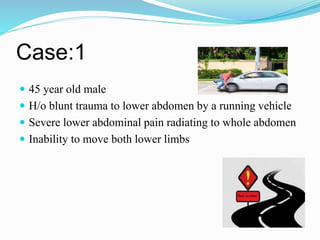
 45 year old male
 H/o blunt trauma to lower abdomen by a running vehicle
 Severe lower abdominal pain radiating to whole abdomen
 Inability to move both lower limbs
PRIMARY SURVEY & RESUSCITATION
 Conscious, alert, restless, GCS -15/15
 Pulse-120/minute, low volume; BP- 110/74 mm of Hg
 Pallor +
 Chest – B/L clear, SpO2- 97%
 Per abdomen- tense, generalised guarding, distended, diffuse
tenderness+, IPS-
 P/R- blood staining+, prostate palpable
 Urine- not passed
 Bruise over left iliac fossa, abrasions over pelvis and both
lower limbs
 Pelvic tenderness+, restriction of movement of B/L L/L
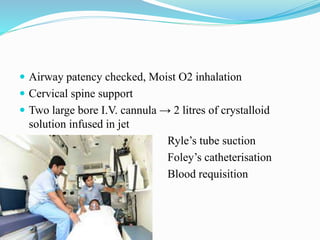
 Airway patency checked, Moist O2 inhalation
 Cervical spine support
 Two large bore I.V. cannula → 2 litres of crystalloid
solution infused in jet
• Ryle’s tube suction
• Foley’s catheterisation
• Blood requisition
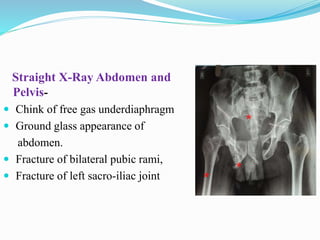
Straight X-Ray Abdomen and
Pelvis-
 Chink of free gas underdiaphragm
 Ground glass appearance of
abdomen.
 Fracture of bilateral pubic rami,
 Fracture of left sacro-iliac joint *
*
*
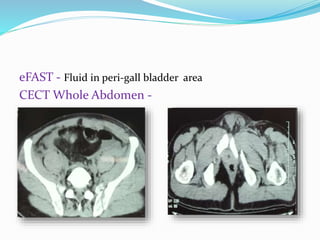
eFAST - Fluid in peri-gall bladder area
CECT Whole Abdomen -
X-Ray Cervical Spine and Chest X-Ray - WNL
Blood Parameters -
Hb- 8 gm%
TLC- 12,800 /cu mm
URGENT EXPLORATORY LAPAROTOMY
Lacerated Perforation
with Devascularisation of
a portion of Sigmoid
Colon
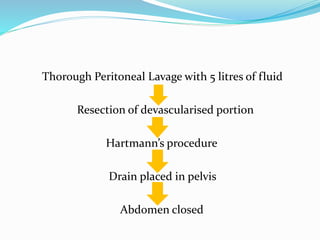
Thorough Peritoneal Lavage with 5 litres of fluid
Resection of devascularised portion
Hartmann’s procedure
Drain placed in pelvis
Abdomen closed
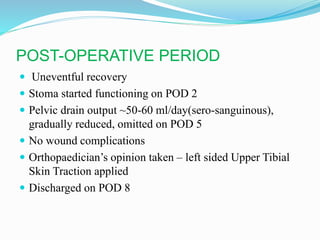
POST-OPERATIVE PERIOD
 Uneventful recovery
 Stoma started functioning on POD 2
 Pelvic drain output ~50-60 ml/day(sero-sanguinous),
gradually reduced, omitted on POD 5
 No wound complications
 Orthopaedician’s opinion taken – left sided Upper Tibial
Skin Traction applied
 Discharged on POD 8
FOLLOW UP
 Surgery and Orthopaedics OPDs
 Rehabilitation
 A year later, the patient walked into the Surgery OPD with
a wish to have the colostomy reversed
CLINICAL EXAMINATION
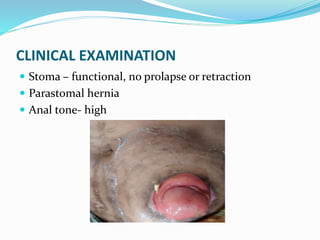
 Stoma – functional, no prolapse or retraction
 Parastomal hernia
 Anal tone- high
INVESTIGATIONS
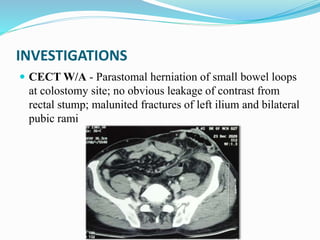
 CECT W/A - Parastomal herniation of small bowel loops
at colostomy site; no obvious leakage of contrast from
rectal stump; malunited fractures of left ilium and bilateral
pubic rami
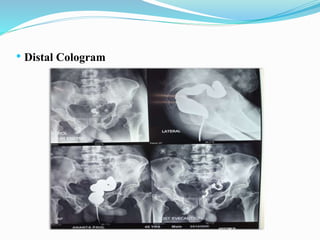
• Distal Cologram
REVERSAL OF HARTMANN’S
PROCEDURE
Abdomen opened → stoma dismantled →
adhesiolysis done → distal stump identified →
margin refreshening done → end to end hand
sewn anastomosis done → parastomal hernia
repaired → abdomen closed.
POST-OPERATIVE PERIOD
 Patient recovered well
 Normal bowel habit resumed and oral diet
started on POD 3
 Discharged in a stable condition on POD 6
Case:2
 25 years old male
 Presented in ER with features of peritonitis
 X-ray – free gas under diaphragm
 Patient was in shock – resuscitated
 Patient did not give any history of trauma
 CECT abdomen – no intra-abdominal
injury/pathology
 Taken up for exploratory laparotomy
 Findings – beyond expectation- a small perforation at
lower part of rectum
 Perforation was repaired
 Sigmoid colostomy done
 Next day – on repeated enquiry – history of
instrumentation per rectum revealed
 Patient was discharged on 8th POD
 Patient lost to follow up
DISCUSSION
BLUNT ABDOMINAL TRAUMA
 Only 1% incidence of hollow viscus injury
 0.3% incidence of colo-rectal injury
MECHANISM:-
Direct rapid compression of bowel between the
blunt object and the vertebral column or pelvis →
tear or laceration (most common)
Sudden deceleration producing bowel-
mesenteric disruption and subsequent
devascularisation
MECHANISM :-
Direct rapid compression of bowel between the
blunt object and the vertebral column or pelvis
→ tear or laceration (most common)
Sudden deceleration producing bowel-
mesenteric disruption and subsequent
devascularisation
DIAGNOSIS
 Colorectal injury associated with blunt abdominal
trauma is especially treacherous and is uncommon
enough to worry even the most experienced surgeon
 Bleeding per rectum, features of peritonitis
 Proper inspection of perineum
 Per rectal examintion – important
 Penetrating trauma is the most common cause of
rectal trauma - accounting for at least 95% of rectal
injuries
 Iatrogenic injuries sometimes occur during diagnostic
procedures, such as endoscopy or barium enema.
 Iatrogenic perforations during pelvic operations such
as radical prostatectomy, prostatic biopsy, or
gynecologic procedures are uncommon, and their true
incidence is unknown. Perforation of the rectum
during internal fixation of a hip fracture has been
reported.
 Presence of urethral injuries or pelvic fractures should
arouse suspicion
 eFAST; Straight X-ray abdomen; CECT W/A and
Pelvis
 Sigmoidoscopy- preferred method, but often not
available
 Diagnosis is often made only at the time of
Laparotomy!
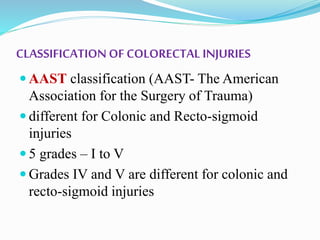
CLASSIFICATION OF COLORECTAL INJURIES
 AAST classification (AAST- The American
Association for the Surgery of Trauma)
 different for Colonic and Recto-sigmoid
injuries
 5 grades – I to V
 Grades IV and V are different for colonic and
recto-sigmoid injuries
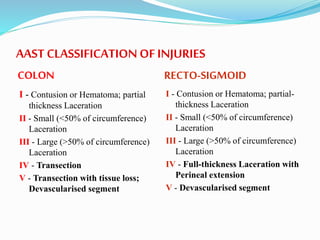
AAST CLASSIFICATION OF INJURIES
COLON RECTO-SIGMOID
I - Contusion or Hematoma; partial
thickness Laceration
II - Small (<50% of circumference)
Laceration
III - Large (>50% of circumference)
Laceration
IV - Transection
V - Transection with tissue loss;
Devascularised segment
I - Contusion or Hematoma; partial-
thickness Laceration
II - Small (<50% of circumference)
Laceration
III - Large (>50% of circumference)
Laceration
IV - Full-thickness Laceration with
Perineal extension
V - Devascularised segment
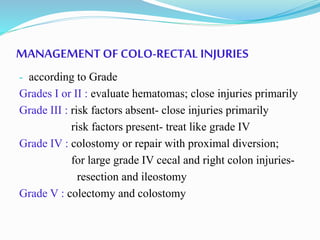
MANAGEMENT OF COLO-RECTAL INJURIES
- according to Grade
Grades I or II : evaluate hematomas; close injuries primarily
Grade III : risk factors absent- close injuries primarily
risk factors present- treat like grade IV
Grade IV : colostomy or repair with proximal diversion;
for large grade IV cecal and right colon injuries-
resection and ileostomy
Grade V : colectomy and colostomy
Colorectal trauma   2 cases

Colorectal trauma 2 cases

  • 1.
    COLORECTAL TRAUMA  DR.ARKAPROVOROY  ASSOCIATE PROFESSOR,  DR. DIBYASREE PAUL  2ND YEAR RESIDENT  DEPARTMENT OF SURGERY, MEDICAL COLLEGE, KOLKATA
  • 2.
    • an event,either witnessed or experienced, that represents a fundamental threat to an individual’s physical safety and survival • More than an event- it’s an EXPERIENCE, it has an EFFECT
  • 3.
    Case:1  45 yearold male  H/o blunt trauma to lower abdomen by a running vehicle  Severe lower abdominal pain radiating to whole abdomen  Inability to move both lower limbs
  • 4.
    PRIMARY SURVEY &RESUSCITATION  Conscious, alert, restless, GCS -15/15  Pulse-120/minute, low volume; BP- 110/74 mm of Hg  Pallor +  Chest – B/L clear, SpO2- 97%  Per abdomen- tense, generalised guarding, distended, diffuse tenderness+, IPS-  P/R- blood staining+, prostate palpable  Urine- not passed  Bruise over left iliac fossa, abrasions over pelvis and both lower limbs  Pelvic tenderness+, restriction of movement of B/L L/L
  • 5.
     Airway patencychecked, Moist O2 inhalation  Cervical spine support  Two large bore I.V. cannula → 2 litres of crystalloid solution infused in jet • Ryle’s tube suction • Foley’s catheterisation • Blood requisition
  • 6.
    Straight X-Ray Abdomenand Pelvis-  Chink of free gas underdiaphragm  Ground glass appearance of abdomen.  Fracture of bilateral pubic rami,  Fracture of left sacro-iliac joint * * *
  • 7.
    eFAST - Fluidin peri-gall bladder area CECT Whole Abdomen -
  • 8.
    X-Ray Cervical Spineand Chest X-Ray - WNL Blood Parameters - Hb- 8 gm% TLC- 12,800 /cu mm
  • 9.
  • 10.
    Lacerated Perforation with Devascularisationof a portion of Sigmoid Colon
  • 11.
    Thorough Peritoneal Lavagewith 5 litres of fluid Resection of devascularised portion Hartmann’s procedure Drain placed in pelvis Abdomen closed
  • 12.
    POST-OPERATIVE PERIOD  Uneventfulrecovery  Stoma started functioning on POD 2  Pelvic drain output ~50-60 ml/day(sero-sanguinous), gradually reduced, omitted on POD 5  No wound complications  Orthopaedician’s opinion taken – left sided Upper Tibial Skin Traction applied  Discharged on POD 8
  • 13.
    FOLLOW UP  Surgeryand Orthopaedics OPDs  Rehabilitation  A year later, the patient walked into the Surgery OPD with a wish to have the colostomy reversed
  • 14.
    CLINICAL EXAMINATION  Stoma– functional, no prolapse or retraction  Parastomal hernia  Anal tone- high
  • 15.
    INVESTIGATIONS  CECT W/A- Parastomal herniation of small bowel loops at colostomy site; no obvious leakage of contrast from rectal stump; malunited fractures of left ilium and bilateral pubic rami
  • 16.
  • 17.
    REVERSAL OF HARTMANN’S PROCEDURE Abdomenopened → stoma dismantled → adhesiolysis done → distal stump identified → margin refreshening done → end to end hand sewn anastomosis done → parastomal hernia repaired → abdomen closed.
  • 18.
    POST-OPERATIVE PERIOD  Patientrecovered well  Normal bowel habit resumed and oral diet started on POD 3  Discharged in a stable condition on POD 6
  • 19.
    Case:2  25 yearsold male  Presented in ER with features of peritonitis  X-ray – free gas under diaphragm  Patient was in shock – resuscitated  Patient did not give any history of trauma  CECT abdomen – no intra-abdominal injury/pathology  Taken up for exploratory laparotomy  Findings – beyond expectation- a small perforation at lower part of rectum
  • 20.
     Perforation wasrepaired  Sigmoid colostomy done  Next day – on repeated enquiry – history of instrumentation per rectum revealed  Patient was discharged on 8th POD  Patient lost to follow up
  • 21.
  • 22.
    BLUNT ABDOMINAL TRAUMA Only 1% incidence of hollow viscus injury  0.3% incidence of colo-rectal injury MECHANISM:- Direct rapid compression of bowel between the blunt object and the vertebral column or pelvis → tear or laceration (most common) Sudden deceleration producing bowel- mesenteric disruption and subsequent devascularisation
  • 23.
    MECHANISM :- Direct rapidcompression of bowel between the blunt object and the vertebral column or pelvis → tear or laceration (most common) Sudden deceleration producing bowel- mesenteric disruption and subsequent devascularisation
  • 24.
    DIAGNOSIS  Colorectal injuryassociated with blunt abdominal trauma is especially treacherous and is uncommon enough to worry even the most experienced surgeon  Bleeding per rectum, features of peritonitis  Proper inspection of perineum  Per rectal examintion – important
  • 25.
     Penetrating traumais the most common cause of rectal trauma - accounting for at least 95% of rectal injuries  Iatrogenic injuries sometimes occur during diagnostic procedures, such as endoscopy or barium enema.  Iatrogenic perforations during pelvic operations such as radical prostatectomy, prostatic biopsy, or gynecologic procedures are uncommon, and their true incidence is unknown. Perforation of the rectum during internal fixation of a hip fracture has been reported.
  • 26.
     Presence ofurethral injuries or pelvic fractures should arouse suspicion  eFAST; Straight X-ray abdomen; CECT W/A and Pelvis  Sigmoidoscopy- preferred method, but often not available  Diagnosis is often made only at the time of Laparotomy!
  • 27.
    CLASSIFICATION OF COLORECTALINJURIES  AAST classification (AAST- The American Association for the Surgery of Trauma)  different for Colonic and Recto-sigmoid injuries  5 grades – I to V  Grades IV and V are different for colonic and recto-sigmoid injuries
  • 28.
    AAST CLASSIFICATION OFINJURIES COLON RECTO-SIGMOID I - Contusion or Hematoma; partial thickness Laceration II - Small (<50% of circumference) Laceration III - Large (>50% of circumference) Laceration IV - Transection V - Transection with tissue loss; Devascularised segment I - Contusion or Hematoma; partial- thickness Laceration II - Small (<50% of circumference) Laceration III - Large (>50% of circumference) Laceration IV - Full-thickness Laceration with Perineal extension V - Devascularised segment
  • 29.
    MANAGEMENT OF COLO-RECTALINJURIES - according to Grade Grades I or II : evaluate hematomas; close injuries primarily Grade III : risk factors absent- close injuries primarily risk factors present- treat like grade IV Grade IV : colostomy or repair with proximal diversion; for large grade IV cecal and right colon injuries- resection and ileostomy Grade V : colectomy and colostomy