RECOMBINANT PROTEIN
    EXPRESSION
           BY
   KARIUKI M. SAMUEL
     ENOS KAMANI
INTRODUCTION
• RPE is a subcomponent of gene expression
  which involves translation of the gene into
  polypeptide chains and folding into proteins
• Used in esp. enzyme production, insulin,
  endonucleases, DNA pol, reverse T.
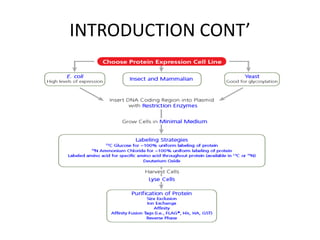
• Classified according to expression systems;
  bacterial, yeast, insect, mammalian.
INTRODUCTION CONT’
Bacterial expression
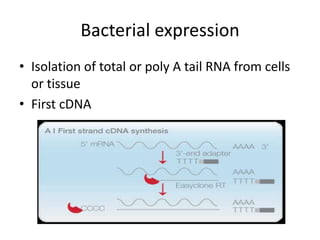
• Isolation of total or poly A tail RNA from cells
  or tissue
• First cDNA
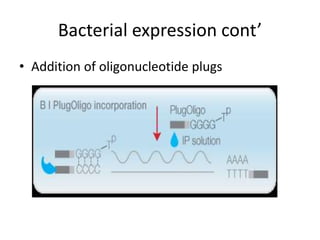
Bacterial expression cont’
• Addition of oligonucleotide plugs
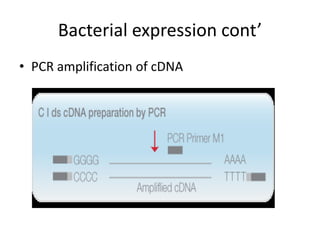
Bacterial expression cont’
• PCR amplification of cDNA
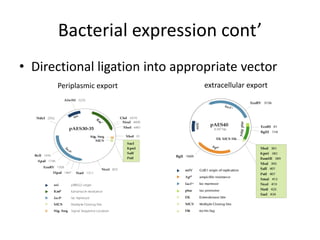
Bacterial expression cont’
• Directional ligation into appropriate vector
      Periplasmic export         extracellular export
Bacterial expression cont’
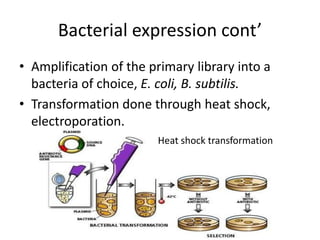
• Amplification of the primary library into a
  bacteria of choice, E. coli, B. subtilis.
• Transformation done through heat shock,
  electroporation.
                        Heat shock transformation
Bacterial expression cont’
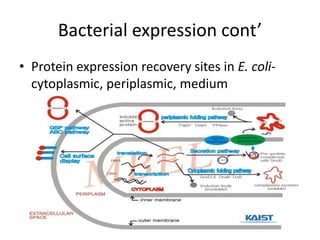
• Protein expression recovery sites in E. coli-
  cytoplasmic, periplasmic, medium
Bacteria expression cont’
•   Harvesting done by
•   Chemical
•   Enzymatic e.g lysozymes
•   Biochemical e.g osmotic shock
•   Physical e.g. sonication
•   Mutant E. coli strains, L-forms
Bacterial expression cont’
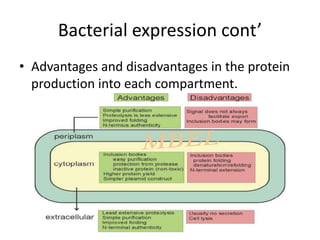
• Advantages and disadvantages in the protein
  production into each compartment.
Bacterial expression cont’
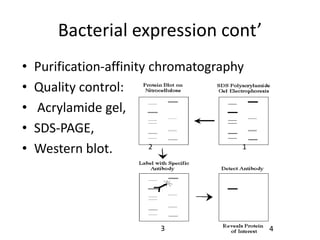
•   Purification-affinity chromatography
•   Quality control:
•   Acrylamide gel,
•   SDS-PAGE,
•   Western blot.         2             1


                          3                 4
Yeast expression
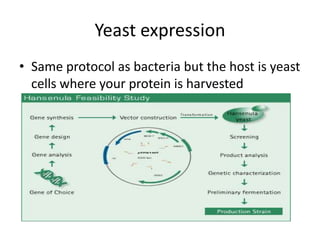
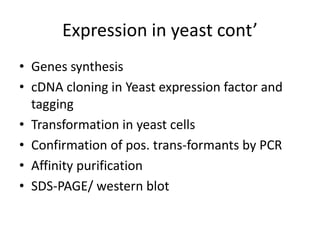
• Same protocol as bacteria but the host is yeast
  cells where your protein is harvested
Expression in yeast cont’
• Genes synthesis
• cDNA cloning in Yeast expression factor and
  tagging
• Transformation in yeast cells
• Confirmation of pos. trans-formants by PCR
• Affinity purification
• SDS-PAGE/ western blot
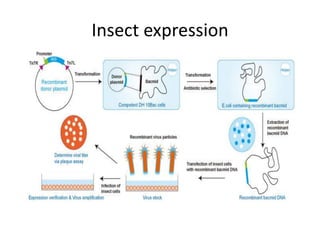
Insect expression
Insect expression cont’
• Gene synthesis
• cDNA cloning in baculovirus expression vector
• Recombinant virus generation and
  recombinant protein in bacmid
• Transfection of insects cells with recombinant
  bacmid
• Generation of virus stock in insect cells
• Quality control, SDS-PAGE/ western blot
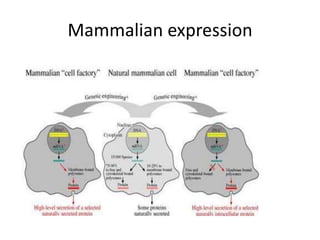
Mammalian expression
•   Gene synthesis
•   cDNA cloning into an expression factor
•   Transfection of cells with expression vector
•   Evaluation of expression by western blotting
•   Bio-reactor production
•   Harvesting
•   Affinity chromatography
•   Quality control, SDS-PAGE/ western blot
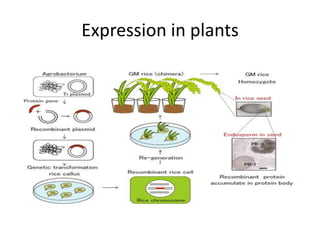
Expression in plants
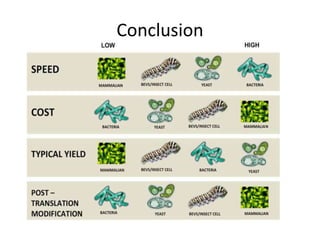
Conclusion
References
•   Artes Biotechnology Langenfeld, Germany, http://www.artes-
    biotechnology.com/expres/hansenula/hansenula01.jsp

•   Dual SystemsBiotech, Schleren, Switzerland.
    http://www.dualsystems.com/products/protein-expression/expression-vectors-
    for-escherichia-coli.html

•   Genscript, the biology GRO, Piscataway, USA.
    http://www.genscript.com/custom_protein_baculovirus_insect_expression.html
•   Joan L. &J. Foster (2009) Microbiology, an evolving science. W.W. Norton, New
    York, USA 2nd ed.
•   Park, S. J. and Lee, S. Y., "Efficient recovery of secretory recombinant protein from
    protease negative mutant Eshcherichia coli" Biotechnol. Techniques, 64(12):4897-
    4903 (1998)
•   Tokyo Future Style Inc.
    http://www.tokyofuturestyle.com/english/products/preventec/preventec_t.php
Merry-xmas

Recombinant protein expression seminar paper

  • 1.
    RECOMBINANT PROTEIN EXPRESSION BY KARIUKI M. SAMUEL ENOS KAMANI
  • 2.
    INTRODUCTION • RPE isa subcomponent of gene expression which involves translation of the gene into polypeptide chains and folding into proteins • Used in esp. enzyme production, insulin, endonucleases, DNA pol, reverse T. • Classified according to expression systems; bacterial, yeast, insect, mammalian.
  • 3.
  • 4.
    Bacterial expression • Isolationof total or poly A tail RNA from cells or tissue • First cDNA
  • 5.
    Bacterial expression cont’ •Addition of oligonucleotide plugs
  • 6.
    Bacterial expression cont’ •PCR amplification of cDNA
  • 7.
    Bacterial expression cont’ •Directional ligation into appropriate vector Periplasmic export extracellular export
  • 8.
    Bacterial expression cont’ •Amplification of the primary library into a bacteria of choice, E. coli, B. subtilis. • Transformation done through heat shock, electroporation. Heat shock transformation
  • 9.
    Bacterial expression cont’ •Protein expression recovery sites in E. coli- cytoplasmic, periplasmic, medium
  • 10.
    Bacteria expression cont’ • Harvesting done by • Chemical • Enzymatic e.g lysozymes • Biochemical e.g osmotic shock • Physical e.g. sonication • Mutant E. coli strains, L-forms
  • 11.
    Bacterial expression cont’ •Advantages and disadvantages in the protein production into each compartment.
  • 12.
    Bacterial expression cont’ • Purification-affinity chromatography • Quality control: • Acrylamide gel, • SDS-PAGE, • Western blot. 2 1 3 4
  • 13.
    Yeast expression • Sameprotocol as bacteria but the host is yeast cells where your protein is harvested
  • 14.
    Expression in yeastcont’ • Genes synthesis • cDNA cloning in Yeast expression factor and tagging • Transformation in yeast cells • Confirmation of pos. trans-formants by PCR • Affinity purification • SDS-PAGE/ western blot
  • 15.
  • 16.
    Insect expression cont’ •Gene synthesis • cDNA cloning in baculovirus expression vector • Recombinant virus generation and recombinant protein in bacmid • Transfection of insects cells with recombinant bacmid • Generation of virus stock in insect cells • Quality control, SDS-PAGE/ western blot
  • 17.
  • 18.
    Mammalian expression • Gene synthesis • cDNA cloning into an expression factor • Transfection of cells with expression vector • Evaluation of expression by western blotting • Bio-reactor production • Harvesting • Affinity chromatography • Quality control, SDS-PAGE/ western blot
  • 19.
  • 20.
  • 21.
    References • Artes Biotechnology Langenfeld, Germany, http://www.artes- biotechnology.com/expres/hansenula/hansenula01.jsp • Dual SystemsBiotech, Schleren, Switzerland. http://www.dualsystems.com/products/protein-expression/expression-vectors- for-escherichia-coli.html • Genscript, the biology GRO, Piscataway, USA. http://www.genscript.com/custom_protein_baculovirus_insect_expression.html • Joan L. &J. Foster (2009) Microbiology, an evolving science. W.W. Norton, New York, USA 2nd ed. • Park, S. J. and Lee, S. Y., "Efficient recovery of secretory recombinant protein from protease negative mutant Eshcherichia coli" Biotechnol. Techniques, 64(12):4897- 4903 (1998) • Tokyo Future Style Inc. http://www.tokyofuturestyle.com/english/products/preventec/preventec_t.php
  • 22.