Canal Preparation with only one
reciprocating instrument without prior
hand filing: A New concept.
Reciprocating Technique
OUTLINES :
Introduction.
Technique.
Advantages.
Obturations Retreatment.
Aim :
To introduce a new concept for canal preparation  a paradigm shift.
Paradigm shift :
• The canal preparation is accomplished using only one specifically
designed nickel-titanium engine-driven instrument used in
reciprocation and without prior hand filing.
• The notion of the "path of least resistance”.
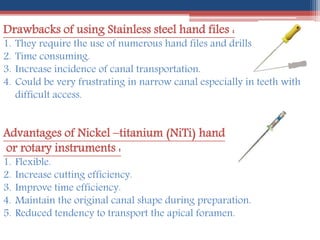
Drawbacks of using Stainless steel hand files :
1. They require the use of numerous hand files and drills .
2. Time consuming.
3. Increase incidence of canal transportation.
4. Could be very frustrating in narrow canal especially in teeth with
difficult access.
Advantages of Nickel –titanium (NiTi) hand
or rotary instruments :
1. Flexible.
2. Increase cutting efficiency.
3. Improve time efficiency.
4. Maintain the original canal shape during preparation.
5. Reduced tendency to transport the apical foramen.
Drawbacks of using instruments in reciprocation :
1. Fracture by cyclic fatigue in relation to the rigidity due to
size of instrument ,taper or cross section.
2. Glide path creation.
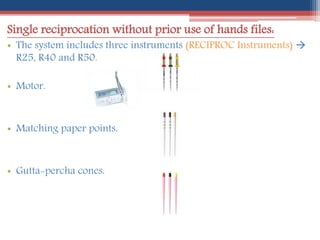
Single reciprocation without prior use of hands files:
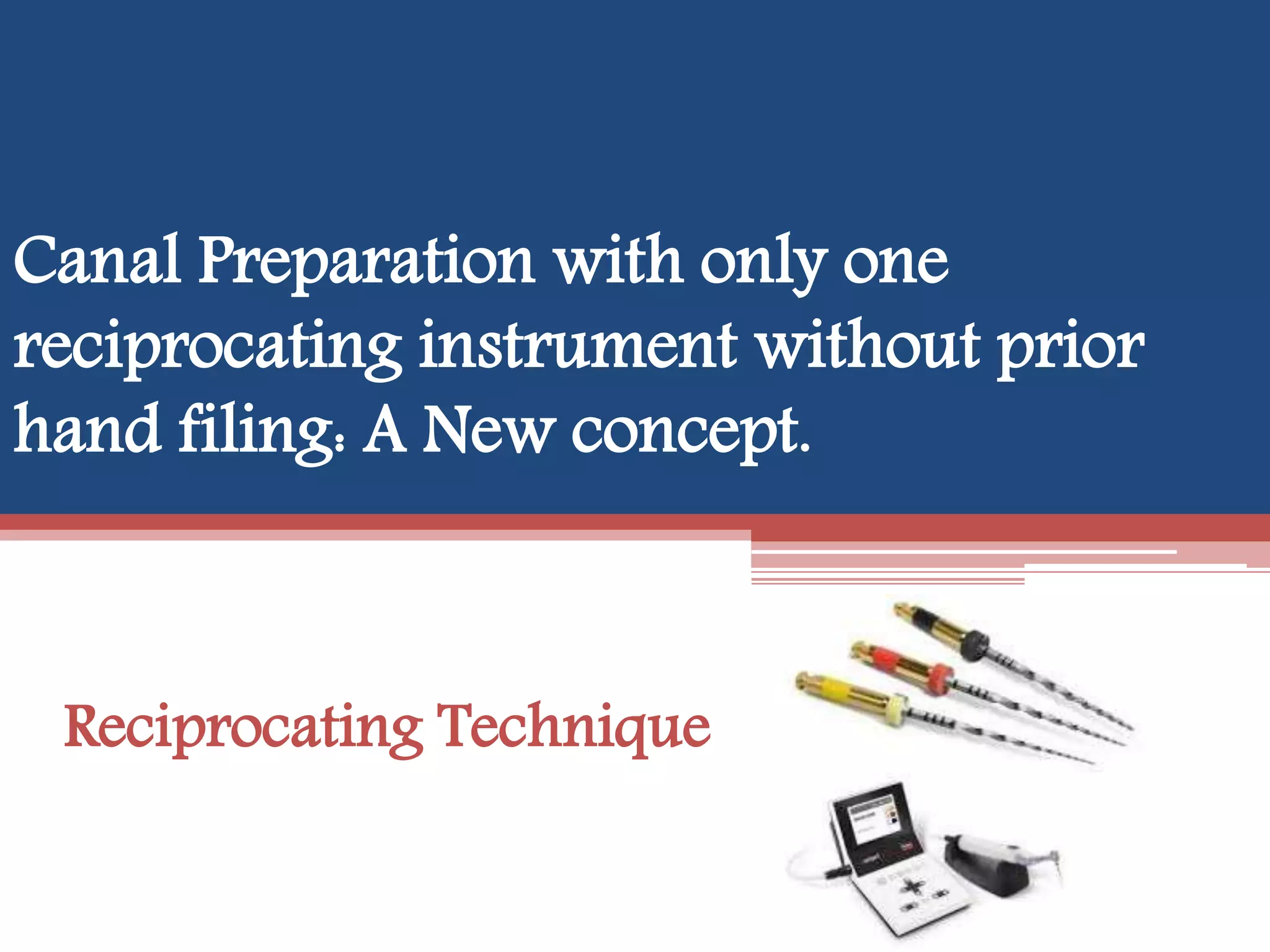
• The system includes three instruments (RECIPROC Instruments) 
R25, R40 and R50.
• Motor.
• Matching paper points.
• Gutta-percha cones.
• The instruments are made from an M-wire nickel –titanium that
prefer greater flexibility and resistance to cyclic stress.
• They also have s-shaped cross-section
with greater tapering.
• Have 10 cycles of reciprocation per second.
• The motor is programmed with the angles of reciprocation and
speed for the three instruments. The values of the CW and CCW
rotations are different. When the instrument rotates in the cutting
direction it will advance in the canal and engage dentine to cut it.
When it rotates in the opposite direction (smaller rotation) the
instrument will be immediately disengaged.
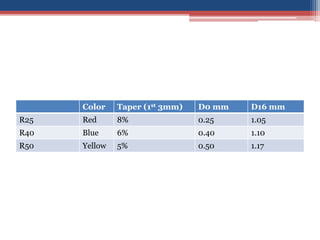
Color Taper (1st 3mm) D0 mm D16 mm
R25 Red 8% 0.25 1.05
R40 Blue 6% 0.40 1.10
R50 Yellow 5% 0.50 1.17
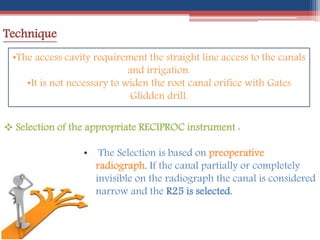
Technique
•The access cavity requirement the straight line access to the canals
and irrigation.
•It is not necessary to widen the root canal orifice with Gates
Glidden drill.
 Selection of the appropriate RECIPROC instrument :
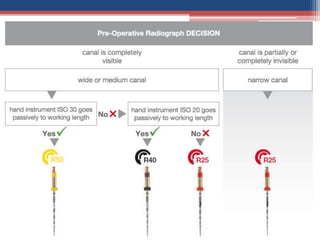
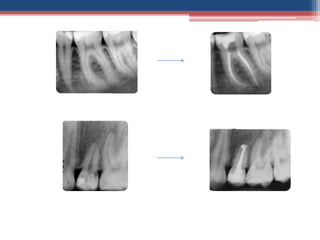
• The Selection is based on preoperative
radiograph. If the canal partially or completely
invisible on the radiograph the canal is considered
narrow and the R25 is selected.
• If radiograph shows the canal clearly from the access cavity to
the apex the canal considered medium , A size 30 hand
instrument ( with gentle watch winding motion but without
filing action) to WL.
• If it reaches the WL the canal is considered large , R50 is selected
for the canal preparation.
• If the size 20 hand instrument dose not reach the WL , the R25 is
selected.
• If it reaches WL the canal is considered medium the R40 is then
selected for the canal preparation .
 Preparation step by step (without creating a glide path) :
• Length of the root canal is estimated by radiograph.
• The Reciproc instrument is used until it reached 2/3 of the working
length.
• Silicon stopper set on the instrument.
• The instrument is introduced in the canal with slow in-and-out
motion, then it pulled out of the canal to clean the flutes.
• The canal is Irrigated.
• #10 file is used to check patency 2/3 of the working length.
• The Reciproc instrument is then used at the
same manner until the working length
has been reached.
( The Reciproc can also be used in a brushing motion).
 Creating a glide path during the use of the RECIPROC®
instruments: indication and management :
• With continues rotary NITI systems it is necessary to create a glide
path in order to minimize the risk of fracture by minimize the
incidence of instrument binding.
• What is the glide path ??
The endodontic glide path is a smooth radicular tunnel from canal
orifice to physiologic terminus (foraminal constriction). Its
minimal size should be a “super loose No.10 or 15”.
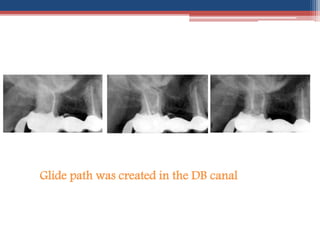
Glide path was created in the DB canal
• When the RECIPROC instrument stops advancing in the canal or
advancement becomes difficult pressure should not be exerted on
the RECIPROC instrument.
What you should do is :
• The instrument should be removed from the canal and the canal
irrigated if still advanced it should be removed from the canal and
at this point hand file #10 and 15 should be used to create a glide
path to the working length
(If the RECEPROC instrument still difficult or not possible the canal
preparation would need to be completed with hand files).
 Using hand files to finish the apical canal preparation:
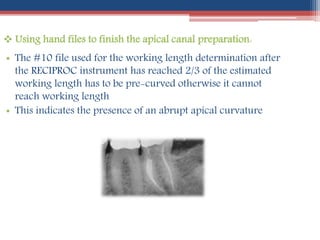
• The #10 file used for the working length determination after
the RECIPROC instrument has reached 2/3 of the estimated
working length has to be pre-curved otherwise it cannot
reach working length
• This indicates the presence of an abrupt apical curvature
 Increased apical enlargement :
• In some canals an increased
apical enlargement may be
required
• A large RECIPROC
instrument or a hand
instrument may be used for
this purpose following R25
and the R40 and a hand
instrument is used
following the R50
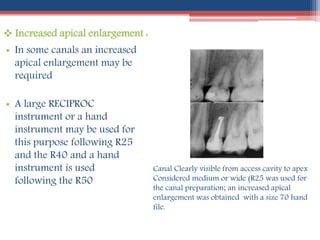
Canal Clearly visible from access cavity to apex
Considered medium or wide (R25 was used for
the canal preparation; an increased apical
enlargement was obtained with a size 70 hand
file.
Advantages of the reciproc concept and instruments:
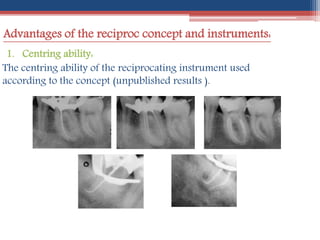
1. Centring ability:
The centring ability of the reciprocating instrument used
according to the concept (unpublished results ).
2. Safety:
In reciprocation, clockwise and counterclockwise
angles determine the amplitude of reciprocation.
These angles, stored in motor are significantly lower than the angles
at any any instrument would usually fracture. If the instrument
binds in the canal will not fracture.
3. Shorter working time:
Working time is 4 times faster with single file reciprocation in
comparison with NiTi.
4.Faster learning :
92% of Reciprco users were able to prepare three canals without
errors compared to 30% of NiTi system.
5. Less procedural errors.
6.Elimination of cross contamination between patients :
The possibility of cross contamination associated with inability
to clean and sterilize instrument.
Tooth structure and organic debris were observed on the
surface of NiTi rotary instrument .
While the single use of instrument was recommended to reduce
instrument fatigue and possible cross contamination.
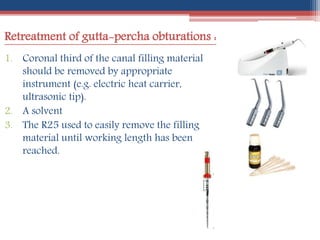
Retreatment of gutta-percha obturations :
1. Coronal third of the canal filling material
should be removed by appropriate
instrument (e.g. electric heat carrier,
ultrasonic tip).
2. A solvent
3. The R25 used to easily remove the filling
material until working length has been
reached.
4. If resistance is encountered, pressure should not be applied.
5. Solvent replaced and The R25 used again.
6. After reaching the working length by R25, the R40 or R50 can be
used for increase the apical enlargement .
(RECIPROC instruments can be used in brushing motion against the
lateral walls of the canal to remove any residual filling material).
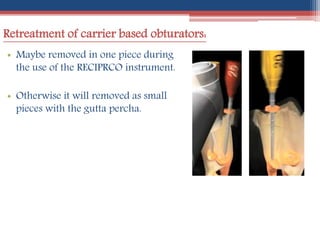
Retreatment of carrier based obturators:
• Maybe removed in one piece during
the use of the RECIPRCO instrument.
• Otherwise it will removed as small
pieces with the gutta percha.
Done By :
Sarah sidky mohammed

Reciprocating technique

  • 1.
    Canal Preparation withonly one reciprocating instrument without prior hand filing: A New concept. Reciprocating Technique
  • 2.
  • 3.
    Aim : To introducea new concept for canal preparation  a paradigm shift. Paradigm shift : • The canal preparation is accomplished using only one specifically designed nickel-titanium engine-driven instrument used in reciprocation and without prior hand filing. • The notion of the "path of least resistance”.
  • 4.
    Drawbacks of usingStainless steel hand files : 1. They require the use of numerous hand files and drills . 2. Time consuming. 3. Increase incidence of canal transportation. 4. Could be very frustrating in narrow canal especially in teeth with difficult access. Advantages of Nickel –titanium (NiTi) hand or rotary instruments : 1. Flexible. 2. Increase cutting efficiency. 3. Improve time efficiency. 4. Maintain the original canal shape during preparation. 5. Reduced tendency to transport the apical foramen.
  • 5.
    Drawbacks of usinginstruments in reciprocation : 1. Fracture by cyclic fatigue in relation to the rigidity due to size of instrument ,taper or cross section. 2. Glide path creation.
  • 6.
    Single reciprocation withoutprior use of hands files: • The system includes three instruments (RECIPROC Instruments)  R25, R40 and R50. • Motor. • Matching paper points. • Gutta-percha cones.
  • 7.
    • The instrumentsare made from an M-wire nickel –titanium that prefer greater flexibility and resistance to cyclic stress. • They also have s-shaped cross-section with greater tapering. • Have 10 cycles of reciprocation per second. • The motor is programmed with the angles of reciprocation and speed for the three instruments. The values of the CW and CCW rotations are different. When the instrument rotates in the cutting direction it will advance in the canal and engage dentine to cut it. When it rotates in the opposite direction (smaller rotation) the instrument will be immediately disengaged.
  • 8.
    Color Taper (1st3mm) D0 mm D16 mm R25 Red 8% 0.25 1.05 R40 Blue 6% 0.40 1.10 R50 Yellow 5% 0.50 1.17
  • 9.
    Technique •The access cavityrequirement the straight line access to the canals and irrigation. •It is not necessary to widen the root canal orifice with Gates Glidden drill.  Selection of the appropriate RECIPROC instrument : • The Selection is based on preoperative radiograph. If the canal partially or completely invisible on the radiograph the canal is considered narrow and the R25 is selected.
  • 11.
    • If radiographshows the canal clearly from the access cavity to the apex the canal considered medium , A size 30 hand instrument ( with gentle watch winding motion but without filing action) to WL. • If it reaches the WL the canal is considered large , R50 is selected for the canal preparation. • If the size 20 hand instrument dose not reach the WL , the R25 is selected. • If it reaches WL the canal is considered medium the R40 is then selected for the canal preparation .
  • 13.
     Preparation stepby step (without creating a glide path) : • Length of the root canal is estimated by radiograph. • The Reciproc instrument is used until it reached 2/3 of the working length. • Silicon stopper set on the instrument. • The instrument is introduced in the canal with slow in-and-out motion, then it pulled out of the canal to clean the flutes. • The canal is Irrigated. • #10 file is used to check patency 2/3 of the working length. • The Reciproc instrument is then used at the same manner until the working length has been reached. ( The Reciproc can also be used in a brushing motion).
  • 14.
     Creating aglide path during the use of the RECIPROC® instruments: indication and management : • With continues rotary NITI systems it is necessary to create a glide path in order to minimize the risk of fracture by minimize the incidence of instrument binding. • What is the glide path ?? The endodontic glide path is a smooth radicular tunnel from canal orifice to physiologic terminus (foraminal constriction). Its minimal size should be a “super loose No.10 or 15”.
  • 15.
    Glide path wascreated in the DB canal
  • 16.
    • When theRECIPROC instrument stops advancing in the canal or advancement becomes difficult pressure should not be exerted on the RECIPROC instrument. What you should do is : • The instrument should be removed from the canal and the canal irrigated if still advanced it should be removed from the canal and at this point hand file #10 and 15 should be used to create a glide path to the working length (If the RECEPROC instrument still difficult or not possible the canal preparation would need to be completed with hand files).
  • 17.
     Using handfiles to finish the apical canal preparation: • The #10 file used for the working length determination after the RECIPROC instrument has reached 2/3 of the estimated working length has to be pre-curved otherwise it cannot reach working length • This indicates the presence of an abrupt apical curvature
  • 18.
     Increased apicalenlargement : • In some canals an increased apical enlargement may be required • A large RECIPROC instrument or a hand instrument may be used for this purpose following R25 and the R40 and a hand instrument is used following the R50 Canal Clearly visible from access cavity to apex Considered medium or wide (R25 was used for the canal preparation; an increased apical enlargement was obtained with a size 70 hand file.
  • 19.
    Advantages of thereciproc concept and instruments: 1. Centring ability: The centring ability of the reciprocating instrument used according to the concept (unpublished results ).
  • 20.
    2. Safety: In reciprocation,clockwise and counterclockwise angles determine the amplitude of reciprocation. These angles, stored in motor are significantly lower than the angles at any any instrument would usually fracture. If the instrument binds in the canal will not fracture.
  • 21.
    3. Shorter workingtime: Working time is 4 times faster with single file reciprocation in comparison with NiTi. 4.Faster learning : 92% of Reciprco users were able to prepare three canals without errors compared to 30% of NiTi system. 5. Less procedural errors.
  • 22.
    6.Elimination of crosscontamination between patients : The possibility of cross contamination associated with inability to clean and sterilize instrument. Tooth structure and organic debris were observed on the surface of NiTi rotary instrument . While the single use of instrument was recommended to reduce instrument fatigue and possible cross contamination.
  • 23.
    Retreatment of gutta-perchaobturations : 1. Coronal third of the canal filling material should be removed by appropriate instrument (e.g. electric heat carrier, ultrasonic tip). 2. A solvent 3. The R25 used to easily remove the filling material until working length has been reached.
  • 24.
    4. If resistanceis encountered, pressure should not be applied. 5. Solvent replaced and The R25 used again. 6. After reaching the working length by R25, the R40 or R50 can be used for increase the apical enlargement . (RECIPROC instruments can be used in brushing motion against the lateral walls of the canal to remove any residual filling material).
  • 25.
    Retreatment of carrierbased obturators: • Maybe removed in one piece during the use of the RECIPRCO instrument. • Otherwise it will removed as small pieces with the gutta percha.
  • 26.
    Done By : Sarahsidky mohammed

Editor's Notes

  • #23 The introduction of this new concept to reduce the number of instrument .