Jyoti Pandey
Optometrist
Recent advancement in
OPTOMETRY
1
Contents..
l Optometry the beginning.
l Recent advancement.
l Reference.
2
Optometry... The Beginning
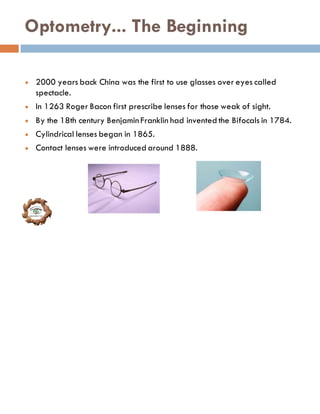
l 2000 years back China was the first to use glasses over eyes called
spectacle.
l In 1263 Roger Bacon first prescribe lenses for those weak of sight.
l By the 18th century Benjamin Franklin had invented the Bifocals in 1784.
l Cylindrical lenses began in 1865.
l Contact lenses were introduced around 1888.
Recent advancement..
l Antimicrobial Coatings for contact lens.
l Advancement in diabetic related eye diseases.
l Stem cells therapy for eye disorders.
l Optiwave refractive analysis.
l Optos retinal scanning.
l Visual prosthesis.
l Ocular drug delivery systems.
l Orthokeratology.
4
Antimicrobial Coatings for contact
lenses.
l Contact lens can act as a vector for microorganismsto the ocular surface.
l Improper Lens handling greatly increases the lens contamination.
l Coagulase-negative Staphylococci are most commonly cultured from worn
lenses.
l Extended wear lenses are risk factors for developing microbial keratitis.
l Contaminated lens solution.
So, these are the difficulties before this advancement.
About Antimicrobial Coatings.
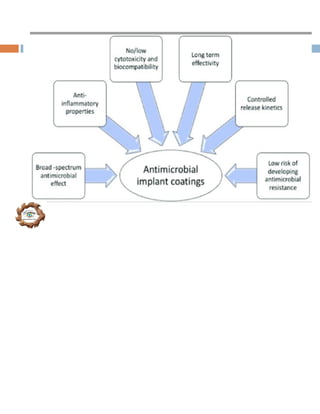
l To protect the lens surface itself from bacteria without the use of
disinfectant solutions.
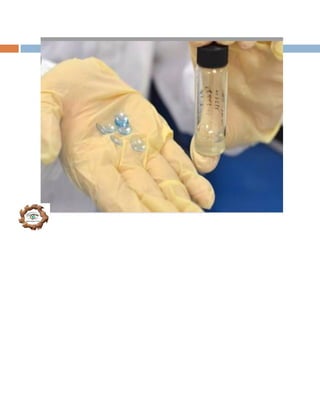
l The university of New South Wales is developing a coating for contact
lenses made of a material called Melimine.
l It is a peptide that remains effective when applied to contact lenses and
worn in your eyes.
l It is safe and remain stable when exposed to heat and liquid.
l Melimine is non toxic to mammals.
Cont...
 Antimicrobial peptides are a class of antimicrobial agents that
are active against a wide spectrum of microorganisms.
 Melimine is a synthetic peptide consisting of 29 amino acid
residues derived from melittin and protamine.
 Melimine has high activity, which exceeds that of a mixture of
two parents.
 Earlier studies have shown that Melimine coated contact lenses
can reduce P. aeruginosa adhesion to contact lenses.
 Studies also showed the reduction of incidence and severity of
noninfectious keratities in a Guinea pig model.
Cont...
 Melimine is not cytotoxic to a mammalian cells in vitro, or
animals eyes and can be worn safely by humans.
 Reference: Dart Jk, Stapleton F, Minassian D. Contact lenses
and orther risk factors in microbial keratities. Lancet.
1991;338:650-653. [cross ref] [pubmed]
Advancement in diabetic related
eye diseases..
 What were the difficulties before this advancement?
1. The first xenon-arcphotocoagulatorin 1956. This was effective but it was
difficult to focus beam to a small spot, treatment required long exposure and
were often painful.
2. Ruby laser successfully applied therapeutically but intense chorioretinal
destruction and frequent hemorrhaging soon showed to be an issue.
3. Also there was problem with the delivery systems like monocular direct
ophthalmoscope.
About scatter laser...
l Scatter laser treatment for diabetic retinopathy is an advancement that has
been proven effective.
12
Cont...
 Treatment is decided based on the type and severity of the
disease, and patients response to prior treatment.
 Nonproliferative diabetic retinopathy may not require
immediate treatment. Maintenance and control of blood sugar
levels can prevent progression to more serious stages of
retinopathy.
 However, severe cases may require surgery. The procedure
include:
 1. Focal laser treatment: A laser is used to burn abnormal
vessels to stop or slow down leakage.
Cont...
 2. Scatter laser treatment: A laser is used to burn, shrink and scar
abnormal vessels. It requires 1200-1800 individual laser spots,
usually spread over two or three sessions. It is used to treat
proliferative diabetic retinopathy.
 3. Vitrectomy: Scar tissues pulling the retina and blood leakage are
removed and replaced with a salt solution to maintain the shape of
the eye.
Benefits of scatter laser:
 Argon laser can use the blue and green light emission absorbed by both
haemoglobin and melanin.
 It produces less adverse effects.
 Also beneficial for age related macular degeneration and retinal vein
occlusion.
 Its delivery systems includes silt lamp and indirect ophthalmoscope which
gives wide view.
 Still many more inventionsare coming up
Cont...
 Researchers have found the new drug called ruboxistaurin (RBX), reduces
the occurrence of moderate vision loss due to diabetes.
 RBX treating diabetic kidney disease and possibly heart disease.
 This drug evolved from a discovery: Joslin scientists uncovered a major
signalling pathway at the molecular level by which high amounts of glucose
damage blood vessels. RBX blocks a form of an enzyme that the Joslin
team found is activated in blood vessels in eyes, kidney and the heart.
 This article originally appeared in the Special Diabetes Insert in the
November13, 2006 issue of TIME Magazine.
Stem cell therapy..
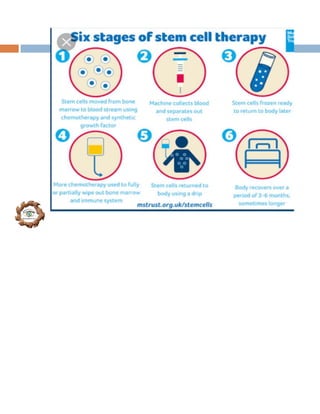
l Researchers are working on stem cell therapy as a treatment for retinal
and optic nerve problems.
l Stem cell treatments enable to body to regenerate healthy cells that have
been destroyed by certain conditions and restore function.
l Helpful in age related macular degeneration and glaucoma.
l At present FDA has not approved
this stem cell therapy.
17
Optiwave refractive analysis..
l Prior to the ORA system, surgeons were unable to assess the
quality of vision during the procedure, and would often have
to wait until weeks after surgery to determine the accuracy of
the surgical results.
This is only problem which was faced before this advancement.
About Optiwave refractive
analysis..
l New technology called optiwave refractive analysis allows surgeonsto
analyze the eyes during the procedure using laser.
l Earlier cataract surgeon would need to wait several weeks in order to
assess the effectiveness of the IOL and to know weather the best type
of IOL was selected.
l ORA reduces the uncertainty and gives our eye surgeon the ability to
verify proper selection of IOL during the cataract surgery procedure.
l With ORA's intraoperative aberrometer our cataract surgeon can get a
precise assessment of the IOL and how much vision improvement can be
obtained from it.
l ORA can also be performed on patients like post LASIK and PRK.
21
Optos retinal scanning..
 Below are the difficulties before Optos retinal scanning introduced:
1. Older retinal imaging technique provide only 15% of retina at a time.
2. Dilating drops were necessary, which feels like irritants for some patients.
3. It provide mainly the view of posteriorpole which includes macula and
optic disc only.
4. Using this older technique one can missed out serious peripheral retinal
view like retinal holes, retinal detachment, lattice etc.
About Optos retinal scanning..
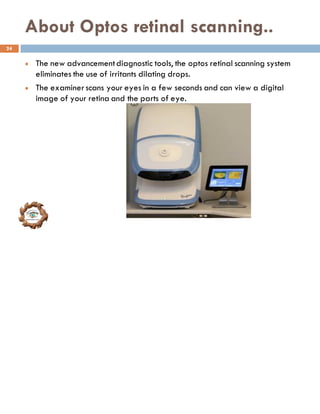
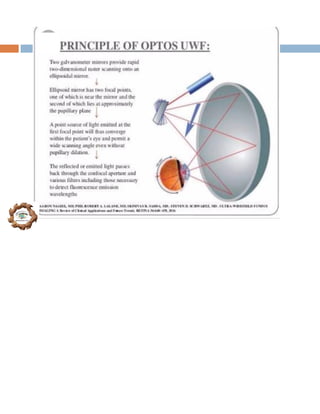
l The new advancementdiagnostic tools, the optos retinal scanning system
eliminates the use of irritants dilating drops.
l The examinerscans your eyes in a few seconds and can view a digital
image of your retina and the parts of eye.
24
Cont...
 This new technology called Optos retinal scanning brings benefits like :
 Used in non-mydriatic, high resolution ultra wide - field imaging ( up to 200
degrees)through many cataracts, and small pupils as 2mm. According to
optos other features include:
 1. Ultra wide field indocyanine green angiography, in addition to the
previously available composite color, red free, autofluorescence and
fluorescein angiographymodes.
 2. The device allows parallel capture of fluorescein angiography and ICG
images without manually switching between modalities.
Cont...
 3. Proviewsoftware which displays wide field scans in a consistent
geometry that accurately represent anatomical features in the retina.
 4. New proprietary optical hardware that optimize resolution through out
retinal scans, resulting in mire clarity in the periphery.
 5. Automatic image registration for longitudinal tracking and inter modality
image comparison.
 6. Images taken in different modalitiesor on different dates can be
overlaid for comparison.
 Reference: sagong M, van Hemert J, Olmos de Koo LC, Barnett C, Sadda
SR. Assessment of accuracy and precision of qualification of ultra wide field
images. Ophthalmology 2015;122:4:864-6.
l OPTOS vs traditional
Visual prosthesis.
l It is achieved by stimulation of nerve fibers. All retinal prosthesis under
developmentare intended to deliver electrical pulses on to the retina.
l The retinal prosthesiswill capture visual images using micro electronic
prosthesis and turn light energy into electrical pulses and pass electrical
pulses to the retina thus enabling the blind to have vision.
l Often referred as a Bionic Eye.
29
Cont...
 Patients with the vision loss due to degeneration of photoreceptor like
retinitis pigmentosa, choroideremia, macular degeneration are the best
candidate for treatment.
 This visual prosthetics manufactured by second sight medical products and
Argus II co developed at the university of southern California eye institute.
 These are on going projects:
1. Argus retinal prosthesis.
2. Microsystem based visual prosthesis.
3. Implantable miniature telescope.
4. Harvard/ MIT retinal implant.
5. Artificial silicone retina.
6. Photovoltaic retinal prosthesis.
7. Intracortical visual prosthesis.
Advances in ocular drug delivery.
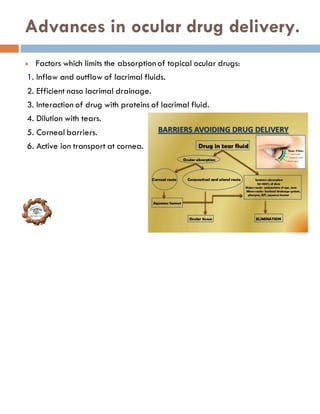
l Factors which limits the absorption of topical ocular drugs:
1. Inflow and outflow of lacrimal fluids.
2. Efficient naso lacrimal drainage.
3. Interaction of drug with proteins of lacrimal fluid.
4. Dilution with tears.
5. Corneal barriers.
6. Active ion transport at cornea.
About ocular drug delivery.
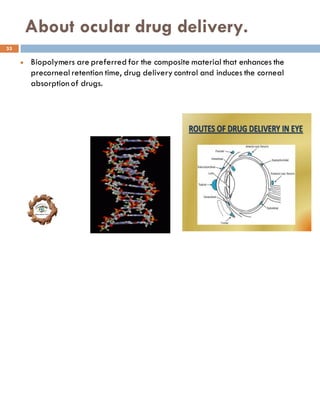
l Biopolymers are preferred for the composite material that enhances the
precorneal retention time, drug delivery control and induces the corneal
absorption of drugs.
33
Cont...
 Administration of drugs to the ocular region with conventional
delivery systems leads to short contact time of the formulations
on the epithelium and fast elimination of drugs.
 This transient residence time involves poor availability of drugs
which can be explained by the tear production, non productive
absorption and impermeability of corneal epithelium.
 Recently on ocular dosage forms, chemical delivery systems
such as prodrugs, the use of cyclodextrins to increase solubility
of various drugs.
 For details: refer to Article. Literature review (PDF available)
in drug development and industrial pharmacy.
Cont...
 Ideal characteristics of ocular drugs delivery systems:
1. Sterility.
2. Isotonicity like 1.9% boric acid, 0.9% NaCl.
3. Buffer/pHadjustment.
4. Less drainage tendency.
5. Minimum protein binding.
Cont...
 Approaches to improve ocular drug delivery systems:
1. Viscosity enhancers.
2. Eye ointment.
3. Gel (hydrogel & organogels)
4. Prodrug.
5. Penetration enhancers.
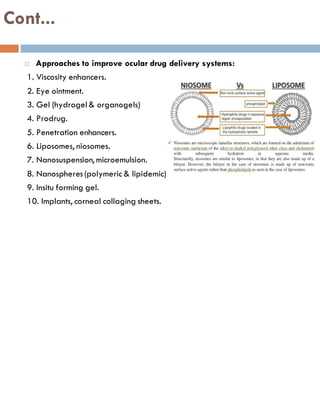
6. Liposomes, niosomes.
7. Nanosuspension, microemulsion.
8. Nanospheres(polymeric & lipidemic)
9. Insitu forming gel.
10. Implants, corneal collaging sheets.
Orthokeratology.
 Difficulties before orthokeratology lenses:
1. Myopia progression leads to frequent change in spectacle power.
2. Need of wearing glasses & contact lenses regularly.
3. CL wearers developed dry eyes because of discomfort or sensitivity to their
lenses.
4. Broken lenses or frame for school age children.
5. Surgery cost.
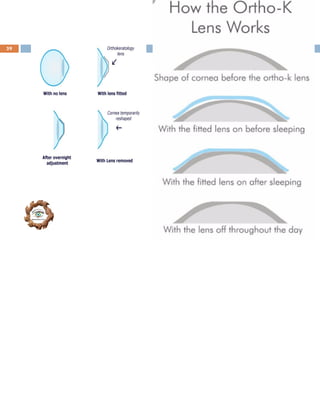
About Orthokeratology.
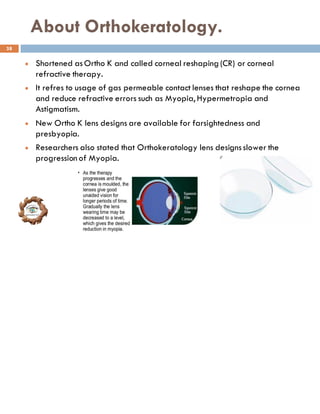
l Shortened asOrtho K and called corneal reshaping (CR) or corneal
refractive therapy.
l It refres to usage of gas permeable contact lenses that reshape the cornea
and reduce refractive errors such as Myopia, Hypermetropia and
Astigmatism.
l New Ortho K lens designs are available for farsightedness and
presbyopia.
l Researchers also stated that Orthokeratology lens designsslower the
progression of Myopia.
38
39
Advantages of Ortho-K
 Free from CL and specs for all waking hours.
 Ideal for sports persons.
 It slows progression ofmyopia by 50% (published in late 2004 in
international journal).
 Procedure is reversible.
 No post operative pain.
 Does not leave hazy vision.
 No loss of Bowman's membrane.
 Cheaper.
 No age limit.
Reference..
l History of Optometry by matty byloss.
l https:/www.lasikmd.com/blog/evolution-optometry-quick-look-history.
l Pointgreyeyecare.com
l Drrosaoptometry.com
l Google for images.
41
Keep learning...
42

Recent advancements in optometry

  • 1.
  • 2.
    Contents.. l Optometry thebeginning. l Recent advancement. l Reference. 2
  • 3.
    Optometry... The Beginning l2000 years back China was the first to use glasses over eyes called spectacle. l In 1263 Roger Bacon first prescribe lenses for those weak of sight. l By the 18th century Benjamin Franklin had invented the Bifocals in 1784. l Cylindrical lenses began in 1865. l Contact lenses were introduced around 1888.
  • 4.
    Recent advancement.. l AntimicrobialCoatings for contact lens. l Advancement in diabetic related eye diseases. l Stem cells therapy for eye disorders. l Optiwave refractive analysis. l Optos retinal scanning. l Visual prosthesis. l Ocular drug delivery systems. l Orthokeratology. 4
  • 5.
    Antimicrobial Coatings forcontact lenses. l Contact lens can act as a vector for microorganismsto the ocular surface. l Improper Lens handling greatly increases the lens contamination. l Coagulase-negative Staphylococci are most commonly cultured from worn lenses. l Extended wear lenses are risk factors for developing microbial keratitis. l Contaminated lens solution. So, these are the difficulties before this advancement.
  • 6.
    About Antimicrobial Coatings. lTo protect the lens surface itself from bacteria without the use of disinfectant solutions. l The university of New South Wales is developing a coating for contact lenses made of a material called Melimine. l It is a peptide that remains effective when applied to contact lenses and worn in your eyes. l It is safe and remain stable when exposed to heat and liquid. l Melimine is non toxic to mammals.
  • 7.
    Cont...  Antimicrobial peptidesare a class of antimicrobial agents that are active against a wide spectrum of microorganisms.  Melimine is a synthetic peptide consisting of 29 amino acid residues derived from melittin and protamine.  Melimine has high activity, which exceeds that of a mixture of two parents.  Earlier studies have shown that Melimine coated contact lenses can reduce P. aeruginosa adhesion to contact lenses.  Studies also showed the reduction of incidence and severity of noninfectious keratities in a Guinea pig model.
  • 8.
    Cont...  Melimine isnot cytotoxic to a mammalian cells in vitro, or animals eyes and can be worn safely by humans.  Reference: Dart Jk, Stapleton F, Minassian D. Contact lenses and orther risk factors in microbial keratities. Lancet. 1991;338:650-653. [cross ref] [pubmed]
  • 11.
    Advancement in diabeticrelated eye diseases..  What were the difficulties before this advancement? 1. The first xenon-arcphotocoagulatorin 1956. This was effective but it was difficult to focus beam to a small spot, treatment required long exposure and were often painful. 2. Ruby laser successfully applied therapeutically but intense chorioretinal destruction and frequent hemorrhaging soon showed to be an issue. 3. Also there was problem with the delivery systems like monocular direct ophthalmoscope.
  • 12.
    About scatter laser... lScatter laser treatment for diabetic retinopathy is an advancement that has been proven effective. 12
  • 13.
    Cont...  Treatment isdecided based on the type and severity of the disease, and patients response to prior treatment.  Nonproliferative diabetic retinopathy may not require immediate treatment. Maintenance and control of blood sugar levels can prevent progression to more serious stages of retinopathy.  However, severe cases may require surgery. The procedure include:  1. Focal laser treatment: A laser is used to burn abnormal vessels to stop or slow down leakage.
  • 14.
    Cont...  2. Scatterlaser treatment: A laser is used to burn, shrink and scar abnormal vessels. It requires 1200-1800 individual laser spots, usually spread over two or three sessions. It is used to treat proliferative diabetic retinopathy.  3. Vitrectomy: Scar tissues pulling the retina and blood leakage are removed and replaced with a salt solution to maintain the shape of the eye.
  • 15.
    Benefits of scatterlaser:  Argon laser can use the blue and green light emission absorbed by both haemoglobin and melanin.  It produces less adverse effects.  Also beneficial for age related macular degeneration and retinal vein occlusion.  Its delivery systems includes silt lamp and indirect ophthalmoscope which gives wide view.  Still many more inventionsare coming up
  • 16.
    Cont...  Researchers havefound the new drug called ruboxistaurin (RBX), reduces the occurrence of moderate vision loss due to diabetes.  RBX treating diabetic kidney disease and possibly heart disease.  This drug evolved from a discovery: Joslin scientists uncovered a major signalling pathway at the molecular level by which high amounts of glucose damage blood vessels. RBX blocks a form of an enzyme that the Joslin team found is activated in blood vessels in eyes, kidney and the heart.  This article originally appeared in the Special Diabetes Insert in the November13, 2006 issue of TIME Magazine.
  • 17.
    Stem cell therapy.. lResearchers are working on stem cell therapy as a treatment for retinal and optic nerve problems. l Stem cell treatments enable to body to regenerate healthy cells that have been destroyed by certain conditions and restore function. l Helpful in age related macular degeneration and glaucoma. l At present FDA has not approved this stem cell therapy. 17
  • 20.
    Optiwave refractive analysis.. lPrior to the ORA system, surgeons were unable to assess the quality of vision during the procedure, and would often have to wait until weeks after surgery to determine the accuracy of the surgical results. This is only problem which was faced before this advancement.
  • 21.
    About Optiwave refractive analysis.. lNew technology called optiwave refractive analysis allows surgeonsto analyze the eyes during the procedure using laser. l Earlier cataract surgeon would need to wait several weeks in order to assess the effectiveness of the IOL and to know weather the best type of IOL was selected. l ORA reduces the uncertainty and gives our eye surgeon the ability to verify proper selection of IOL during the cataract surgery procedure. l With ORA's intraoperative aberrometer our cataract surgeon can get a precise assessment of the IOL and how much vision improvement can be obtained from it. l ORA can also be performed on patients like post LASIK and PRK. 21
  • 23.
    Optos retinal scanning.. Below are the difficulties before Optos retinal scanning introduced: 1. Older retinal imaging technique provide only 15% of retina at a time. 2. Dilating drops were necessary, which feels like irritants for some patients. 3. It provide mainly the view of posteriorpole which includes macula and optic disc only. 4. Using this older technique one can missed out serious peripheral retinal view like retinal holes, retinal detachment, lattice etc.
  • 24.
    About Optos retinalscanning.. l The new advancementdiagnostic tools, the optos retinal scanning system eliminates the use of irritants dilating drops. l The examinerscans your eyes in a few seconds and can view a digital image of your retina and the parts of eye. 24
  • 25.
    Cont...  This newtechnology called Optos retinal scanning brings benefits like :  Used in non-mydriatic, high resolution ultra wide - field imaging ( up to 200 degrees)through many cataracts, and small pupils as 2mm. According to optos other features include:  1. Ultra wide field indocyanine green angiography, in addition to the previously available composite color, red free, autofluorescence and fluorescein angiographymodes.  2. The device allows parallel capture of fluorescein angiography and ICG images without manually switching between modalities.
  • 26.
    Cont...  3. Proviewsoftwarewhich displays wide field scans in a consistent geometry that accurately represent anatomical features in the retina.  4. New proprietary optical hardware that optimize resolution through out retinal scans, resulting in mire clarity in the periphery.  5. Automatic image registration for longitudinal tracking and inter modality image comparison.  6. Images taken in different modalitiesor on different dates can be overlaid for comparison.  Reference: sagong M, van Hemert J, Olmos de Koo LC, Barnett C, Sadda SR. Assessment of accuracy and precision of qualification of ultra wide field images. Ophthalmology 2015;122:4:864-6.
  • 28.
    l OPTOS vstraditional
  • 29.
    Visual prosthesis. l Itis achieved by stimulation of nerve fibers. All retinal prosthesis under developmentare intended to deliver electrical pulses on to the retina. l The retinal prosthesiswill capture visual images using micro electronic prosthesis and turn light energy into electrical pulses and pass electrical pulses to the retina thus enabling the blind to have vision. l Often referred as a Bionic Eye. 29
  • 30.
    Cont...  Patients withthe vision loss due to degeneration of photoreceptor like retinitis pigmentosa, choroideremia, macular degeneration are the best candidate for treatment.  This visual prosthetics manufactured by second sight medical products and Argus II co developed at the university of southern California eye institute.  These are on going projects: 1. Argus retinal prosthesis. 2. Microsystem based visual prosthesis. 3. Implantable miniature telescope. 4. Harvard/ MIT retinal implant. 5. Artificial silicone retina. 6. Photovoltaic retinal prosthesis. 7. Intracortical visual prosthesis.
  • 32.
    Advances in oculardrug delivery. l Factors which limits the absorption of topical ocular drugs: 1. Inflow and outflow of lacrimal fluids. 2. Efficient naso lacrimal drainage. 3. Interaction of drug with proteins of lacrimal fluid. 4. Dilution with tears. 5. Corneal barriers. 6. Active ion transport at cornea.
  • 33.
    About ocular drugdelivery. l Biopolymers are preferred for the composite material that enhances the precorneal retention time, drug delivery control and induces the corneal absorption of drugs. 33
  • 34.
    Cont...  Administration ofdrugs to the ocular region with conventional delivery systems leads to short contact time of the formulations on the epithelium and fast elimination of drugs.  This transient residence time involves poor availability of drugs which can be explained by the tear production, non productive absorption and impermeability of corneal epithelium.  Recently on ocular dosage forms, chemical delivery systems such as prodrugs, the use of cyclodextrins to increase solubility of various drugs.  For details: refer to Article. Literature review (PDF available) in drug development and industrial pharmacy.
  • 35.
    Cont...  Ideal characteristicsof ocular drugs delivery systems: 1. Sterility. 2. Isotonicity like 1.9% boric acid, 0.9% NaCl. 3. Buffer/pHadjustment. 4. Less drainage tendency. 5. Minimum protein binding.
  • 36.
    Cont...  Approaches toimprove ocular drug delivery systems: 1. Viscosity enhancers. 2. Eye ointment. 3. Gel (hydrogel & organogels) 4. Prodrug. 5. Penetration enhancers. 6. Liposomes, niosomes. 7. Nanosuspension, microemulsion. 8. Nanospheres(polymeric & lipidemic) 9. Insitu forming gel. 10. Implants, corneal collaging sheets.
  • 37.
    Orthokeratology.  Difficulties beforeorthokeratology lenses: 1. Myopia progression leads to frequent change in spectacle power. 2. Need of wearing glasses & contact lenses regularly. 3. CL wearers developed dry eyes because of discomfort or sensitivity to their lenses. 4. Broken lenses or frame for school age children. 5. Surgery cost.
  • 38.
    About Orthokeratology. l ShortenedasOrtho K and called corneal reshaping (CR) or corneal refractive therapy. l It refres to usage of gas permeable contact lenses that reshape the cornea and reduce refractive errors such as Myopia, Hypermetropia and Astigmatism. l New Ortho K lens designs are available for farsightedness and presbyopia. l Researchers also stated that Orthokeratology lens designsslower the progression of Myopia. 38
  • 39.
  • 40.
    Advantages of Ortho-K Free from CL and specs for all waking hours.  Ideal for sports persons.  It slows progression ofmyopia by 50% (published in late 2004 in international journal).  Procedure is reversible.  No post operative pain.  Does not leave hazy vision.  No loss of Bowman's membrane.  Cheaper.  No age limit.
  • 41.
    Reference.. l History ofOptometry by matty byloss. l https:/www.lasikmd.com/blog/evolution-optometry-quick-look-history. l Pointgreyeyecare.com l Drrosaoptometry.com l Google for images. 41
  • 42.