SUBJECT-VERB AGREEMENT 
Welcome to the PowerPoint Presentation 
on Subject-Verb Agreement, the 
of grammar!
SUBJECT-VERB AGREEMENT 
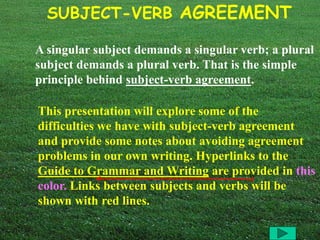
A singular subject demands a singular verb; a plural 
subject demands a plural verb. That is the simple 
principle behind subject-verb agreement. 
This presentation will explore some of the 
difficulties we have with subject-verb agreement 
and provide some notes about avoiding agreement 
problems in our own writing. Hyperlinks to the 
Guide to Grammar and Writing are provided in this 
color. Links between subjects and verbs will be 
shown with red lines.
SUBJECT-VERB AGREEMENT 
Indefinite pronouns such as everyone and everybody 
feel plural to some writers, but they are always 
singular — and take a singular verb. 
Everyone associated with the project is 
proud to be part of the effort. 
Someone has to be responsible. 
Don’t be confused by phrases that come between the 
subject pronoun and its verb — phrases that may 
contain plural words. 
Each of the project partners is responsible for 
writing a chapter summary.
SUBJECT-VERB AGREEMENT 
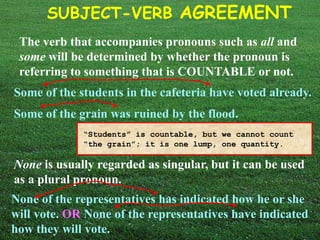
The verb that accompanies pronouns such as all and 
some will be determined by whether the pronoun is 
referring to something that is COUNTABLE or not. 
Some of the students in the cafeteria have voted already. 
Some of the grain was ruined by the flood. 
“Students” is countable, but we cannot count 
“the grain”; it is one lump, one quantity. 
None is usually regarded as singular, but it can be used 
as a plural pronoun. 
None of the representatives has indicated how he or she 
will vote. OR None of the representatives have indicated 
how they will vote.
SUBJECT-VERB AGREEMENT 
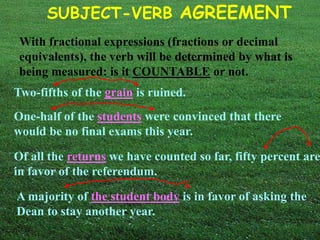
With fractional expressions (fractions or decimal 
equivalents), the verb will be determined by what is 
being measured: is it COUNTABLE or not. 
Two-fifths of the grain is ruined. 
One-half of the students were convinced that there 
would be no final exams this year. 
Of all the returns we have counted so far, fifty percent are 
in favor of the referendum. 
A majority of the student body is in favor of asking the 
Dean to stay another year.
SUBJECT-VERB AGREEMENT 
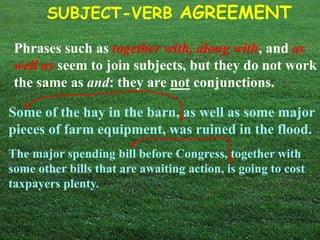
Phrases such as together with, along with, and as 
well as seem to join subjects, but they do not work 
the same as and: they are not conjunctions. 
Some of the hay in the barn, as well as some major 
pieces of farm equipment, was ruined in the flood. 
The major spending bill before Congress, together with 
some other bills that are awaiting action, is going to cost 
taxpayers plenty.
SUBJECT-VERB AGREEMENT 
In formal writing, when either and neither appear 
as a subject alone (without their sidekicks or and 
nor), they are singular. This is true even though 
the subject seems to be two things. 
Neither of these choices appears to be satisfactory. 
The purchasing office will lend me a company car 
or compensate me for travel expenses. Either is fine 
with me. 
When either and neither act as correlative conjunctions, 
however, life becomes a bit more complicated!
SUBJECT-VERB AGREEMENT 
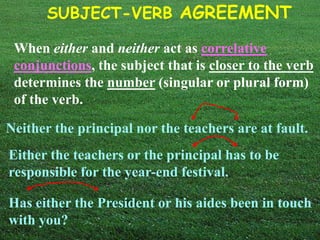
When either and neither act as correlative 
conjunctions, the subject that is closer to the verb 
determines the number (singular or plural form) 
of the verb. 
Neither the principal nor the teachers are at fault. 
Either the teachers or the principal has to be 
responsible for the year-end festival. 
Has either the President or his aides been in touch 
with you?
SUBJECT-VERB AGREEMENT 
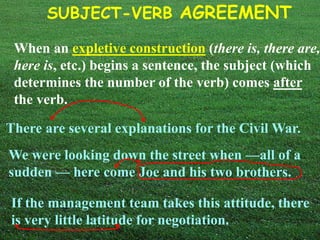
When an expletive construction (there is, there are, 
here is, etc.) begins a sentence, the subject (which 
determines the number of the verb) comes after 
the verb. 
There are several explanations for the Civil War. 
We were looking down the street when —all of a 
sudden — here come Joe and his two brothers. 
If the management team takes this attitude, there 
is very little latitude for negotiation.
SUBJECT-VERB AGREEMENT 
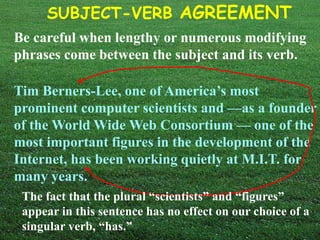
Be careful when lengthy or numerous modifying 
phrases come between the subject and its verb. 
Tim Berners-Lee, one of America’s most 
prominent computer scientists and —as a founder 
of the World Wide Web Consortium — one of the 
most important figures in the development of the 
Internet, has been working quietly at M.I.T. for 
many years. 
The fact that the plural “scientists” and “figures” 
appear in this sentence has no effect on our choice of a 
singular verb, “has.”
SUBJECT-VERB AGREEMENT 
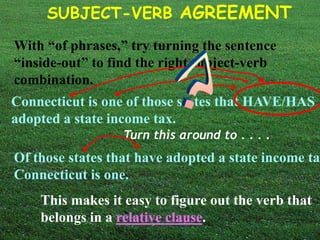
With “of phrases,” try turning the sentence 
“inside-out” to find the right subject-verb 
combination. 
Connecticut is one of those states that HAVE/HAS 
adopted a state income tax. 
Turn this around to . . . . 
Of those states that have adopted a state income tax, 
Connecticut is one. 
This makes it easy to figure out the verb that 
belongs in a relative clause.
SUBJECT-VERB AGREEMENT 
Review the rest of the material on subject-verb 
agreement in the Guide to Grammar and Writing 
and don’t forget to take the relevant quizzes listed 
on the List of Interactive Quizzes. 
The “sore thumb of grammar” will never 
be seen in your writing again!
SUBJECT-VERB AGREEMENT 
This PowerPoint presentation was created by 
Charles Darling, PhD 
Professor of English and Webmaster 
Capital Community College 
Hartford, Connecticut 
copyright November 1999

Subject verb agreement -- grammarccc

  • 1.
    SUBJECT-VERB AGREEMENT Welcometo the PowerPoint Presentation on Subject-Verb Agreement, the of grammar!
  • 2.
    SUBJECT-VERB AGREEMENT Asingular subject demands a singular verb; a plural subject demands a plural verb. That is the simple principle behind subject-verb agreement. This presentation will explore some of the difficulties we have with subject-verb agreement and provide some notes about avoiding agreement problems in our own writing. Hyperlinks to the Guide to Grammar and Writing are provided in this color. Links between subjects and verbs will be shown with red lines.
  • 3.
    SUBJECT-VERB AGREEMENT Indefinitepronouns such as everyone and everybody feel plural to some writers, but they are always singular — and take a singular verb. Everyone associated with the project is proud to be part of the effort. Someone has to be responsible. Don’t be confused by phrases that come between the subject pronoun and its verb — phrases that may contain plural words. Each of the project partners is responsible for writing a chapter summary.
  • 4.
    SUBJECT-VERB AGREEMENT Theverb that accompanies pronouns such as all and some will be determined by whether the pronoun is referring to something that is COUNTABLE or not. Some of the students in the cafeteria have voted already. Some of the grain was ruined by the flood. “Students” is countable, but we cannot count “the grain”; it is one lump, one quantity. None is usually regarded as singular, but it can be used as a plural pronoun. None of the representatives has indicated how he or she will vote. OR None of the representatives have indicated how they will vote.
  • 5.
    SUBJECT-VERB AGREEMENT Withfractional expressions (fractions or decimal equivalents), the verb will be determined by what is being measured: is it COUNTABLE or not. Two-fifths of the grain is ruined. One-half of the students were convinced that there would be no final exams this year. Of all the returns we have counted so far, fifty percent are in favor of the referendum. A majority of the student body is in favor of asking the Dean to stay another year.
  • 6.
    SUBJECT-VERB AGREEMENT Phrasessuch as together with, along with, and as well as seem to join subjects, but they do not work the same as and: they are not conjunctions. Some of the hay in the barn, as well as some major pieces of farm equipment, was ruined in the flood. The major spending bill before Congress, together with some other bills that are awaiting action, is going to cost taxpayers plenty.
  • 7.
    SUBJECT-VERB AGREEMENT Informal writing, when either and neither appear as a subject alone (without their sidekicks or and nor), they are singular. This is true even though the subject seems to be two things. Neither of these choices appears to be satisfactory. The purchasing office will lend me a company car or compensate me for travel expenses. Either is fine with me. When either and neither act as correlative conjunctions, however, life becomes a bit more complicated!
  • 8.
    SUBJECT-VERB AGREEMENT Wheneither and neither act as correlative conjunctions, the subject that is closer to the verb determines the number (singular or plural form) of the verb. Neither the principal nor the teachers are at fault. Either the teachers or the principal has to be responsible for the year-end festival. Has either the President or his aides been in touch with you?
  • 9.
    SUBJECT-VERB AGREEMENT Whenan expletive construction (there is, there are, here is, etc.) begins a sentence, the subject (which determines the number of the verb) comes after the verb. There are several explanations for the Civil War. We were looking down the street when —all of a sudden — here come Joe and his two brothers. If the management team takes this attitude, there is very little latitude for negotiation.
  • 10.
    SUBJECT-VERB AGREEMENT Becareful when lengthy or numerous modifying phrases come between the subject and its verb. Tim Berners-Lee, one of America’s most prominent computer scientists and —as a founder of the World Wide Web Consortium — one of the most important figures in the development of the Internet, has been working quietly at M.I.T. for many years. The fact that the plural “scientists” and “figures” appear in this sentence has no effect on our choice of a singular verb, “has.”
  • 11.
    SUBJECT-VERB AGREEMENT With“of phrases,” try turning the sentence “inside-out” to find the right subject-verb combination. Connecticut is one of those states that HAVE/HAS adopted a state income tax. Turn this around to . . . . Of those states that have adopted a state income tax, Connecticut is one. This makes it easy to figure out the verb that belongs in a relative clause.
  • 12.
    SUBJECT-VERB AGREEMENT Reviewthe rest of the material on subject-verb agreement in the Guide to Grammar and Writing and don’t forget to take the relevant quizzes listed on the List of Interactive Quizzes. The “sore thumb of grammar” will never be seen in your writing again!
  • 13.
    SUBJECT-VERB AGREEMENT ThisPowerPoint presentation was created by Charles Darling, PhD Professor of English and Webmaster Capital Community College Hartford, Connecticut copyright November 1999