Realism
The term realism applies specifically to the tendency
to create detailed, probing analyses of the way
"things really are," usually involving an emphasis on
nearly photographic details, the author's inclusion of
in-depth psychological traits for his or her characters,
and an attempt to create a literary facsimile of human
existence unclouded by convention, cliché, formulaic
traits of genre, or sentiment.
Characteristics of Realism
•

•

•

Renders reality closely and in
comprehensive detail. Selective
presentation of reality with an
emphasis on verisimilitude,
even at the expense of a wellmade plot
Character is more important
than action and plot; complex
ethical choices are often the
subject.
Class is important; the novel
has traditionally served the
interests and aspirations of an
insurgent middle class.

•

•
•

Diction is natural vernacular, not
heightened or poetic; tone may
be comic, satiric, or matter-offact.
Objectivity in presentation
becomes increasingly important.
Events will usually be plausible.
Realistic novels avoid the
sensational, dramatic elements
of naturalistic novels and
romances.
American Realists
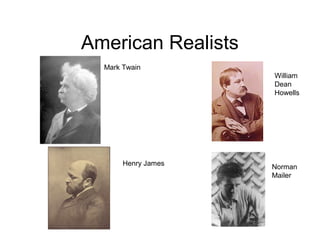
Mark Twain
William
Dean
Howells

Henry James

Norman
Mailer
Naturalism
The term naturalism describes a type of literature that attempts to apply scientific
principles of objectivity and detachment to its study of human beings. Unlike realism,
which focuses on literary technique, naturalism implies a philosophical position: for
naturalistic writers, since human beings are, in Emile Zola's phrase, "human beasts,"
characters can be studied through their relationships to their surroundings.
Through this objective study of human beings, naturalistic writers believed that the laws
behind the forces that govern human lives might be studied and understood. Naturalistic
writers thus used a version of the scientific method to write their novels; they studied
human beings governed by their instincts and passions as well as the ways in which the
characters' lives were governed by forces of heredity and environment. Although they
used the techniques of accumulating detail pioneered by the realists, the naturalists thus
had a specific object in mind when they chose the segment of reality that they wished to
convey.
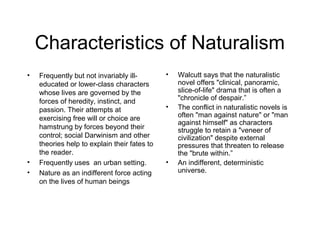
Characteristics of Naturalism
•

•
•

Frequently but not invariably illeducated or lower-class characters
whose lives are governed by the
forces of heredity, instinct, and
passion. Their attempts at
exercising free will or choice are
hamstrung by forces beyond their
control; social Darwinism and other
theories help to explain their fates to
the reader.
Frequently uses an urban setting.
Nature as an indifferent force acting
on the lives of human beings

•

•

•

Walcutt says that the naturalistic
novel offers "clinical, panoramic,
slice-of-life" drama that is often a
"chronicle of despair.”
The conflict in naturalistic novels is
often "man against nature" or "man
against himself" as characters
struggle to retain a "veneer of
civilization" despite external
pressures that threaten to release
the "brute within.”
An indifferent, deterministic
universe.
American Naturalists
Jack London
Stephen Crane

Theodore Dreiser

Frank
Norris
Regionalism
Local color or regional literature is fiction and poetry that focuses on the
characters, dialect, customs, topography, and other features particular to a
specific region. Influenced by Southwestern and Down East humor, between
the Civil War and the end of the nineteenth century this mode of writing became
dominant in American literature. According to the Oxford Companion to
American Literature, "In local-color literature one finds the dual influence of
romanticism and realism, since the author frequently looks away from ordinary
life to distant lands, strange customs, or exotic scenes, but retains through
minute detail a sense of fidelity and accuracy of description" (439).
Characteristics of Regionalism
•

•

Setting: The emphasis is frequently
on nature and the limitations it
imposes; settings are frequently
remote and inaccessible. The
setting is integral to the story and
may sometimes become a character
in itself.
Characters: Local color stories tend
to be concerned with the character
of the district or region rather than
with the individual: characters may
become character types, sometimes
quaint or stereotypical. The
characters are marked by their
adherence to the old ways, by
dialect, and by particular personality
traits central to the region. In
women's local color fiction, the
heroines are often unmarried
women or young girls.

•

•

Narrator: The narrator is typically an
educated observer from the world
beyond who learns something from
the characters while preserving a
sometimes sympathetic, sometimes
ironic distance from them. The
narrator serves as mediator
between the rural folk of the tale and
the urban audience to whom the tale
is directed.
Plots. It has been said that "nothing
happens" in local color stories by
women authors, and often very little
does happen. Stories may include
lots of storytelling and revolve
around the community and its
rituals.

Ch 15 3 realism

  • 1.
    Realism The term realismapplies specifically to the tendency to create detailed, probing analyses of the way "things really are," usually involving an emphasis on nearly photographic details, the author's inclusion of in-depth psychological traits for his or her characters, and an attempt to create a literary facsimile of human existence unclouded by convention, cliché, formulaic traits of genre, or sentiment.
  • 2.
    Characteristics of Realism • • • Rendersreality closely and in comprehensive detail. Selective presentation of reality with an emphasis on verisimilitude, even at the expense of a wellmade plot Character is more important than action and plot; complex ethical choices are often the subject. Class is important; the novel has traditionally served the interests and aspirations of an insurgent middle class. • • • Diction is natural vernacular, not heightened or poetic; tone may be comic, satiric, or matter-offact. Objectivity in presentation becomes increasingly important. Events will usually be plausible. Realistic novels avoid the sensational, dramatic elements of naturalistic novels and romances.
  • 3.
  • 4.
    Naturalism The term naturalismdescribes a type of literature that attempts to apply scientific principles of objectivity and detachment to its study of human beings. Unlike realism, which focuses on literary technique, naturalism implies a philosophical position: for naturalistic writers, since human beings are, in Emile Zola's phrase, "human beasts," characters can be studied through their relationships to their surroundings. Through this objective study of human beings, naturalistic writers believed that the laws behind the forces that govern human lives might be studied and understood. Naturalistic writers thus used a version of the scientific method to write their novels; they studied human beings governed by their instincts and passions as well as the ways in which the characters' lives were governed by forces of heredity and environment. Although they used the techniques of accumulating detail pioneered by the realists, the naturalists thus had a specific object in mind when they chose the segment of reality that they wished to convey.
  • 5.
    Characteristics of Naturalism • • • Frequentlybut not invariably illeducated or lower-class characters whose lives are governed by the forces of heredity, instinct, and passion. Their attempts at exercising free will or choice are hamstrung by forces beyond their control; social Darwinism and other theories help to explain their fates to the reader. Frequently uses an urban setting. Nature as an indifferent force acting on the lives of human beings • • • Walcutt says that the naturalistic novel offers "clinical, panoramic, slice-of-life" drama that is often a "chronicle of despair.” The conflict in naturalistic novels is often "man against nature" or "man against himself" as characters struggle to retain a "veneer of civilization" despite external pressures that threaten to release the "brute within.” An indifferent, deterministic universe.
  • 6.
    American Naturalists Jack London StephenCrane Theodore Dreiser Frank Norris
  • 7.
    Regionalism Local color orregional literature is fiction and poetry that focuses on the characters, dialect, customs, topography, and other features particular to a specific region. Influenced by Southwestern and Down East humor, between the Civil War and the end of the nineteenth century this mode of writing became dominant in American literature. According to the Oxford Companion to American Literature, "In local-color literature one finds the dual influence of romanticism and realism, since the author frequently looks away from ordinary life to distant lands, strange customs, or exotic scenes, but retains through minute detail a sense of fidelity and accuracy of description" (439).
  • 8.
    Characteristics of Regionalism • • Setting:The emphasis is frequently on nature and the limitations it imposes; settings are frequently remote and inaccessible. The setting is integral to the story and may sometimes become a character in itself. Characters: Local color stories tend to be concerned with the character of the district or region rather than with the individual: characters may become character types, sometimes quaint or stereotypical. The characters are marked by their adherence to the old ways, by dialect, and by particular personality traits central to the region. In women's local color fiction, the heroines are often unmarried women or young girls. • • Narrator: The narrator is typically an educated observer from the world beyond who learns something from the characters while preserving a sometimes sympathetic, sometimes ironic distance from them. The narrator serves as mediator between the rural folk of the tale and the urban audience to whom the tale is directed. Plots. It has been said that "nothing happens" in local color stories by women authors, and often very little does happen. Stories may include lots of storytelling and revolve around the community and its rituals.