NARRATIVE & FILM
THEORY
Anna De Azevedo -13 C
Is a sequence of events, known
correctly as the plot


    Is the way those events are put
    together to be presented to an
    audience.
• Is the way those events are put together to be presented to an
  audience.
• That describes a sequence of fictional or non-fictional events


          •   Work of Speech
          •   Literature Pictures
          •   Motion Pictures
          •   Theatre
          •   Television
          •   Song
          •   Writing
          •   Film
          •   Photography
• Tzvetan Todorov is a philosopher and
  cultural critic and the author of over 20
  books. Born in Sofia, Bulgaria, he has lived
  in France since 1963.


     • Two of his famous work:


      (1991)                  (2000)
• The fictional environment begins with a state of equilibrium
• It then suffers some disruption (disequilibrium)
• New equilibrium is produced at the end of the narrative


     Sense of a balance


     Sense of unbalance


     Sense of a new balance
Sam Witwicky   Evil              The evil
living as      Decepticon,       decepticon
usual.         starts the        gets kill by the
               attack with his   heroic
               evil power.       Autobot.
Peter Parker        While he is in the   Norman is
living his normal   genetics lab gets    defeated the city
high school life    bitten by a mutant   is back to normal.
                    spider making him
                    have super powers.
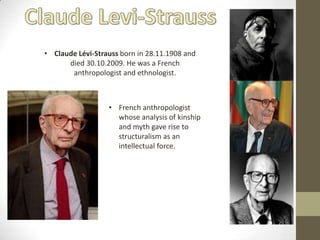
• Claude Lévi-Strauss born in 28.11.1908 and
      died 30.10.2009. He was a French
       anthropologist and ethnologist.


                  • French anthropologist
                    whose analysis of kinship
                    and myth gave rise to
                    structuralism as an
                    intellectual force.
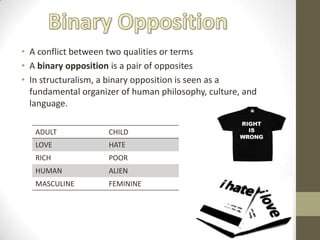
• A conflict between two qualities or terms
• A binary opposition is a pair of opposites
• In structuralism, a binary opposition is seen as a
  fundamental organizer of human philosophy, culture, and
  language.

   ADULT             CHILD
   LOVE              HATE
   RICH              POOR
   HUMAN             ALIEN
   MASCULINE         FEMININE
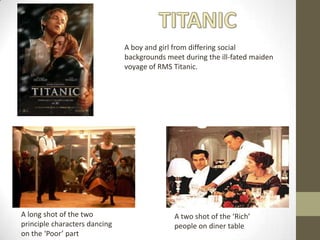
A boy and girl from differing social
                               backgrounds meet during the ill-fated maiden
                               voyage of RMS Titanic.


A long shot of the two                       A two shot of the ‘Rich’
principle characters dancing                 people on diner table
on the ‘Poor’ part
A poor and passionate young man falls in love
                               with a rich young woman and gives her a sense
                               of freedom. They soon are separated by their
                               social differences.


A mid shot of the two                         A two shot of the ‘Rich’
principle characters kissing                  people dancing
next to the simple car. The
‘Poor’ part
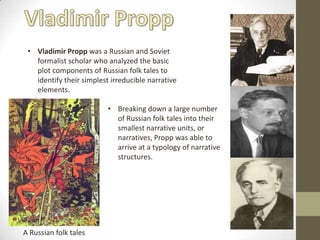
• Vladimir Propp was a Russian and Soviet
   formalist scholar who analyzed the basic
   plot components of Russian folk tales to
   identify their simplest irreducible narrative
   elements.

                          • Breaking down a large number
                            of Russian folk tales into their
                            smallest narrative units, or
                            narratives, Propp was able to
                            arrive at a typology of narrative
                            structures.


A Russian folk tales
• The villain (struggles against the hero)
• The donor (prepares the hero or gives the hero
  some magical object)
• The (magical) helper (helps the hero in the
  quest)
• The princess (person the hero marries, often
  sought for during the narrative)
• Her father
• The dispatcher (character who makes the lack
  known and sends the hero off)
• The hero or victim/seeker hero, reacts to the
  donor, weds the princess
• Erving Goffman was a Canadian-born sociologist and
  writer.
• Goffman was born in 1922 in Mannville, Alberta, Canada to
  parents Max Goffman, and his wife, Ann.

                                 • Goffman's greatest
                                   contribution to social
                                   theory is his study of
                                   symbolic interaction in the
                                   form of dramaturgical
                                   perspective that began
                                   with his 1959 book The
                                   Presentation of Self in
                                   Everyday Life.

Narrative final draft

  • 1.
  • 2.
    Is a sequenceof events, known correctly as the plot Is the way those events are put together to be presented to an audience.
  • 3.
    • Is theway those events are put together to be presented to an audience. • That describes a sequence of fictional or non-fictional events • Work of Speech • Literature Pictures • Motion Pictures • Theatre • Television • Song • Writing • Film • Photography
  • 5.
    • Tzvetan Todorovis a philosopher and cultural critic and the author of over 20 books. Born in Sofia, Bulgaria, he has lived in France since 1963. • Two of his famous work: (1991) (2000)
  • 6.
    • The fictionalenvironment begins with a state of equilibrium • It then suffers some disruption (disequilibrium) • New equilibrium is produced at the end of the narrative Sense of a balance Sense of unbalance Sense of a new balance
  • 7.
    Sam Witwicky Evil The evil living as Decepticon, decepticon usual. starts the gets kill by the attack with his heroic evil power. Autobot.
  • 8.
    Peter Parker While he is in the Norman is living his normal genetics lab gets defeated the city high school life bitten by a mutant is back to normal. spider making him have super powers.
  • 9.
    • Claude Lévi-Straussborn in 28.11.1908 and died 30.10.2009. He was a French anthropologist and ethnologist. • French anthropologist whose analysis of kinship and myth gave rise to structuralism as an intellectual force.
  • 10.
    • A conflictbetween two qualities or terms • A binary opposition is a pair of opposites • In structuralism, a binary opposition is seen as a fundamental organizer of human philosophy, culture, and language. ADULT CHILD LOVE HATE RICH POOR HUMAN ALIEN MASCULINE FEMININE
  • 11.
    A boy andgirl from differing social backgrounds meet during the ill-fated maiden voyage of RMS Titanic. A long shot of the two A two shot of the ‘Rich’ principle characters dancing people on diner table on the ‘Poor’ part
  • 12.
    A poor andpassionate young man falls in love with a rich young woman and gives her a sense of freedom. They soon are separated by their social differences. A mid shot of the two A two shot of the ‘Rich’ principle characters kissing people dancing next to the simple car. The ‘Poor’ part
  • 13.
    • Vladimir Proppwas a Russian and Soviet formalist scholar who analyzed the basic plot components of Russian folk tales to identify their simplest irreducible narrative elements. • Breaking down a large number of Russian folk tales into their smallest narrative units, or narratives, Propp was able to arrive at a typology of narrative structures. A Russian folk tales
  • 14.
    • The villain(struggles against the hero) • The donor (prepares the hero or gives the hero some magical object) • The (magical) helper (helps the hero in the quest) • The princess (person the hero marries, often sought for during the narrative) • Her father • The dispatcher (character who makes the lack known and sends the hero off) • The hero or victim/seeker hero, reacts to the donor, weds the princess
  • 15.
    • Erving Goffmanwas a Canadian-born sociologist and writer. • Goffman was born in 1922 in Mannville, Alberta, Canada to parents Max Goffman, and his wife, Ann. • Goffman's greatest contribution to social theory is his study of symbolic interaction in the form of dramaturgical perspective that began with his 1959 book The Presentation of Self in Everyday Life.