Realism for Scientific Ontologies

                   Michel Dumontier and Robert Hoehndorf

                 Carleton University and European Bioinformatics Institute


  6th International Conference on Formal Ontology in Information
                              Systems


Robert Hoehndorf (EBI)           Realism for Scientific Ontologies            FOIS2010   1 / 34
Introduction


Introduction


   Robert Hoehndorf (EBI)   Realism for Scientific Ontologies   FOIS2010   2 / 34
Introduction


Introduction
Summary


    Terms in an ontology should correspond to instances in reality.
    [...] Ontologies consist of representations of types in reality.

    realism criteria for biomedical ontologies: all classes must be based on
    (Aristotelian) universals
    no adequate representation of theories and hypotheses
    no adequate representation of plans and descriptions
    not suited for scientific discourse
    harmful for many applications of ontologies in science


   Robert Hoehndorf (EBI)   Realism for Scientific Ontologies    FOIS2010   3 / 34
Introduction


Introduction
What is science?


      Science is the concerted human effort to understand, or to
      understand better, the history of the natural world and how the
      natural world works, with observable physical evidence as the
      basis of that understanding (E.O. Wilson).

      Science is not truth.
      Science is not certainty.


    Robert Hoehndorf (EBI)    Realism for Scientific Ontologies   FOIS2010   4 / 34
Introduction


Introduction
The scientific method


     collection of data through observation
     formulation of hypotheses and theories
     inference and prediction
     experimentation


    Robert Hoehndorf (EBI)   Realism for Scientific Ontologies   FOIS2010   5 / 34
Introduction


Introduction
The role of ontology


In each step of the scientific method we require ontology:
      to describe and classify collected data,
      to formulate and express hypotheses and theories
      to infer and predict outcomes,
      to collect evidence through experimentation, e.g., to find predicted
      instances of a type.


    Robert Hoehndorf (EBI)    Realism for Scientific Ontologies   FOIS2010   6 / 34
Ontologies in biomedicine


Biomedical ontologies
Database annotation


     End of 1990s: genome projects
     Large number of homologous genes
     Data available and annotated in model organism databases
     Different terms used to describe gene functions
     Problem: integration and communication problem


    Robert Hoehndorf (EBI)              Realism for Scientific Ontologies   FOIS2010   7 / 34
Ontologies in biomedicine


Biomedical ontologies
Gene Ontology


     three branches: cellular components, biological processes, molecular
     functions
     vocabulary organized as directed acyclic graph
     edges labelled is-a, part-of, regulates
     textual definitions for all terms
     goal: integration of model organism databases


    Robert Hoehndorf (EBI)              Realism for Scientific Ontologies   FOIS2010   8 / 34
Ontologies in biomedicine


Biomedical ontologies
Open Biomedical Ontologies (OBO)


     about 100 domain ontologies
     designed as vocabularies for database interoperability
     common principles: openness, common syntax, definitions and
     documentation, orthogonality


    Robert Hoehndorf (EBI)              Realism for Scientific Ontologies   FOIS2010   9 / 34
Ontologies in biomedicine


Biomedical ontologies
Which problem do we want to solve?


     ontologies (in biology) intend to solve a communication problem
     database integration by defining the terms used in databases
     support scientific discourse
     specify the meaning of terms in a vocabulary
     terms refer to observations, hypotheses, theories, predictions and
     experiments


    Robert Hoehndorf (EBI)              Realism for Scientific Ontologies   FOIS2010   10 / 34
Ontologies in biomedicine


Biomedical ontologies
OBO Foundry


    “high-quality” ontologies for science
    Relationship Ontology and Basic Formal Ontology (BFO)
    “Terms in an ontology should correspond to instances in reality.”
    “Ontologies consist of representations of types in reality.”
    collection of realist ontologies
What is a realist ontology?


   Robert Hoehndorf (EBI)              Realism for Scientific Ontologies   FOIS2010   11 / 34
Realism


Realism
Types of realism


      Realism does not say how things are but only that there is a way
      that they are. [Searle]

      Realism about the world
      Modal realism
      Scientific realism
      Realism about universals


    Robert Hoehndorf (EBI)   Realism for Scientific Ontologies   FOIS2010   12 / 34
Realism


Realism
Types of realism


      Realism does not say how things are but only that there is a way
      that they are. [Searle]

      Realism about the world
      Modal realism
      Scientific realism
      Realism about universals


    Robert Hoehndorf (EBI)   Realism for Scientific Ontologies   FOIS2010   13 / 34
Realism


Realism
Realism about universals: Aristotle


      universals exist independently from minds
      universals exist in things (in re)
      something identical in all instances
      dependent on particulars


    Robert Hoehndorf (EBI)       Realism for Scientific Ontologies   FOIS2010   14 / 34
Realism


Realism
BFO and OBO Foundry


Realism in BFO and OBO Foundry: all classes in an ontology must be
based on Aristotelian universals.
    no inconsistent classes
    no classes which have no instances in “reality”
    only represent types in “reality”
    “ontology as reality representation” (Smith, 2004)


   Robert Hoehndorf (EBI)     Realism for Scientific Ontologies   FOIS2010   15 / 34
Realism


Realism
Scientific theories: the Standard Model


Standard Model in particle physics:
      theory of the strong, electromagnetic and weak interaction between
      elementary particles
      consistent with most high-energy physics experiments
      predictive power: W and Z bosons, gluon, top and charm quarks,
      decay of Z bosons
      Hypothetical and unconfirmed: Higgs boson, graviton, magnetic
      photon, X boson, Y boson, ...
      the meaning of Higgs boson (X, Y boson, graviton, ...) is undisputed


    Robert Hoehndorf (EBI)      Realism for Scientific Ontologies   FOIS2010   16 / 34
Realism


Realism
Scientific theories: Higgs boson


      Electron can be a class in OBO Foundry/BFO
      Higgs boson cannot be a class in an OBO Foundry/BFO based
      ontology until instances are found
      theories and hypotheses about Higgs boson exist in “reality”
      How can the ontology of the Standard Model be made available for
      scientists?


    Robert Hoehndorf (EBI)        Realism for Scientific Ontologies   FOIS2010   17 / 34
Realism


Realism
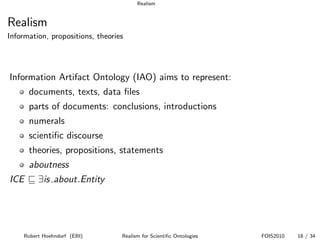
Information, propositions, theories


Information Artifact Ontology (IAO) aims to represent:
      documents, texts, data files
      parts of documents: conclusions, introductions
      numerals
      scientific discourse
      theories, propositions, statements
      aboutness
ICE      ∃is about.Entity


    Robert Hoehndorf (EBI)        Realism for Scientific Ontologies   FOIS2010   18 / 34
Realism


Realism
Information


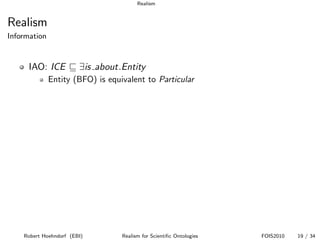
      IAO: ICE          ∃is about.Entity
              Entity (BFO) is equivalent to Particular


    Robert Hoehndorf (EBI)        Realism for Scientific Ontologies   FOIS2010   19 / 34
Realism


Realism
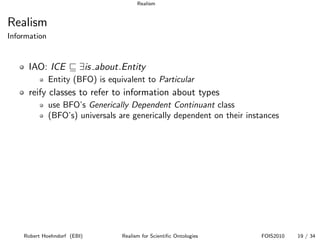
Information


      IAO: ICE          ∃is about.Entity
              Entity (BFO) is equivalent to Particular
      reify classes to refer to information about types
              use BFO’s Generically Dependent Continuant class
              (BFO’s) universals are generically dependent on their instances


    Robert Hoehndorf (EBI)        Realism for Scientific Ontologies      FOIS2010   19 / 34
Realism


Realism
Information


      IAO: ICE          ∃is about.Entity
              Entity (BFO) is equivalent to Particular
      reify classes to refer to information about types
              use BFO’s Generically Dependent Continuant class
              (BFO’s) universals are generically dependent on their instances
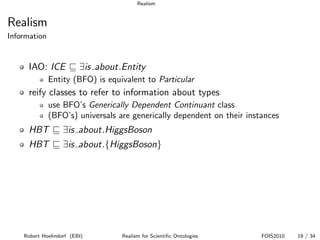
      HBT         ∃is about.HiggsBoson
      HBT         ∃is about.{HiggsBoson}


    Robert Hoehndorf (EBI)        Realism for Scientific Ontologies      FOIS2010   19 / 34
Realism


Realism
Information


      IAO: ICE          ∃is about.Entity
              Entity (BFO) is equivalent to Particular
      reify classes to refer to information about types
              use BFO’s Generically Dependent Continuant class
              (BFO’s) universals are generically dependent on their instances
      HBT         ∃is about.HiggsBoson
      HBT         ∃is about.{HiggsBoson}
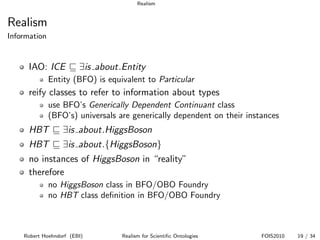
      no instances of HiggsBoson in “reality”
      therefore
              no HiggsBoson class in BFO/OBO Foundry
              no HBT class definition in BFO/OBO Foundry


    Robert Hoehndorf (EBI)        Realism for Scientific Ontologies      FOIS2010   19 / 34
Realism


Realism
Information


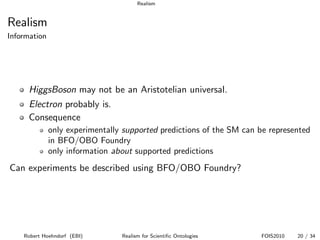
      HiggsBoson may not be an Aristotelian universal.
      Electron probably is.
      Consequence
              only experimentally supported predictions of the SM can be represented
              in BFO/OBO Foundry
              only information about supported predictions
Can experiments be described using BFO/OBO Foundry?


    Robert Hoehndorf (EBI)       Realism for Scientific Ontologies     FOIS2010   20 / 34
Realism


Realism
Experimentation and interpretation


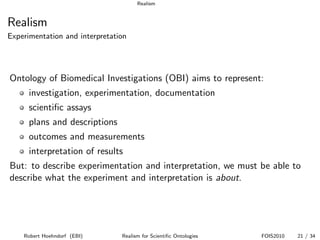
Ontology of Biomedical Investigations (OBI) aims to represent:
      investigation, experimentation, documentation
      scientific assays
      plans and descriptions
      outcomes and measurements
      interpretation of results
But: to describe experimentation and interpretation, we must be able to
describe what the experiment and interpretation is about.


    Robert Hoehndorf (EBI)      Realism for Scientific Ontologies   FOIS2010   21 / 34
Realism


Realism
Experimentation and interpretation


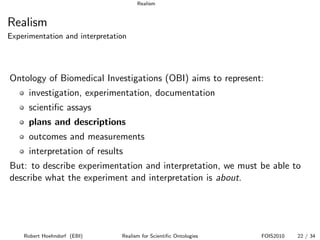
Ontology of Biomedical Investigations (OBI) aims to represent:
      investigation, experimentation, documentation
      scientific assays
      plans and descriptions
      outcomes and measurements
      interpretation of results
But: to describe experimentation and interpretation, we must be able to
describe what the experiment and interpretation is about.


    Robert Hoehndorf (EBI)      Realism for Scientific Ontologies   FOIS2010   22 / 34
Realism


Realism
Plans


        [I]t would be an error to include in a scientific ontology of drugs
        terms referring to pharmaceutical products which do not yet
        (and may never) exist, solely on the basis of plans and
        descriptions. Rather, such terms should be included precisely at
        the point where the corresponding instances do indeed exist in
        reality [...] [Smith et al., 2006]


    Robert Hoehndorf (EBI)     Realism for Scientific Ontologies    FOIS2010   23 / 34
Realism


Realism
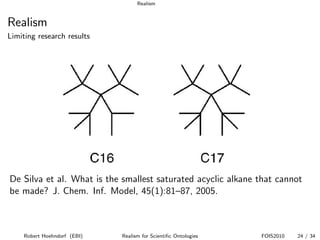
Limiting research results


De Silva et al. What is the smallest saturated acyclic alkane that cannot
be made? J. Chem. Inf. Model, 45(1):81–87, 2005.


    Robert Hoehndorf (EBI)   Realism for Scientific Ontologies   FOIS2010   24 / 34
Realism


What are chemical structures and their relations?
Original example: Hastings et al., 2010


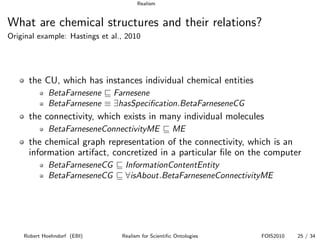
      the CU, which has instances individual chemical entities
             BetaFarnesene Farnesene
             BetaFarnesene ≡ ∃hasSpecification.BetaFarneseneCG
      the connectivity, which exists in many individual molecules
             BetaFarneseneConnectivityME              ME
      the chemical graph representation of the connectivity, which is an
      information artifact, concretized in a particular file on the computer
             BetaFarneseneCG      InformationContentEntity
             BetaFarneseneCG      ∀isAbout.BetaFarneseneConnectivityME


    Robert Hoehndorf (EBI)       Realism for Scientific Ontologies   FOIS2010   25 / 34
Realism


What are chemical structures and their relations?
Critique


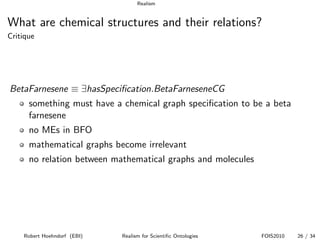
BetaFarnesene ≡ ∃hasSpecification.BetaFarneseneCG
      something must have a chemical graph specification to be a beta
      farnesene
      no MEs in BFO
      mathematical graphs become irrelevant
      no relation between mathematical graphs and molecules


    Robert Hoehndorf (EBI)   Realism for Scientific Ontologies   FOIS2010   26 / 34
Realism


What are chemical structures and their relations?
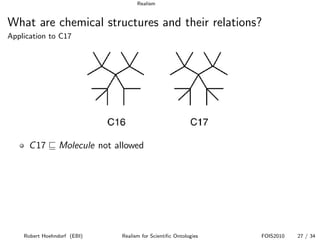
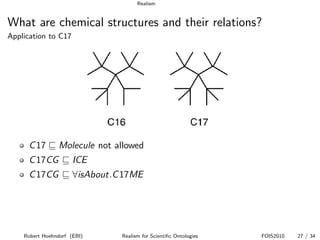
Application to C17


     C 17       Molecule not allowed


    Robert Hoehndorf (EBI)    Realism for Scientific Ontologies   FOIS2010   27 / 34
Realism


What are chemical structures and their relations?
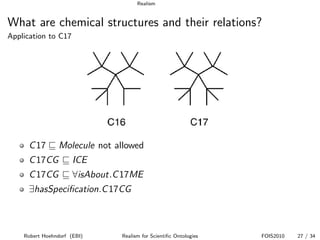
Application to C17


     C 17       Molecule not allowed
     C 17CG           ICE
     C 17CG           ∀isAbout.C 17ME


    Robert Hoehndorf (EBI)      Realism for Scientific Ontologies   FOIS2010   27 / 34
Realism


What are chemical structures and their relations?
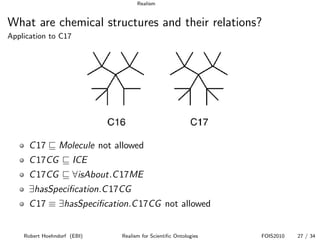
Application to C17


     C 17       Molecule not allowed
     C 17CG           ICE
     C 17CG           ∀isAbout.C 17ME
     ∃hasSpecification.C 17CG


    Robert Hoehndorf (EBI)      Realism for Scientific Ontologies   FOIS2010   27 / 34
Realism


What are chemical structures and their relations?
Application to C17


     C 17       Molecule not allowed
     C 17CG           ICE
     C 17CG           ∀isAbout.C 17ME
     ∃hasSpecification.C 17CG
     C 17 ≡ ∃hasSpecification.C 17CG not allowed


    Robert Hoehndorf (EBI)      Realism for Scientific Ontologies   FOIS2010   27 / 34
Realism


Realism
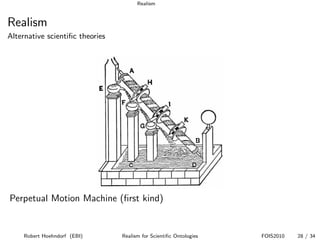
Alternative scientific theories


Perpetual Motion Machine (first kind)


     Robert Hoehndorf (EBI)      Realism for Scientific Ontologies   FOIS2010   28 / 34
Realism


Formal Ontology
Which problem do ontologies solve?


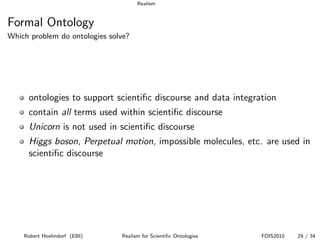
     ontologies to support scientific discourse and data integration
     contain all terms used within scientific discourse
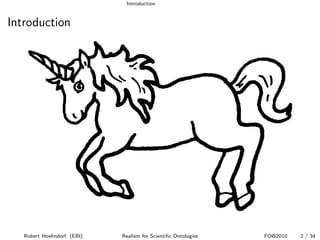
     Unicorn is not used in scientific discourse
     Higgs boson, Perpetual motion, impossible molecules, etc. are used in
     scientific discourse


    Robert Hoehndorf (EBI)     Realism for Scientific Ontologies   FOIS2010   29 / 34
Realism


Formal Ontology
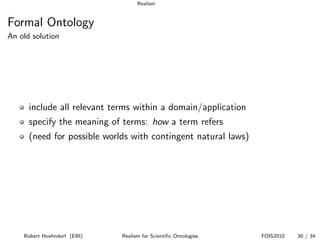
An old solution


      include all relevant terms within a domain/application
      specify the meaning of terms: how a term refers
      (need for possible worlds with contingent natural laws)


    Robert Hoehndorf (EBI)   Realism for Scientific Ontologies   FOIS2010   30 / 34
Conclusions


Conclusions
Summary


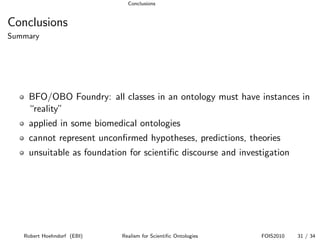
    BFO/OBO Foundry: all classes in an ontology must have instances in
    “reality”
    applied in some biomedical ontologies
    cannot represent unconfirmed hypotheses, predictions, theories
    unsuitable as foundation for scientific discourse and investigation


   Robert Hoehndorf (EBI)   Realism for Scientific Ontologies   FOIS2010   31 / 34
Conclusions


Conclusions
Summary


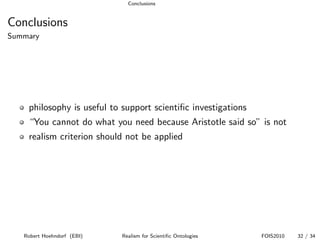
    philosophy is useful to support scientific investigations
    “You cannot do what you need because Aristotle said so” is not
    realism criterion should not be applied


   Robert Hoehndorf (EBI)   Realism for Scientific Ontologies   FOIS2010   32 / 34
Conclusions


Acknowledgements


        Heinrich Herre                                  Janna Hastings
        Phillip Lord                                    Philippe Rocca-Serra
        Robert Stevens                                  Susanna-Assunta Sansone
        Janet Kelso                                     Helen Parkinson
        Frank Loebe                                     James Malone
        Nico Adams                                      Jennifer Fostel
        Dietrich                                        Anika Oellrich
        Rebholz-Schuhmann                               Darius Sulskus
        Maria Laikata                                   Christoph Grabmueller


  Robert Hoehndorf (EBI)   Realism for Scientific Ontologies               FOIS2010   33 / 34
Conclusions


                               Thank you!


Robert Hoehndorf (EBI)   Realism for Scientific Ontologies   FOIS2010   34 / 34

Realism for Scientific Ontologies

  • 1.
    Realism for ScientificOntologies Michel Dumontier and Robert Hoehndorf Carleton University and European Bioinformatics Institute 6th International Conference on Formal Ontology in Information Systems Robert Hoehndorf (EBI) Realism for Scientific Ontologies FOIS2010 1 / 34
  • 2.
    Introduction Introduction Robert Hoehndorf (EBI) Realism for Scientific Ontologies FOIS2010 2 / 34
  • 3.
    Introduction Introduction Summary Terms in an ontology should correspond to instances in reality. [...] Ontologies consist of representations of types in reality. realism criteria for biomedical ontologies: all classes must be based on (Aristotelian) universals no adequate representation of theories and hypotheses no adequate representation of plans and descriptions not suited for scientific discourse harmful for many applications of ontologies in science Robert Hoehndorf (EBI) Realism for Scientific Ontologies FOIS2010 3 / 34
  • 4.
    Introduction Introduction What is science? Science is the concerted human effort to understand, or to understand better, the history of the natural world and how the natural world works, with observable physical evidence as the basis of that understanding (E.O. Wilson). Science is not truth. Science is not certainty. Robert Hoehndorf (EBI) Realism for Scientific Ontologies FOIS2010 4 / 34
  • 5.
    Introduction Introduction The scientific method collection of data through observation formulation of hypotheses and theories inference and prediction experimentation Robert Hoehndorf (EBI) Realism for Scientific Ontologies FOIS2010 5 / 34
  • 6.
    Introduction Introduction The role ofontology In each step of the scientific method we require ontology: to describe and classify collected data, to formulate and express hypotheses and theories to infer and predict outcomes, to collect evidence through experimentation, e.g., to find predicted instances of a type. Robert Hoehndorf (EBI) Realism for Scientific Ontologies FOIS2010 6 / 34
  • 7.
    Ontologies in biomedicine Biomedicalontologies Database annotation End of 1990s: genome projects Large number of homologous genes Data available and annotated in model organism databases Different terms used to describe gene functions Problem: integration and communication problem Robert Hoehndorf (EBI) Realism for Scientific Ontologies FOIS2010 7 / 34
  • 8.
    Ontologies in biomedicine Biomedicalontologies Gene Ontology three branches: cellular components, biological processes, molecular functions vocabulary organized as directed acyclic graph edges labelled is-a, part-of, regulates textual definitions for all terms goal: integration of model organism databases Robert Hoehndorf (EBI) Realism for Scientific Ontologies FOIS2010 8 / 34
  • 9.
    Ontologies in biomedicine Biomedicalontologies Open Biomedical Ontologies (OBO) about 100 domain ontologies designed as vocabularies for database interoperability common principles: openness, common syntax, definitions and documentation, orthogonality Robert Hoehndorf (EBI) Realism for Scientific Ontologies FOIS2010 9 / 34
  • 10.
    Ontologies in biomedicine Biomedicalontologies Which problem do we want to solve? ontologies (in biology) intend to solve a communication problem database integration by defining the terms used in databases support scientific discourse specify the meaning of terms in a vocabulary terms refer to observations, hypotheses, theories, predictions and experiments Robert Hoehndorf (EBI) Realism for Scientific Ontologies FOIS2010 10 / 34
  • 11.
    Ontologies in biomedicine Biomedicalontologies OBO Foundry “high-quality” ontologies for science Relationship Ontology and Basic Formal Ontology (BFO) “Terms in an ontology should correspond to instances in reality.” “Ontologies consist of representations of types in reality.” collection of realist ontologies What is a realist ontology? Robert Hoehndorf (EBI) Realism for Scientific Ontologies FOIS2010 11 / 34
  • 12.
    Realism Realism Types of realism Realism does not say how things are but only that there is a way that they are. [Searle] Realism about the world Modal realism Scientific realism Realism about universals Robert Hoehndorf (EBI) Realism for Scientific Ontologies FOIS2010 12 / 34
  • 13.
    Realism Realism Types of realism Realism does not say how things are but only that there is a way that they are. [Searle] Realism about the world Modal realism Scientific realism Realism about universals Robert Hoehndorf (EBI) Realism for Scientific Ontologies FOIS2010 13 / 34
  • 14.
    Realism Realism Realism about universals:Aristotle universals exist independently from minds universals exist in things (in re) something identical in all instances dependent on particulars Robert Hoehndorf (EBI) Realism for Scientific Ontologies FOIS2010 14 / 34
  • 15.
    Realism Realism BFO and OBOFoundry Realism in BFO and OBO Foundry: all classes in an ontology must be based on Aristotelian universals. no inconsistent classes no classes which have no instances in “reality” only represent types in “reality” “ontology as reality representation” (Smith, 2004) Robert Hoehndorf (EBI) Realism for Scientific Ontologies FOIS2010 15 / 34
  • 16.
    Realism Realism Scientific theories: theStandard Model Standard Model in particle physics: theory of the strong, electromagnetic and weak interaction between elementary particles consistent with most high-energy physics experiments predictive power: W and Z bosons, gluon, top and charm quarks, decay of Z bosons Hypothetical and unconfirmed: Higgs boson, graviton, magnetic photon, X boson, Y boson, ... the meaning of Higgs boson (X, Y boson, graviton, ...) is undisputed Robert Hoehndorf (EBI) Realism for Scientific Ontologies FOIS2010 16 / 34
  • 17.
    Realism Realism Scientific theories: Higgsboson Electron can be a class in OBO Foundry/BFO Higgs boson cannot be a class in an OBO Foundry/BFO based ontology until instances are found theories and hypotheses about Higgs boson exist in “reality” How can the ontology of the Standard Model be made available for scientists? Robert Hoehndorf (EBI) Realism for Scientific Ontologies FOIS2010 17 / 34
  • 18.
    Realism Realism Information, propositions, theories InformationArtifact Ontology (IAO) aims to represent: documents, texts, data files parts of documents: conclusions, introductions numerals scientific discourse theories, propositions, statements aboutness ICE ∃is about.Entity Robert Hoehndorf (EBI) Realism for Scientific Ontologies FOIS2010 18 / 34
  • 19.
    Realism Realism Information IAO: ICE ∃is about.Entity Entity (BFO) is equivalent to Particular Robert Hoehndorf (EBI) Realism for Scientific Ontologies FOIS2010 19 / 34
  • 20.
    Realism Realism Information IAO: ICE ∃is about.Entity Entity (BFO) is equivalent to Particular reify classes to refer to information about types use BFO’s Generically Dependent Continuant class (BFO’s) universals are generically dependent on their instances Robert Hoehndorf (EBI) Realism for Scientific Ontologies FOIS2010 19 / 34
  • 21.
    Realism Realism Information IAO: ICE ∃is about.Entity Entity (BFO) is equivalent to Particular reify classes to refer to information about types use BFO’s Generically Dependent Continuant class (BFO’s) universals are generically dependent on their instances HBT ∃is about.HiggsBoson HBT ∃is about.{HiggsBoson} Robert Hoehndorf (EBI) Realism for Scientific Ontologies FOIS2010 19 / 34
  • 22.
    Realism Realism Information IAO: ICE ∃is about.Entity Entity (BFO) is equivalent to Particular reify classes to refer to information about types use BFO’s Generically Dependent Continuant class (BFO’s) universals are generically dependent on their instances HBT ∃is about.HiggsBoson HBT ∃is about.{HiggsBoson} no instances of HiggsBoson in “reality” therefore no HiggsBoson class in BFO/OBO Foundry no HBT class definition in BFO/OBO Foundry Robert Hoehndorf (EBI) Realism for Scientific Ontologies FOIS2010 19 / 34
  • 23.
    Realism Realism Information HiggsBoson may not be an Aristotelian universal. Electron probably is. Consequence only experimentally supported predictions of the SM can be represented in BFO/OBO Foundry only information about supported predictions Can experiments be described using BFO/OBO Foundry? Robert Hoehndorf (EBI) Realism for Scientific Ontologies FOIS2010 20 / 34
  • 24.
    Realism Realism Experimentation and interpretation Ontologyof Biomedical Investigations (OBI) aims to represent: investigation, experimentation, documentation scientific assays plans and descriptions outcomes and measurements interpretation of results But: to describe experimentation and interpretation, we must be able to describe what the experiment and interpretation is about. Robert Hoehndorf (EBI) Realism for Scientific Ontologies FOIS2010 21 / 34
  • 25.
    Realism Realism Experimentation and interpretation Ontologyof Biomedical Investigations (OBI) aims to represent: investigation, experimentation, documentation scientific assays plans and descriptions outcomes and measurements interpretation of results But: to describe experimentation and interpretation, we must be able to describe what the experiment and interpretation is about. Robert Hoehndorf (EBI) Realism for Scientific Ontologies FOIS2010 22 / 34
  • 26.
    Realism Realism Plans [I]t would be an error to include in a scientific ontology of drugs terms referring to pharmaceutical products which do not yet (and may never) exist, solely on the basis of plans and descriptions. Rather, such terms should be included precisely at the point where the corresponding instances do indeed exist in reality [...] [Smith et al., 2006] Robert Hoehndorf (EBI) Realism for Scientific Ontologies FOIS2010 23 / 34
  • 27.
    Realism Realism Limiting research results DeSilva et al. What is the smallest saturated acyclic alkane that cannot be made? J. Chem. Inf. Model, 45(1):81–87, 2005. Robert Hoehndorf (EBI) Realism for Scientific Ontologies FOIS2010 24 / 34
  • 28.
    Realism What are chemicalstructures and their relations? Original example: Hastings et al., 2010 the CU, which has instances individual chemical entities BetaFarnesene Farnesene BetaFarnesene ≡ ∃hasSpecification.BetaFarneseneCG the connectivity, which exists in many individual molecules BetaFarneseneConnectivityME ME the chemical graph representation of the connectivity, which is an information artifact, concretized in a particular file on the computer BetaFarneseneCG InformationContentEntity BetaFarneseneCG ∀isAbout.BetaFarneseneConnectivityME Robert Hoehndorf (EBI) Realism for Scientific Ontologies FOIS2010 25 / 34
  • 29.
    Realism What are chemicalstructures and their relations? Critique BetaFarnesene ≡ ∃hasSpecification.BetaFarneseneCG something must have a chemical graph specification to be a beta farnesene no MEs in BFO mathematical graphs become irrelevant no relation between mathematical graphs and molecules Robert Hoehndorf (EBI) Realism for Scientific Ontologies FOIS2010 26 / 34
  • 30.
    Realism What are chemicalstructures and their relations? Application to C17 C 17 Molecule not allowed Robert Hoehndorf (EBI) Realism for Scientific Ontologies FOIS2010 27 / 34
  • 31.
    Realism What are chemicalstructures and their relations? Application to C17 C 17 Molecule not allowed C 17CG ICE C 17CG ∀isAbout.C 17ME Robert Hoehndorf (EBI) Realism for Scientific Ontologies FOIS2010 27 / 34
  • 32.
    Realism What are chemicalstructures and their relations? Application to C17 C 17 Molecule not allowed C 17CG ICE C 17CG ∀isAbout.C 17ME ∃hasSpecification.C 17CG Robert Hoehndorf (EBI) Realism for Scientific Ontologies FOIS2010 27 / 34
  • 33.
    Realism What are chemicalstructures and their relations? Application to C17 C 17 Molecule not allowed C 17CG ICE C 17CG ∀isAbout.C 17ME ∃hasSpecification.C 17CG C 17 ≡ ∃hasSpecification.C 17CG not allowed Robert Hoehndorf (EBI) Realism for Scientific Ontologies FOIS2010 27 / 34
  • 34.
    Realism Realism Alternative scientific theories PerpetualMotion Machine (first kind) Robert Hoehndorf (EBI) Realism for Scientific Ontologies FOIS2010 28 / 34
  • 35.
    Realism Formal Ontology Which problemdo ontologies solve? ontologies to support scientific discourse and data integration contain all terms used within scientific discourse Unicorn is not used in scientific discourse Higgs boson, Perpetual motion, impossible molecules, etc. are used in scientific discourse Robert Hoehndorf (EBI) Realism for Scientific Ontologies FOIS2010 29 / 34
  • 36.
    Realism Formal Ontology An oldsolution include all relevant terms within a domain/application specify the meaning of terms: how a term refers (need for possible worlds with contingent natural laws) Robert Hoehndorf (EBI) Realism for Scientific Ontologies FOIS2010 30 / 34
  • 37.
    Conclusions Conclusions Summary BFO/OBO Foundry: all classes in an ontology must have instances in “reality” applied in some biomedical ontologies cannot represent unconfirmed hypotheses, predictions, theories unsuitable as foundation for scientific discourse and investigation Robert Hoehndorf (EBI) Realism for Scientific Ontologies FOIS2010 31 / 34
  • 38.
    Conclusions Conclusions Summary philosophy is useful to support scientific investigations “You cannot do what you need because Aristotle said so” is not realism criterion should not be applied Robert Hoehndorf (EBI) Realism for Scientific Ontologies FOIS2010 32 / 34
  • 39.
    Conclusions Acknowledgements Heinrich Herre Janna Hastings Phillip Lord Philippe Rocca-Serra Robert Stevens Susanna-Assunta Sansone Janet Kelso Helen Parkinson Frank Loebe James Malone Nico Adams Jennifer Fostel Dietrich Anika Oellrich Rebholz-Schuhmann Darius Sulskus Maria Laikata Christoph Grabmueller Robert Hoehndorf (EBI) Realism for Scientific Ontologies FOIS2010 33 / 34
  • 40.
    Conclusions Thank you! Robert Hoehndorf (EBI) Realism for Scientific Ontologies FOIS2010 34 / 34