
1
Michel Dumontier, Ph.D.
Distinguished Professor of Data Science
Director, Institute of Data Science
@micheldumontier::RDA:2018-01-31
An increasing number of
discoveries are made using other
people’s data
@micheldumontier::RDA:2018-01-312
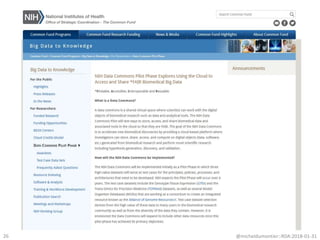
3
A common rejection module (CRM) for acute rejection across multiple organs identifies
novel therapeutics for organ transplantation
Khatri et al. JEM. 210 (11): 2205
DOI: 10.1084/jem.20122709
@micheldumontier::RDA:2018-01-31
1. CRM genes correlated with the extent of graft injury and predicted future injury to a graft
2. Mice treated with drugs against the CRM genes extended graft survival
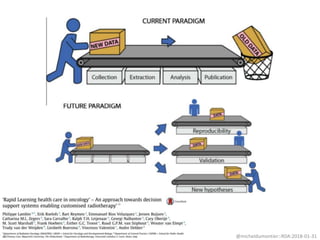
However, significant effort was
needed to find the right datasets,
put them together, and use them
@micheldumontier::RDA:2018-01-314
@micheldumontier::RDA:2018-01-315
If we are ever to realize the full
potential of content we create
then we must find ways to reduce
the barrier to (automatically) find
and reuse that content
@micheldumontier::RDA:2018-01-316
To achieve this objective
we must build a social and
technological infrastructure for
the discovery and assessment of
digital resources
@micheldumontier::RDA:2018-01-317
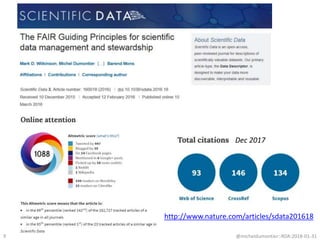
Principles to enhance the value of all digital resources
data, images, software, web services, repositories,…
Developed and endorsed by researchers, publishers,
funding agencies, industry partners.
@micheldumontier::RDA:2018-01-318
@micheldumontier::RDA:2018-01-319
http://www.nature.com/articles/sdata201618
Dec 2017
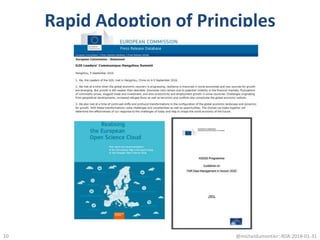
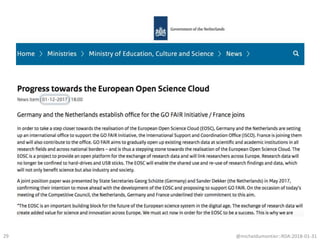
Rapid Adoption of Principles
@micheldumontier::RDA:2018-01-3110
@micheldumontier::RDA:2018-01-3111
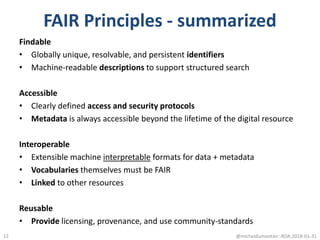
4 Principles (F,A,I,R) and 15 sub-principles.
FAIR Principles - summarized
Findable
• Globally unique, resolvable, and persistent identifiers
• Machine-readable descriptions to support structured search
Accessible
• Clearly defined access and security protocols
• Metadata is always accessible beyond the lifetime of the digital resource
Interoperable
• Extensible machine interpretable formats for data + metadata
• Vocabularies themselves must be FAIR
• Linked to other resources
Reusable
• Provide licensing, provenance, and use community-standards
@micheldumontier::RDA:2018-01-3112
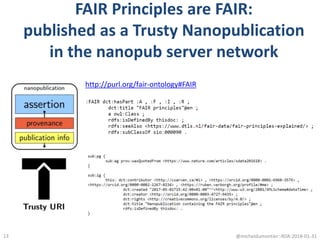
FAIR Principles are FAIR:
published as a Trusty Nanopublication
in the nanopub server network
@micheldumontier::RDA:2018-01-3113
http://purl.org/fair-ontology#FAIR
Improving the FAIRness of digital
resources will increase their quality and
their potential for reuse.
@micheldumontier::RDA:2018-01-3114
What is FAIRness?
FAIRness reflects the extent to which a digital
resource addresses the FAIR principles as per the
expectations defined by a community.
@micheldumontier::RDA:2018-01-3115
How it might look at DANS
@micheldumontier::RDA:2018-01-3116
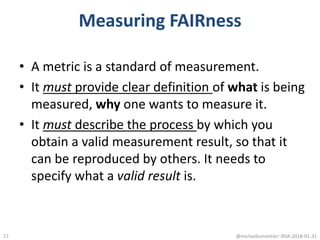
Measuring FAIRness
• A metric is a standard of measurement.
• It must provide clear definition of what is being
measured, why one wants to measure it.
• It must describe the process by which you
obtain a valid measurement result, so that it
can be reproduced by others. It needs to
specify what a valid result is.
@micheldumontier::RDA:2018-01-3117
Qualities of a Good Metric
• Clear: anyone can understand the purpose of the metric
• Realistic: compliance should not be unduly complicated
• Discriminating: the measure can distinguish between
those that meet and those that do not meet the
objective
• Measurable: the assessment can be made in an
objective, quantitative, machine-interpretable, scalable
and reproducible manner
• Universal: The metric should be applicable to all digital
resources
@micheldumontier::RDA:2018-01-3118
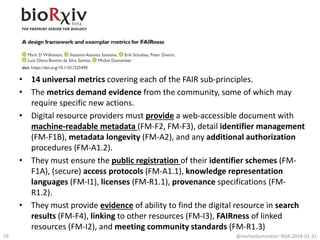
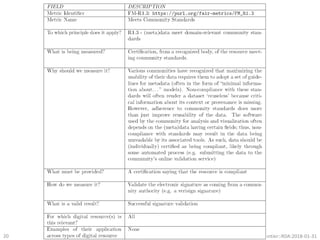
• 14 universal metrics covering each of the FAIR sub-principles.
• The metrics demand evidence from the community, some of which may
require specific new actions.
• Digital resource providers must provide a web-accessible document with
machine-readable metadata (FM-F2, FM-F3), detail identifier management
(FM-F1B), metadata longevity (FM-A2), and any additional authorization
procedures (FM-A1.2).
• They must ensure the public registration of their identifier schemes (FM-
F1A), (secure) access protocols (FM-A1.1), knowledge representation
languages (FM-I1), licenses (FM-R1.1), provenance specifications (FM-
R1.2).
• They must provide evidence of ability to find the digital resource in search
results (FM-F4), linking to other resources (FM-I3), FAIRness of linked
resources (FM-I2), and meeting community standards (FM-R1.3)
@micheldumontier::RDA:2018-01-3119
@micheldumontier::RDA:2018-01-3120
@micheldumontier::RDA:2018-01-3121
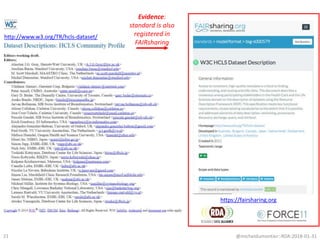
http://www.w3.org/TR/hcls-dataset/
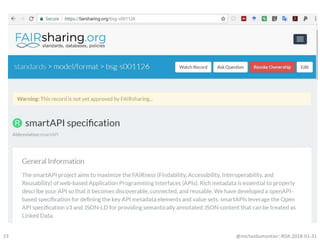
Evidence:
standard is also
registered in
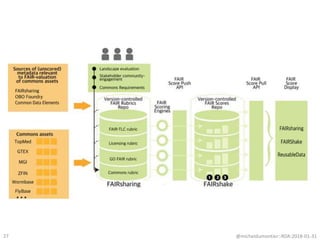
FAIRsharing
https://fairsharing.org
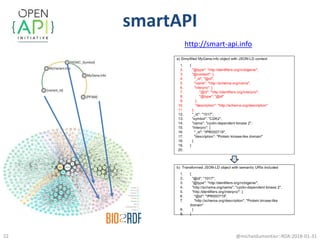
smartAPI
@micheldumontier::RDA:2018-01-3122
http://smart-api.info
@micheldumontier::RDA:2018-01-3123
@micheldumontier::RDA:2018-01-3124
Availability of Metrics
• The current metrics are available for public discussion
at the FAIR Metrics GitHub, with suggestions and
comments being made through the GitHub comment
submission system (https://github.com/FAIRMetrics).
• They are represented as i) nanopublications and ii)
latex and iii) PDF documents
• They are free to use for any purpose under the CC0
license.
• Versioned releases will be made to Zenodo as the
metrics evolve, with the first release already available
for download
@micheldumontier::RDA:2018-01-3125
@micheldumontier::RDA:2018-01-3126
@micheldumontier::RDA:2018-01-3127
@micheldumontier::RDA:2018-01-3128
@micheldumontier::RDA:2018-01-3129
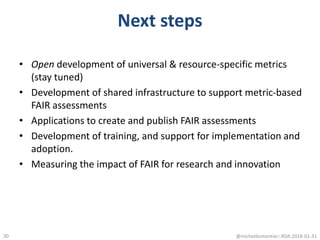
Next steps
• Open development of universal & resource-specific metrics
(stay tuned)
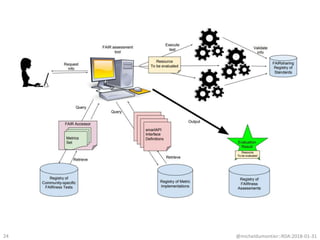
• Development of shared infrastructure to support metric-based
FAIR assessments
• Applications to create and publish FAIR assessments
• Development of training, and support for implementation and
adoption.
• Measuring the impact of FAIR for research and innovation
@micheldumontier::RDA:2018-01-3130
Acknowledgements
@micheldumontier::RDA:2018-01-3131
FAIR
FAIR metrics
Myles Axton, Jennifer Boyd, Helena Cousijn, Scott Edmunds, Emma Ganley, Andrew Hufton, Rebecca
Lawrence, Thomas Lemberger, Varsha Khodiyar, Robert Kiley, Michael Markie and Jonathan Tedds for their
prospective on the metrics as journal editors and publishers, and their contribution to FAIRsharing
RDA/Force 11 WG.
michel.dumontier@maastrichtuniversity.nl
Website: http://maastrichtuniversity.nl/ids
32 @micheldumontier::RDA:2018-01-31
How are you contributing to the FAIR initiative?

Are we FAIR yet?

  • 1.
    1 Michel Dumontier, Ph.D. DistinguishedProfessor of Data Science Director, Institute of Data Science @micheldumontier::RDA:2018-01-31
  • 2.
    An increasing numberof discoveries are made using other people’s data @micheldumontier::RDA:2018-01-312
  • 3.
    3 A common rejectionmodule (CRM) for acute rejection across multiple organs identifies novel therapeutics for organ transplantation Khatri et al. JEM. 210 (11): 2205 DOI: 10.1084/jem.20122709 @micheldumontier::RDA:2018-01-31 1. CRM genes correlated with the extent of graft injury and predicted future injury to a graft 2. Mice treated with drugs against the CRM genes extended graft survival
  • 4.
    However, significant effortwas needed to find the right datasets, put them together, and use them @micheldumontier::RDA:2018-01-314
  • 5.
  • 6.
    If we areever to realize the full potential of content we create then we must find ways to reduce the barrier to (automatically) find and reuse that content @micheldumontier::RDA:2018-01-316
  • 7.
    To achieve thisobjective we must build a social and technological infrastructure for the discovery and assessment of digital resources @micheldumontier::RDA:2018-01-317
  • 8.
    Principles to enhancethe value of all digital resources data, images, software, web services, repositories,… Developed and endorsed by researchers, publishers, funding agencies, industry partners. @micheldumontier::RDA:2018-01-318
  • 9.
  • 10.
    Rapid Adoption ofPrinciples @micheldumontier::RDA:2018-01-3110
  • 11.
  • 12.
    FAIR Principles -summarized Findable • Globally unique, resolvable, and persistent identifiers • Machine-readable descriptions to support structured search Accessible • Clearly defined access and security protocols • Metadata is always accessible beyond the lifetime of the digital resource Interoperable • Extensible machine interpretable formats for data + metadata • Vocabularies themselves must be FAIR • Linked to other resources Reusable • Provide licensing, provenance, and use community-standards @micheldumontier::RDA:2018-01-3112
  • 13.
    FAIR Principles areFAIR: published as a Trusty Nanopublication in the nanopub server network @micheldumontier::RDA:2018-01-3113 http://purl.org/fair-ontology#FAIR
  • 14.
    Improving the FAIRnessof digital resources will increase their quality and their potential for reuse. @micheldumontier::RDA:2018-01-3114
  • 15.
    What is FAIRness? FAIRnessreflects the extent to which a digital resource addresses the FAIR principles as per the expectations defined by a community. @micheldumontier::RDA:2018-01-3115
  • 16.
    How it mightlook at DANS @micheldumontier::RDA:2018-01-3116
  • 17.
    Measuring FAIRness • Ametric is a standard of measurement. • It must provide clear definition of what is being measured, why one wants to measure it. • It must describe the process by which you obtain a valid measurement result, so that it can be reproduced by others. It needs to specify what a valid result is. @micheldumontier::RDA:2018-01-3117
  • 18.
    Qualities of aGood Metric • Clear: anyone can understand the purpose of the metric • Realistic: compliance should not be unduly complicated • Discriminating: the measure can distinguish between those that meet and those that do not meet the objective • Measurable: the assessment can be made in an objective, quantitative, machine-interpretable, scalable and reproducible manner • Universal: The metric should be applicable to all digital resources @micheldumontier::RDA:2018-01-3118
  • 19.
    • 14 universalmetrics covering each of the FAIR sub-principles. • The metrics demand evidence from the community, some of which may require specific new actions. • Digital resource providers must provide a web-accessible document with machine-readable metadata (FM-F2, FM-F3), detail identifier management (FM-F1B), metadata longevity (FM-A2), and any additional authorization procedures (FM-A1.2). • They must ensure the public registration of their identifier schemes (FM- F1A), (secure) access protocols (FM-A1.1), knowledge representation languages (FM-I1), licenses (FM-R1.1), provenance specifications (FM- R1.2). • They must provide evidence of ability to find the digital resource in search results (FM-F4), linking to other resources (FM-I3), FAIRness of linked resources (FM-I2), and meeting community standards (FM-R1.3) @micheldumontier::RDA:2018-01-3119
  • 20.
  • 21.
  • 22.
  • 23.
  • 24.
  • 25.
    Availability of Metrics •The current metrics are available for public discussion at the FAIR Metrics GitHub, with suggestions and comments being made through the GitHub comment submission system (https://github.com/FAIRMetrics). • They are represented as i) nanopublications and ii) latex and iii) PDF documents • They are free to use for any purpose under the CC0 license. • Versioned releases will be made to Zenodo as the metrics evolve, with the first release already available for download @micheldumontier::RDA:2018-01-3125
  • 26.
  • 27.
  • 28.
  • 29.
  • 30.
    Next steps • Opendevelopment of universal & resource-specific metrics (stay tuned) • Development of shared infrastructure to support metric-based FAIR assessments • Applications to create and publish FAIR assessments • Development of training, and support for implementation and adoption. • Measuring the impact of FAIR for research and innovation @micheldumontier::RDA:2018-01-3130
  • 31.
    Acknowledgements @micheldumontier::RDA:2018-01-3131 FAIR FAIR metrics Myles Axton,Jennifer Boyd, Helena Cousijn, Scott Edmunds, Emma Ganley, Andrew Hufton, Rebecca Lawrence, Thomas Lemberger, Varsha Khodiyar, Robert Kiley, Michael Markie and Jonathan Tedds for their prospective on the metrics as journal editors and publishers, and their contribution to FAIRsharing RDA/Force 11 WG.
  • 32.

Editor's Notes

  • #4 Abstract Using meta-analysis of eight independent transplant datasets (236 graft biopsy samples) from four organs, we identified a common rejection module (CRM) consisting of 11 genes that were significantly overexpressed in acute rejection (AR) across all transplanted organs. The CRM genes could diagnose AR with high specificity and sensitivity in three additional independent cohorts (794 samples). In another two independent cohorts (151 renal transplant biopsies), the CRM genes correlated with the extent of graft injury and predicted future injury to a graft using protocol biopsies. Inferred drug mechanisms from the literature suggested that two FDA-approved drugs (atorvastatin and dasatinib), approved for nontransplant indications, could regulate specific CRM genes and reduce the number of graft-infiltrating cells during AR. We treated mice with HLA-mismatched mouse cardiac transplant with atorvastatin and dasatinib and showed reduction of the CRM genes, significant reduction of graft-infiltrating cells, and extended graft survival. We further validated the beneficial effect of atorvastatin on graft survival by retrospective analysis of electronic medical records of a single-center cohort of 2,515 renal transplant patients followed for up to 22 yr. In conclusion, we identified a CRM in transplantation that provides new opportunities for diagnosis, drug repositioning, and rational drug design.
  • #8 G20: http://europa.eu/rapid/press-release_STATEMENT-16-2967_en.htm EOSC: https://ec.europa.eu/research/openscience/pdf/realising_the_european_open_science_cloud_2016.pdf H2020: https://goo.gl/Strjua
  • #11 G20: http://europa.eu/rapid/press-release_STATEMENT-16-2967_en.htm EOSC: https://ec.europa.eu/research/openscience/pdf/realising_the_european_open_science_cloud_2016.pdf H2020: https://goo.gl/Strjua