Around the
multicultural health policy world
     in 80 minutes (or less)
Julia Puebla Fortier
                 Executive Director

DiversityRx – Resources for Cross Cultural Health Care

                www.diversityRx.org
DiversityRx:
Improving health care for a diverse world

   Policy development          Working with:

   Research                    Hospitals and health departments


   Information dissemination   Universities


   Education and training      Philanthropic foundations


                                Government agencies


                                International organizations
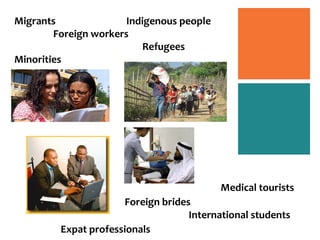
Migrants               Indigenous people
        Foreign workers
                          Refugees
Minorities


                                           Medical tourists
                      Foreign brides
                                    International students
         Expat professionals
Policy tools:
Laws and regulations, standards, resolutions,
performance measures, accountability frameworks

   U.S. – CLAS Standards, Joint Commission, health reform

   State laws and regulations: California

   Australia: Cultural responsiveness framework

   Scotland: Policy tools and lessons learned
U.S. CLAS Standards (2001)
Categories of interventions
 Culturally Sensitive Interventions
  Cultural competence education
  Race, ethnic and linguistic concordance
  Community  health workers and culturally competent
   health promotion
 Language Assistance
  Bilingual services, oral interpretation, translated
   written materials
Categories of interventions (con’t)
 Organizational Supports for Cultural Competence
  Management and policy strategies
  Community engagement
  Information and data for planning and evaluation
  Appropriate ethics and conflict resolution processes
Review and enhancement process
(2010-12)
   Review process: literature review, national public comment
    period, advisory committee

   Revised objective of standards:
       advance health equity
       improve quality
        help eliminate health care disparities by providing a blueprint to
        implement culturally and linguistically appropriate services
Expanded definitions

   Culture: integrated pattern of thoughts, communications, actions,
    customs, beliefs, values, and institutions associated, wholly or
    partially, with racial, ethnic, or linguistic groups, as well as with
    religious, spiritual, biological, geographical, or sociological
    characteristics.

   Health: including physical, mental, social, and spiritual well-being

   Targeted audience: health care settings, such as hospitals, clinics,
    and community health centers, as well as organizations that
    provide behavioral and mental health, public health, emergency,
    and community health services
New Standard:
Governance and Leadership
 CLAS should be integrated throughout an organization.

 Requires a bottom-up and a top-down

 Organizational governance and leadership are key to
 ensuring the successful implementation and
 maintenance of CLAS.
The Joint Commission

   Required accreditation process

   Early interest in cultural, linguistic issues

   Comparison of CLAS standards and JC standards

   Hospital, Language and Culture study

   Standards and implementation guide released in 2011
National Committee for
Quality Assurance
   Voluntary standards and accrediting body for managed care plans

   Test waters with CLAS awards program – highlight best practices

   Multicultural Health Standards released this year

   Focus on data collection, staff diversity/ cultural competence,
    language services
National Quality Forum
 Comprehensive voluntary framework and preferred
 practices for measuring and reporting cultural
 competency
 45 preferred practices in 6 domains:
    Leadership
    Integration into management systems
    Patient-provider communication
    Care delivery structures
    Workforce diversity and training
    Community engagement
Performance measures for cultural
competence and disparities reduction
   NQF endorsement of 12 performance measures, August 2012
       Workforce development
       Performance evaluation
       Leadership commitment
       Individual engagement
       Cross cultural communication
       Language services
       Screening for and receipt of language services
       Health literacy
       Overall organizational cultural competence
       (Race, ethnicity and language data collection toolkit previously
        endorsed
       Disparities reduction measures in late 2012
California state law and regulations:
SB 853 (2003)
Health plans (insurance schemes) required to:
periodically evaluate the linguistic needs of their enrollee
populations

maintain policies and procedures on access language assistance
services

instruct staff on the use of the language assistance services

monitor operations and services to ensure compliance

submit a one-time "Cultural Appropriateness Report”
Lines of accountability

State law >>

      Department of Managed Health Care >>

               Health Plans (insurance schemes) >>
                    In house or contracted

                    hospitals, clinics, services,

                    group practices, individual
providers
Audit (2011)

State Department of Managed Health Care is legally
required to audit implementation and report to the
legislature

43 health plans, ranging in size from 10,000 enrollees to
more than 1 million
Used survey audit tools to evaluate compliance

Reviewed consumer complaints
Findings

 Ongoing need to educate health plans and their
 providers about the requirements
  Language services meet proficiency standards
  Services made available at provider offices and
   hospitals
  Services are offered to all even when friends or family
   can interpret
 Educate enrollees about their rights to language
 services and health plan obligations to provide them
Deficiencies

 The failure to properly train provider groups and offices
 on the plan’s language assistance program
 requirements
 The failure to arrange for the provision   of language
 assistance at all points of contact
 The failure to ensure the proficiency of the interpreter
 services provided to plan enrollees
Small and specialized plans (dental
and vision)
   Majority of deficiencies

   Smaller enrollment and fewer resources; proportionately more
    individual provider offices

   Need to
     educate providers on their obligation to provide language
      assistance
     inform the public of the availability of language assistance

     coordinate the arrangement of qualified interpreter services
      within the plans’ health care delivery system
     oversee and ensure the quality and timeliness of those services.
Compliance monitoring

 Significant improvements needed:
  Improve oversight of the proficiency of bilingual
   office staff
  Refine criteria used in audit tools to verify proficiency
  Ensure that providers comply with the plan’s
   language assistance program
Are services getting to the patients?

 Patients have ability to directly request interpreters
 when making appointments, but mostly do not
 Health plan pilot project:
  Web based appointment system for providers, direct
   link to booking interpreter
  Of 100 providers, only 6 agreed to try it
  2 of these reported positive outcomes and
   satisfaction
  Only 20 came to a luncheon to report results and
   promote the system
State of Victoria, Australia:
Cultural responsiveness framework (2009)

 Link access & equity and quality &
   safety
 Embed cultural responsiveness
   into core planning
 Different levels of intervention:
   systemic, organisational,
   professional and individual


http://www.health.vic.gov.au/cald
Six Standards

 A whole-of-organisation approach

 Leadership demonstrated

 Accredited interpreters available

 Inclusive practice in care planning, eg: dietary, spiritual,
 family, attitudinal, and other cultural practices
 Consumer/community involve in the planning,
 improvement
 Staff professional development opportunities to
 enhance their cultural responsiveness
Link to quality and safety

Four domains of quality and safety as per the Victorian
clinical governance policy framework (2009)
Organisational effectiveness

Risk management

Consumer participation

Effective workforce
Lessons learned

 Consultation and testing the draft framework and
 standards with health services prior to implementation
 Drawing from an international research and evidence
 base
 Setting standards to work towards over time

 Linking standards to existing reporting requirements

 Building upon successful practices and integrated with
 key policy and legislative frameworks
 Aspiration can foster motivation
Opportunities and challenges

 Achievements are a foundation to build upon

 Some standards are aspirational measures and sub-
 measures used to guide achievement
 Data: some not currently collected or recorded

 Coordination with other cultural diversity reporting
 criteria and requirements across health service
 Implementing a whole-of-organisation training
 approach
Achievements and promising
practices
   Alignment of cultural responsiveness with quality and safety in
    health care delivery.

   Promoted a higher standard of planning for culturally responsive
    healthcare.

   Health services have a 3-4 year Cultural Responsiveness Plan linked
    to strategic plan and other policy and reporting frameworks.

   Significantly, many health services have exceeded the minimum
    requirements by additionally addressing all sub measures within
    the framework.
Achievements and promising
practices
   Legitimisation and contextualisation of cultural responsiveness as
    a core health service activity

   Monitoring of standards and development of benchmarks over
    time

   Adaptation of framework by a variety of health care organisations

   Development of innovative research activities and service delivery
    models and resources at a health service level.
Scotland: Policy tools

 2000 Race Relations Amendment Act
  a duty to demonstrably promote equality by
   publishing both plans and progress
 Ethnicity and Health (Fair for All) Policy
  Energizing the organization, leadership
  Demographics, understanding the populations under
   consideration.
  Access and adaptation of service delivery
  Human resources, equality in employment
  Community engagement
Scotland: Policy tools (con’t)

   National Resource for Ethnic Minority Health (2003-08) >>>

   Directorate of Equalities and Planning
       Merged into overall NHS structure
       Integrating the issue of ethnic disparity with other equality strands
        such as age, gender, religion, sexual orientation and disability.

   Checking for Change, Case Studies for Change
       Organization-level performance measurement toolkit, progression
        from basic to advanced level
       Model practices collected from around the country

   Equity Impact Assessment
       Performance of NHS regional boards
Successes                                Challenges
   Strong and clear policy framework       Implementation
    with performance measures
                                            Insufficient monitoring
   Robust data collection, analysis
    and research                            Sparse budgets
   Free interpretation services            Competing priorities
   Targets for diversifying workforce      Mainstreaming projects into
                                             routine service
   Staff training opportunities
                                            Maintaining engagement between
   Patient accommodations: menus,           the statutory and voluntary sectors
    religions spaces, signage
                                            Altering service delivery
   Community outreach programs,
    population-specific interventions       Winning hearts and minds.
Observations
   Transferability across different contexts: paradigms, resources,
    politics, social attitudes, level of development

   Find balance between highly specific and streamlined approaches,
    different tools for different tasks

   Dangers of the checkbox mentality

   How to affect the intangibles

   Does what’s being measured relate to desired outcomes

   Mainstreaming v. combined approach v. targeted agenda

   Rules or suggestions: the need for accountability

   Leadership imperative
Contact: rcchc@aol.com

Multicultural health standards around the world

  • 1.
    Around the multicultural healthpolicy world in 80 minutes (or less)
  • 2.
    Julia Puebla Fortier Executive Director DiversityRx – Resources for Cross Cultural Health Care www.diversityRx.org
  • 3.
    DiversityRx: Improving health carefor a diverse world  Policy development Working with:  Research Hospitals and health departments  Information dissemination Universities  Education and training Philanthropic foundations Government agencies International organizations
  • 4.
    Migrants Indigenous people Foreign workers Refugees Minorities Medical tourists Foreign brides International students Expat professionals
  • 5.
    Policy tools: Laws andregulations, standards, resolutions, performance measures, accountability frameworks  U.S. – CLAS Standards, Joint Commission, health reform  State laws and regulations: California  Australia: Cultural responsiveness framework  Scotland: Policy tools and lessons learned
  • 6.
    U.S. CLAS Standards(2001) Categories of interventions  Culturally Sensitive Interventions  Cultural competence education  Race, ethnic and linguistic concordance  Community health workers and culturally competent health promotion  Language Assistance  Bilingual services, oral interpretation, translated written materials
  • 7.
    Categories of interventions(con’t)  Organizational Supports for Cultural Competence  Management and policy strategies  Community engagement  Information and data for planning and evaluation  Appropriate ethics and conflict resolution processes
  • 8.
    Review and enhancementprocess (2010-12)  Review process: literature review, national public comment period, advisory committee  Revised objective of standards:  advance health equity  improve quality  help eliminate health care disparities by providing a blueprint to implement culturally and linguistically appropriate services
  • 9.
    Expanded definitions  Culture: integrated pattern of thoughts, communications, actions, customs, beliefs, values, and institutions associated, wholly or partially, with racial, ethnic, or linguistic groups, as well as with religious, spiritual, biological, geographical, or sociological characteristics.  Health: including physical, mental, social, and spiritual well-being  Targeted audience: health care settings, such as hospitals, clinics, and community health centers, as well as organizations that provide behavioral and mental health, public health, emergency, and community health services
  • 10.
    New Standard: Governance andLeadership  CLAS should be integrated throughout an organization.  Requires a bottom-up and a top-down  Organizational governance and leadership are key to ensuring the successful implementation and maintenance of CLAS.
  • 11.
    The Joint Commission  Required accreditation process  Early interest in cultural, linguistic issues  Comparison of CLAS standards and JC standards  Hospital, Language and Culture study  Standards and implementation guide released in 2011
  • 12.
    National Committee for QualityAssurance  Voluntary standards and accrediting body for managed care plans  Test waters with CLAS awards program – highlight best practices  Multicultural Health Standards released this year  Focus on data collection, staff diversity/ cultural competence, language services
  • 13.
    National Quality Forum Comprehensive voluntary framework and preferred practices for measuring and reporting cultural competency  45 preferred practices in 6 domains:  Leadership  Integration into management systems  Patient-provider communication  Care delivery structures  Workforce diversity and training  Community engagement
  • 14.
    Performance measures forcultural competence and disparities reduction  NQF endorsement of 12 performance measures, August 2012  Workforce development  Performance evaluation  Leadership commitment  Individual engagement  Cross cultural communication  Language services  Screening for and receipt of language services  Health literacy  Overall organizational cultural competence  (Race, ethnicity and language data collection toolkit previously endorsed  Disparities reduction measures in late 2012
  • 15.
    California state lawand regulations: SB 853 (2003) Health plans (insurance schemes) required to: periodically evaluate the linguistic needs of their enrollee populations maintain policies and procedures on access language assistance services instruct staff on the use of the language assistance services monitor operations and services to ensure compliance submit a one-time "Cultural Appropriateness Report”
  • 16.
    Lines of accountability Statelaw >> Department of Managed Health Care >> Health Plans (insurance schemes) >> In house or contracted hospitals, clinics, services, group practices, individual providers
  • 17.
    Audit (2011) State Departmentof Managed Health Care is legally required to audit implementation and report to the legislature 43 health plans, ranging in size from 10,000 enrollees to more than 1 million Used survey audit tools to evaluate compliance Reviewed consumer complaints
  • 18.
    Findings  Ongoing needto educate health plans and their providers about the requirements  Language services meet proficiency standards  Services made available at provider offices and hospitals  Services are offered to all even when friends or family can interpret  Educate enrollees about their rights to language services and health plan obligations to provide them
  • 19.
    Deficiencies  The failureto properly train provider groups and offices on the plan’s language assistance program requirements  The failure to arrange for the provision of language assistance at all points of contact  The failure to ensure the proficiency of the interpreter services provided to plan enrollees
  • 20.
    Small and specializedplans (dental and vision)  Majority of deficiencies  Smaller enrollment and fewer resources; proportionately more individual provider offices  Need to  educate providers on their obligation to provide language assistance  inform the public of the availability of language assistance  coordinate the arrangement of qualified interpreter services within the plans’ health care delivery system  oversee and ensure the quality and timeliness of those services.
  • 21.
    Compliance monitoring  Significantimprovements needed:  Improve oversight of the proficiency of bilingual office staff  Refine criteria used in audit tools to verify proficiency  Ensure that providers comply with the plan’s language assistance program
  • 22.
    Are services gettingto the patients?  Patients have ability to directly request interpreters when making appointments, but mostly do not  Health plan pilot project:  Web based appointment system for providers, direct link to booking interpreter  Of 100 providers, only 6 agreed to try it  2 of these reported positive outcomes and satisfaction  Only 20 came to a luncheon to report results and promote the system
  • 23.
    State of Victoria,Australia: Cultural responsiveness framework (2009)  Link access & equity and quality & safety  Embed cultural responsiveness into core planning  Different levels of intervention: systemic, organisational, professional and individual http://www.health.vic.gov.au/cald
  • 24.
    Six Standards  Awhole-of-organisation approach  Leadership demonstrated  Accredited interpreters available  Inclusive practice in care planning, eg: dietary, spiritual, family, attitudinal, and other cultural practices  Consumer/community involve in the planning, improvement  Staff professional development opportunities to enhance their cultural responsiveness
  • 25.
    Link to qualityand safety Four domains of quality and safety as per the Victorian clinical governance policy framework (2009) Organisational effectiveness Risk management Consumer participation Effective workforce
  • 26.
    Lessons learned  Consultationand testing the draft framework and standards with health services prior to implementation  Drawing from an international research and evidence base  Setting standards to work towards over time  Linking standards to existing reporting requirements  Building upon successful practices and integrated with key policy and legislative frameworks  Aspiration can foster motivation
  • 27.
    Opportunities and challenges Achievements are a foundation to build upon  Some standards are aspirational measures and sub- measures used to guide achievement  Data: some not currently collected or recorded  Coordination with other cultural diversity reporting criteria and requirements across health service  Implementing a whole-of-organisation training approach
  • 28.
    Achievements and promising practices  Alignment of cultural responsiveness with quality and safety in health care delivery.  Promoted a higher standard of planning for culturally responsive healthcare.  Health services have a 3-4 year Cultural Responsiveness Plan linked to strategic plan and other policy and reporting frameworks.  Significantly, many health services have exceeded the minimum requirements by additionally addressing all sub measures within the framework.
  • 29.
    Achievements and promising practices  Legitimisation and contextualisation of cultural responsiveness as a core health service activity  Monitoring of standards and development of benchmarks over time  Adaptation of framework by a variety of health care organisations  Development of innovative research activities and service delivery models and resources at a health service level.
  • 30.
    Scotland: Policy tools 2000 Race Relations Amendment Act  a duty to demonstrably promote equality by publishing both plans and progress  Ethnicity and Health (Fair for All) Policy  Energizing the organization, leadership  Demographics, understanding the populations under consideration.  Access and adaptation of service delivery  Human resources, equality in employment  Community engagement
  • 31.
    Scotland: Policy tools(con’t)  National Resource for Ethnic Minority Health (2003-08) >>>  Directorate of Equalities and Planning  Merged into overall NHS structure  Integrating the issue of ethnic disparity with other equality strands such as age, gender, religion, sexual orientation and disability.  Checking for Change, Case Studies for Change  Organization-level performance measurement toolkit, progression from basic to advanced level  Model practices collected from around the country  Equity Impact Assessment  Performance of NHS regional boards
  • 32.
    Successes Challenges  Strong and clear policy framework  Implementation with performance measures  Insufficient monitoring  Robust data collection, analysis and research  Sparse budgets  Free interpretation services  Competing priorities  Targets for diversifying workforce  Mainstreaming projects into routine service  Staff training opportunities  Maintaining engagement between  Patient accommodations: menus, the statutory and voluntary sectors religions spaces, signage  Altering service delivery  Community outreach programs, population-specific interventions  Winning hearts and minds.
  • 33.
    Observations  Transferability across different contexts: paradigms, resources, politics, social attitudes, level of development  Find balance between highly specific and streamlined approaches, different tools for different tasks  Dangers of the checkbox mentality  How to affect the intangibles  Does what’s being measured relate to desired outcomes  Mainstreaming v. combined approach v. targeted agenda  Rules or suggestions: the need for accountability  Leadership imperative
  • 34.

Editor's Notes

  • #2 Good morning. It’s a great honor to be in Australia for this conference, and to have the opportunity to share some reflections with you about improving the quality of health care for culturally diverse populations through standards and policy development. I’ve decided to use the metaphor of a journey to talk about this topic today, although the journey is also a real and personal one. Over the last 15 years, I’ve had the opportunity to take a literal and philosophical trip through the health policy world of several continents, from the U.S. to Europe to Japan. I’ve been fortunate to observe or participate in policy development in many settings, and witness the evolution of multicultural health from an obscure marginal topic to one that is on the agenda of many national governments and international organizations. Today I will share some insights and offer a global context for the important work you are doing here in Australia.
  • #3 My name is Julia Puebla Fortier, and I am the executive director of the non governmental organization DiversityRx – Resources for Cross Cultural Health Care. In many ways, I am an example of the multicultural world that many of our patients come from: I’m the child of a Mexican immigrant mother and 2 nd generation American father. I grew up in the United States, and have lived in England, Switzerland, France, and now Japan.
  • #4 The mandate of DiversityRx is to improve the accessibility and quality of health care for a diverse and globalized world. We support those who develop and provide health services that are responsive to cultural and linguistic differences presented by mobile, minority and indigenous populations. Active in the United States, Europe and now Asia, DiversityRx has worked with hospitals, universities, philanthropic foundations, government agencies and international organizations to develop policy, raise awareness and develop strategic collaborations. Through research, conferences and the internet, we collect and disseminate information about model programs and policies around the world.
  • #5 What happens when a person gets sick outside their own country or home town is an increasing global phenomena. The impact is faced by every hospital and health care provider, sometimes multiple times a day. There are 214 million international migrants – that would be the 5 th most populous country in the world. 922 million business and recreational travellers. 10.5 million refugees and 27 million internally displaced people. Millions of men and women who leave their homes to work or get married in another country. Increasing incentives to develop services for medical tourists. And because they speak different languages or have different cultural practices, minorities and indigenous people often experience the same barriers as mobile populations. Now, I’d like to make a distinction between vulnerable populations and more privileged populations. There may be more incentive to service some populations groups and disincentives to serve others. But many of the needs are the same, and can be met by some of the same interventions. This is the globalized patient. And as health care providers, policymakers, researchers and advocates, we are called to serve them.
  • #6 The key to long-term improvements in the delivery of care to to the globalized patient lies in formal systems of programs and policies in mainstream health organizations, as opposed to ad hoc, short term individual projects. These strategies must engage health staff from all disciplines and areas of responsibility, and address all levels of health planning, service delivery, management, and governance. There is an emerging field of policies being implemented around the world that address these issues, from professional accreditation to policies and regulations to international initiatives. Let’s look at a few examples.
  • #9 Patchwork regullatory strructure in the US – some public, some private and required, some private and voliuntary. Leads to fragmentation and lack of clarity, but not static and so open to innovation and experimentation, and eventual integtation into binding policy structures.
  • #35 Thank you for your attention today. I would be very happy to discuss your own experiences and questions about how to adapt health systems for the globalized patient. Please feel free to contact me by email at [email_address] And don’t forget to download the resource document.