Data-Driven Discovery Science with FAIR
Knowledge Graphs
@micheldumontier::AIML:2022-03-29
1
Michel Dumontier, Ph.D.
Distinguished Professor of Data Science
Director, Institute of Data Science
@micheldumontier::AIML:2022-03-29
2
Large Scale Data-Driven Discovery is increasingly
possible with growing amounts of open data
@micheldumontier::AIML:2022-03-29
3
4
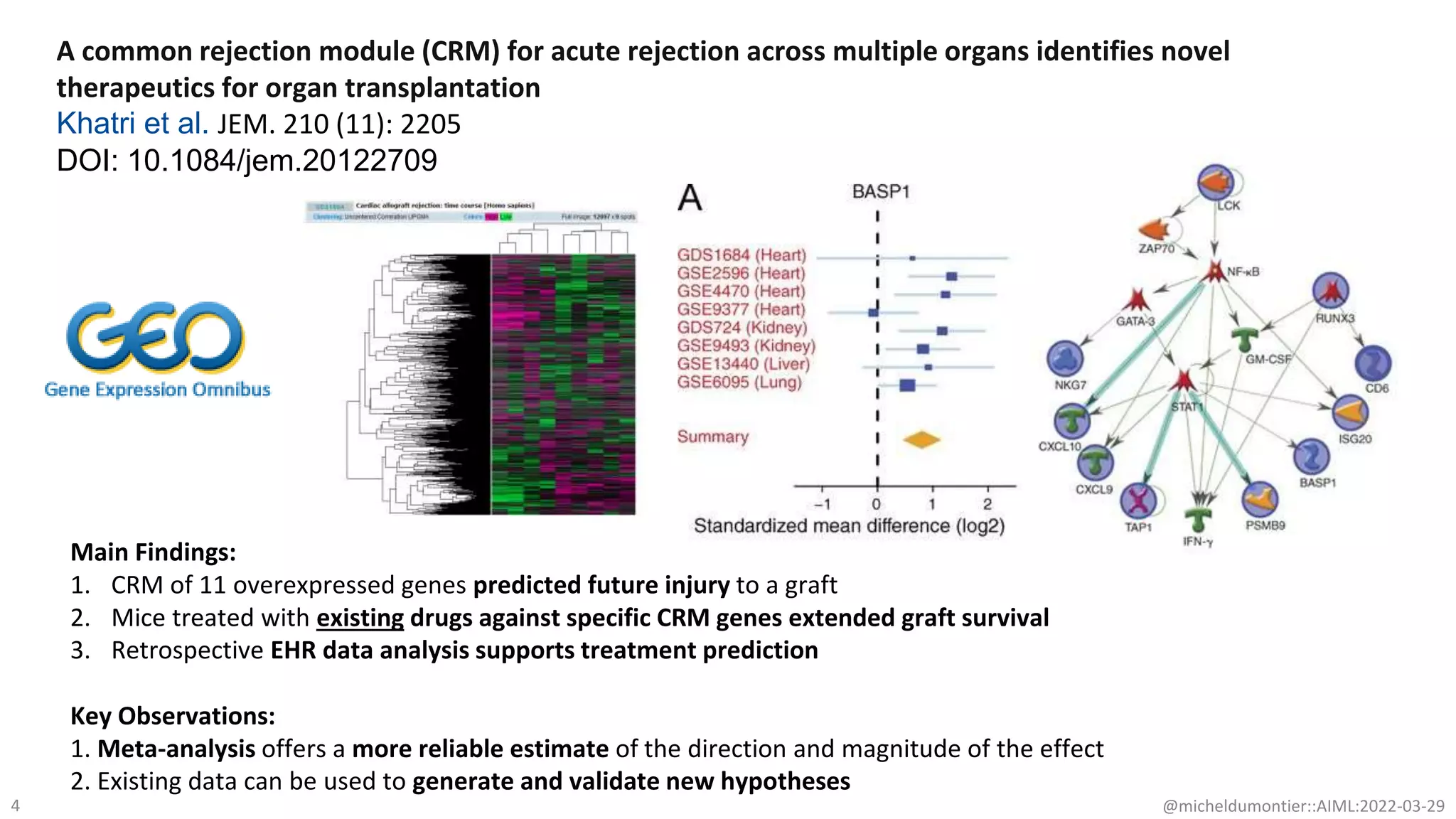
A common rejection module (CRM) for acute rejection across multiple organs identifies novel
therapeutics for organ transplantation
Khatri et al. JEM. 210 (11): 2205
DOI: 10.1084/jem.20122709
@micheldumontier::AIML:2022-03-29
Main Findings:
1. CRM of 11 overexpressed genes predicted future injury to a graft
2. Mice treated with existing drugs against specific CRM genes extended graft survival
3. Retrospective EHR data analysis supports treatment prediction
Key Observations:
1. Meta-analysis offers a more reliable estimate of the direction and magnitude of the effect
2. Existing data can be used to generate and validate new hypotheses
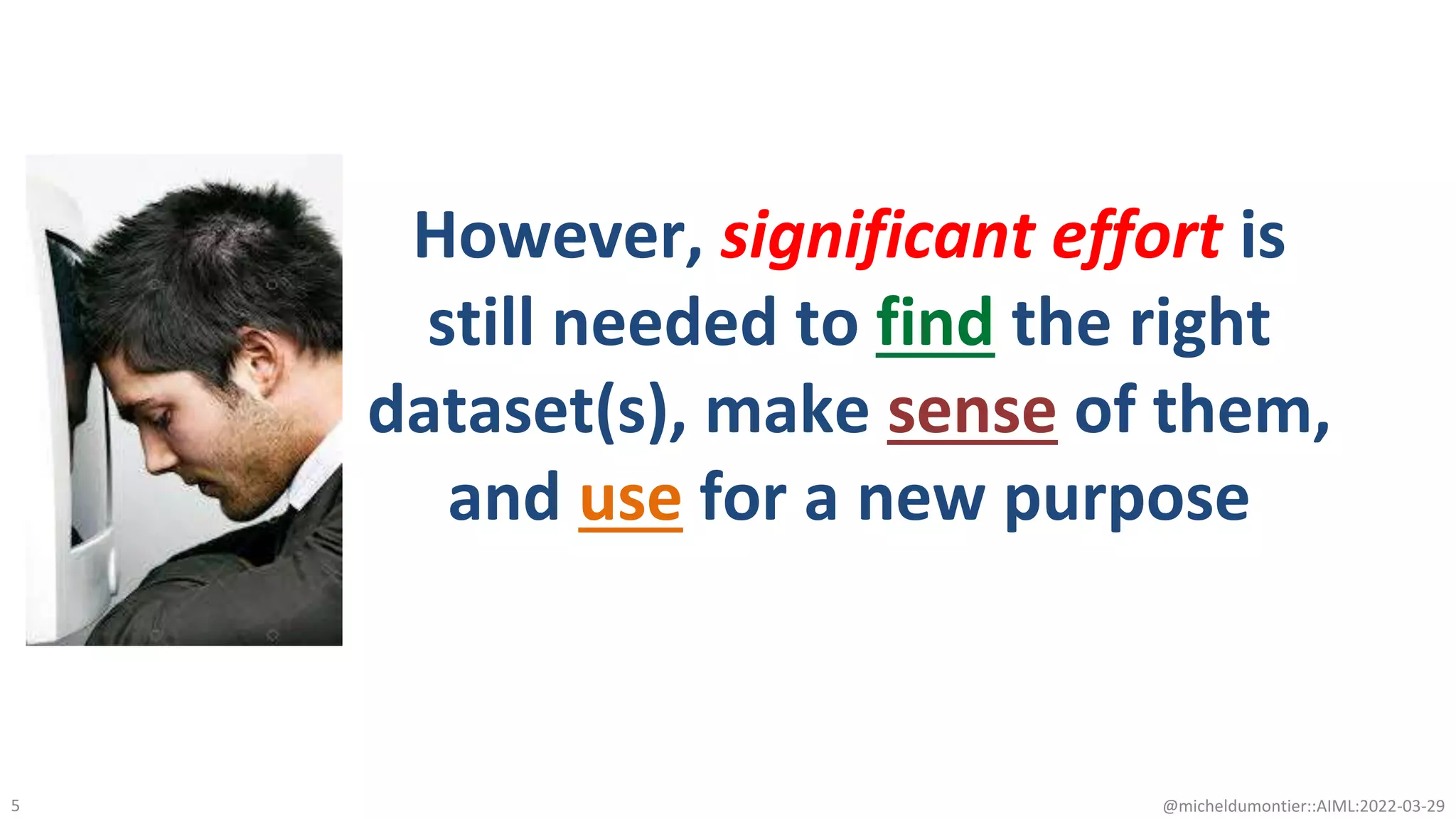
However, significant effort is
still needed to find the right
dataset(s), make sense of them,
and use for a new purpose
@micheldumontier::AIML:2022-03-29
5
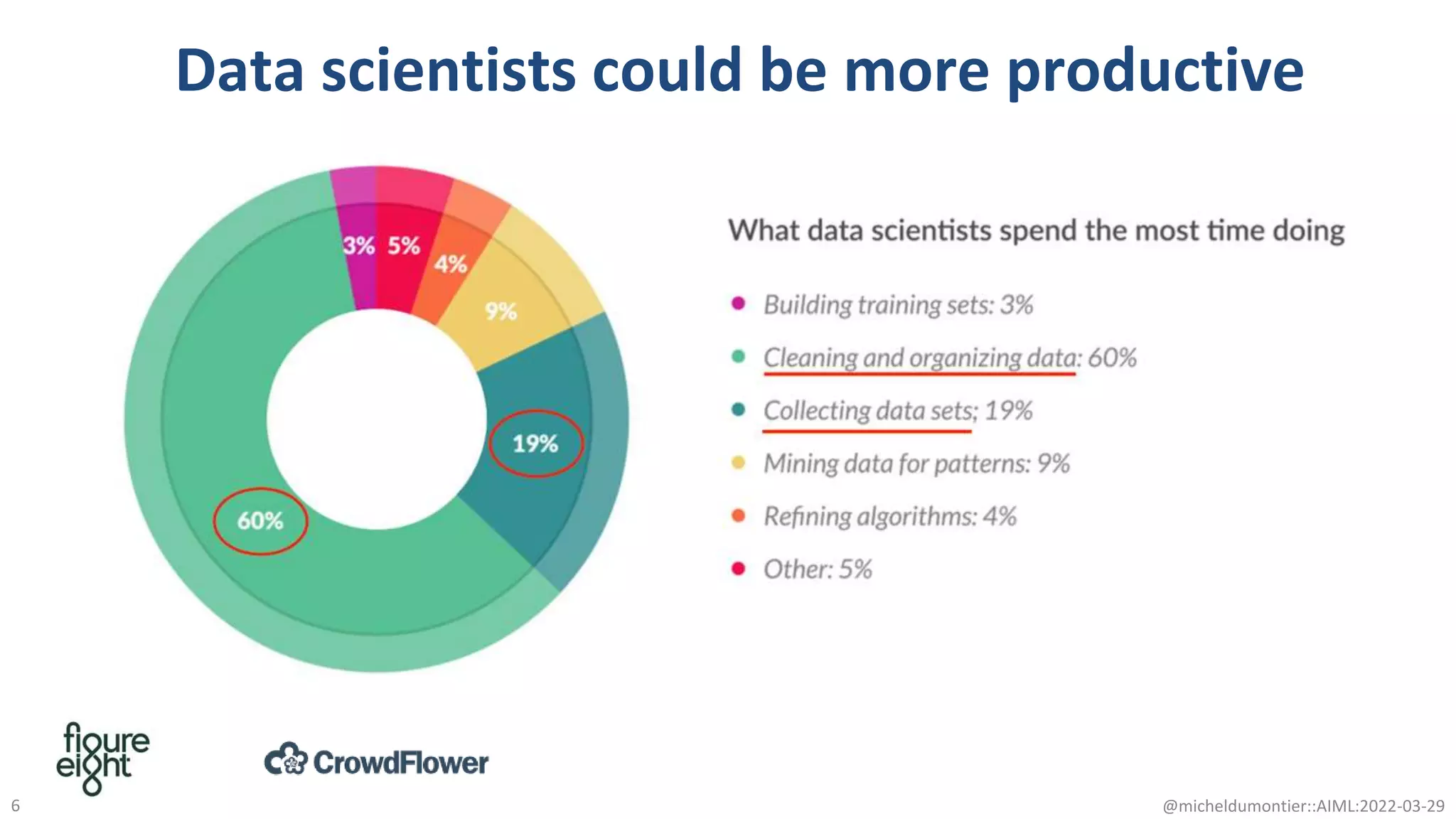
Data scientists could be more productive
@micheldumontier::AIML:2022-03-29
6
7 @micheldumontier::AIML:2022-03-29
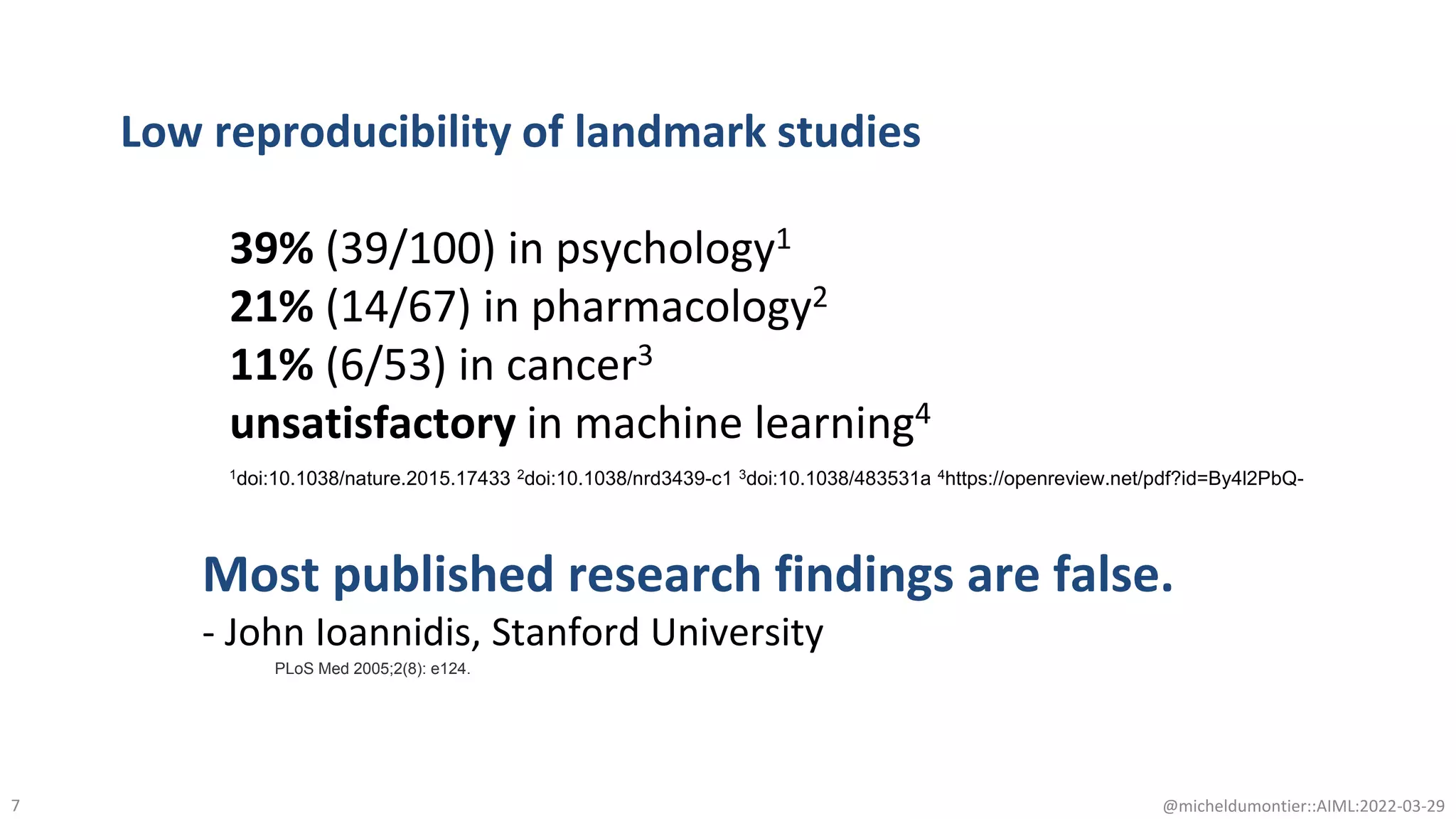
Low reproducibility of landmark studies
39% (39/100) in psychology1
21% (14/67) in pharmacology2
11% (6/53) in cancer3
unsatisfactory in machine learning4
1doi:10.1038/nature.2015.17433 2doi:10.1038/nrd3439-c1 3doi:10.1038/483531a 4https://openreview.net/pdf?id=By4l2PbQ-
Most published research findings are false.
- John Ioannidis, Stanford University
PLoS Med 2005;2(8): e124.
@micheldumontier::AIML:2022-03-29
8
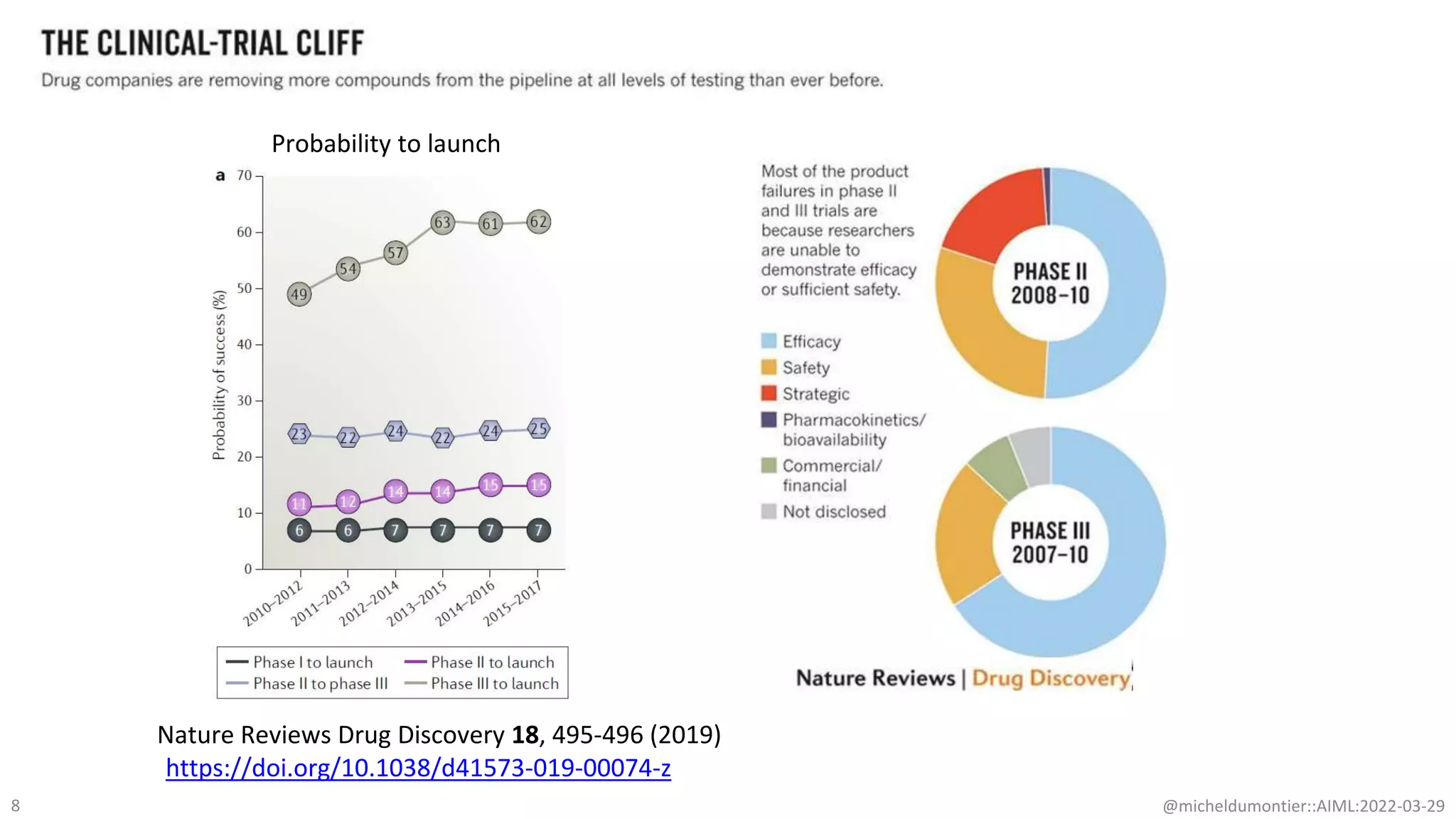
https://doi.org/10.1038/d41573-019-00074-z
Probability to launch
Nature Reviews Drug Discovery 18, 495-496 (2019)
@micheldumontier::AIML:2022-03-29
9
It’s time to completely rethink how we
perform and document empirical research
@micheldumontier::AIML:2022-03-29
10
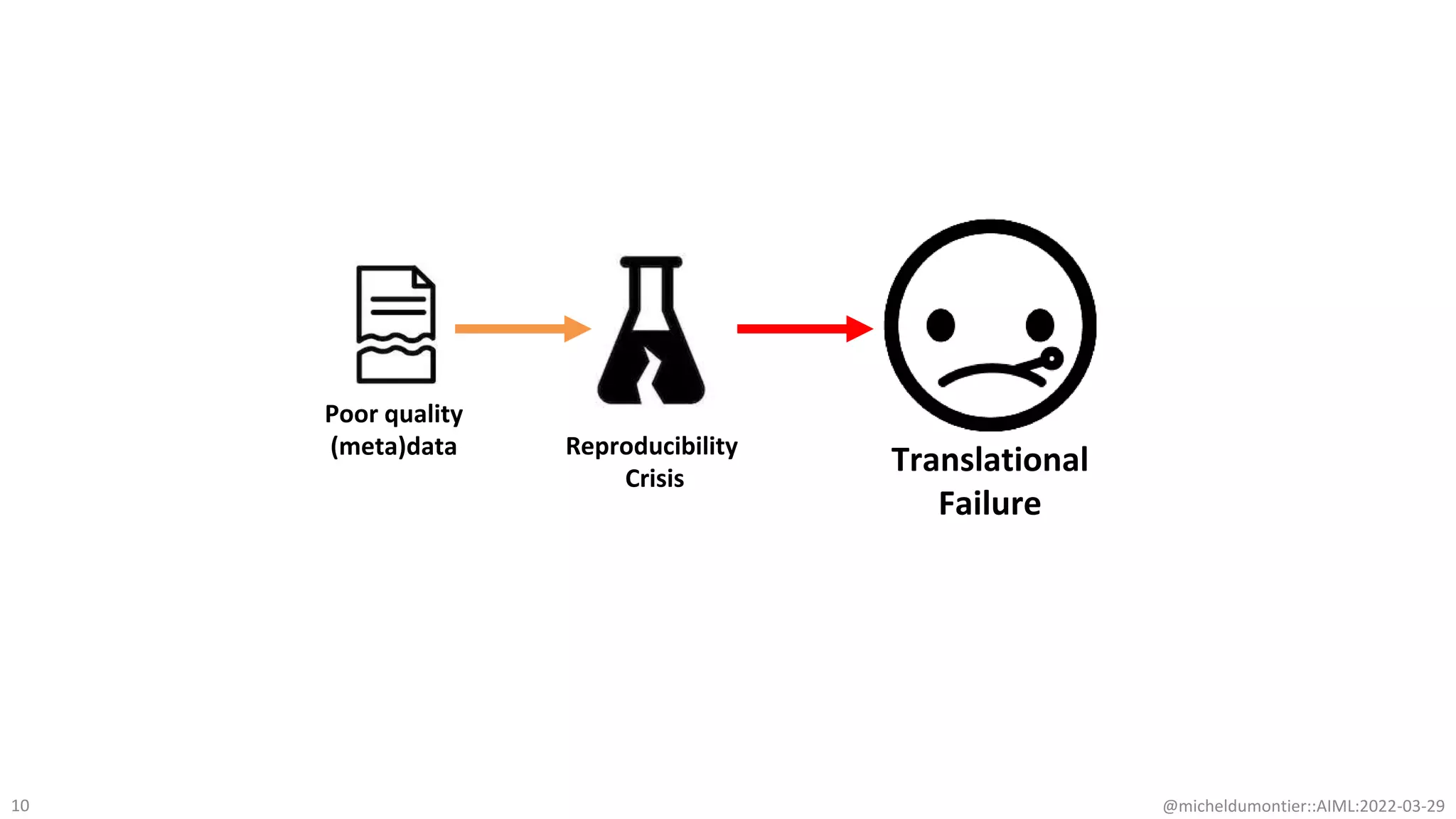
Poor quality
(meta)data Reproducibility
Crisis
Translational
Failure
Human Machine collaboration
is crucial to our future success
@micheldumontier::AIML:2022-03-29
11
Machines, not people,
need to be able to discover and reuse data
@micheldumontier::AIML:2022-03-29
12
We need a new social contract, supported
by legal and technological infrastructure
to make digital resources available in a
responsible manner
@micheldumontier::AIML:2022-03-29
13
@micheldumontier::AIML:2022-03-29
14
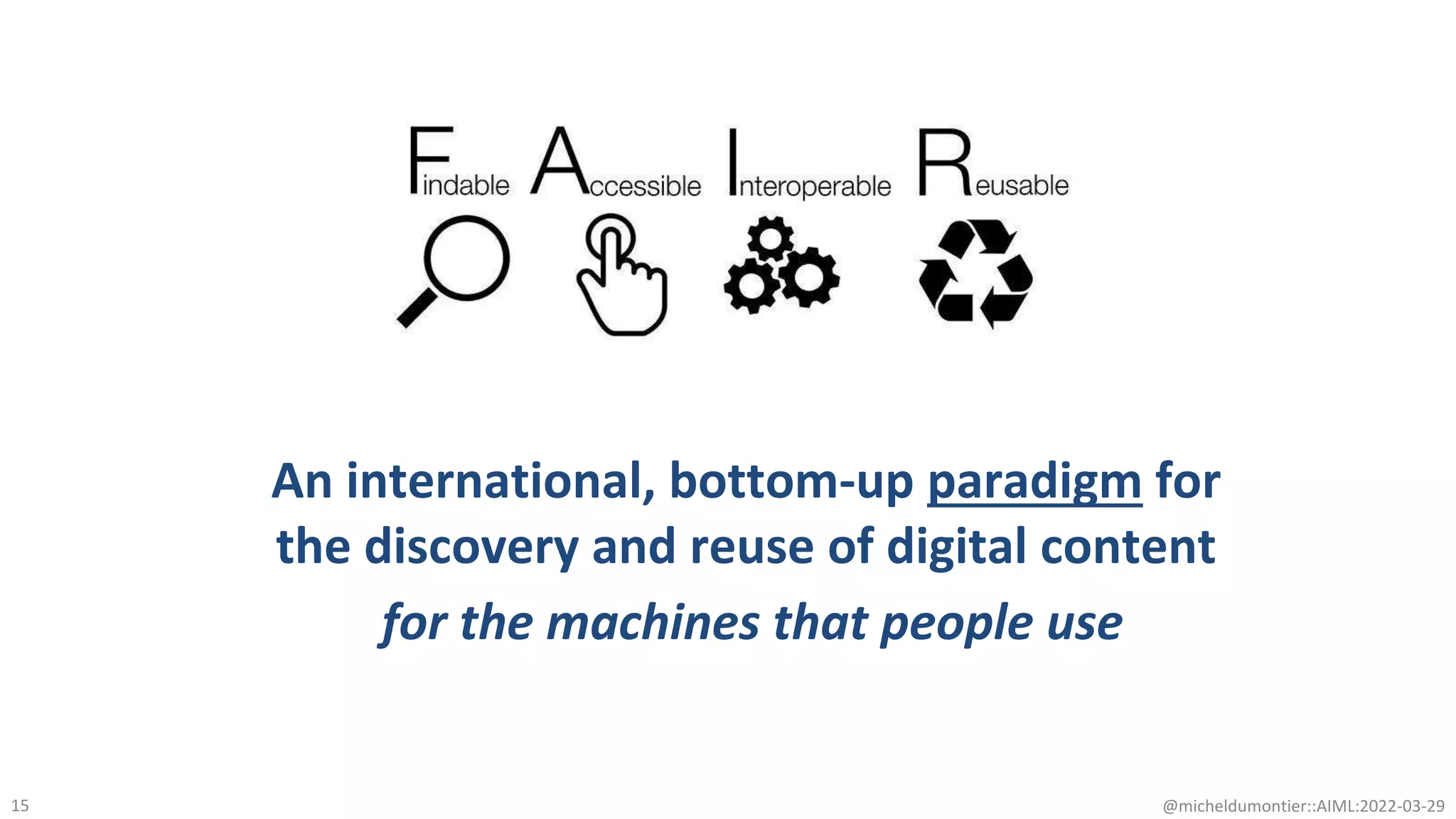
An international, bottom-up paradigm for
the discovery and reuse of digital content
for the machines that people use
@micheldumontier::AIML:2022-03-29
15
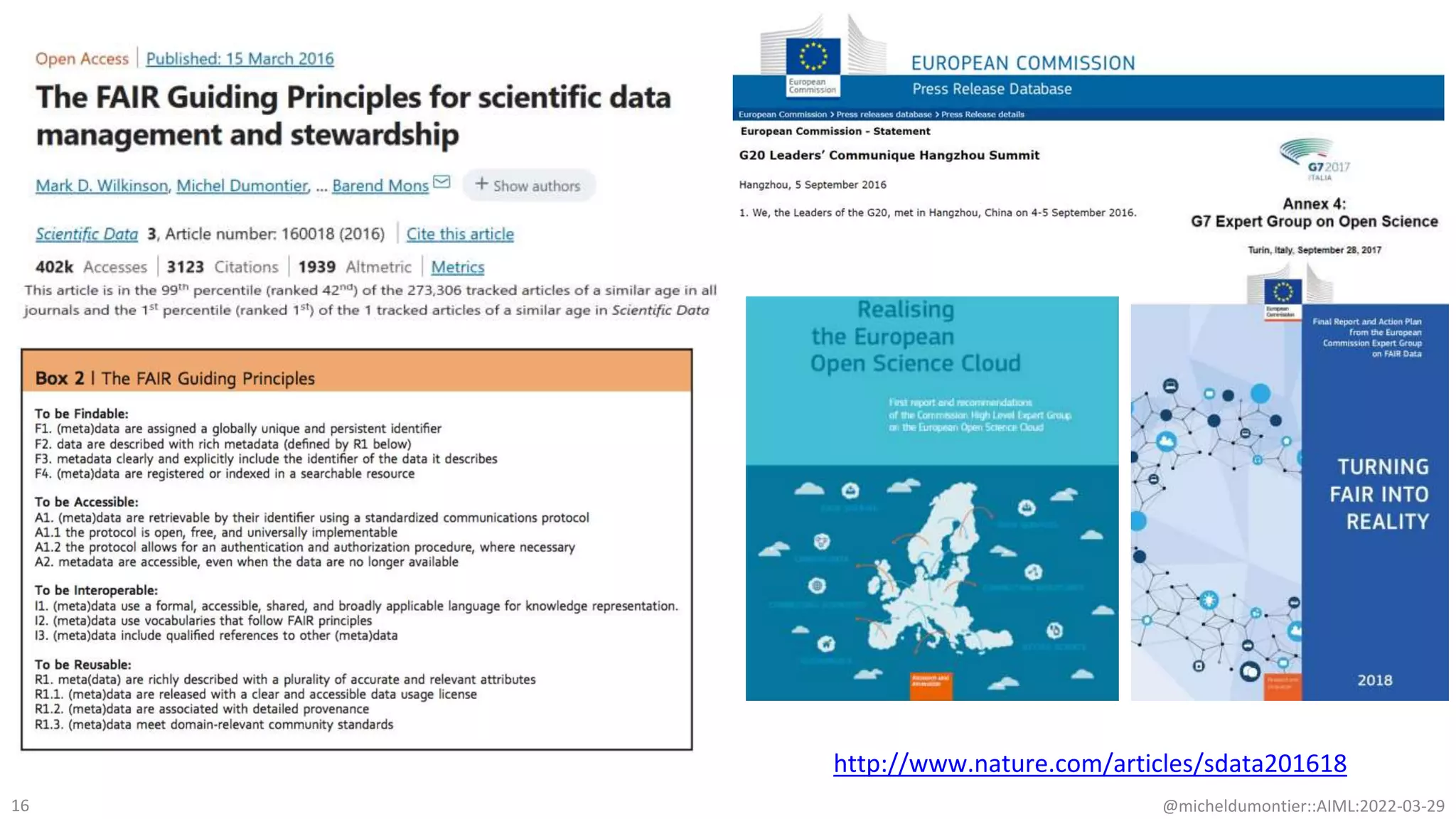
http://www.nature.com/articles/sdata201618
@micheldumontier::AIML:2022-03-29
16
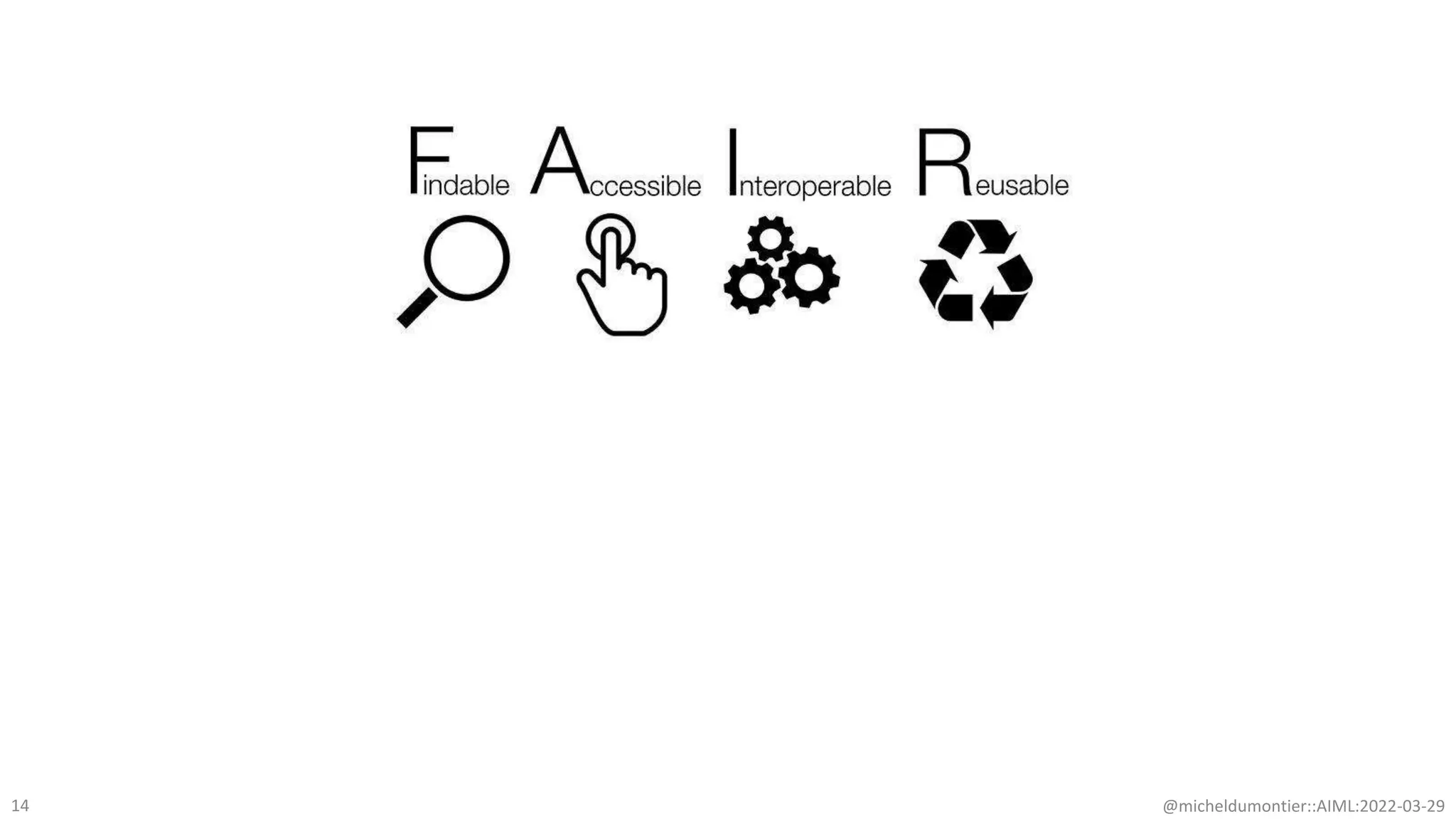
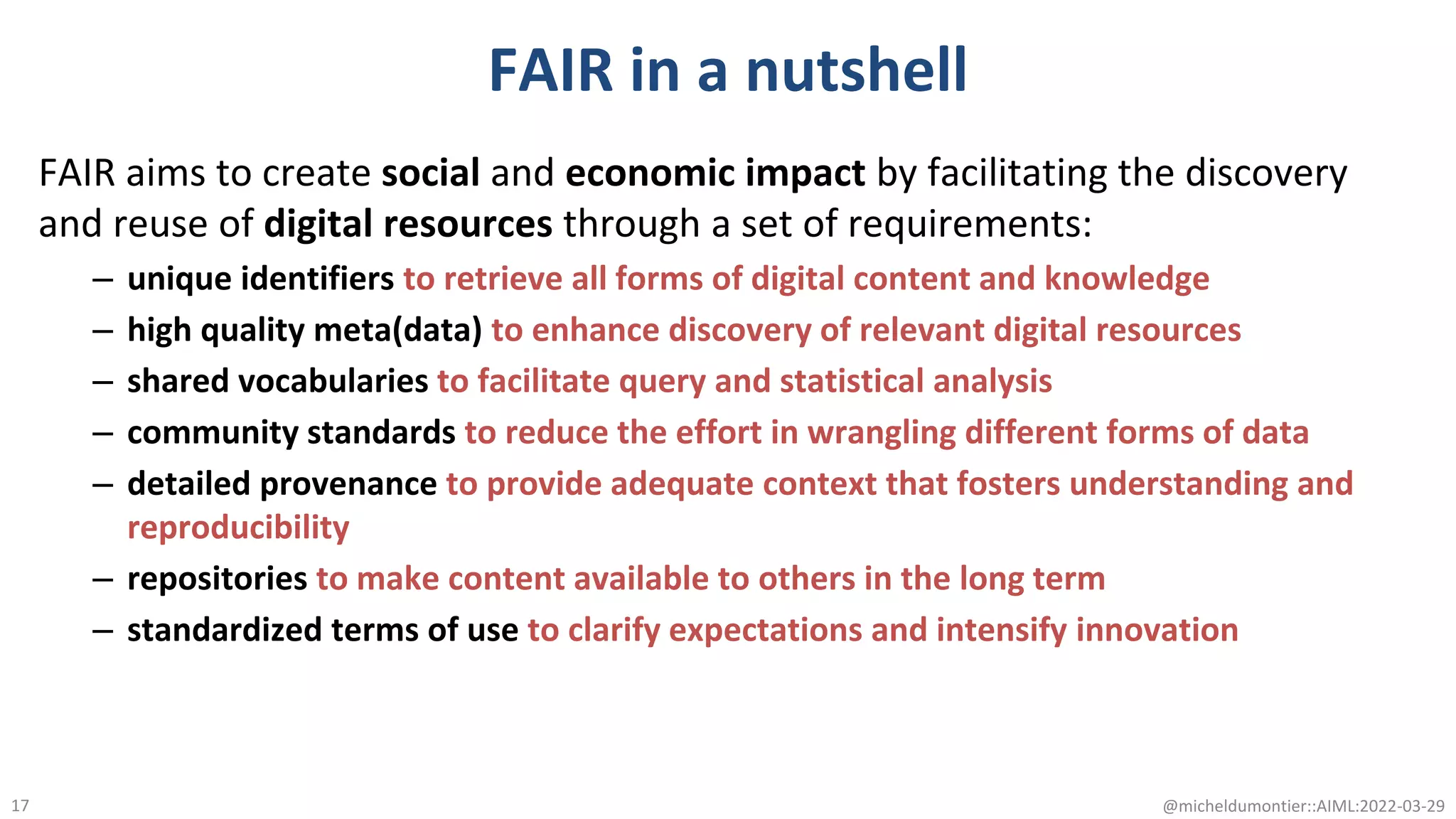
FAIR in a nutshell
FAIR aims to create social and economic impact by facilitating the discovery
and reuse of digital resources through a set of requirements:
– unique identifiers to retrieve all forms of digital content and knowledge
– high quality meta(data) to enhance discovery of relevant digital resources
– shared vocabularies to facilitate query and statistical analysis
– community standards to reduce the effort in wrangling different forms of data
– detailed provenance to provide adequate context that fosters understanding and
reproducibility
– repositories to make content available to others in the long term
– standardized terms of use to clarify expectations and intensify innovation
@micheldumontier::AIML:2022-03-29
17
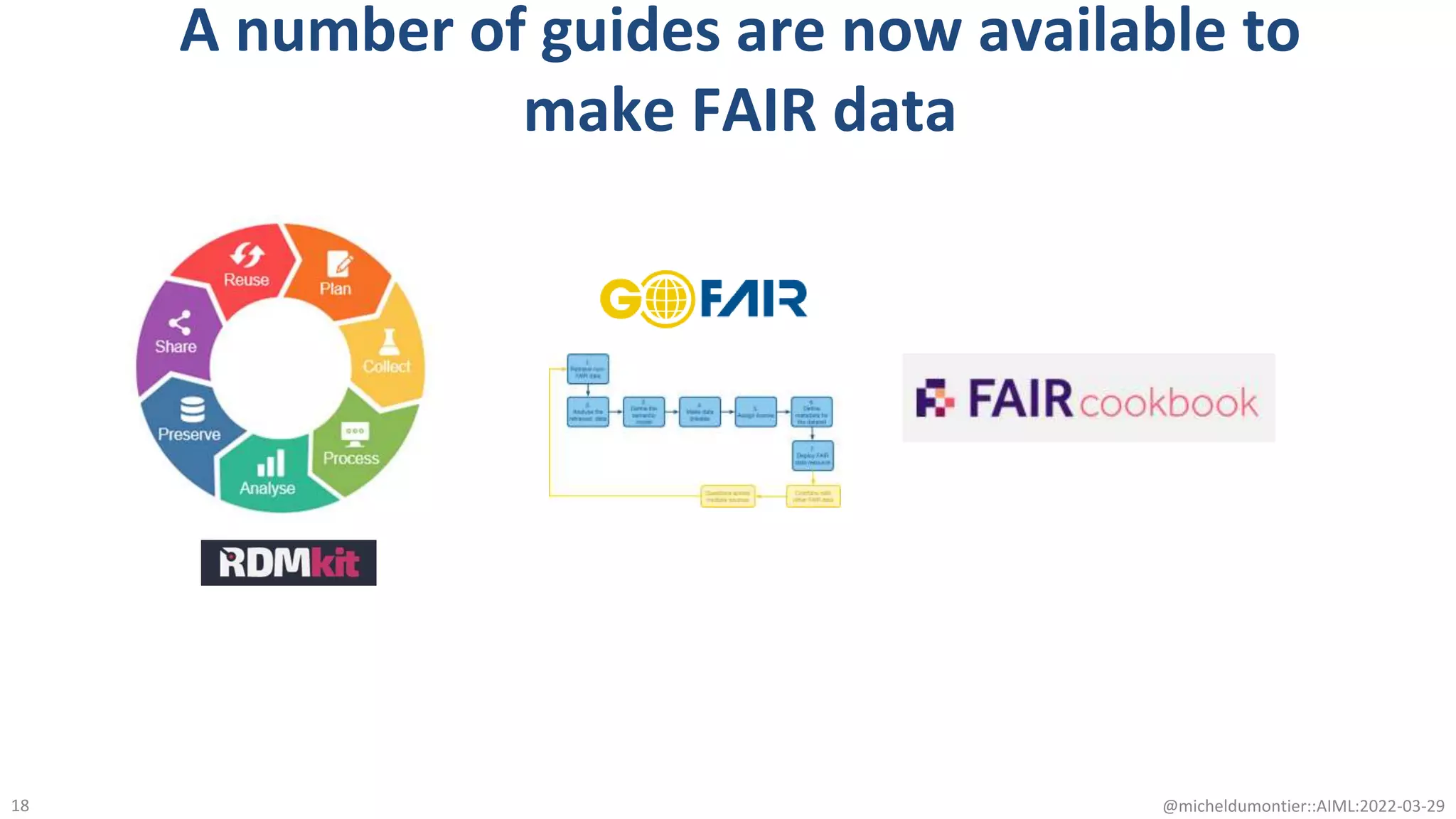
A number of guides are now available to
make FAIR data
@micheldumontier::AIML:2022-03-29
18
19
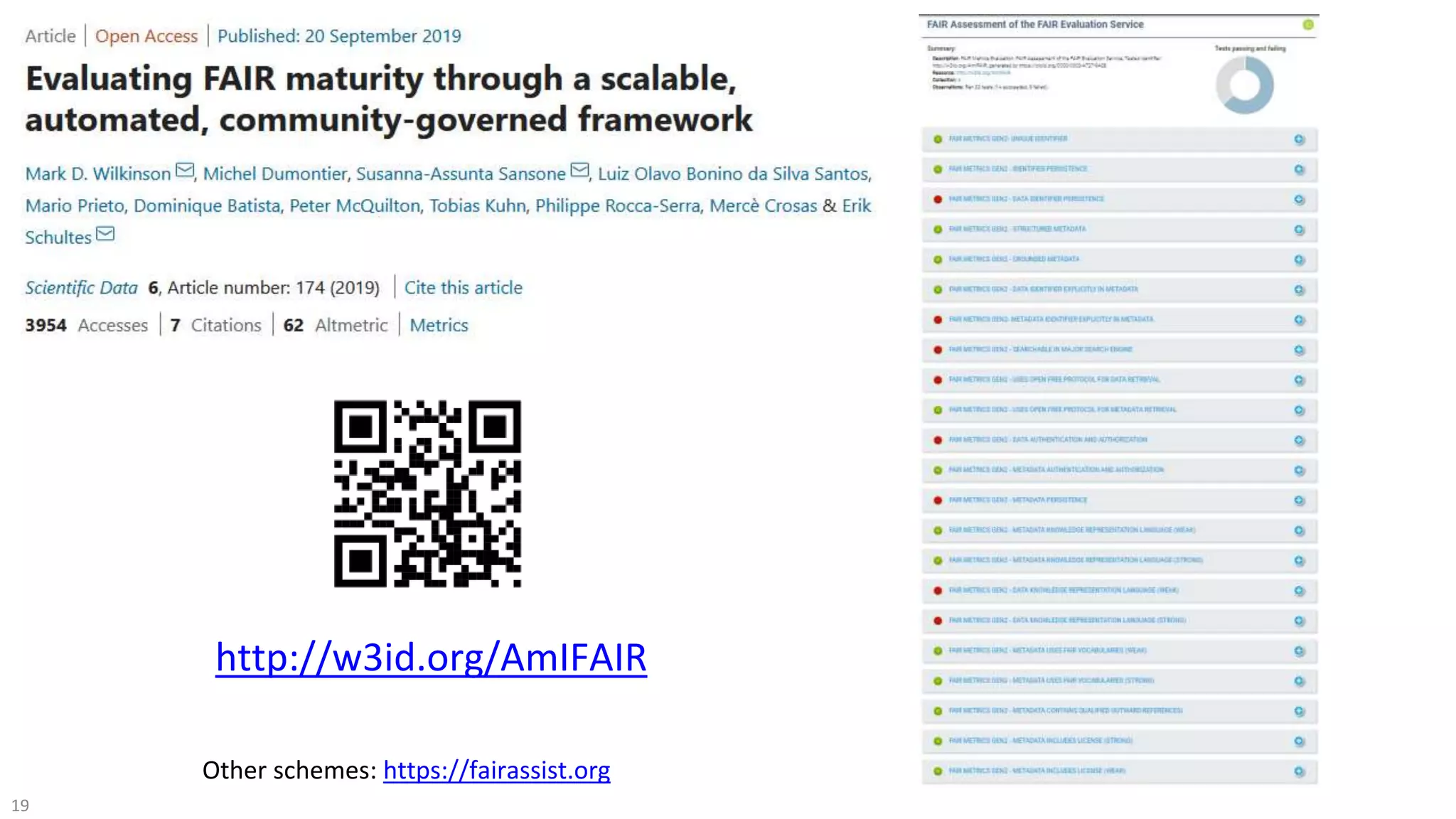
http://w3id.org/AmIFAIR
Other schemes: https://fairassist.org
FAIR Knowledge Graphs
@micheldumontier::AIML:2022-03-29
20
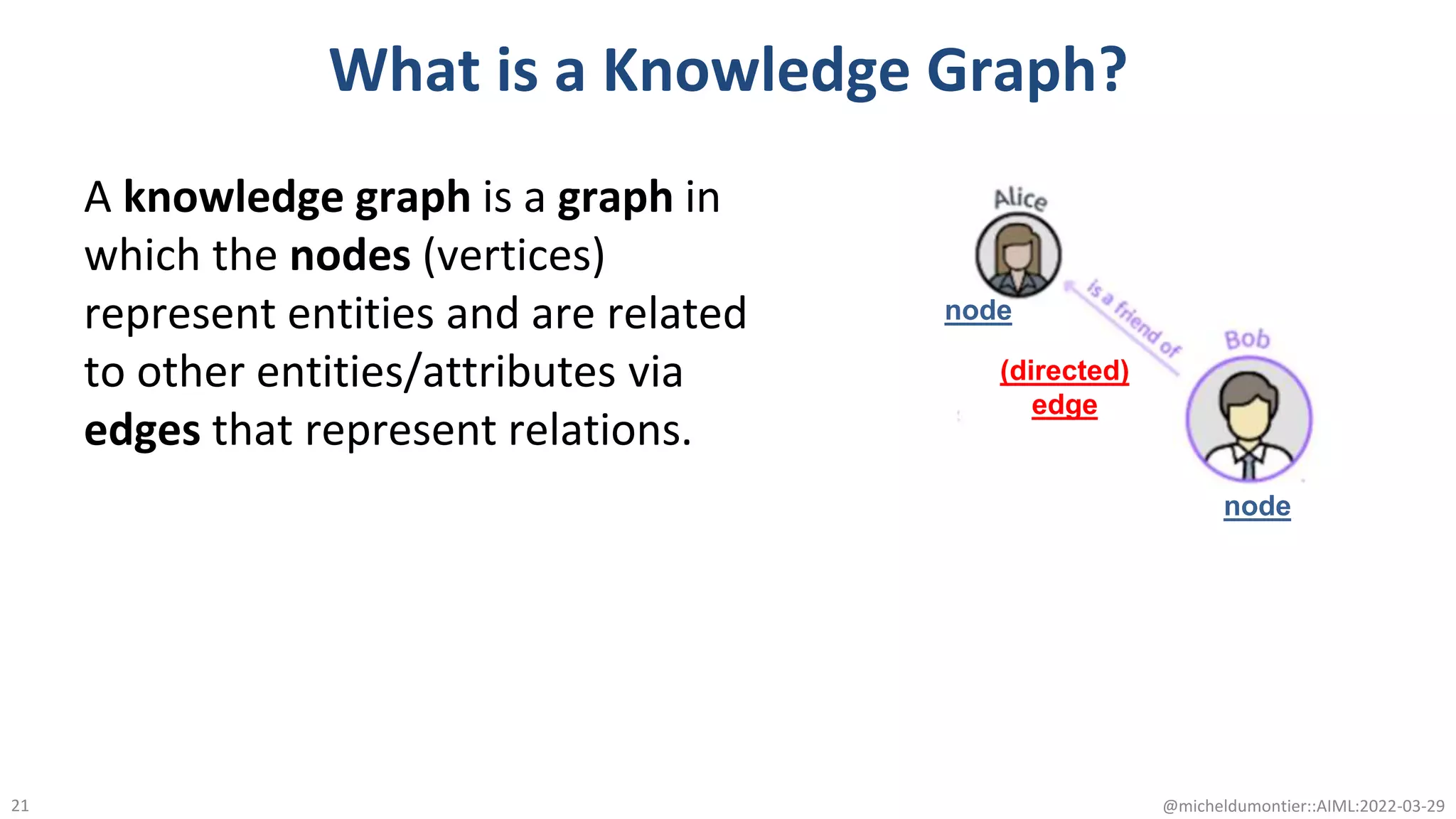
What is a Knowledge Graph?
A knowledge graph is a graph in
which the nodes (vertices)
represent entities and are related
to other entities/attributes via
edges that represent relations.
@micheldumontier::AIML:2022-03-29
21
node
(directed)
edge
node
What is a Knowledge Graph?
A knowledge graph is a graph in
which the nodes (vertices) represent
entities and are related to other
entities/attributes via edges that
represent relations.
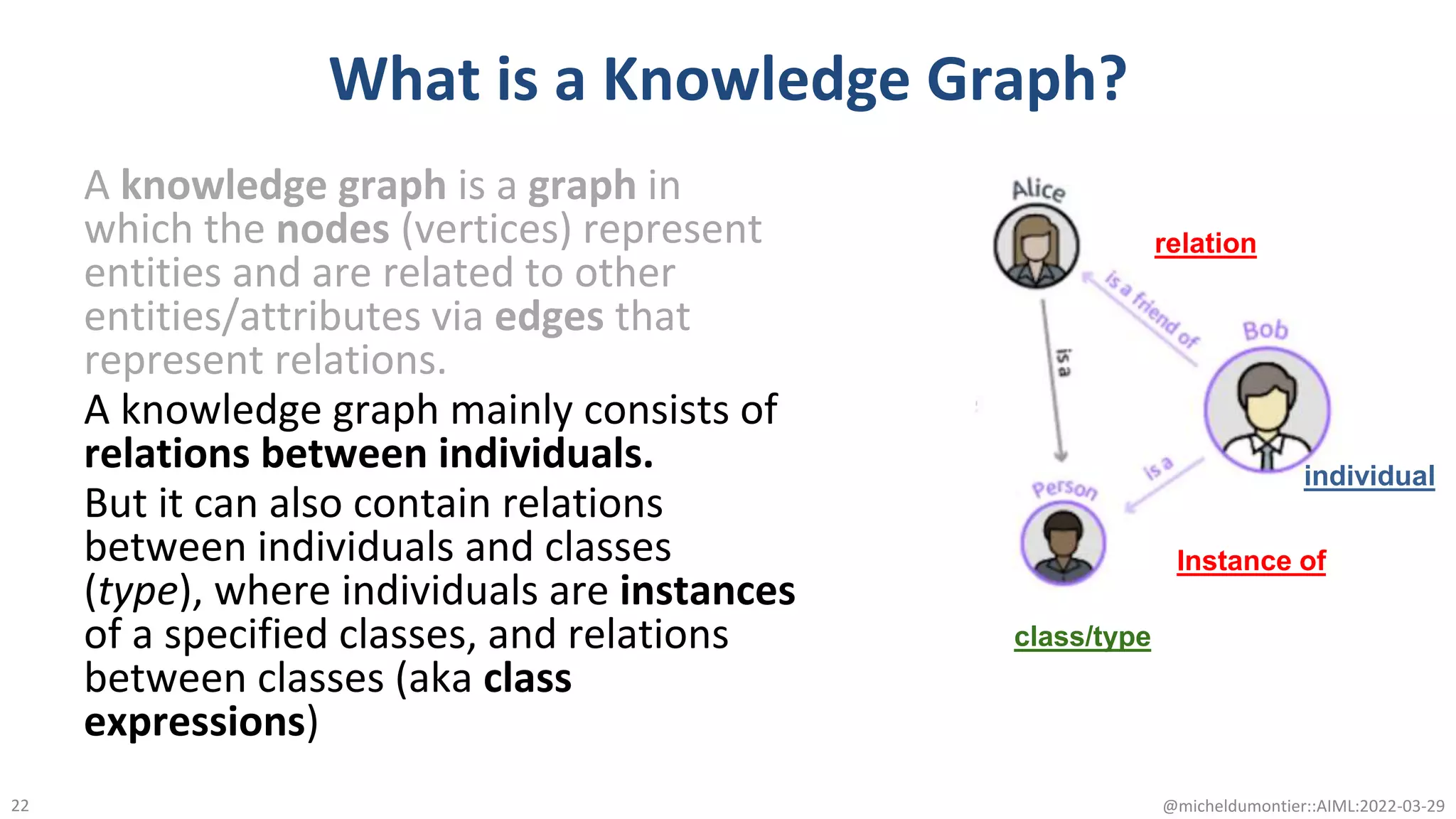
A knowledge graph mainly consists of
relations between individuals.
But it can also contain relations
between individuals and classes
(type), where individuals are instances
of a specified classes, and relations
between classes (aka class
expressions)
@micheldumontier::AIML:2022-03-29
22
class/type
individual
relation
Instance of
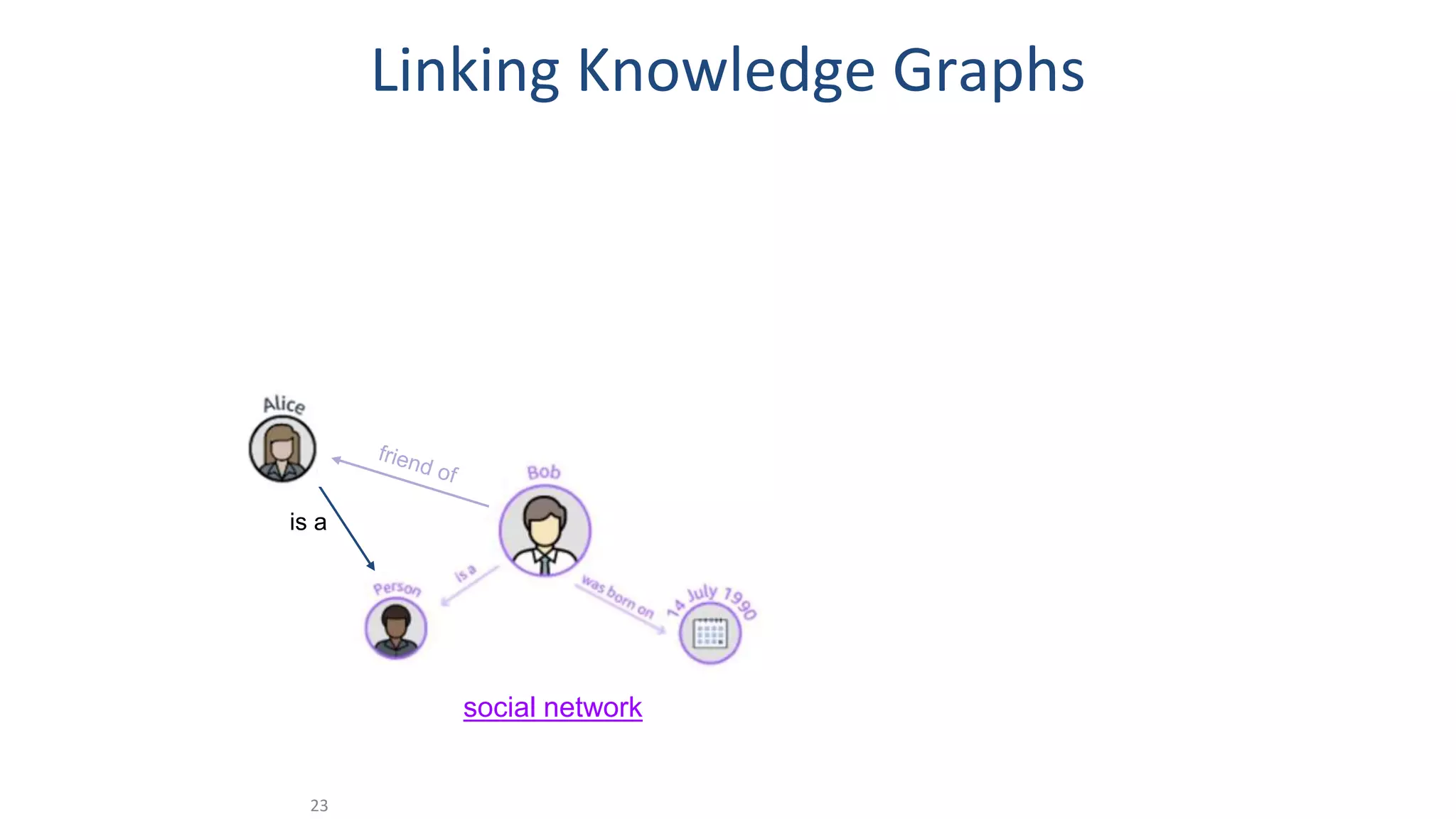
social network
is a
Linking Knowledge Graphs
23
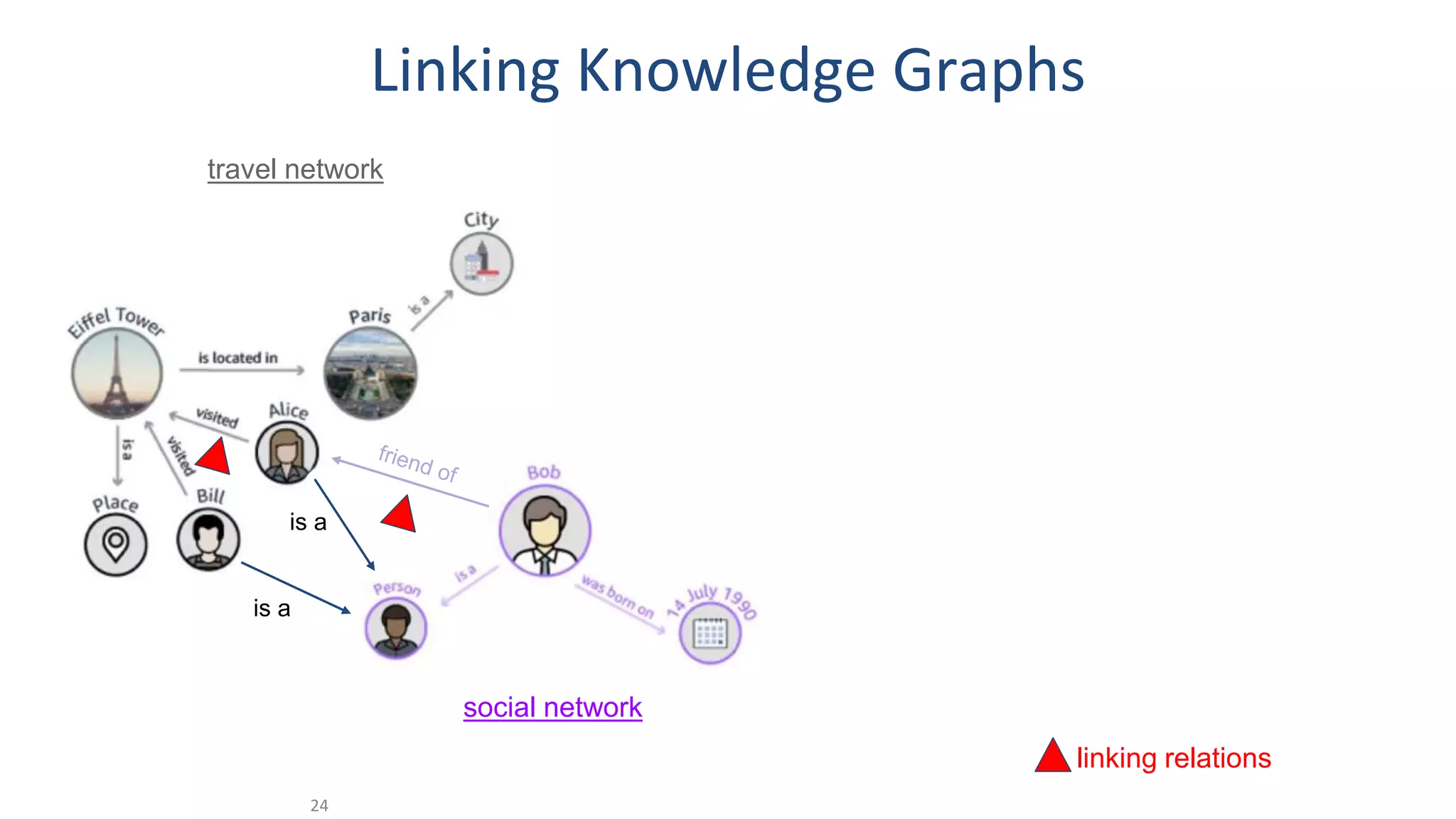
travel network
social network
is a
is a
linking relations
Linking Knowledge Graphs
24
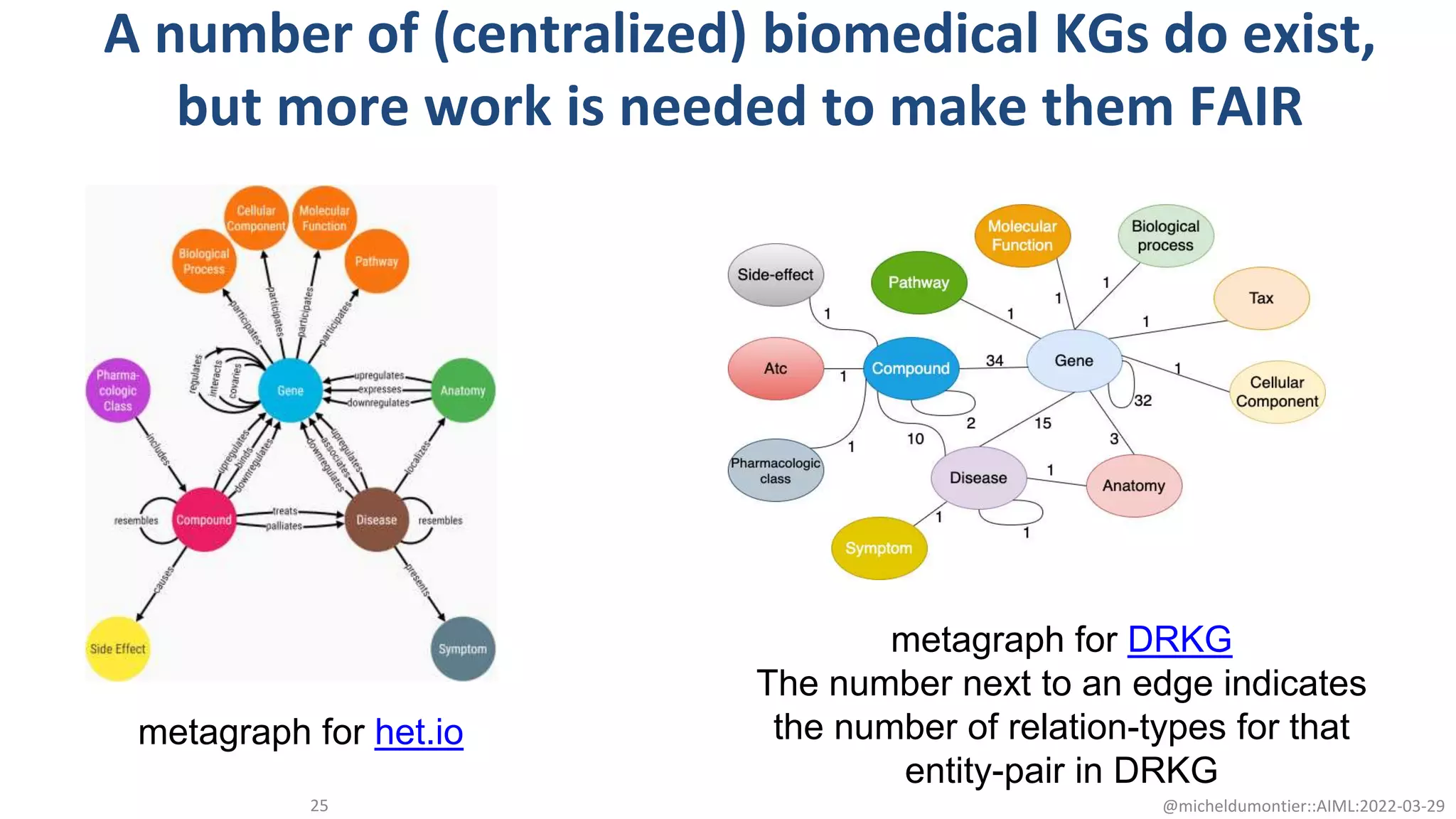
metagraph for het.io
metagraph for DRKG
The number next to an edge indicates
the number of relation-types for that
entity-pair in DRKG
A number of (centralized) biomedical KGs do exist,
but more work is needed to make them FAIR
25 @micheldumontier::AIML:2022-03-29
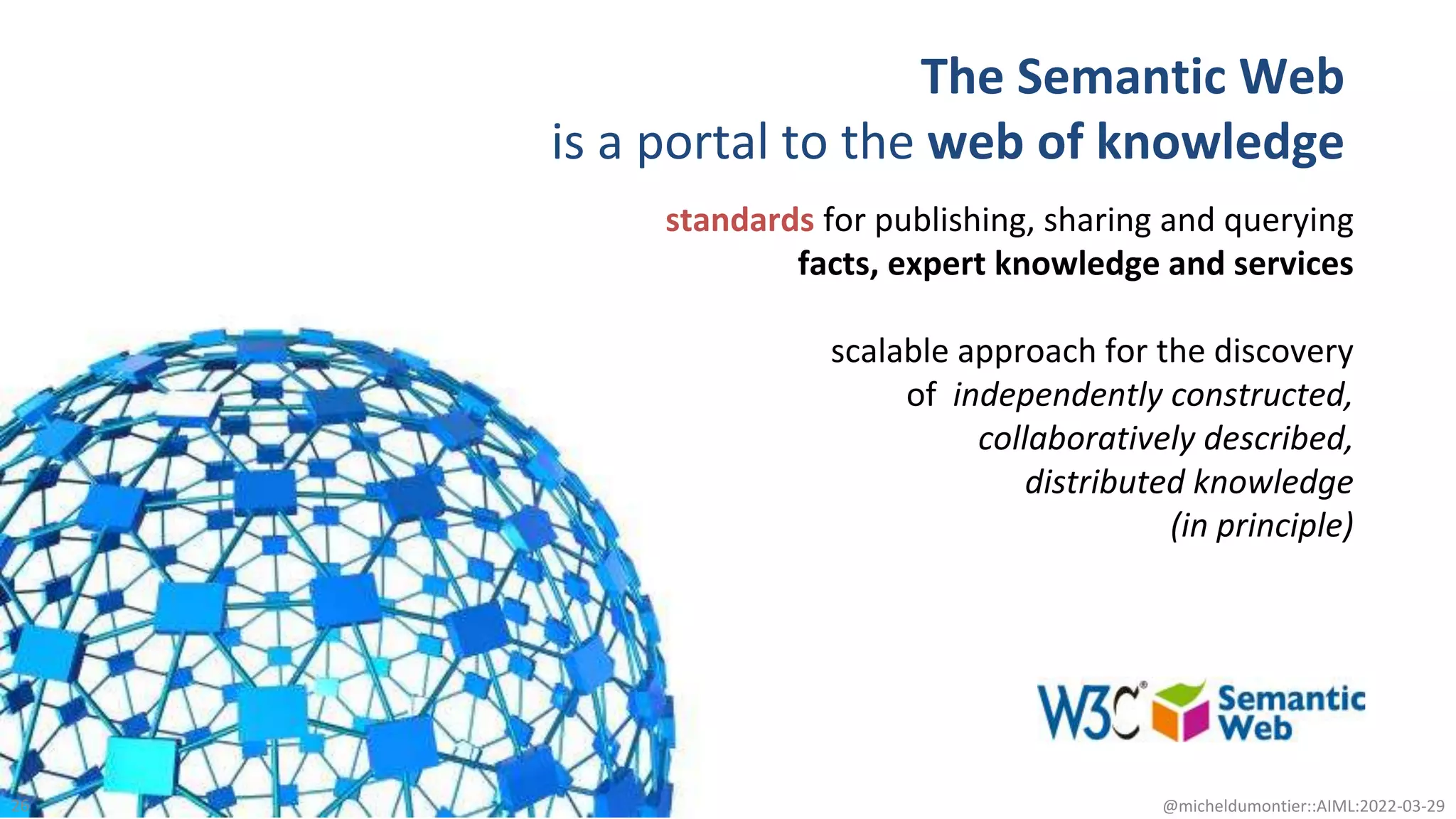
The Semantic Web
is a portal to the web of knowledge
26 @micheldumontier::AIML:2022-03-29
standards for publishing, sharing and querying
facts, expert knowledge and services
scalable approach for the discovery
of independently constructed,
collaboratively described,
distributed knowledge
(in principle)
@micheldumontier::AIML:2022-03-29
27
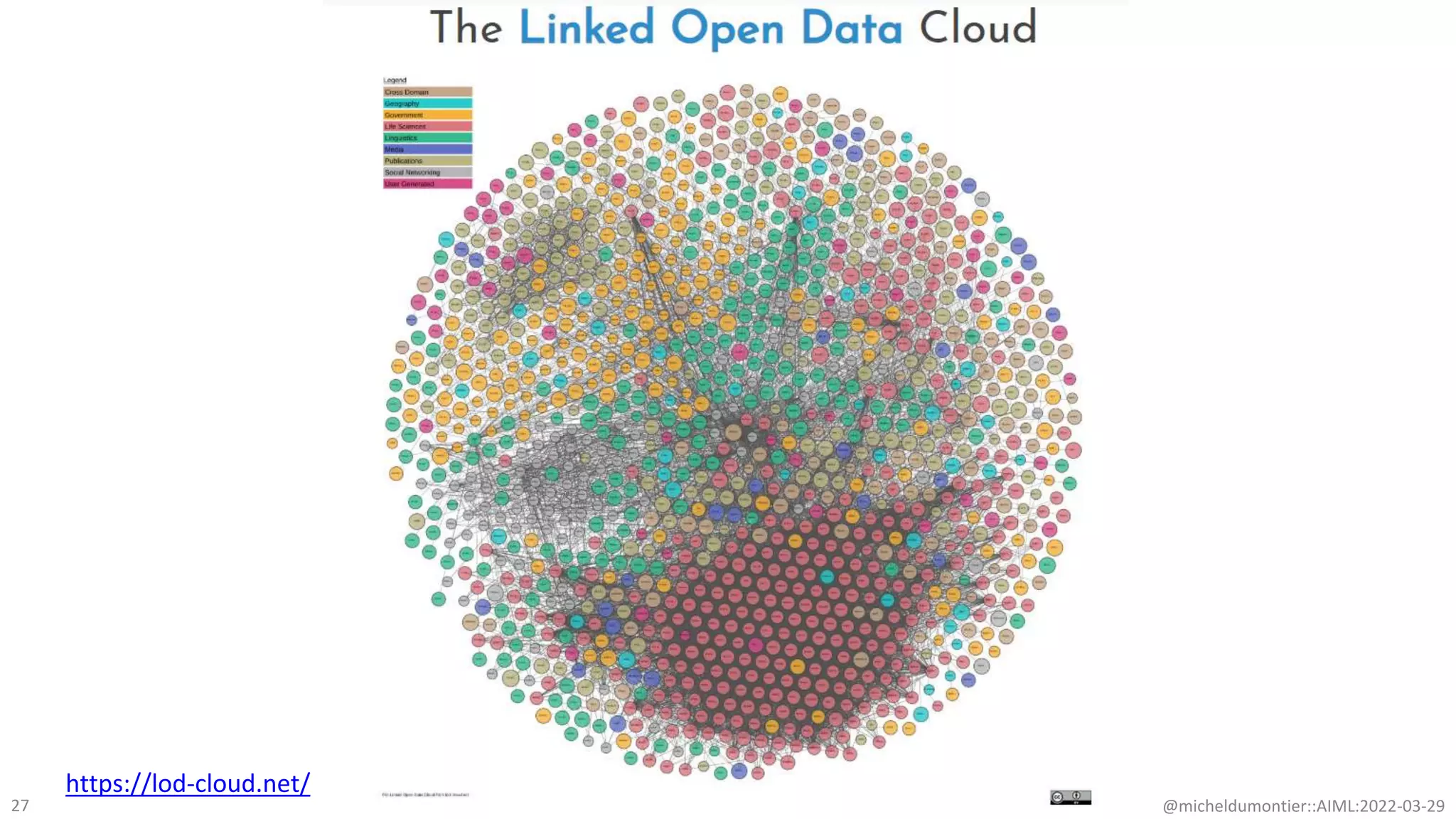
https://lod-cloud.net/
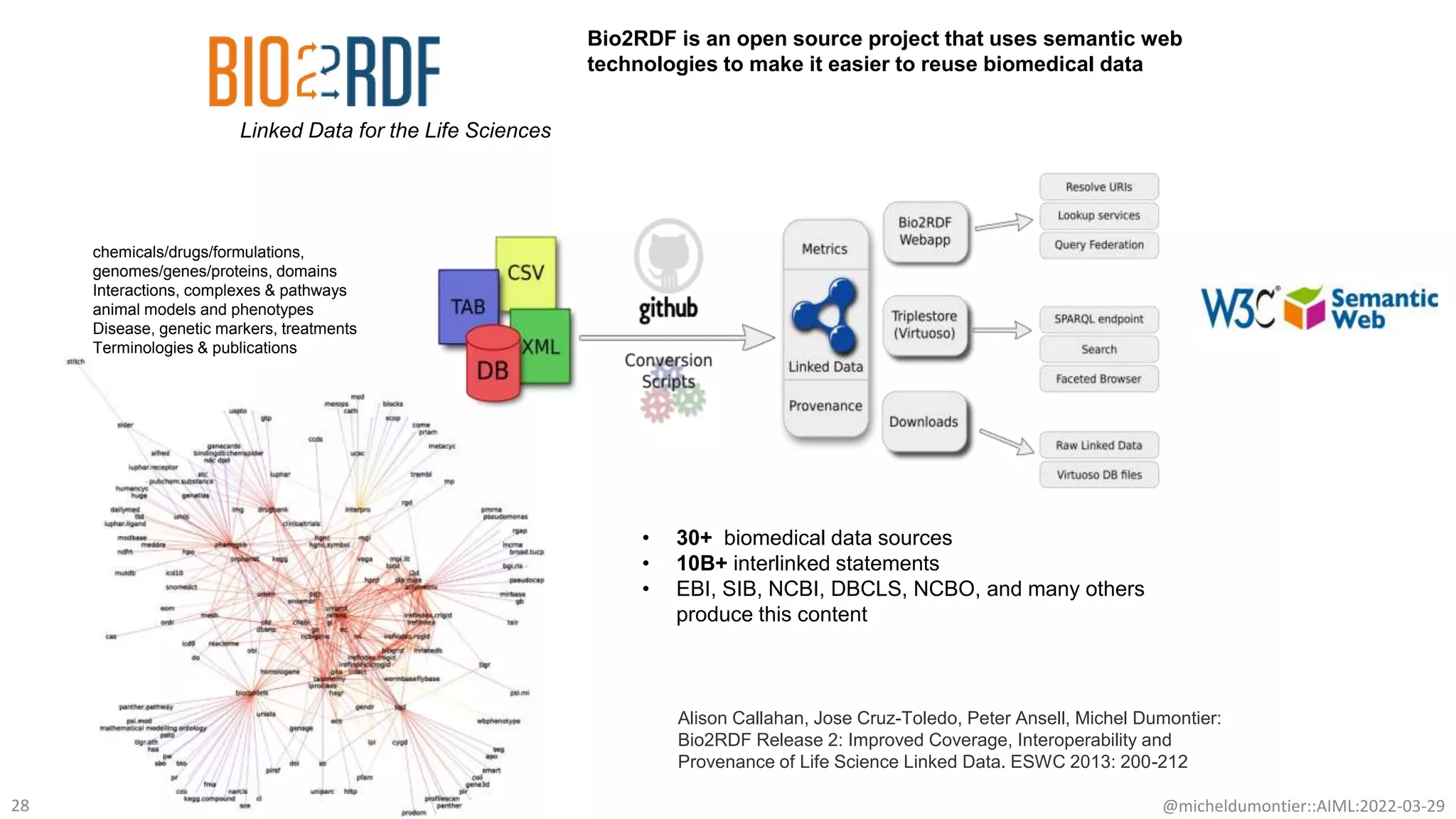
• 30+ biomedical data sources
• 10B+ interlinked statements
• EBI, SIB, NCBI, DBCLS, NCBO, and many others
produce this content
chemicals/drugs/formulations,
genomes/genes/proteins, domains
Interactions, complexes & pathways
animal models and phenotypes
Disease, genetic markers, treatments
Terminologies & publications
28
Alison Callahan, Jose Cruz-Toledo, Peter Ansell, Michel Dumontier:
Bio2RDF Release 2: Improved Coverage, Interoperability and
Provenance of Life Science Linked Data. ESWC 2013: 200-212
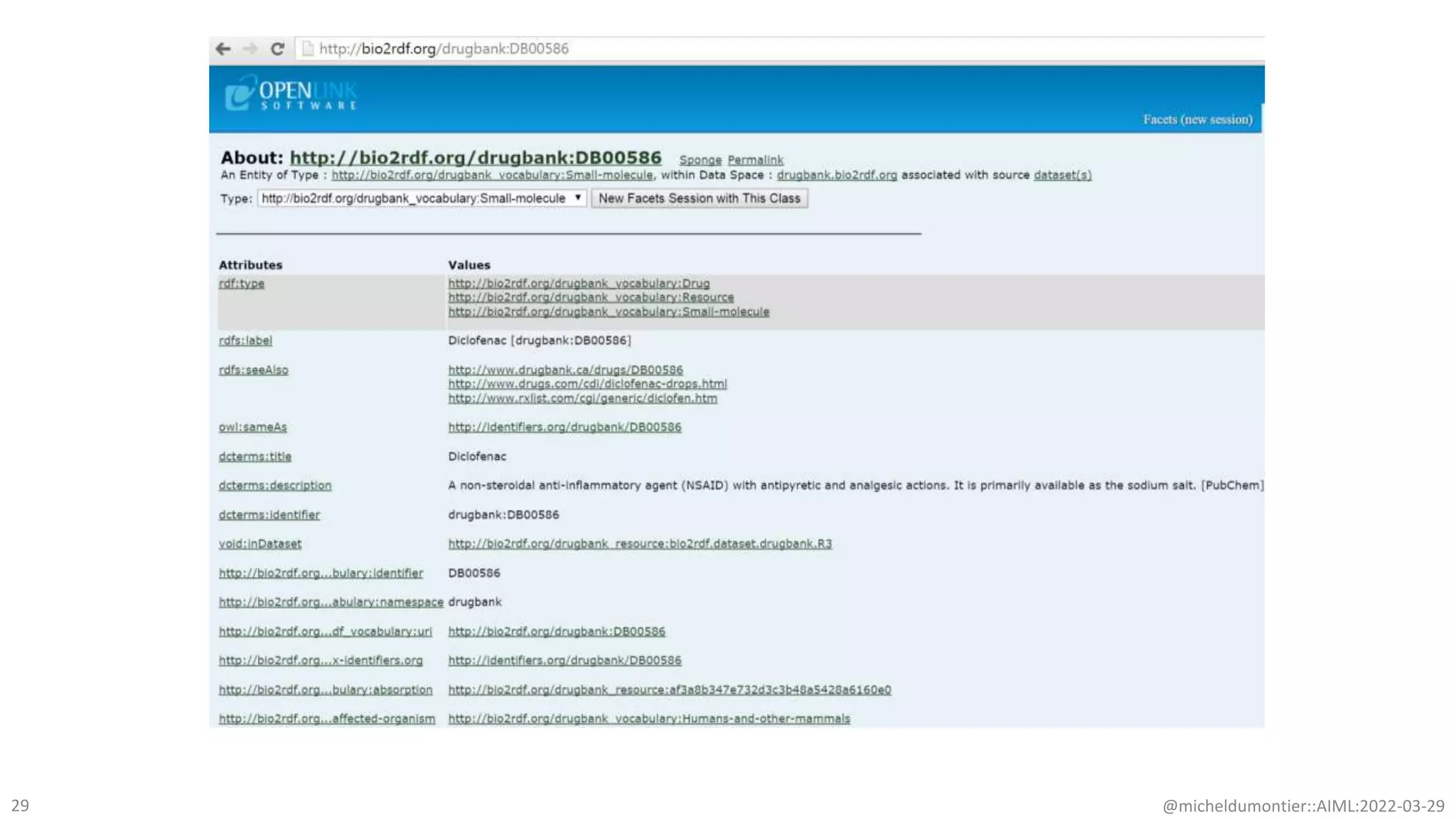
Linked Data for the Life Sciences
Bio2RDF is an open source project that uses semantic web
technologies to make it easier to reuse biomedical data
@micheldumontier::AIML:2022-03-29
29
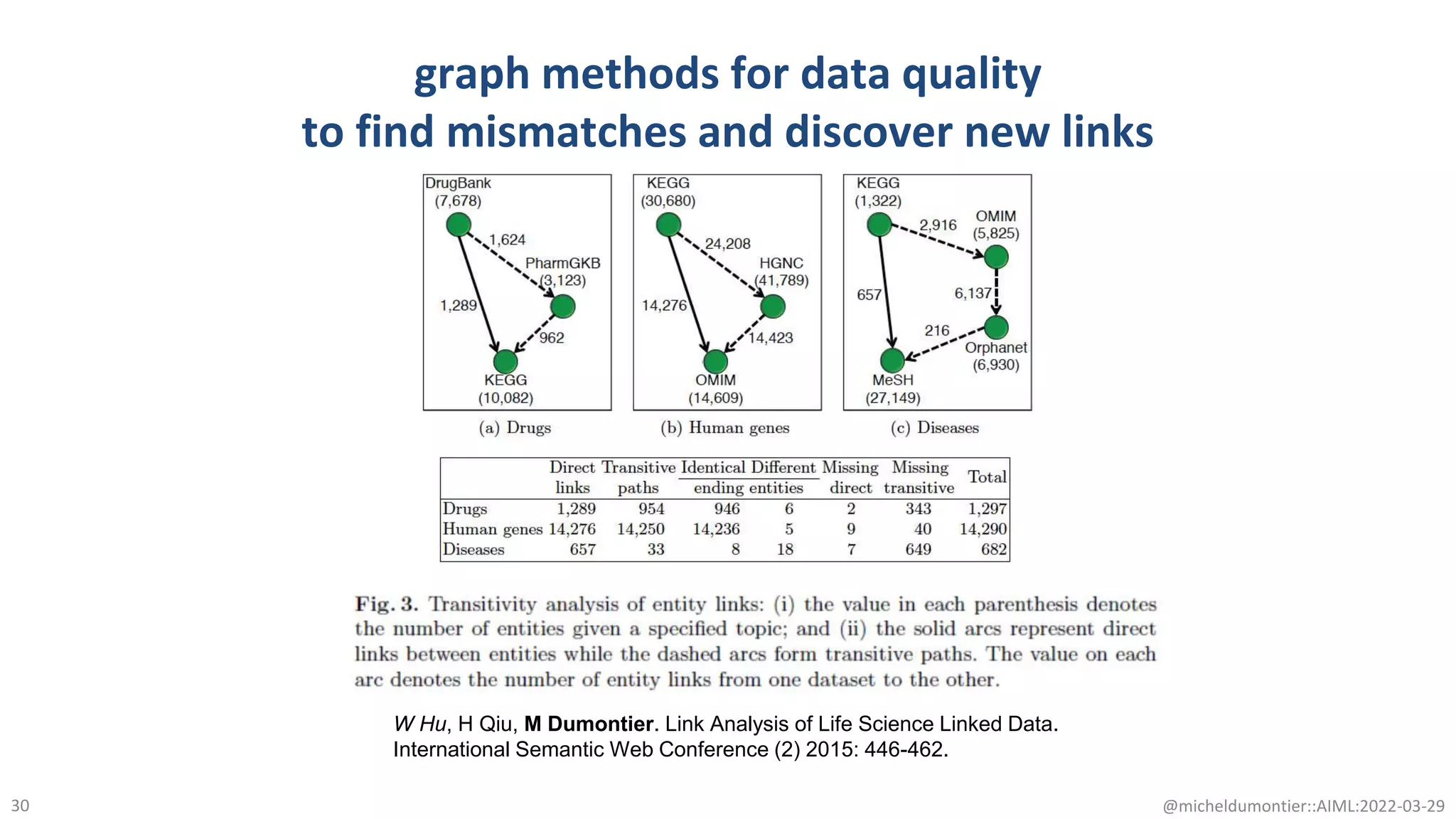
graph methods for data quality
to find mismatches and discover new links
@micheldumontier::AIML:2022-03-29
30
W Hu, H Qiu, M Dumontier. Link Analysis of Life Science Linked Data.
International Semantic Web Conference (2) 2015: 446-462.
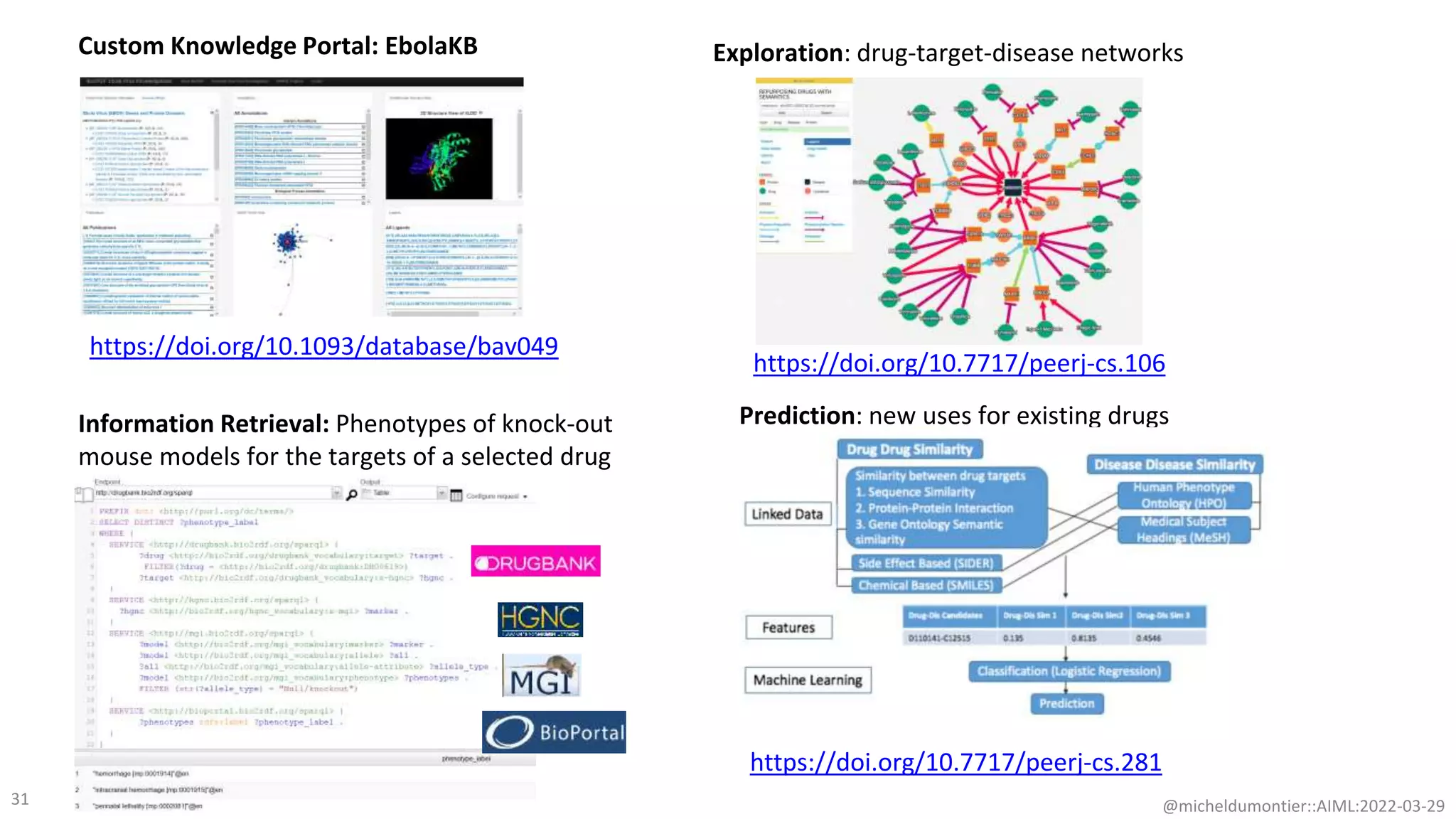
31
Prediction: new uses for existing drugs
Information Retrieval: Phenotypes of knock-out
mouse models for the targets of a selected drug
Exploration: drug-target-disease networks
https://doi.org/10.7717/peerj-cs.281
https://doi.org/10.7717/peerj-cs.106
@micheldumontier::AIML:2022-03-29
Custom Knowledge Portal: EbolaKB
https://doi.org/10.1093/database/bav049
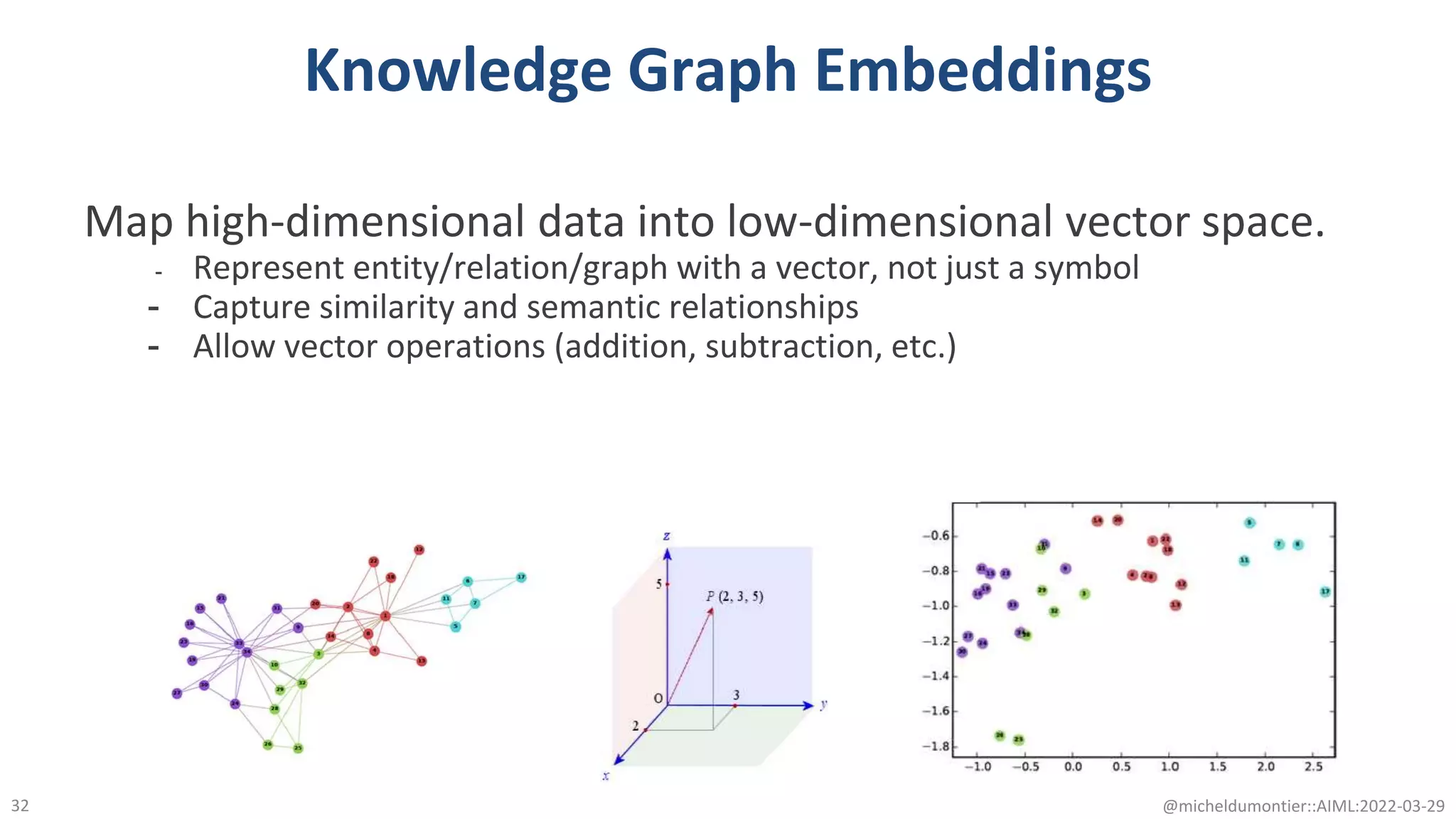
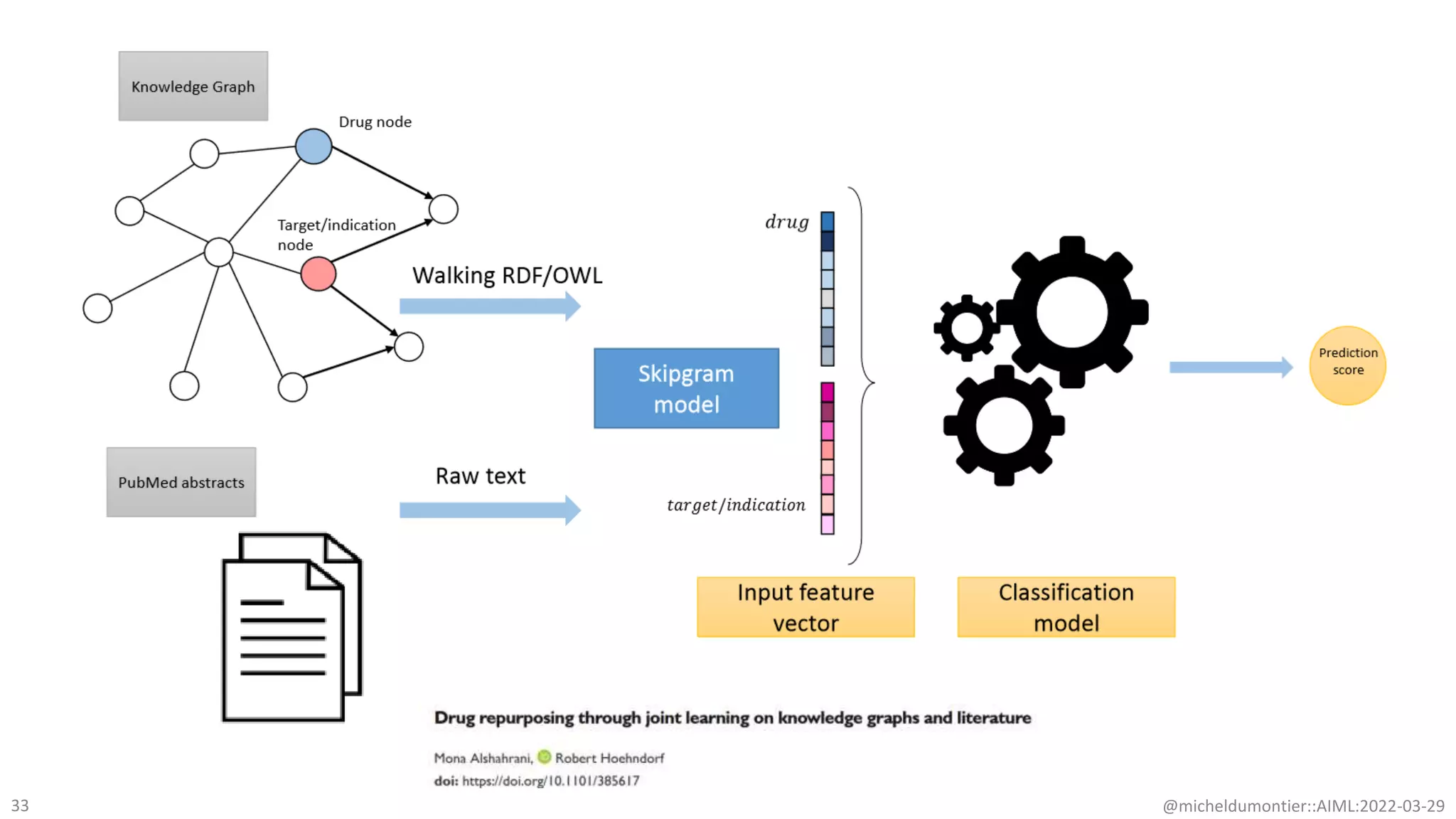
Knowledge Graph Embeddings
Map high-dimensional data into low-dimensional vector space.
- Represent entity/relation/graph with a vector, not just a symbol
- Capture similarity and semantic relationships
- Allow vector operations (addition, subtraction, etc.)
@micheldumontier::AIML:2022-03-29
32
@micheldumontier::AIML:2022-03-29
33
@micheldumontier::AIML:2022-03-29
34
@micheldumontier::AIML:2022-03-29
35
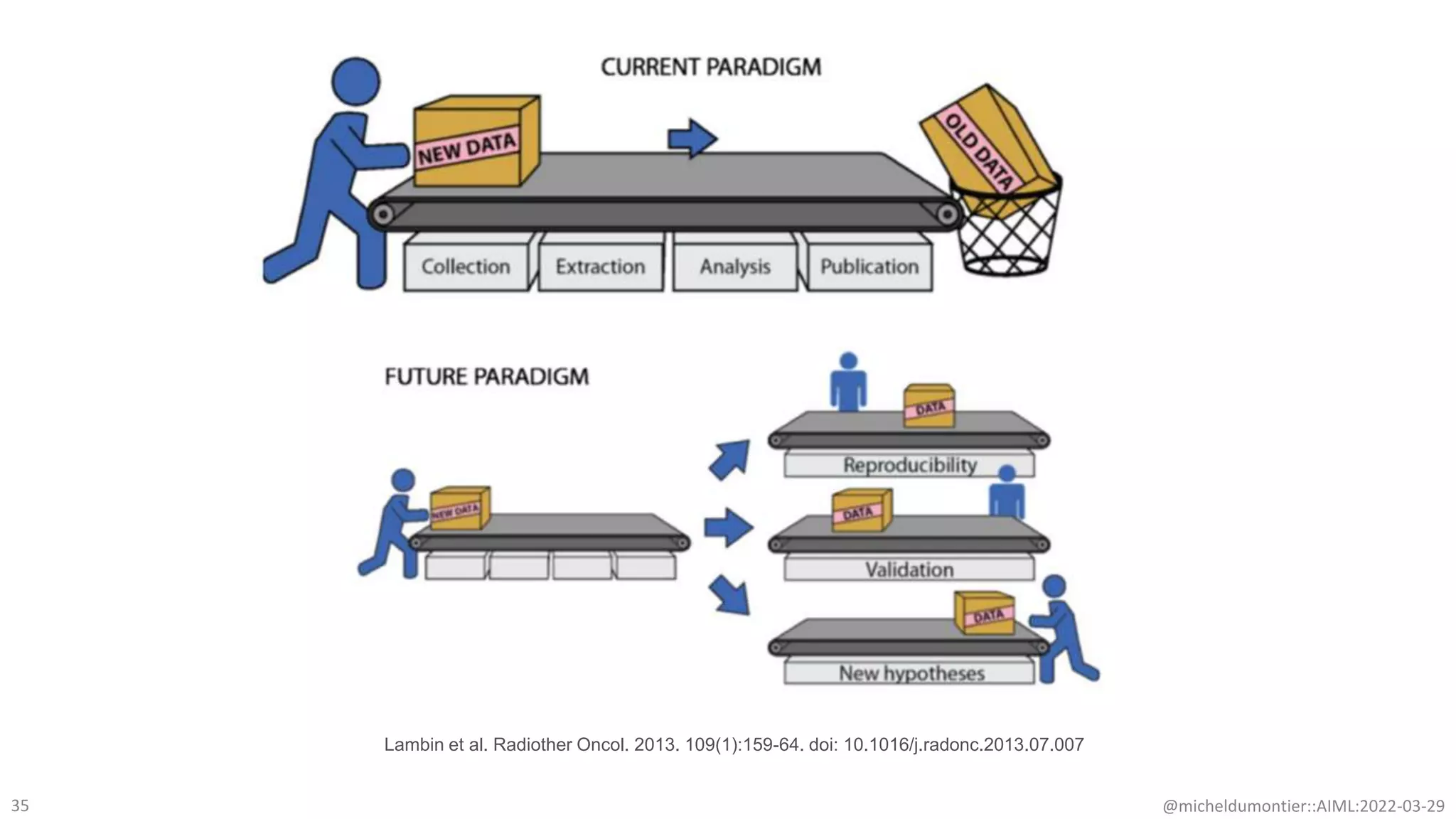
Lambin et al. Radiother Oncol. 2013. 109(1):159-64. doi: 10.1016/j.radonc.2013.07.007
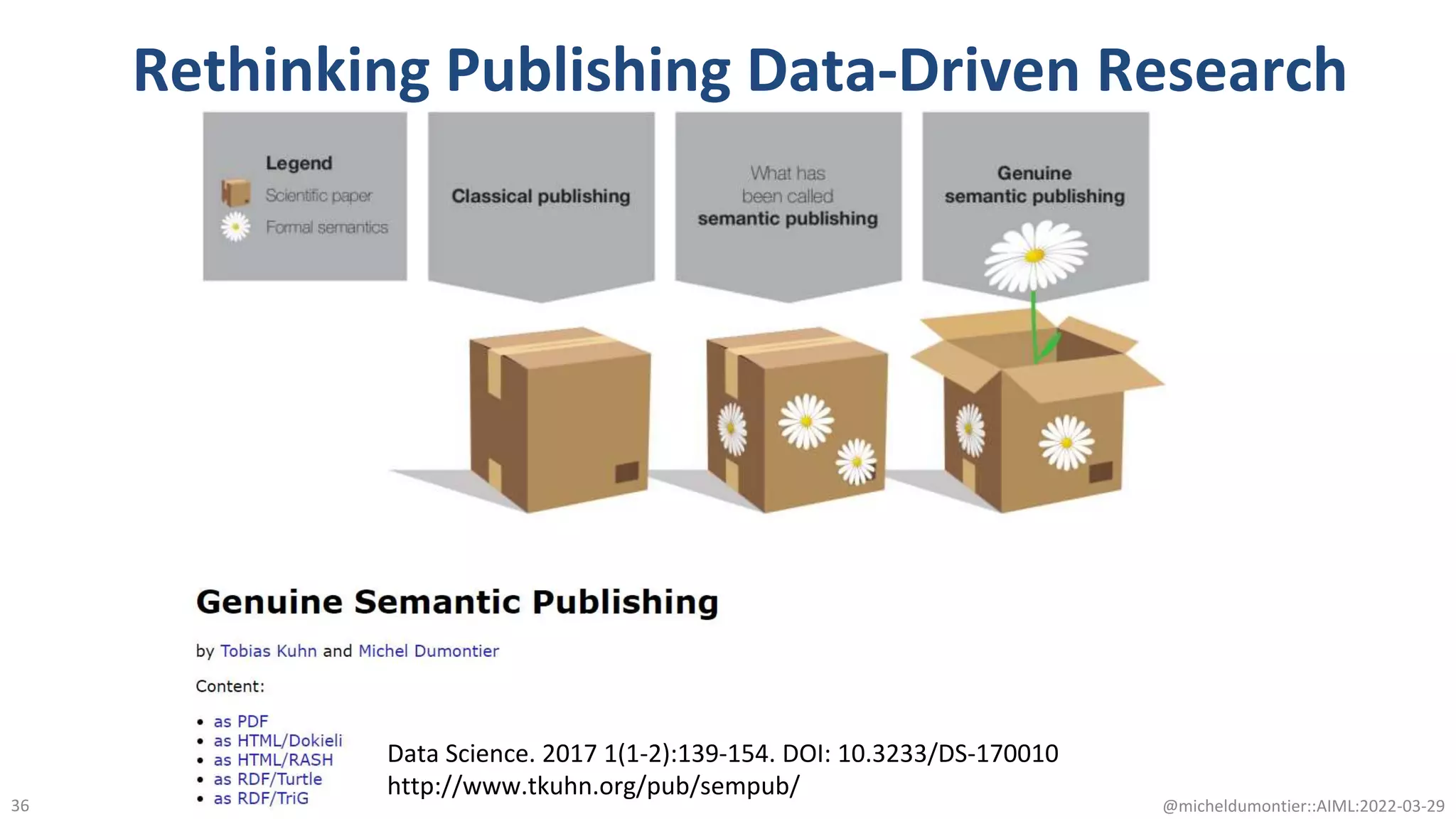
Rethinking Publishing Data-Driven Research
@micheldumontier::AIML:2022-03-29
36
Data Science. 2017 1(1-2):139-154. DOI: 10.3233/DS-170010
http://www.tkuhn.org/pub/sempub/
@micheldumontier::AIML:2022-03-29
37
Summary
FAIR data requires certain features for machine discovery and reuse, and
offers new research possibilities that may reduce effort and improve
transparency and confidence in published research
FAIR KGs aim to provide semantically annotated, standardized, and AI-
ready data
AI technologies, coupled with semantics, will enable researchers to exploit
an emerging Internet of FAIR data and services in a (semi)automated
manner, and hence to accelerate discovery in biomedicine and in other
disciplines, and to help realize the unforeseen value of existing data.
@micheldumontier::AIML:2022-03-29
38
michel.dumontier@maastrichtuniversity.nl
Website: http://maastrichtuniversity.nl/ids
39 @micheldumontier::AIML:2022-03-29
The mission of the Institute of Data Science at Maastricht University is to foster a
collaborative environment for multi-disciplinary data science research,
interdisciplinary training, and data-driven innovation .
We tackle key scientific, technical, social, legal, ethical issues that advance our
understanding across a variety of disciplines and strengthen our communities in
the face of these developments.

Data-Driven Discovery Science with FAIR Knowledge Graphs

  • 1.
    Data-Driven Discovery Sciencewith FAIR Knowledge Graphs @micheldumontier::AIML:2022-03-29 1 Michel Dumontier, Ph.D. Distinguished Professor of Data Science Director, Institute of Data Science
  • 2.
    @micheldumontier::AIML:2022-03-29 2 Large Scale Data-DrivenDiscovery is increasingly possible with growing amounts of open data
  • 3.
  • 4.
    4 A common rejectionmodule (CRM) for acute rejection across multiple organs identifies novel therapeutics for organ transplantation Khatri et al. JEM. 210 (11): 2205 DOI: 10.1084/jem.20122709 @micheldumontier::AIML:2022-03-29 Main Findings: 1. CRM of 11 overexpressed genes predicted future injury to a graft 2. Mice treated with existing drugs against specific CRM genes extended graft survival 3. Retrospective EHR data analysis supports treatment prediction Key Observations: 1. Meta-analysis offers a more reliable estimate of the direction and magnitude of the effect 2. Existing data can be used to generate and validate new hypotheses
  • 5.
    However, significant effortis still needed to find the right dataset(s), make sense of them, and use for a new purpose @micheldumontier::AIML:2022-03-29 5
  • 6.
    Data scientists couldbe more productive @micheldumontier::AIML:2022-03-29 6
  • 7.
    7 @micheldumontier::AIML:2022-03-29 Low reproducibilityof landmark studies 39% (39/100) in psychology1 21% (14/67) in pharmacology2 11% (6/53) in cancer3 unsatisfactory in machine learning4 1doi:10.1038/nature.2015.17433 2doi:10.1038/nrd3439-c1 3doi:10.1038/483531a 4https://openreview.net/pdf?id=By4l2PbQ- Most published research findings are false. - John Ioannidis, Stanford University PLoS Med 2005;2(8): e124.
  • 8.
  • 9.
    @micheldumontier::AIML:2022-03-29 9 It’s time tocompletely rethink how we perform and document empirical research
  • 10.
  • 11.
    Human Machine collaboration iscrucial to our future success @micheldumontier::AIML:2022-03-29 11
  • 12.
    Machines, not people, needto be able to discover and reuse data @micheldumontier::AIML:2022-03-29 12
  • 13.
    We need anew social contract, supported by legal and technological infrastructure to make digital resources available in a responsible manner @micheldumontier::AIML:2022-03-29 13
  • 14.
  • 15.
    An international, bottom-upparadigm for the discovery and reuse of digital content for the machines that people use @micheldumontier::AIML:2022-03-29 15
  • 16.
  • 17.
    FAIR in anutshell FAIR aims to create social and economic impact by facilitating the discovery and reuse of digital resources through a set of requirements: – unique identifiers to retrieve all forms of digital content and knowledge – high quality meta(data) to enhance discovery of relevant digital resources – shared vocabularies to facilitate query and statistical analysis – community standards to reduce the effort in wrangling different forms of data – detailed provenance to provide adequate context that fosters understanding and reproducibility – repositories to make content available to others in the long term – standardized terms of use to clarify expectations and intensify innovation @micheldumontier::AIML:2022-03-29 17
  • 18.
    A number ofguides are now available to make FAIR data @micheldumontier::AIML:2022-03-29 18
  • 19.
  • 20.
  • 21.
    What is aKnowledge Graph? A knowledge graph is a graph in which the nodes (vertices) represent entities and are related to other entities/attributes via edges that represent relations. @micheldumontier::AIML:2022-03-29 21 node (directed) edge node
  • 22.
    What is aKnowledge Graph? A knowledge graph is a graph in which the nodes (vertices) represent entities and are related to other entities/attributes via edges that represent relations. A knowledge graph mainly consists of relations between individuals. But it can also contain relations between individuals and classes (type), where individuals are instances of a specified classes, and relations between classes (aka class expressions) @micheldumontier::AIML:2022-03-29 22 class/type individual relation Instance of
  • 23.
    social network is a LinkingKnowledge Graphs 23
  • 24.
    travel network social network isa is a linking relations Linking Knowledge Graphs 24
  • 25.
    metagraph for het.io metagraphfor DRKG The number next to an edge indicates the number of relation-types for that entity-pair in DRKG A number of (centralized) biomedical KGs do exist, but more work is needed to make them FAIR 25 @micheldumontier::AIML:2022-03-29
  • 26.
    The Semantic Web isa portal to the web of knowledge 26 @micheldumontier::AIML:2022-03-29 standards for publishing, sharing and querying facts, expert knowledge and services scalable approach for the discovery of independently constructed, collaboratively described, distributed knowledge (in principle)
  • 27.
  • 28.
    • 30+ biomedicaldata sources • 10B+ interlinked statements • EBI, SIB, NCBI, DBCLS, NCBO, and many others produce this content chemicals/drugs/formulations, genomes/genes/proteins, domains Interactions, complexes & pathways animal models and phenotypes Disease, genetic markers, treatments Terminologies & publications 28 Alison Callahan, Jose Cruz-Toledo, Peter Ansell, Michel Dumontier: Bio2RDF Release 2: Improved Coverage, Interoperability and Provenance of Life Science Linked Data. ESWC 2013: 200-212 Linked Data for the Life Sciences Bio2RDF is an open source project that uses semantic web technologies to make it easier to reuse biomedical data @micheldumontier::AIML:2022-03-29
  • 29.
  • 30.
    graph methods fordata quality to find mismatches and discover new links @micheldumontier::AIML:2022-03-29 30 W Hu, H Qiu, M Dumontier. Link Analysis of Life Science Linked Data. International Semantic Web Conference (2) 2015: 446-462.
  • 31.
    31 Prediction: new usesfor existing drugs Information Retrieval: Phenotypes of knock-out mouse models for the targets of a selected drug Exploration: drug-target-disease networks https://doi.org/10.7717/peerj-cs.281 https://doi.org/10.7717/peerj-cs.106 @micheldumontier::AIML:2022-03-29 Custom Knowledge Portal: EbolaKB https://doi.org/10.1093/database/bav049
  • 32.
    Knowledge Graph Embeddings Maphigh-dimensional data into low-dimensional vector space. - Represent entity/relation/graph with a vector, not just a symbol - Capture similarity and semantic relationships - Allow vector operations (addition, subtraction, etc.) @micheldumontier::AIML:2022-03-29 32
  • 33.
  • 34.
  • 35.
    @micheldumontier::AIML:2022-03-29 35 Lambin et al.Radiother Oncol. 2013. 109(1):159-64. doi: 10.1016/j.radonc.2013.07.007
  • 36.
    Rethinking Publishing Data-DrivenResearch @micheldumontier::AIML:2022-03-29 36 Data Science. 2017 1(1-2):139-154. DOI: 10.3233/DS-170010 http://www.tkuhn.org/pub/sempub/
  • 37.
  • 38.
    Summary FAIR data requirescertain features for machine discovery and reuse, and offers new research possibilities that may reduce effort and improve transparency and confidence in published research FAIR KGs aim to provide semantically annotated, standardized, and AI- ready data AI technologies, coupled with semantics, will enable researchers to exploit an emerging Internet of FAIR data and services in a (semi)automated manner, and hence to accelerate discovery in biomedicine and in other disciplines, and to help realize the unforeseen value of existing data. @micheldumontier::AIML:2022-03-29 38
  • 39.
    michel.dumontier@maastrichtuniversity.nl Website: http://maastrichtuniversity.nl/ids 39 @micheldumontier::AIML:2022-03-29 Themission of the Institute of Data Science at Maastricht University is to foster a collaborative environment for multi-disciplinary data science research, interdisciplinary training, and data-driven innovation . We tackle key scientific, technical, social, legal, ethical issues that advance our understanding across a variety of disciplines and strengthen our communities in the face of these developments.