Lecture 7 Towards a Standard Upper Level Ontology
A shocking idea Before we build a data model let’s look at the reality we are trying to represent (= let’s look at the best scientific theory we have of this reality) Let’s constrain our data models so that our databases are veridical representations of the world outside
Scientific ontologies have special features Every term in a scientific ontology must be such that the developers of the ontology believe it to refer to some entity* in reality on the basis of the best current evidence *in first approximation: instances of a type
For science, and thus for scientific ontologies, it is  generalizations  that are of prime important = universals, types, kinds, species
For scientific ontologies reusability, openness is crucial intelligibility to humans is crucial revisability is crucial  there is always an open world assumption testability is crucial compatibility with neighboring scientific ontologies is crucial     it should not be too easy to add new terms to an ontology
For scientific ontologies the issue of how the ontology will be  used  is not a factor relevant for determining how entities are treated by the ontology If this decision is made to reflect specific, local practical needs, this will thwart reusability of the data the ontology is used to annotate
BFO  A simple top-level ontology to support information integration in scientific research Defining a framework that will help to ensure consistency and non-redundancy of the ontologies created in its terms
Three Fundamental Dichotomies Continuant vs. occurrent Dependent vs. independent Type vs. instance http://ontology.buffalo.edu/bfo/
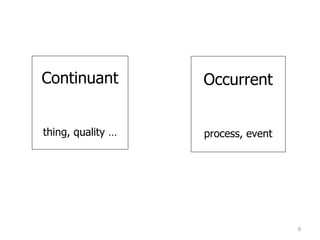
Continuant thing, quality … Occurrent process, event
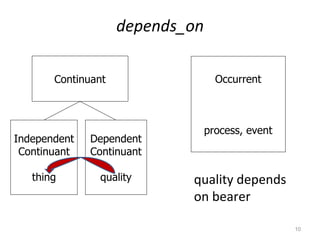
depends_on Continuant Occurrent process, event Independent Continuant thing Dependent Continuant quality quality depends on bearer
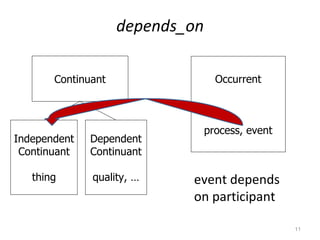
depends_on Continuant Occurrent process, event Independent Continuant thing Dependent Continuant quality, … event depends on participant
instance_of Continuant Occurrent process, event Independent Continuant thing Dependent Continuant quality ....  .....  ....... types instances
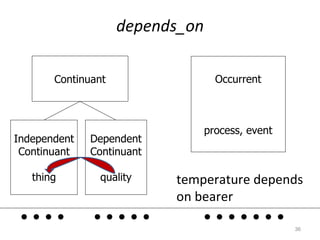
depends_on Continuant Occurrent process Independent Continuant thing Dependent Continuant quality ....  .....  ....... temperature depends on bearer
3 kinds of (binary) relations Between types human is_a mammal human heart part_of   human Between an instance and a type this human  instance_of  the type  human this human  allergic_to  the type  tamiflu Between instances Mary’s heart  part_of  Mary Mary’s aorta  connected_to  Mary’s heart
Clark  et al ., 2005 part_of is_a Definitions of relations Barry Smith, et al., “Relations in Biomedical Ontologies”,  Genome Biology  2005, 6 (5), R46.
Type-level relations presuppose the underlying instance-level relations A part_of B = def. All   instances of  A  are instance-level-parts-of some instance of  B e.g. human heart part_of human A has_participant B  =def. All instances of  A  have an instance of  B  as instance-level participant  e.g.  cell binding has_participant cell
Blinding Flash of the Obvious Continuant Occurrent (Process, Event) Independent Continuant Dependent Continuant How to create an ontology from the top down
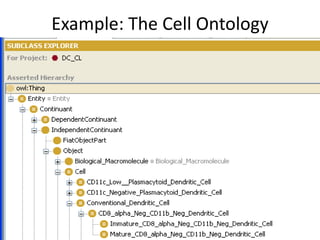
Example: The Cell  Ontology
Benefits of coordination No need to reinvent the wheel Can profit from lessons learned through mistakes made by others Can more easily reuse what is made by others Can more easily inspect and criticize results of others’ work (PATO) Leads to innovations (e.g. Mireot) in strategies for combining ontologies
Users of BFO PharmaOntology (W3C HCLS SIG) MediCognos / Microsoft Healthvault Cleveland Clinic Semantic Database in Cardiothoracic Surgery Major Histocompatibility Complex (MHC) Ontology (NIAID) Neuroscience Information Framework Standard (NIFSTD) and Constituent Ontologies
Users of BFO Interdisciplinary Prostate Ontology (IPO) Nanoparticle Ontology (NPO): Ontology for Cancer Nanotechnology Research Neural Electromagnetic Ontologies (NEMO) ChemAxiom – Ontology for Chemistry Ontology for Risks Against Patient Safety (RAPS/REMINE) (EU FP7) IDO Infectious Disease Ontology (NIAID)
Users of BFO National Cancer Institute Biomedical Grid Terminology (BiomedGT) US Army Universal Core Semantic Layer (UCore SL) US Army Biometrics Ontology US Army Command and Control Ontology Ontology for General Medical Science (OGMS)
Infectious Disease Ontology Consortium MITRE, Mount Sinai, UTSouthwestern  –  Influenza IMBB/VectorBase – Vector borne diseases ( A. gambiae, A. aegypti, I. scapularis, C. pipiens, P. humanus ) Colorado State University – Dengue Fever Duke University – Tuberculosis,  Staph. aureus,  HIV Case Western Reserve – Infective Endocarditis University of Michigan – Brucilosis
GO Gene Ontology CL Cell Ontology SO Sequence Ontology ChEBI Chemical Ontology  PATO Phenotype (Quality) Ontology FMA Foundational Model of Anatomy ChEBI Chemical Entities of Biological Interest  PRO Protein Ontology Plant Ontology Environment Ontology Ontology for Biomedical Investigations RNA Ontology OBO Open Biomedical Ontologies
The Open Biomedical Ontologies (OBO) Foundry RELATION TO TIME  GRANULARITY CONTINUANT OCCURRENT INDEPENDENT DEPENDENT ORGAN AND ORGANISM Organism (NCBI Taxonomy) Anatomical Entity (FMA, CARO) Organ Function (FMP, CPRO) Phenotypic Quality (PaTO) Biological Process (GO) CELL AND CELLULAR COMPONENT Cell (CL) Cellular Component (FMA, GO) Cellular Function (GO) MOLECULE Molecule (ChEBI, SO, RnaO, PrO) Molecular Function (GO) Molecular Process (GO)
maintained by Werner Ceusters, Buffalo Pierre Grenon, Open University Chris Mungall, Berkeley Fabian Neuhaus, NIST Holger Stenzhorn, IFOMIS, Saarland University Alan Ruttenberg, Science Commons plus 103 other members of BFO Discussion Group: http://groups.google.com/group/bfo-discuss?
inspired by Aristotle Husserl Roman Ingarden Ingvar Johansson Kevin Mulligan, University of Geneva Cornelius Rosse Peter Simons, Trinity College, Dublin Wittgenstein’s  Tractatus  (picture theory of language) Wolfgang Degen, Nicola Guarino, Patrick Hayes
some important users Bjoern Peters, University of California, San Diego Mathias Brochausen, IFOMIS Lindsay Cowell, Duke University Medical Center Albert Goldfain, University at Buffalo/Blue Highway William Hogan, University of Pittsburgh Ontology for Biomedical Investigations Stephan Schulz, Freiburg University Kent Spackman, SNOMED / IHTSDO
Blinding Flash of the Obvious Continuant Occurrent (Process, Event) Independent Continuant Dependent Continuant How to create an ontology from the top down
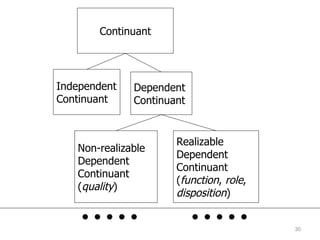
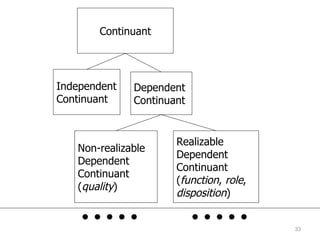
Continuant Independent Continuant Dependent Continuant .....  ..... Non-realizable Dependent Continuant ( quality ) Realizable  Dependent Continuant ( function ,  role ,  disposition )
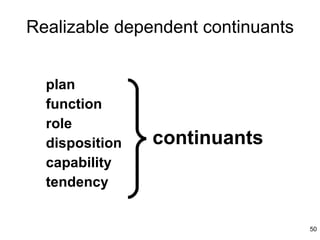
Realizable dependent continuants plan function role disposition capability tendency continuants
Their realizations  execution  expression  exercise  realization  application course occurrents
Continuant Independent Continuant Dependent Continuant .....  ..... Non-realizable Dependent Continuant ( quality ) Realizable  Dependent Continuant ( function ,  role ,  disposition )
realization depends_on realizable Continuant Occurrent Independent Continuant bearer Dependent Continuant disposition ....  .....  ....... Process of  realization
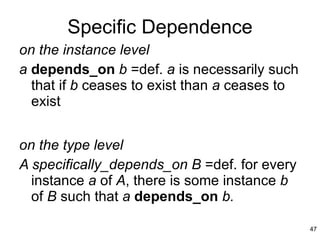
Specific Dependence on the instance level a   depends_on  b  =def.  a  is necessarily such that if  b  ceases to exist than  a  ceases to exist on the type level A specifically_depends_on B  =def. for every instance  a  of  A , there is some instance  b  of  B  such that  a  depends_on  b.
depends_on Continuant Occurrent process, event Independent Continuant thing Dependent Continuant quality ....  .....  ....... temperature depends on bearer
The (Aristotelian) Ontological Sextet Substances Quality entities Processes Universals Substance-universals Quality-universals  Process-universals Particulars Individual Substances Quality-instances (Tropes…) Process-instances
 
Specifically dependent continuants the  quality  of whiteness of this cheese your  role  as lecturer the  disposition  of this patient to experience diarrhea
the particular case of redness (of a particular fly eye) the universal  red instantiates an instance of an eye (in a particular fly) the universal  eye instantiates depends on
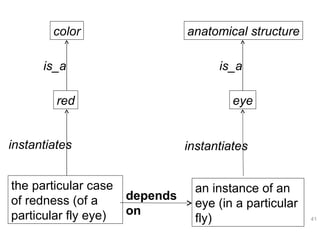
the particular case of redness (of a particular fly eye) red instantiates an instance of an eye (in a particular fly) eye instantiates depends on color anatomical structure is_a is_a
depends_on Continuant Occurrent process Independent Continuant thing Dependent Continuant quality ....  .....  ....... temperature depends on bearer
Specifically Dependent Continuants Specifically Dependent Continuant Quality,  Pattern Realizable  Dependent  Continuant if the bearer ceases to exist, then its quality, function, role ceases to exist the color of my skin the function of my heart to pump blood my weight
The Open Biomedical Ontologies (OBO) Foundry RELATION TO TIME  GRANULARITY CONTINUANT OCCURRENT INDEPENDENT DEPENDENT ORGAN AND ORGANISM Organism (NCBI Taxonomy) Anatomical Entity (FMA, CARO) Organ Function (FMP, CPRO) Phenotypic Quality (PaTO) Biological Process (GO) CELL AND CELLULAR COMPONENT Cell (CL) Cellular Component (FMA, GO) Cellular Function (GO) MOLECULE Molecule (ChEBI, SO, RnaO, PrO) Molecular Function (GO) Molecular Process (GO)
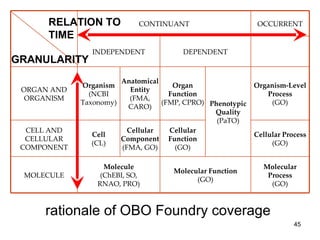
rationale of OBO Foundry coverage  CONTINUANT OCCURRENT INDEPENDENT DEPENDENT ORGAN AND ORGANISM Organism (NCBI Taxonomy) Anatomical Entity (FMA, CARO) Organ Function (FMP, CPRO) Phenotypic Quality (PaTO) Organism-Level Process (GO) CELL AND CELLULAR COMPONENT Cell (CL) Cellular Component (FMA, GO) Cellular Function (GO) Cellular Process (GO) MOLECULE Molecule (ChEBI, SO, RNAO, PRO) Molecular Function (GO) Molecular Process (GO) GRANULARITY RELATION TO TIME
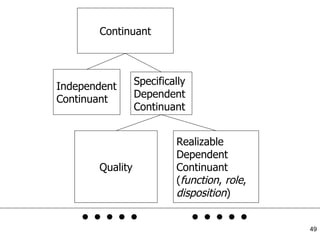
Continuant Independent Continuant Specifically  Dependent Continuant .....  ..... Quality Realizable  Dependent Continuant ( function ,  role ,  disposition )
Specific Dependence on the instance level a   depends_on  b  =def.  a  is necessarily such that if  b  ceases to exist than  a  ceases to exist on the type level A specifically_depends_on B  =def. for every instance  a  of  A , there is some instance  b  of  B  such that  a  depends_on  b.
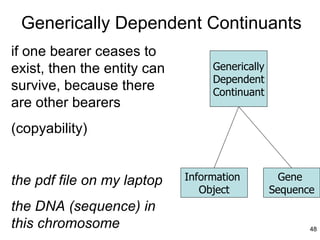
Generically Dependent Continuants Generically Dependent Continuant Information  Object Gene  Sequence if one bearer ceases to exist, then the entity can survive, because there are other bearers (copyability) the pdf file on my laptop the DNA (sequence) in this chromosome
Continuant Independent Continuant Specifically  Dependent Continuant .....  ..... Quality Realizable  Dependent Continuant ( function ,  role ,  disposition )
Realizable dependent continuants plan function role disposition capability tendency continuants
Their realizations  execution  expression  exercise  realization  application course occurrents
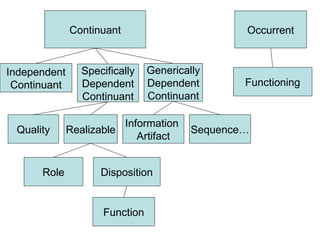
Generically Dependent Continuant Realizable Role Information  Artifact Sequence… Continuant Occurrent Independent Continuant Specifically Dependent Continuant Quality Disposition Functioning Function
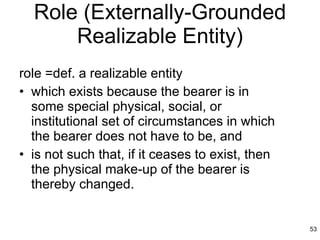
Role (Externally-Grounded Realizable Entity) role =def. a realizable entity which exists because the bearer is in some special physical, social, or institutional set of circumstances in which the bearer does not have to be, and is not such that, if it ceases to exist, then the physical make-up of the bearer is thereby changed.
Disposition (Internally-Grounded Realizable Entity) disposition  =def. a realizable entity which if it ceases to exist, then its bearer is physically changed, and  whose realization occurs when this bearer is in some special physical circumstances, in virtue of the bearer’s physical make-up
Function (A Disposition Designed or Selected For) function  =def. a disposition that exists in virtue of the bearer’s physical make-up, ,  and this physical make-up is something the bearer possesses because it came into being, either through evolution (in the case of natural biological entities) or through intentional design (in the case of artifacts), in order to realize processes of a certain kind.
The parts of the organism have functions They have been selected for to ensure that the events transpiring inside the organism remain within the spectrum of allowed values and to respond when they move outside this spectrum of allowed values
What is a Disease? a state in which a function or part of the body is no longer in a healthy condition. an illness a process that is a hazard to health and/or longevity. a pathological condition that is cross-culturally defined and recognized
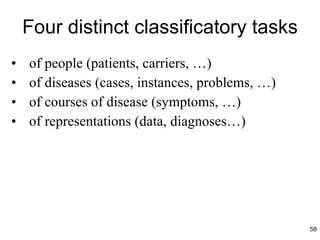
Four distinct classificatory tasks of people (patients, carriers, …) of diseases (cases, instances, problems, …) of courses of disease (symptoms, …) of representations (data, diagnoses…)
Four distinct BFO categories person (patient, carrier, …)  – independent continuant disease (case, instance, problem, …)  – specifically dependent continuant course of disease (symptom, treatment…) –  occurrent representation (record, datum, diagnosis…) –  generically dependent continuant
Disposition  Internally-Grounded Realizable Entity A  disposition  is a realizable entity which is such that (1) if it ceases to exist, then its bearer is physically changed, and (2) whose realization occurs, in virtue of the bearer’s physical make-up, when this bearer is in some special physical circumstances
Disorder A  part  of an (extended) organism which serves as the bearer of a  disposition  of a certain sort
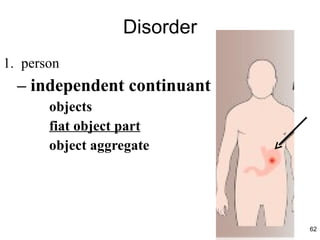
Disorder person –  independent continuant objects fiat object part object aggregate
Disorder A  fiat object part  of an organism which serves as the bearer of a  disposition  of a certain sort This fiat object part is part of the organism and in the case of progressive diseases typically grows larger through time It is real, but it may have no determinate boundaries
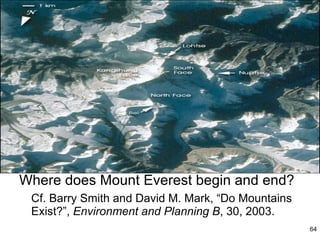
Where does Mount Everest begin and end? Cf. Barry Smith and David M. Mark, “Do Mountains Exist?”,  Environment and Planning B , 30, 2003.
Big Picture
A  disease  is a  disposition  rooted in a  physical disorder  in the organism and  realized in  pathological processes .  etiological process produces disorder bears disposition realized_in pathological process produces abnormal bodily features recognized_as signs & symptoms interpretive process produces diagnosis used_in
Elucidation of Primitive Terms ‘ bodily feature ’ - an abbreviation for a physical component, a bodily quality, or a bodily process. disposition -  an attribute describing the propensity to initiate certain specific sorts of processes when certain conditions are satisfied. clinically abnormal  - some bodily feature that  (1) is not part of the life plan for an organism of the relevant type (unlike aging or pregnancy),  (2) is causally linked to an elevated risk either of pain or other feelings of illness, or of death or dysfunction, and  (3) is such that the elevated risk exceeds a certain threshold level.* *Compare: baldness
Definitions - Foundational Terms Disorder =def . – A physical component that is clinically abnormal. Pathological Process =def. –  A bodily process that is a realization of a disorder and is clinically abnormal . Disease =def. –  A disposition (i) to undergo pathological processes that (ii) exists in an organism because of one or more disorders in that organism.
Dispositions and Predispositions All diseases are dispositions; not all dispositions are diseases. A predisposition is a disposition. Predisposition to Disease of Type X =def.   –  A disposition in an organism that constitutes an increased risk of the organism’s subsequently developing the disease X.
Cirrhosis - environmental exposure Etiological process -  phenobarbitol-induced hepatic cell death produces Disorder -  necrotic liver bears Disposition (disease) -  cirrhosis realized_in Pathological process -  abnormal tissue repair with cell proliferation and fibrosis that exceed a certain threshold; hypoxia-induced cell death produces Abnormal bodily features recognized_as Symptoms -  fatigue, anorexia Signs -  jaundice, splenomegaly Symptoms & Signs used_in Interpretive process produces Hypothesis -  rule out cirrhosis suggests Laboratory tests produces Test results -  elevated liver enzymes in serum used_in Interpretive process produces Result -  diagnosis that patient X has a disorder that bears the disease cirrhosis
Influenza - infectious Etiological process -  infection of airway epithelial cells with influenza virus produces Disorder -  viable cells with influenza virus bears Disposition (disease) -  flu realized_in Pathological process -  acute inflammation produces Abnormal bodily features recognized_as Symptoms -  weakness, dizziness Signs -  fever Symptoms & Signs used_in Interpretive process produces Hypothesis -  rule out influenza suggests Laboratory tests produces Test results -  elevated serum antibody titers used_in Interpretive process produces Result -  diagnosis that patient X has a disorder that bears the disease flu But the disorder also induces normal physiological processes (immune response) that can results in the elimination of the disorder (transient disease course).
Huntington’s Disease - genetic Etiological process -  inheritance of >39 CAG repeats in the HTT gene produces Disorder -  chromosome 4 with abnormal mHTT bears Disposition (disease) -  Huntington’s disease realized_in Pathological process -  accumulation of mHTT protein fragments, abnormal transcription regulation, neuronal cell death in striatum produces Abnormal bodily features recognized_as Symptoms -  anxiety, depression Signs -  difficulties in speaking and swallowing Symptoms & Signs used_in Interpretive process produces Hypothesis -  rule out Huntington’s suggests Laboratory tests produces Test results -  molecular detection of the HTT gene with >39CAG repeats used_in Interpretive process produces Result -  diagnosis that patient X has a disorder that bears the disease Huntington’s disease
Benefits of coordination No need to reinvent the wheel Can profit from lessons learned through mistakes made by others Can more easily reuse data collected by others Can more easily resolve the silo problems created by multiple independent discipline-specific ontologies
Why GO is so successful Strategy of low hanging fruit Lessons learned and disseminated as common guidelines – all developers in a large community are doing it the same way Ontologies are built by domain experts Ontologies based on  real thinking  (not for example on automatic extraction of terms from text)
Benefits of BFO small, simple, rigorously tested large community of users and maintainers top-down development methodology has been shown to work in many different domains humanly intelligible compatible with top-level of DOLCE a genuine top level

Basic Formal Ontology: A Common Standard

  • 1.
    Lecture 7 Towardsa Standard Upper Level Ontology
  • 2.
    A shocking ideaBefore we build a data model let’s look at the reality we are trying to represent (= let’s look at the best scientific theory we have of this reality) Let’s constrain our data models so that our databases are veridical representations of the world outside
  • 3.
    Scientific ontologies havespecial features Every term in a scientific ontology must be such that the developers of the ontology believe it to refer to some entity* in reality on the basis of the best current evidence *in first approximation: instances of a type
  • 4.
    For science, andthus for scientific ontologies, it is generalizations that are of prime important = universals, types, kinds, species
  • 5.
    For scientific ontologiesreusability, openness is crucial intelligibility to humans is crucial revisability is crucial there is always an open world assumption testability is crucial compatibility with neighboring scientific ontologies is crucial  it should not be too easy to add new terms to an ontology
  • 6.
    For scientific ontologiesthe issue of how the ontology will be used is not a factor relevant for determining how entities are treated by the ontology If this decision is made to reflect specific, local practical needs, this will thwart reusability of the data the ontology is used to annotate
  • 7.
    BFO Asimple top-level ontology to support information integration in scientific research Defining a framework that will help to ensure consistency and non-redundancy of the ontologies created in its terms
  • 8.
    Three Fundamental DichotomiesContinuant vs. occurrent Dependent vs. independent Type vs. instance http://ontology.buffalo.edu/bfo/
  • 9.
    Continuant thing, quality… Occurrent process, event
  • 10.
    depends_on Continuant Occurrentprocess, event Independent Continuant thing Dependent Continuant quality quality depends on bearer
  • 11.
    depends_on Continuant Occurrentprocess, event Independent Continuant thing Dependent Continuant quality, … event depends on participant
  • 12.
    instance_of Continuant Occurrentprocess, event Independent Continuant thing Dependent Continuant quality .... ..... ....... types instances
  • 13.
    depends_on Continuant Occurrentprocess Independent Continuant thing Dependent Continuant quality .... ..... ....... temperature depends on bearer
  • 14.
    3 kinds of(binary) relations Between types human is_a mammal human heart part_of human Between an instance and a type this human instance_of the type human this human allergic_to the type tamiflu Between instances Mary’s heart part_of Mary Mary’s aorta connected_to Mary’s heart
  • 15.
    Clark etal ., 2005 part_of is_a Definitions of relations Barry Smith, et al., “Relations in Biomedical Ontologies”, Genome Biology 2005, 6 (5), R46.
  • 16.
    Type-level relations presupposethe underlying instance-level relations A part_of B = def. All instances of A are instance-level-parts-of some instance of B e.g. human heart part_of human A has_participant B =def. All instances of A have an instance of B as instance-level participant e.g. cell binding has_participant cell
  • 17.
    Blinding Flash ofthe Obvious Continuant Occurrent (Process, Event) Independent Continuant Dependent Continuant How to create an ontology from the top down
  • 18.
  • 19.
    Benefits of coordinationNo need to reinvent the wheel Can profit from lessons learned through mistakes made by others Can more easily reuse what is made by others Can more easily inspect and criticize results of others’ work (PATO) Leads to innovations (e.g. Mireot) in strategies for combining ontologies
  • 20.
    Users of BFOPharmaOntology (W3C HCLS SIG) MediCognos / Microsoft Healthvault Cleveland Clinic Semantic Database in Cardiothoracic Surgery Major Histocompatibility Complex (MHC) Ontology (NIAID) Neuroscience Information Framework Standard (NIFSTD) and Constituent Ontologies
  • 21.
    Users of BFOInterdisciplinary Prostate Ontology (IPO) Nanoparticle Ontology (NPO): Ontology for Cancer Nanotechnology Research Neural Electromagnetic Ontologies (NEMO) ChemAxiom – Ontology for Chemistry Ontology for Risks Against Patient Safety (RAPS/REMINE) (EU FP7) IDO Infectious Disease Ontology (NIAID)
  • 22.
    Users of BFONational Cancer Institute Biomedical Grid Terminology (BiomedGT) US Army Universal Core Semantic Layer (UCore SL) US Army Biometrics Ontology US Army Command and Control Ontology Ontology for General Medical Science (OGMS)
  • 23.
    Infectious Disease OntologyConsortium MITRE, Mount Sinai, UTSouthwestern – Influenza IMBB/VectorBase – Vector borne diseases ( A. gambiae, A. aegypti, I. scapularis, C. pipiens, P. humanus ) Colorado State University – Dengue Fever Duke University – Tuberculosis, Staph. aureus, HIV Case Western Reserve – Infective Endocarditis University of Michigan – Brucilosis
  • 24.
    GO Gene OntologyCL Cell Ontology SO Sequence Ontology ChEBI Chemical Ontology PATO Phenotype (Quality) Ontology FMA Foundational Model of Anatomy ChEBI Chemical Entities of Biological Interest PRO Protein Ontology Plant Ontology Environment Ontology Ontology for Biomedical Investigations RNA Ontology OBO Open Biomedical Ontologies
  • 25.
    The Open BiomedicalOntologies (OBO) Foundry RELATION TO TIME GRANULARITY CONTINUANT OCCURRENT INDEPENDENT DEPENDENT ORGAN AND ORGANISM Organism (NCBI Taxonomy) Anatomical Entity (FMA, CARO) Organ Function (FMP, CPRO) Phenotypic Quality (PaTO) Biological Process (GO) CELL AND CELLULAR COMPONENT Cell (CL) Cellular Component (FMA, GO) Cellular Function (GO) MOLECULE Molecule (ChEBI, SO, RnaO, PrO) Molecular Function (GO) Molecular Process (GO)
  • 26.
    maintained by WernerCeusters, Buffalo Pierre Grenon, Open University Chris Mungall, Berkeley Fabian Neuhaus, NIST Holger Stenzhorn, IFOMIS, Saarland University Alan Ruttenberg, Science Commons plus 103 other members of BFO Discussion Group: http://groups.google.com/group/bfo-discuss?
  • 27.
    inspired by AristotleHusserl Roman Ingarden Ingvar Johansson Kevin Mulligan, University of Geneva Cornelius Rosse Peter Simons, Trinity College, Dublin Wittgenstein’s Tractatus (picture theory of language) Wolfgang Degen, Nicola Guarino, Patrick Hayes
  • 28.
    some important usersBjoern Peters, University of California, San Diego Mathias Brochausen, IFOMIS Lindsay Cowell, Duke University Medical Center Albert Goldfain, University at Buffalo/Blue Highway William Hogan, University of Pittsburgh Ontology for Biomedical Investigations Stephan Schulz, Freiburg University Kent Spackman, SNOMED / IHTSDO
  • 29.
    Blinding Flash ofthe Obvious Continuant Occurrent (Process, Event) Independent Continuant Dependent Continuant How to create an ontology from the top down
  • 30.
    Continuant Independent ContinuantDependent Continuant ..... ..... Non-realizable Dependent Continuant ( quality ) Realizable Dependent Continuant ( function , role , disposition )
  • 31.
    Realizable dependent continuantsplan function role disposition capability tendency continuants
  • 32.
    Their realizations execution expression exercise realization application course occurrents
  • 33.
    Continuant Independent ContinuantDependent Continuant ..... ..... Non-realizable Dependent Continuant ( quality ) Realizable Dependent Continuant ( function , role , disposition )
  • 34.
    realization depends_on realizableContinuant Occurrent Independent Continuant bearer Dependent Continuant disposition .... ..... ....... Process of realization
  • 35.
    Specific Dependence onthe instance level a depends_on b =def. a is necessarily such that if b ceases to exist than a ceases to exist on the type level A specifically_depends_on B =def. for every instance a of A , there is some instance b of B such that a depends_on b.
  • 36.
    depends_on Continuant Occurrentprocess, event Independent Continuant thing Dependent Continuant quality .... ..... ....... temperature depends on bearer
  • 37.
    The (Aristotelian) OntologicalSextet Substances Quality entities Processes Universals Substance-universals Quality-universals Process-universals Particulars Individual Substances Quality-instances (Tropes…) Process-instances
  • 38.
  • 39.
    Specifically dependent continuantsthe quality of whiteness of this cheese your role as lecturer the disposition of this patient to experience diarrhea
  • 40.
    the particular caseof redness (of a particular fly eye) the universal red instantiates an instance of an eye (in a particular fly) the universal eye instantiates depends on
  • 41.
    the particular caseof redness (of a particular fly eye) red instantiates an instance of an eye (in a particular fly) eye instantiates depends on color anatomical structure is_a is_a
  • 42.
    depends_on Continuant Occurrentprocess Independent Continuant thing Dependent Continuant quality .... ..... ....... temperature depends on bearer
  • 43.
    Specifically Dependent ContinuantsSpecifically Dependent Continuant Quality, Pattern Realizable Dependent Continuant if the bearer ceases to exist, then its quality, function, role ceases to exist the color of my skin the function of my heart to pump blood my weight
  • 44.
    The Open BiomedicalOntologies (OBO) Foundry RELATION TO TIME GRANULARITY CONTINUANT OCCURRENT INDEPENDENT DEPENDENT ORGAN AND ORGANISM Organism (NCBI Taxonomy) Anatomical Entity (FMA, CARO) Organ Function (FMP, CPRO) Phenotypic Quality (PaTO) Biological Process (GO) CELL AND CELLULAR COMPONENT Cell (CL) Cellular Component (FMA, GO) Cellular Function (GO) MOLECULE Molecule (ChEBI, SO, RnaO, PrO) Molecular Function (GO) Molecular Process (GO)
  • 45.
    rationale of OBOFoundry coverage CONTINUANT OCCURRENT INDEPENDENT DEPENDENT ORGAN AND ORGANISM Organism (NCBI Taxonomy) Anatomical Entity (FMA, CARO) Organ Function (FMP, CPRO) Phenotypic Quality (PaTO) Organism-Level Process (GO) CELL AND CELLULAR COMPONENT Cell (CL) Cellular Component (FMA, GO) Cellular Function (GO) Cellular Process (GO) MOLECULE Molecule (ChEBI, SO, RNAO, PRO) Molecular Function (GO) Molecular Process (GO) GRANULARITY RELATION TO TIME
  • 46.
    Continuant Independent ContinuantSpecifically Dependent Continuant ..... ..... Quality Realizable Dependent Continuant ( function , role , disposition )
  • 47.
    Specific Dependence onthe instance level a depends_on b =def. a is necessarily such that if b ceases to exist than a ceases to exist on the type level A specifically_depends_on B =def. for every instance a of A , there is some instance b of B such that a depends_on b.
  • 48.
    Generically Dependent ContinuantsGenerically Dependent Continuant Information Object Gene Sequence if one bearer ceases to exist, then the entity can survive, because there are other bearers (copyability) the pdf file on my laptop the DNA (sequence) in this chromosome
  • 49.
    Continuant Independent ContinuantSpecifically Dependent Continuant ..... ..... Quality Realizable Dependent Continuant ( function , role , disposition )
  • 50.
    Realizable dependent continuantsplan function role disposition capability tendency continuants
  • 51.
    Their realizations execution expression exercise realization application course occurrents
  • 52.
    Generically Dependent ContinuantRealizable Role Information Artifact Sequence… Continuant Occurrent Independent Continuant Specifically Dependent Continuant Quality Disposition Functioning Function
  • 53.
    Role (Externally-Grounded RealizableEntity) role =def. a realizable entity which exists because the bearer is in some special physical, social, or institutional set of circumstances in which the bearer does not have to be, and is not such that, if it ceases to exist, then the physical make-up of the bearer is thereby changed.
  • 54.
    Disposition (Internally-Grounded RealizableEntity) disposition =def. a realizable entity which if it ceases to exist, then its bearer is physically changed, and whose realization occurs when this bearer is in some special physical circumstances, in virtue of the bearer’s physical make-up
  • 55.
    Function (A DispositionDesigned or Selected For) function =def. a disposition that exists in virtue of the bearer’s physical make-up, , and this physical make-up is something the bearer possesses because it came into being, either through evolution (in the case of natural biological entities) or through intentional design (in the case of artifacts), in order to realize processes of a certain kind.
  • 56.
    The parts ofthe organism have functions They have been selected for to ensure that the events transpiring inside the organism remain within the spectrum of allowed values and to respond when they move outside this spectrum of allowed values
  • 57.
    What is aDisease? a state in which a function or part of the body is no longer in a healthy condition. an illness a process that is a hazard to health and/or longevity. a pathological condition that is cross-culturally defined and recognized
  • 58.
    Four distinct classificatorytasks of people (patients, carriers, …) of diseases (cases, instances, problems, …) of courses of disease (symptoms, …) of representations (data, diagnoses…)
  • 59.
    Four distinct BFOcategories person (patient, carrier, …) – independent continuant disease (case, instance, problem, …) – specifically dependent continuant course of disease (symptom, treatment…) – occurrent representation (record, datum, diagnosis…) – generically dependent continuant
  • 60.
    Disposition Internally-GroundedRealizable Entity A disposition is a realizable entity which is such that (1) if it ceases to exist, then its bearer is physically changed, and (2) whose realization occurs, in virtue of the bearer’s physical make-up, when this bearer is in some special physical circumstances
  • 61.
    Disorder A part of an (extended) organism which serves as the bearer of a disposition of a certain sort
  • 62.
    Disorder person – independent continuant objects fiat object part object aggregate
  • 63.
    Disorder A fiat object part of an organism which serves as the bearer of a disposition of a certain sort This fiat object part is part of the organism and in the case of progressive diseases typically grows larger through time It is real, but it may have no determinate boundaries
  • 64.
    Where does MountEverest begin and end? Cf. Barry Smith and David M. Mark, “Do Mountains Exist?”, Environment and Planning B , 30, 2003.
  • 65.
  • 66.
    A disease is a disposition rooted in a physical disorder in the organism and realized in pathological processes . etiological process produces disorder bears disposition realized_in pathological process produces abnormal bodily features recognized_as signs & symptoms interpretive process produces diagnosis used_in
  • 67.
    Elucidation of PrimitiveTerms ‘ bodily feature ’ - an abbreviation for a physical component, a bodily quality, or a bodily process. disposition - an attribute describing the propensity to initiate certain specific sorts of processes when certain conditions are satisfied. clinically abnormal - some bodily feature that (1) is not part of the life plan for an organism of the relevant type (unlike aging or pregnancy), (2) is causally linked to an elevated risk either of pain or other feelings of illness, or of death or dysfunction, and (3) is such that the elevated risk exceeds a certain threshold level.* *Compare: baldness
  • 68.
    Definitions - FoundationalTerms Disorder =def . – A physical component that is clinically abnormal. Pathological Process =def. – A bodily process that is a realization of a disorder and is clinically abnormal . Disease =def. – A disposition (i) to undergo pathological processes that (ii) exists in an organism because of one or more disorders in that organism.
  • 69.
    Dispositions and PredispositionsAll diseases are dispositions; not all dispositions are diseases. A predisposition is a disposition. Predisposition to Disease of Type X =def. – A disposition in an organism that constitutes an increased risk of the organism’s subsequently developing the disease X.
  • 70.
    Cirrhosis - environmentalexposure Etiological process - phenobarbitol-induced hepatic cell death produces Disorder - necrotic liver bears Disposition (disease) - cirrhosis realized_in Pathological process - abnormal tissue repair with cell proliferation and fibrosis that exceed a certain threshold; hypoxia-induced cell death produces Abnormal bodily features recognized_as Symptoms - fatigue, anorexia Signs - jaundice, splenomegaly Symptoms & Signs used_in Interpretive process produces Hypothesis - rule out cirrhosis suggests Laboratory tests produces Test results - elevated liver enzymes in serum used_in Interpretive process produces Result - diagnosis that patient X has a disorder that bears the disease cirrhosis
  • 71.
    Influenza - infectiousEtiological process - infection of airway epithelial cells with influenza virus produces Disorder - viable cells with influenza virus bears Disposition (disease) - flu realized_in Pathological process - acute inflammation produces Abnormal bodily features recognized_as Symptoms - weakness, dizziness Signs - fever Symptoms & Signs used_in Interpretive process produces Hypothesis - rule out influenza suggests Laboratory tests produces Test results - elevated serum antibody titers used_in Interpretive process produces Result - diagnosis that patient X has a disorder that bears the disease flu But the disorder also induces normal physiological processes (immune response) that can results in the elimination of the disorder (transient disease course).
  • 72.
    Huntington’s Disease -genetic Etiological process - inheritance of >39 CAG repeats in the HTT gene produces Disorder - chromosome 4 with abnormal mHTT bears Disposition (disease) - Huntington’s disease realized_in Pathological process - accumulation of mHTT protein fragments, abnormal transcription regulation, neuronal cell death in striatum produces Abnormal bodily features recognized_as Symptoms - anxiety, depression Signs - difficulties in speaking and swallowing Symptoms & Signs used_in Interpretive process produces Hypothesis - rule out Huntington’s suggests Laboratory tests produces Test results - molecular detection of the HTT gene with >39CAG repeats used_in Interpretive process produces Result - diagnosis that patient X has a disorder that bears the disease Huntington’s disease
  • 73.
    Benefits of coordinationNo need to reinvent the wheel Can profit from lessons learned through mistakes made by others Can more easily reuse data collected by others Can more easily resolve the silo problems created by multiple independent discipline-specific ontologies
  • 74.
    Why GO isso successful Strategy of low hanging fruit Lessons learned and disseminated as common guidelines – all developers in a large community are doing it the same way Ontologies are built by domain experts Ontologies based on real thinking (not for example on automatic extraction of terms from text)
  • 75.
    Benefits of BFOsmall, simple, rigorously tested large community of users and maintainers top-down development methodology has been shown to work in many different domains humanly intelligible compatible with top-level of DOLCE a genuine top level

Editor's Notes

  • #15 In the following discussion: Classes are in upper case ‘ A ’ is the class Instances are in lower case ‘ a ’ is a particular instance
  • #16 The gene ontology consortium develops ontologies and makes annotation of gene products to those ontologies. The ontologies are databases containing sets of biological processes, molecular functions, and cellular components and the relationships between them. Annotators within the consortium use these ontologies to categorise gene products. During my talk today I’m going to explain about the uses of GO and give a more detailed explanation of the ontolgoies and of the system of annotation. Then Harold Drabkin is going to talk in more detail about annotation and about how you can submit annotations of your own gene products of interest.