RRI
Philosophical Foundation Of
Education
REALISM
Presented by: Jiejan O. Fabian
Irene L. Mirasol
Marizen Barrion
Virginia G. Sengkey
CURRICULUM DEVELOPMENT
 Philosophy
 Aims
 Proponents
 Implications to Education
 Teacher’s Role
 Methods of Teaching
 Disciplined Content
REALISM
-Is derived from a Greek word , “ Res”
which means real.
-It is an attempt to portray life as it is.
-The world is real and material.
“ Realism is the reinforcement of our common
acceptance of this world as it appears to us.”-
Butler
“ The doctrine of realism asserts that there
is a real world of things behind and
corresponding to the objects of perception.”-
Ross
AIMS
1. Preparing the Child for a Happy and Successful
Life.
2. Preparing the Child for a Real Life
3. Developing the physical and mental
powers of child.
4. Acquainting the Child with Nature and
Social Environment.
5. Imparting Vocational Education
6. Developing and Training of Senses
Educational aims are viewed from two perspectives:
Religious realism and Secular realism
Religious perspective : The religious realist believes
that matter is not important unless it leads to
something else.
Secular perspective : The secular realist believes in
understanding the material world through methods of
rigorous inquiry. Self-preservation is the aim of
education.
PROPONENTS
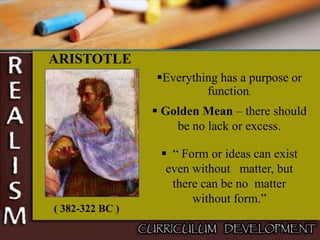
ARISTOTLE
Everything has a purpose or
function.
 Golden Mean – there should
be no lack or excess.
( 382-322 BC )
 “ Form or ideas can exist
even without matter, but
there can be no matter
without form.”
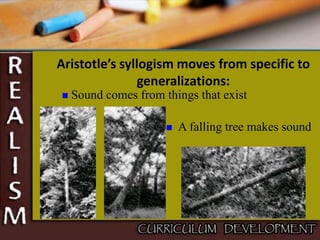
Aristotle’s syllogism moves from specific to
generalizations:
 A falling tree makes sound
 Sound comes from things that exist
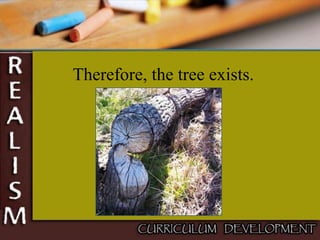
Therefore, the tree exists.
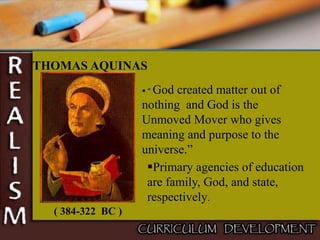
THOMAS AQUINAS
( 384-322 BC )
 “ God created matter out of
nothing and God is the
Unmoved Mover who gives
meaning and purpose to the
universe.”
Primary agencies of education
are family, God, and state,
respectively.
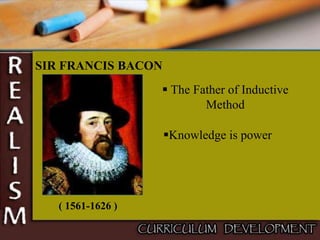
SIR FRANCIS BACON
( 1561-1626 )
 The Father of Inductive
Method
Knowledge is power
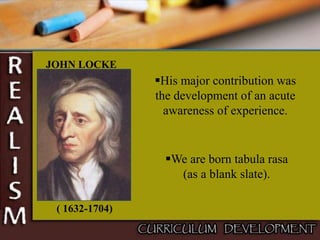
JOHN LOCKE
( 1632-1704)
His major contribution was
the development of an acute
awareness of experience.
We are born tabula rasa
(as a blank slate).
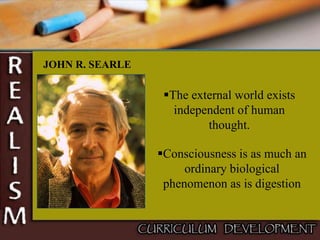
JOHN R. SEARLE
The external world exists
independent of human
thought.
Consciousness is as much an
ordinary biological
phenomenon as is digestion
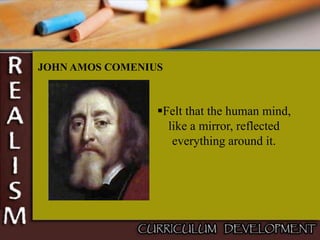
JOHN AMOS COMENIUS
Felt that the human mind,
like a mirror, reflected
everything around it.
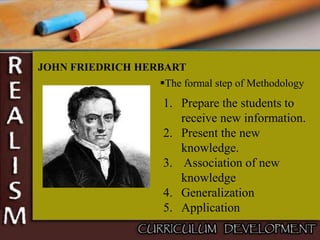
JOHN FRIEDRICH HERBART
The formal step of Methodology
1. Prepare the students to
receive new information.
2. Present the new
knowledge.
3. Association of new
knowledge
4. Generalization
5. Application
• Focuses on the basics of reading, writing and
arithmetic.
• Classroom environment is highly structured and
organized.
• Education should be fun and interesting for the
student.
• Education should prepare students for life in the
real world.
• The teacher according to realist, is expected to have a full
knowledge of the content and needs of the students.
• Should have a knowledge of child psychology & should
have undergone training.
• Prepares the students to receive new information
• Organizes and presents content systematically within a
discipline, demonstrating use of criteria in making decisions
• Imparts knowledge of this reality to students or display
such reality for observation and study
• Inspires and encourages the student sympathetically
• Problem-centered (subject-centered curriculum)
• Practical and useful
• Physical activity has educational value
• Attention to the complete person
• Extensive use of pictures
• Use of objects in education
• Most effective way to find out reality is to study it through
organized, separate, and systematically arranged matter
• The realist stresses a curriculum consisting of
organized topics and subject matter
• Locates the most general and abstract subject at the
top of the curriculum hierarchy and gives particular
transitory subjects a lower order of priority
• The three “R’s” (reading, writing, and arithmetic) are
also necessary in a person’s basic education
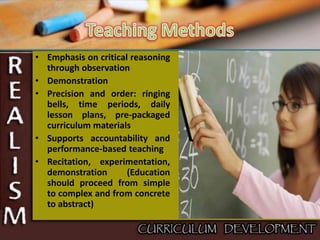
• Emphasis on critical reasoning
through observation
• Demonstration
• Precision and order: ringing
bells, time periods, daily
lesson plans, pre-packaged
curriculum materials
• Supports accountability and
performance-based teaching
• Recitation, experimentation,
demonstration (Education
should proceed from simple
to complex and from concrete
to abstract)
• Tutorial system
• Travel
• Observation and social contracts
• Things before rules and words
Herbart developed a five-step method as follows:
1. Preparation
2. Presentation
3. Association
4. Generalization
5. Application
• Knowledge based; subject based; arts and sciences; hierarchy of
subjects: humanistic and scientific subject
• Realist emphasizes prime importance to nature, science and vocational
subjects whereas secondary place to arts, literature, and languages.
• Subjects should have a sense of utility
• Stress on objects than words
• Stress on previous knowledge of students
• Subjects: Inclusion of daily life subjects in the curriculum, modern
language, physics, chemistry, biology, botany, hygiene, tours,
mathematics, astronomy, science
• Realist advocates self discipline to affect smooth adjustment of the
child with the external environment
1 John 2:27
As for you, the anointing you received from him
remains in you, and you do not need anyone to teach
you. But as his anointing teaches you about all things
and as that anointing is real, not counterfeit– just as
it has taught you, remain in him.
Realism

Realism

  • 1.
    RRI Philosophical Foundation Of Education REALISM Presentedby: Jiejan O. Fabian Irene L. Mirasol Marizen Barrion Virginia G. Sengkey CURRICULUM DEVELOPMENT
  • 4.
     Philosophy  Aims Proponents  Implications to Education  Teacher’s Role  Methods of Teaching  Disciplined Content
  • 5.
    REALISM -Is derived froma Greek word , “ Res” which means real. -It is an attempt to portray life as it is. -The world is real and material.
  • 6.
    “ Realism isthe reinforcement of our common acceptance of this world as it appears to us.”- Butler “ The doctrine of realism asserts that there is a real world of things behind and corresponding to the objects of perception.”- Ross
  • 9.
  • 10.
    1. Preparing theChild for a Happy and Successful Life. 2. Preparing the Child for a Real Life 3. Developing the physical and mental powers of child. 4. Acquainting the Child with Nature and Social Environment. 5. Imparting Vocational Education 6. Developing and Training of Senses
  • 11.
    Educational aims areviewed from two perspectives: Religious realism and Secular realism Religious perspective : The religious realist believes that matter is not important unless it leads to something else. Secular perspective : The secular realist believes in understanding the material world through methods of rigorous inquiry. Self-preservation is the aim of education.
  • 12.
  • 13.
    ARISTOTLE Everything has apurpose or function.  Golden Mean – there should be no lack or excess. ( 382-322 BC )  “ Form or ideas can exist even without matter, but there can be no matter without form.”
  • 14.
    Aristotle’s syllogism movesfrom specific to generalizations:  A falling tree makes sound  Sound comes from things that exist
  • 15.
  • 16.
    THOMAS AQUINAS ( 384-322BC )  “ God created matter out of nothing and God is the Unmoved Mover who gives meaning and purpose to the universe.” Primary agencies of education are family, God, and state, respectively.
  • 17.
    SIR FRANCIS BACON (1561-1626 )  The Father of Inductive Method Knowledge is power
  • 18.
    JOHN LOCKE ( 1632-1704) Hismajor contribution was the development of an acute awareness of experience. We are born tabula rasa (as a blank slate).
  • 19.
    JOHN R. SEARLE Theexternal world exists independent of human thought. Consciousness is as much an ordinary biological phenomenon as is digestion
  • 20.
    JOHN AMOS COMENIUS Feltthat the human mind, like a mirror, reflected everything around it.
  • 21.
    JOHN FRIEDRICH HERBART Theformal step of Methodology 1. Prepare the students to receive new information. 2. Present the new knowledge. 3. Association of new knowledge 4. Generalization 5. Application
  • 24.
    • Focuses onthe basics of reading, writing and arithmetic. • Classroom environment is highly structured and organized. • Education should be fun and interesting for the student. • Education should prepare students for life in the real world.
  • 25.
    • The teacheraccording to realist, is expected to have a full knowledge of the content and needs of the students. • Should have a knowledge of child psychology & should have undergone training. • Prepares the students to receive new information • Organizes and presents content systematically within a discipline, demonstrating use of criteria in making decisions • Imparts knowledge of this reality to students or display such reality for observation and study • Inspires and encourages the student sympathetically
  • 26.
    • Problem-centered (subject-centeredcurriculum) • Practical and useful • Physical activity has educational value • Attention to the complete person • Extensive use of pictures • Use of objects in education • Most effective way to find out reality is to study it through organized, separate, and systematically arranged matter
  • 27.
    • The realiststresses a curriculum consisting of organized topics and subject matter • Locates the most general and abstract subject at the top of the curriculum hierarchy and gives particular transitory subjects a lower order of priority • The three “R’s” (reading, writing, and arithmetic) are also necessary in a person’s basic education
  • 28.
    • Emphasis oncritical reasoning through observation • Demonstration • Precision and order: ringing bells, time periods, daily lesson plans, pre-packaged curriculum materials • Supports accountability and performance-based teaching • Recitation, experimentation, demonstration (Education should proceed from simple to complex and from concrete to abstract)
  • 29.
    • Tutorial system •Travel • Observation and social contracts • Things before rules and words
  • 30.
    Herbart developed afive-step method as follows: 1. Preparation 2. Presentation 3. Association 4. Generalization 5. Application
  • 31.
    • Knowledge based;subject based; arts and sciences; hierarchy of subjects: humanistic and scientific subject • Realist emphasizes prime importance to nature, science and vocational subjects whereas secondary place to arts, literature, and languages. • Subjects should have a sense of utility • Stress on objects than words • Stress on previous knowledge of students • Subjects: Inclusion of daily life subjects in the curriculum, modern language, physics, chemistry, biology, botany, hygiene, tours, mathematics, astronomy, science • Realist advocates self discipline to affect smooth adjustment of the child with the external environment
  • 32.
    1 John 2:27 Asfor you, the anointing you received from him remains in you, and you do not need anyone to teach you. But as his anointing teaches you about all things and as that anointing is real, not counterfeit– just as it has taught you, remain in him.