International Journal of Computer Science, Engineering and Applications (IJCSEA) Vol.2, No.1, February 2012
DOI : 10.5121/ijcsea.2012.2106 55
REAL TIME WEB BASED SYSTEM FOR OBSERVING
SAG AT SUBSTATION
Sangeeta Kambojଵ
and Dr. Ratna Dahiyaଶ
1
Research Scholar, National Institute of Technology Kurukshetra - 136119, Haryana,
India
http://www.nitkkr.ac.in/
2
Faculty, National Institute of Technology Kurukshetra- 136119, Haryana, India
http://www.nitkkr.ac.in/
ABSTRACT
The paper describes the designing of web based system for transmission of GPS measurements so that
power system operator may monitor overhead conductor sag of power transmission line at substation in
real time. The testing results of transmission of GPS measurements from 11KV power transmission line to
substation have also been discussed in detail. Raw GPS measurements are not so accurate that these are
usable for overhead conductor sag evaluation. The estimated GPS altitude measurements obtained using
signal processing techniques such as Least Square Parameter Estimation(LSPE) and Haar Wavelet
Transform (HWT) with LSPE are also presented in this paper.
KEYWORDS
GPS, LSPE method, Wavelet Analysis, Web Server, Overhead conductor sag, NMEA0183.
I. INTRODUCTION
GPS is satellite based radio positioning and navigation system. It provides position in three
dimension and time information to users worldwide with twenty four hours a day [2]. It was
declared operational for civilian users in December 1993. The developments in applications of
GPS over last 10 years have done at higher rate than advancements in realization of GPS
constellation. It is maintained by the United States government and every user can freely access
this with a GPS receiver. According to W. Wooden, the detailed definition of GPS is “The
Navstar GPS is an all-weather, space based navigation system under development by the
Department of Defense to satisfy the requirements for the military forces to accurately determine
their position, velocity, and time in common reference system, anywhere on or near earth on a
continuous basis”. A GPS receiver calculates its position by precisely timing the signals sent by
GPS satellites. There may be visible more than four satellites but only four satellites are used in
position calculation of GPS receiver [3, 9].The application market for vehicular tracking and
International Journal of Computer Science, Engineering and Applications (IJCSEA) Vol.2, No.1, February 2012
56
monitoring, digital video processing, recording and transmission is nowadays considered one of
the most promising in the security area [8]. Tracking systems were first developed for the
shipping industry because they wanted to determine where each vehicle was at any given time.
But nowadays Automatic Vehicle Location system has been used which transmit the vehicle
location information in real time. Real time vehicular tracking system incorporates a hardware
device installed in the vehicle and a remote Tracking server [7]. The ability of GPS Technology
to provide time synchronization in order of nanoseconds over wide area has opened up the usage
of GPS in electric power systems for its reliable and secure operation [5, 6].
The most concerned issue about GPS application in measurement of overhead conductor sag is
its accuracy. There are several factors that affect the accuracy of GPS [4]. Various signal
processing techniques such as LSPE method and HWT with LSPE to improve accuracy of GPS
measurements are used in the paper. In the paper test system for GPS data transmission to Web
Server at 66KV Grid Substation Idgah, sector6, Faridabad has been designed. The testing results
of GPS data transmission from pole of overhead conductor of 11KV Public Health Feeder, sector
6, Faridabad to substation for sag measurement are also shown in the paper.
II. WEB BASED SYSTEM DESIGN AND IMPLEMENTATION
The overhead conductor position is determined using GPS and transmission mechanism could be
a satellite, terrestrial radio or cellular connection from overhead conductor to a radio receiver,
satellite or nearby cell tower of power substation. The main aim of the transmission of GPS data
from overhead conductor to remotely located server is as follows:
• Exploring GPS based sag observation at substation for monitoring purposes.
• Designing System for GPS data transmission through TCP/IP with following features.
• Acquisition of overhead conductor’s position in terms of latitude, longitude and altitude
after specified interval of time at control room of substation.
• Transmission of GPS data provided by GPS receiver to be placed on overhead conductor
to Web Server so that authorized users can access the GPS data via website over the
internet.
Overall Web Based System is partitioned into two major design units:
1. On-Overhead Conductor Unit
2. Remote Server/Control Room of Substation
1. On-Overhead Conductor Unit
This is major part of the system. It is responsible for acquiring the current position of overhead
conductor (latitude, longitude and altitude). This unit is also responsible for transmitting the
current position of overhead conductor to Web Server located anywhere in the world. The current
position of overhead conductor provided by GPS receiver needs to be processed using any GPS
logging software. Thus current position of overhead conductor provided by GPS receiver is
transferred to NMEA/GPS logger software through serial interface via Bluetooth link. GPS
receiver can also provide other information such as time of GPS fix, status of GPS fix and
International Journal of Computer Science, Engineering and Applications (IJCSEA) Vol.2, No.1, February 2012
57
number of satellites used to compute current location information. GPS fix means last reported
location. For sag measuring purposes only altitude of overhead conductor is required.
When all required information is extracted and processed, it needs to be transmitted to remote
server which will be able to display this information to end user. For real time observation of
overhead conductor sag of power transmission lines, reliable data transmission to remote server is
very important. Wireless network is required for transmission of logged file to remote server.
Existing TCP/IP network is selected to transmit the logged file to remote server because of broad
coverage of this network. For transmission of logged file over internet through TCP/IP Modem is
used. The logged file is synchronized with FTP Server.
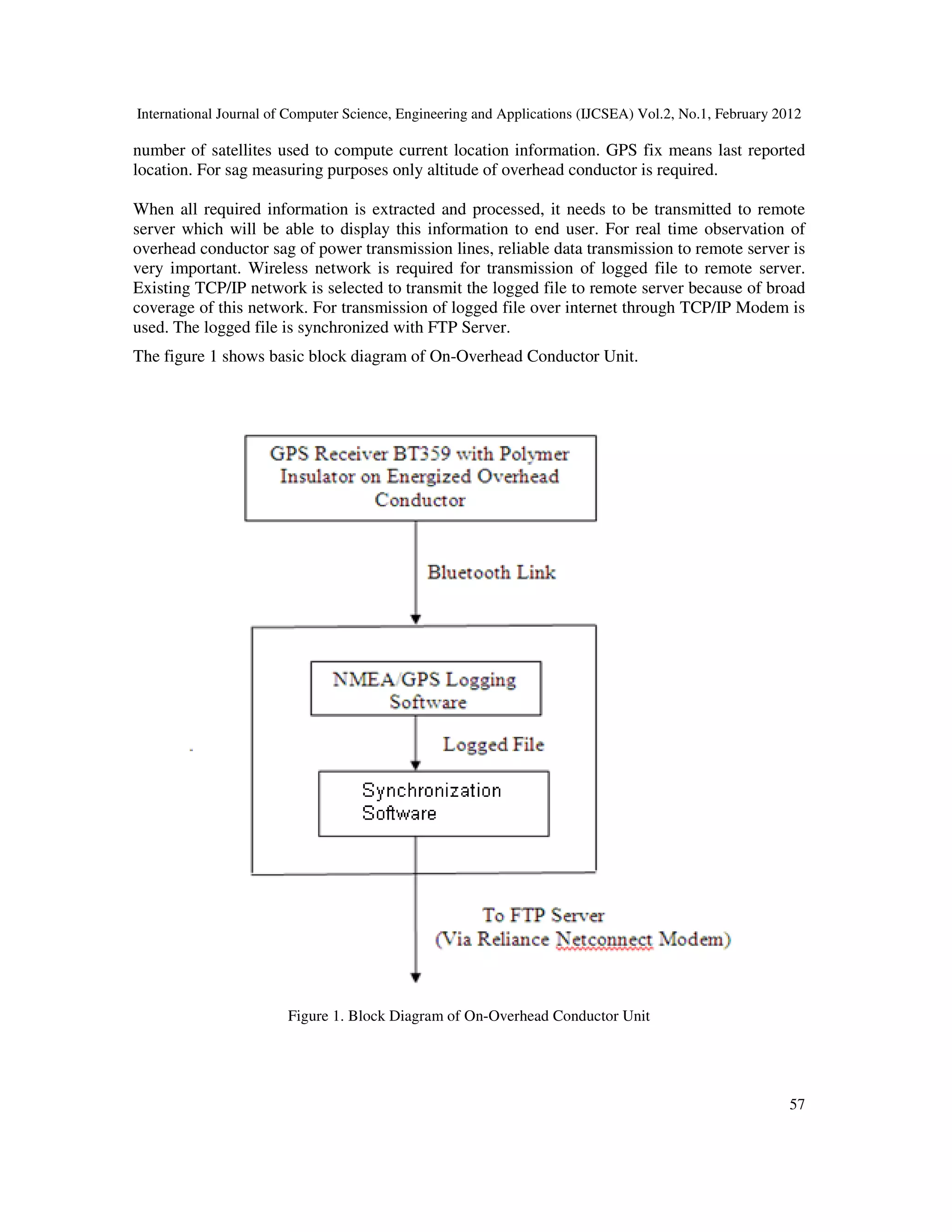
The figure 1 shows basic block diagram of On-Overhead Conductor Unit.
Figure 1. Block Diagram of On-Overhead Conductor Unit
International Journal of Computer Science, Engineering and Applications (IJCSEA) Vol.2, No.1, February 2012
58
2. Remote Server/Control Room of Substation
In this case remote server is at control room of 66KV Grid Substation Idgah, sector6, Faridabad,
Haryana, India. At this substation GPS data has been received for observation of overhead
conductor sag of 11KV Public health feeder. To receive logged file from FTP Server, Modem at
laptop of substation is used. Remote Server has a Reliance Netconnect Modem attached to laptop
that receive logged file from FTP server (as transmission of logged file to FTP server discussed in
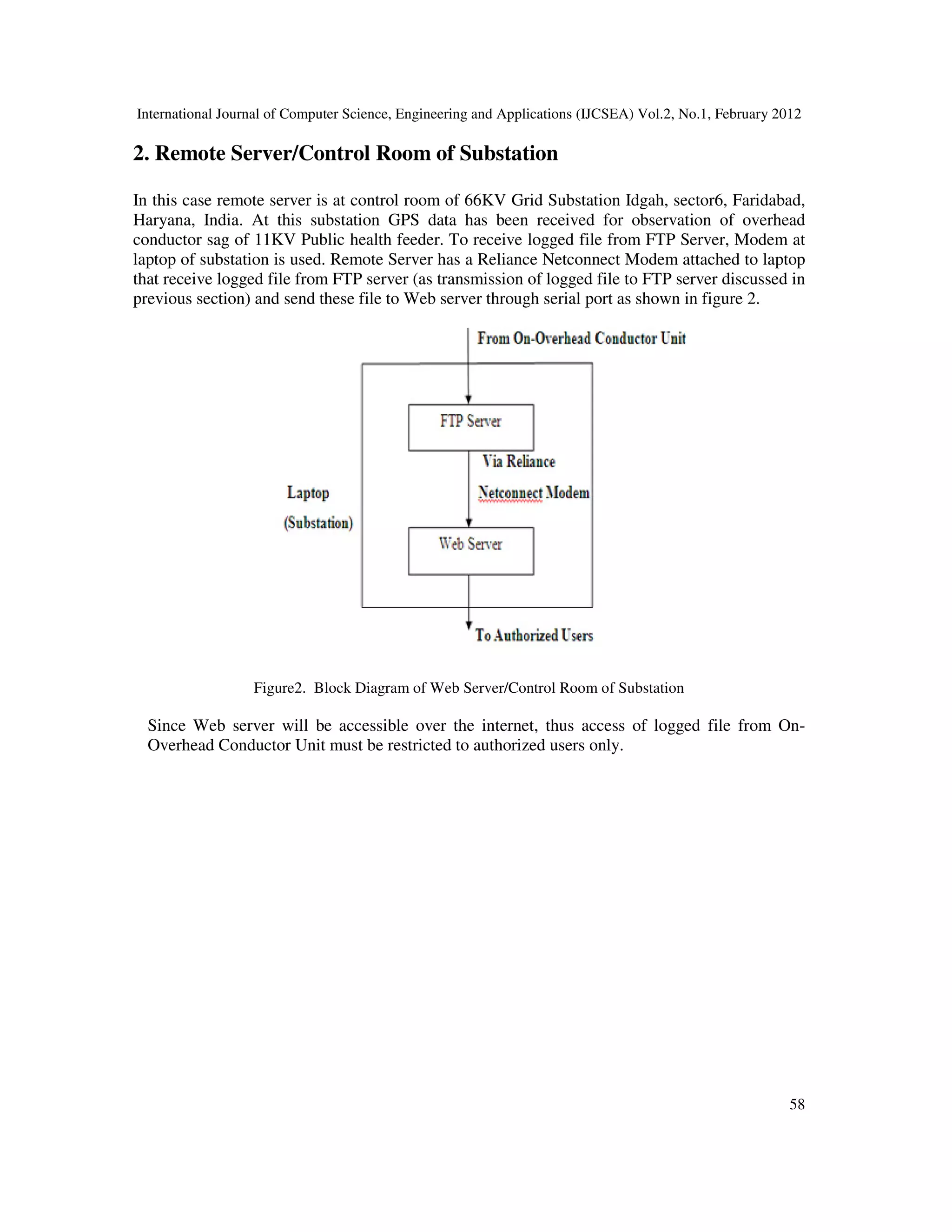
previous section) and send these file to Web server through serial port as shown in figure 2.
Figure2. Block Diagram of Web Server/Control Room of Substation
Since Web server will be accessible over the internet, thus access of logged file from On-
Overhead Conductor Unit must be restricted to authorized users only.
International Journal of Computer Science, Engineering and Applications (IJCSEA) Vol.2, No.1, February 2012
59
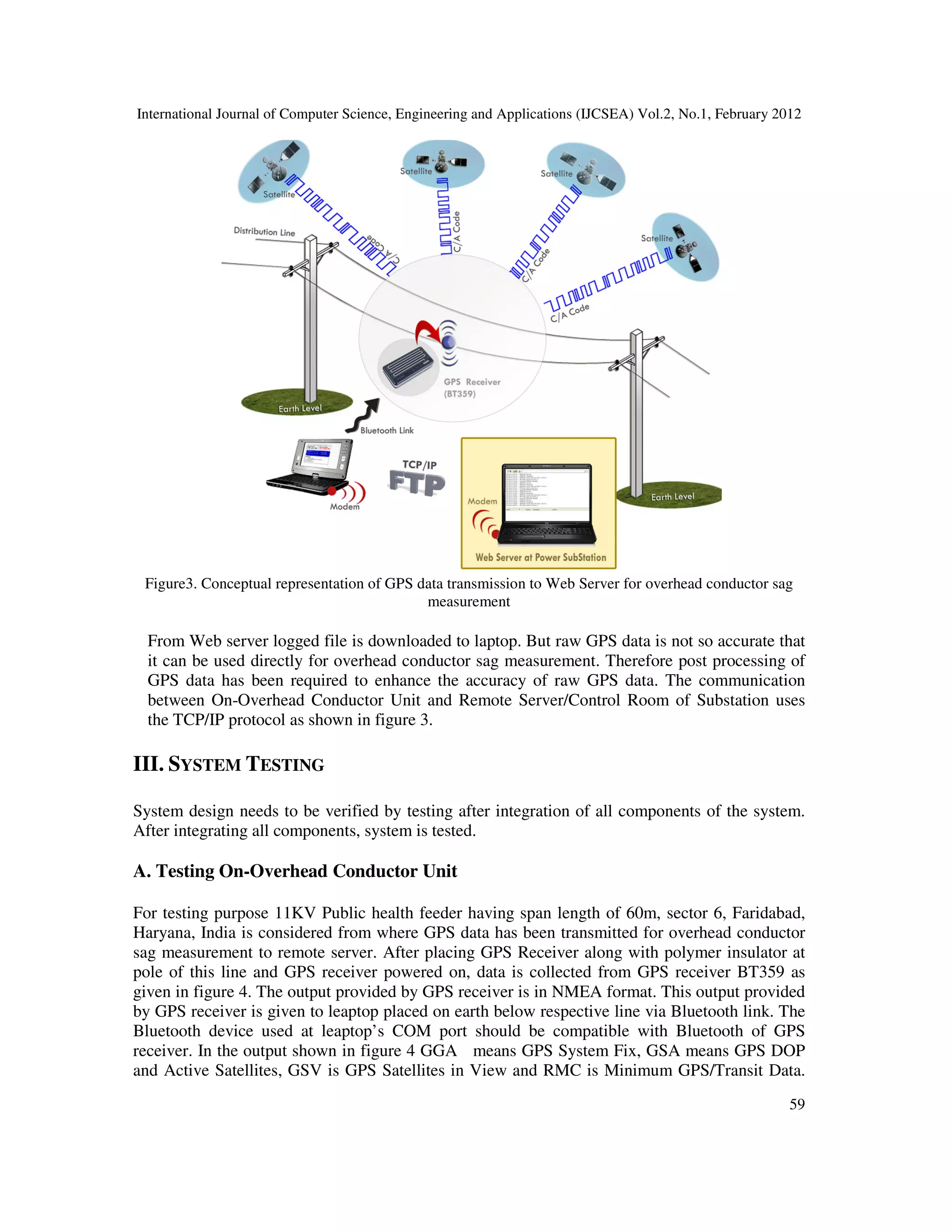
Figure3. Conceptual representation of GPS data transmission to Web Server for overhead conductor sag
measurement
From Web server logged file is downloaded to laptop. But raw GPS data is not so accurate that
it can be used directly for overhead conductor sag measurement. Therefore post processing of
GPS data has been required to enhance the accuracy of raw GPS data. The communication
between On-Overhead Conductor Unit and Remote Server/Control Room of Substation uses
the TCP/IP protocol as shown in figure 3.
III. SYSTEM TESTING
System design needs to be verified by testing after integration of all components of the system.
After integrating all components, system is tested.
A. Testing On-Overhead Conductor Unit
For testing purpose 11KV Public health feeder having span length of 60m, sector 6, Faridabad,
Haryana, India is considered from where GPS data has been transmitted for overhead conductor
sag measurement to remote server. After placing GPS Receiver along with polymer insulator at
pole of this line and GPS receiver powered on, data is collected from GPS receiver BT359 as
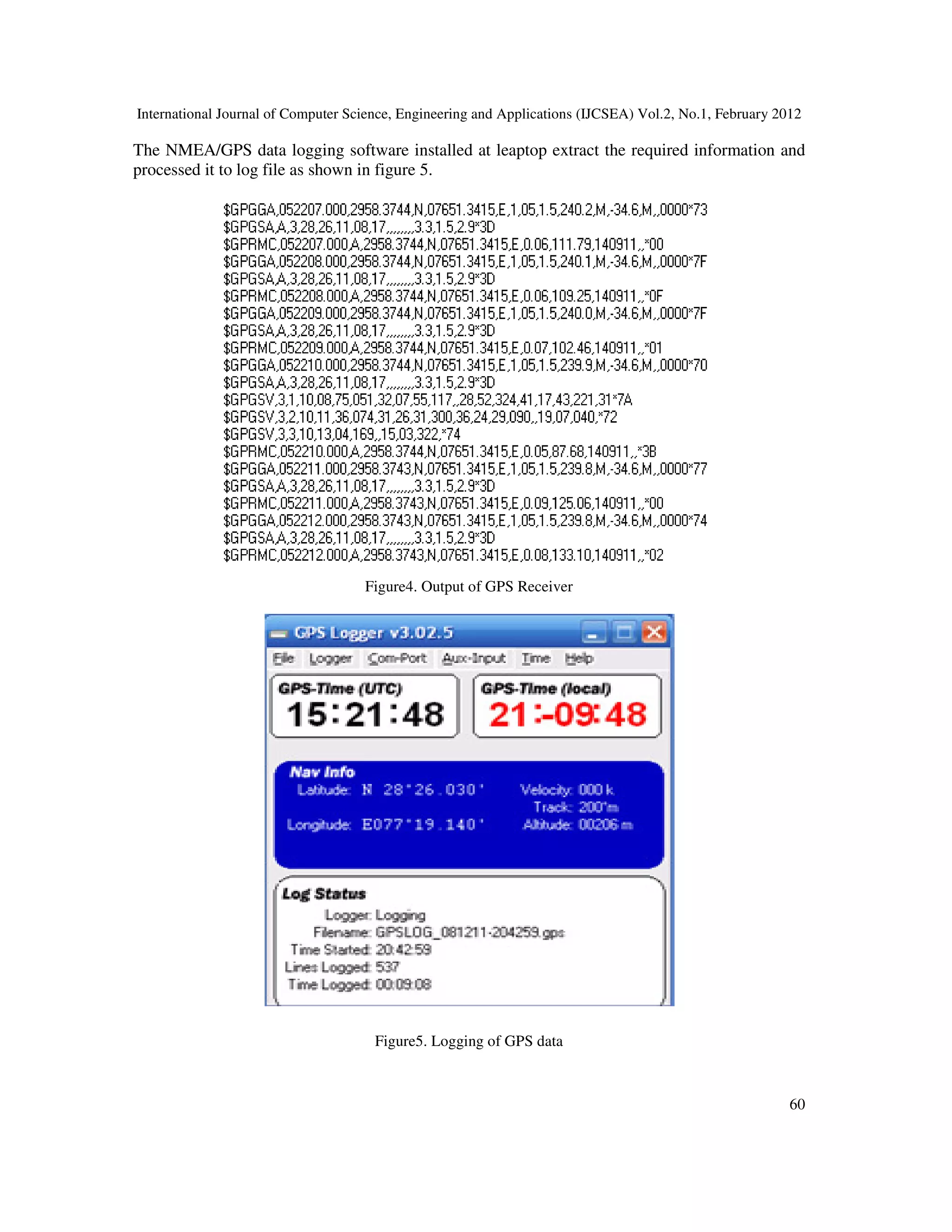
given in figure 4. The output provided by GPS receiver is in NMEA format. This output provided
by GPS receiver is given to leaptop placed on earth below respective line via Bluetooth link. The
Bluetooth device used at leaptop’s COM port should be compatible with Bluetooth of GPS
receiver. In the output shown in figure 4 GGA means GPS System Fix, GSA means GPS DOP
and Active Satellites, GSV is GPS Satellites in View and RMC is Minimum GPS/Transit Data.
International Journal of Computer Science, Engineering and Applications (IJCSEA) Vol.2, No.1, February 2012
60
The NMEA/GPS data logging software installed at leaptop extract the required information and
processed it to log file as shown in figure 5.
Figure4. Output of GPS Receiver
Figure5. Logging of GPS data
International Journal of Computer Science, Engineering and Applications (IJCSEA) Vol.2, No.1, February 2012
61
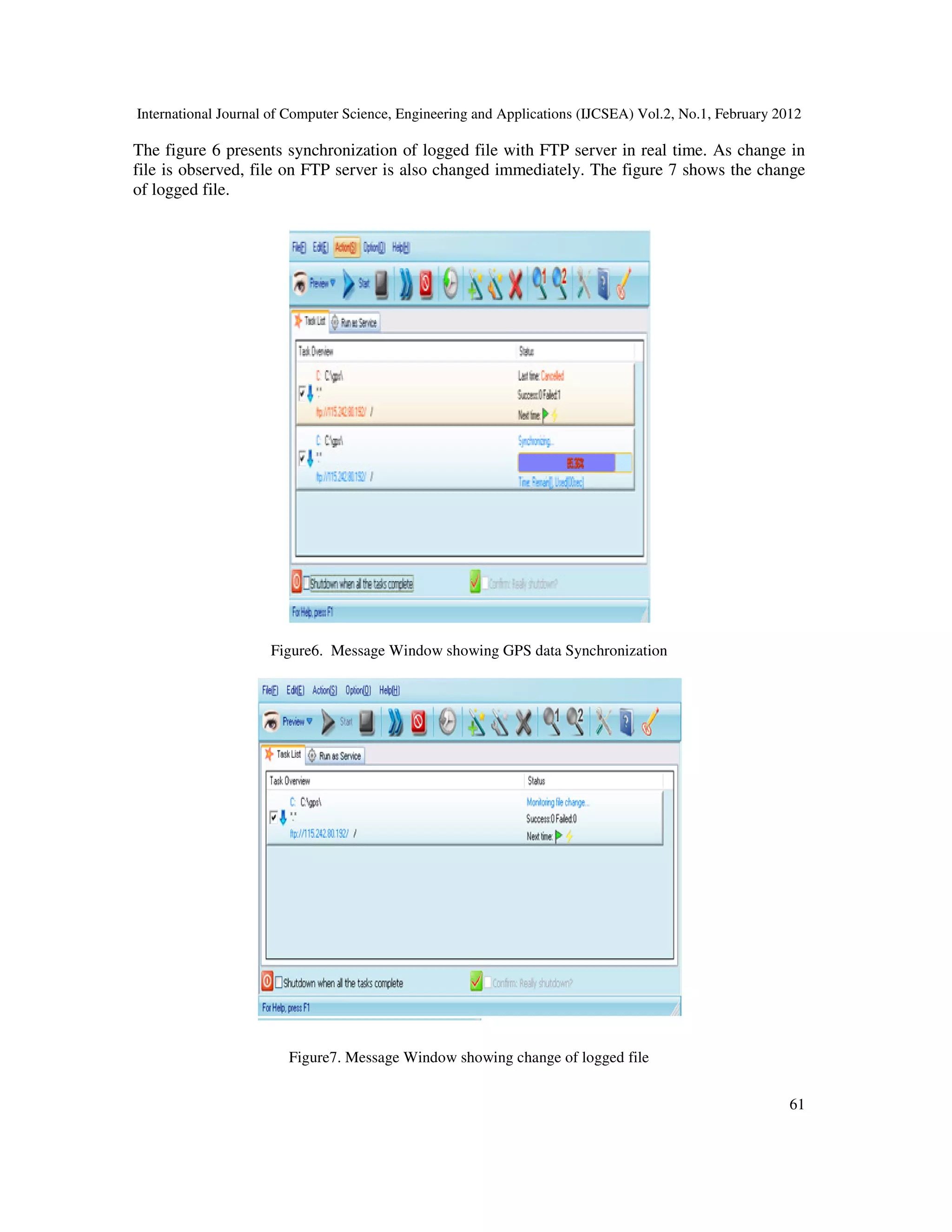
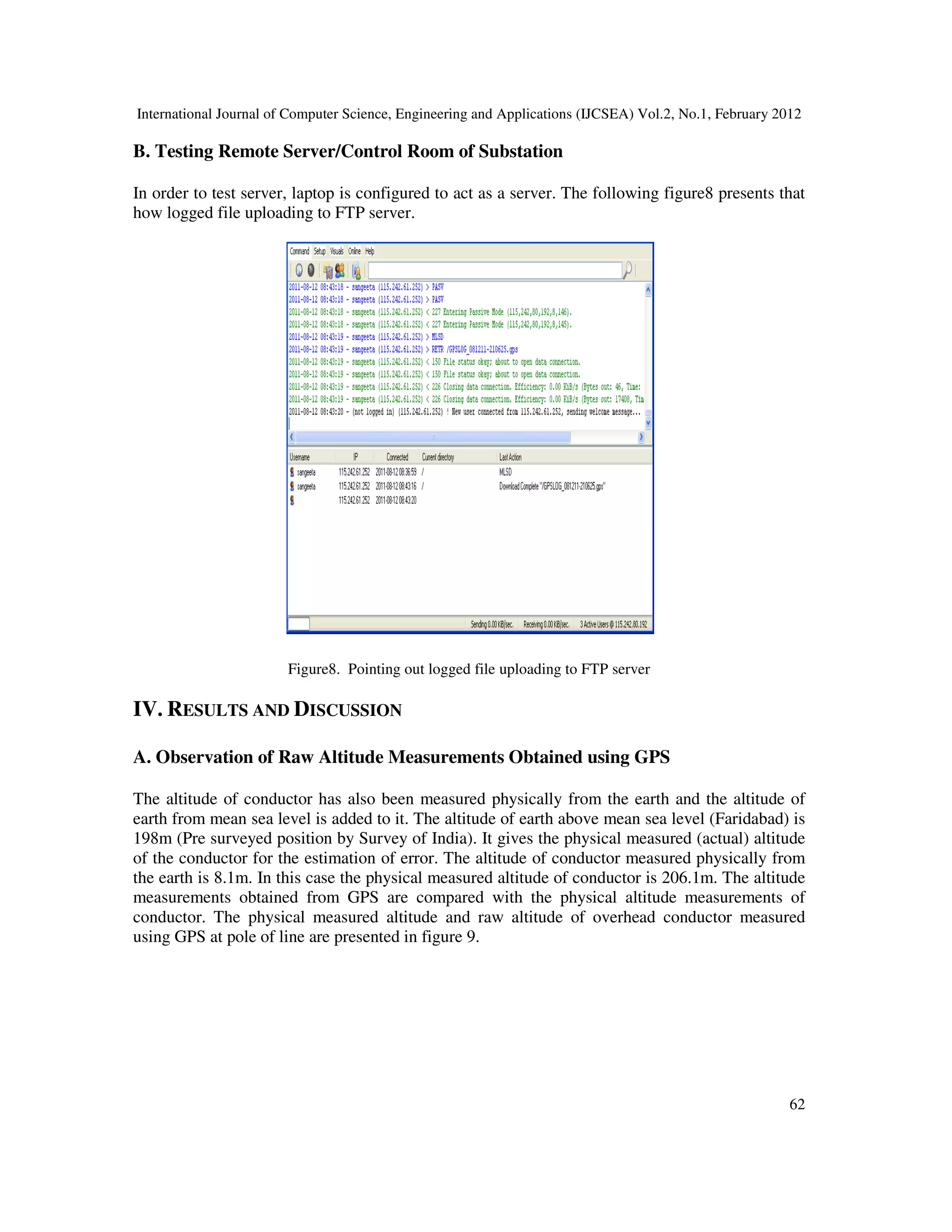
The figure 6 presents synchronization of logged file with FTP server in real time. As change in
file is observed, file on FTP server is also changed immediately. The figure 7 shows the change
of logged file.
Figure6. Message Window showing GPS data Synchronization
Figure7. Message Window showing change of logged file
International Journal of Computer Science, Engineering and Applications (IJCSEA) Vol.2, No.1, February 2012
62
B. Testing Remote Server/Control Room of Substation
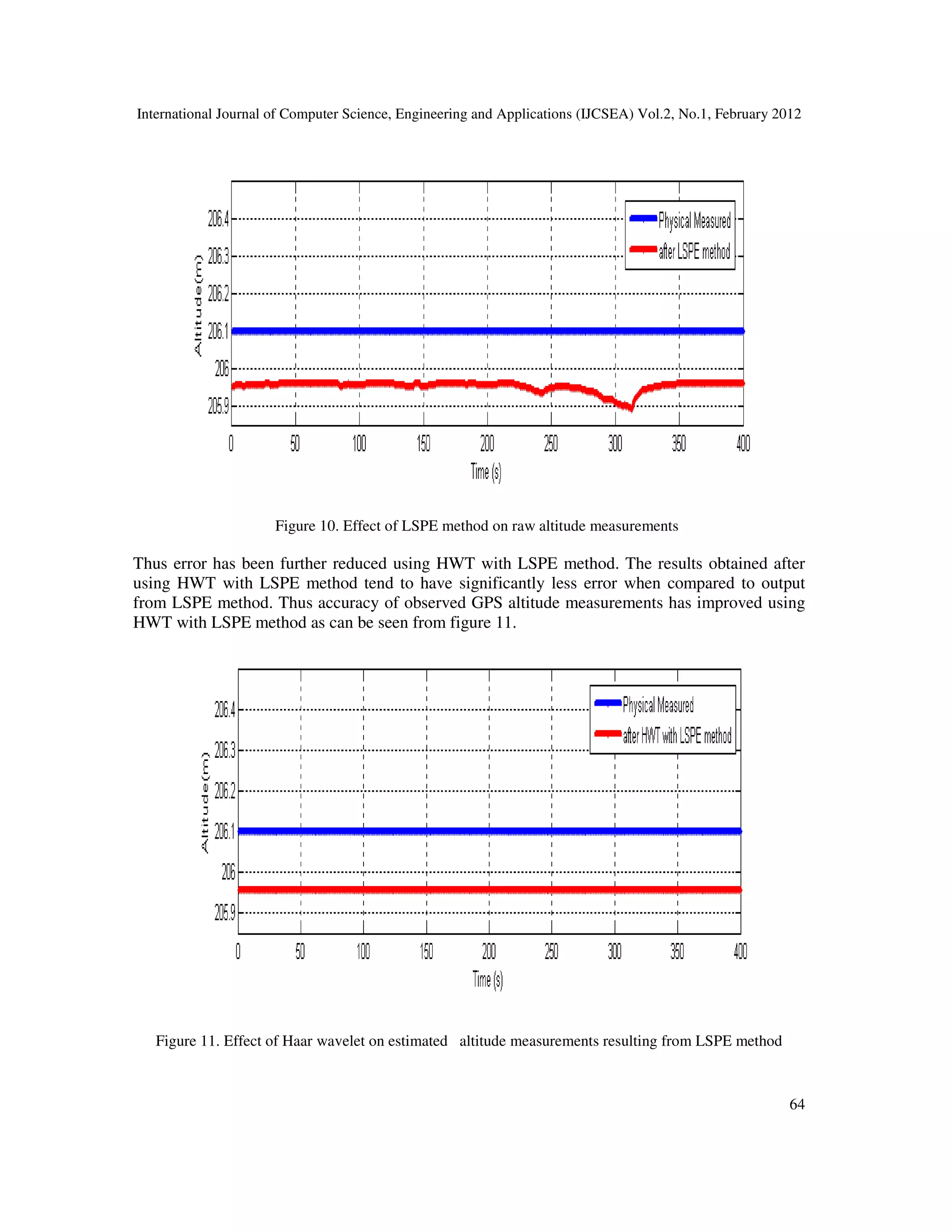
In order to test server, laptop is configured to act as a server. The following figure8 presents that
how logged file uploading to FTP server.
Figure8. Pointing out logged file uploading to FTP server
IV. RESULTS AND DISCUSSION
A. Observation of Raw Altitude Measurements Obtained using GPS
The altitude of conductor has also been measured physically from the earth and the altitude of
earth from mean sea level is added to it. The altitude of earth above mean sea level (Faridabad) is
198m (Pre surveyed position by Survey of India). It gives the physical measured (actual) altitude
of the conductor for the estimation of error. The altitude of conductor measured physically from
the earth is 8.1m. In this case the physical measured altitude of conductor is 206.1m. The altitude
measurements obtained from GPS are compared with the physical altitude measurements of
conductor. The physical measured altitude and raw altitude of overhead conductor measured
using GPS at pole of line are presented in figure 9.
International Journal of Computer Science, Engineering and Applications (IJCSEA) Vol.2, No.1, February 2012
63
Figure9. Raw GPS altitude measurements at Pole
B. Processing of Altitude measurements obtained using GPS
In the raw altitude measurements obtained using GPS as shown in figure 9 error has been
experienced with respect to its physical measured altitude of conductor. The error in altitude
measurements obtained using GPS has been reduced with various signal processing techniques
such as LSPE method and HWT with LSPE method [10]. As raw GPS altitude measurements has
been processed using LSPE method, error in raw altitude measurements obtained using GPS has
been reduced to greater extent. The figure10 depicts processed altitude measurements of
conductor obtained using GPS resulting from LSPE method at pole. It has been observed that an
maximum absolute error of 6.1m in raw altitude measurements obtained using GPS technique has
been reduced to error of 0.2m after using LSPE method . It can be seen from figure 10. Also it
can be observed from figure 10 that the estimated altitude measurements obtained using GPS
resulting from LSPE method doesn’t very much close to physical measured altitude of
conductor. This could be due to further error in estimated altitude measurements obtained using
GPS resulting from LSPE method.
International Journal of Computer Science, Engineering and Applications (IJCSEA) Vol.2, No.1, February 2012
64
Figure 10. Effect of LSPE method on raw altitude measurements
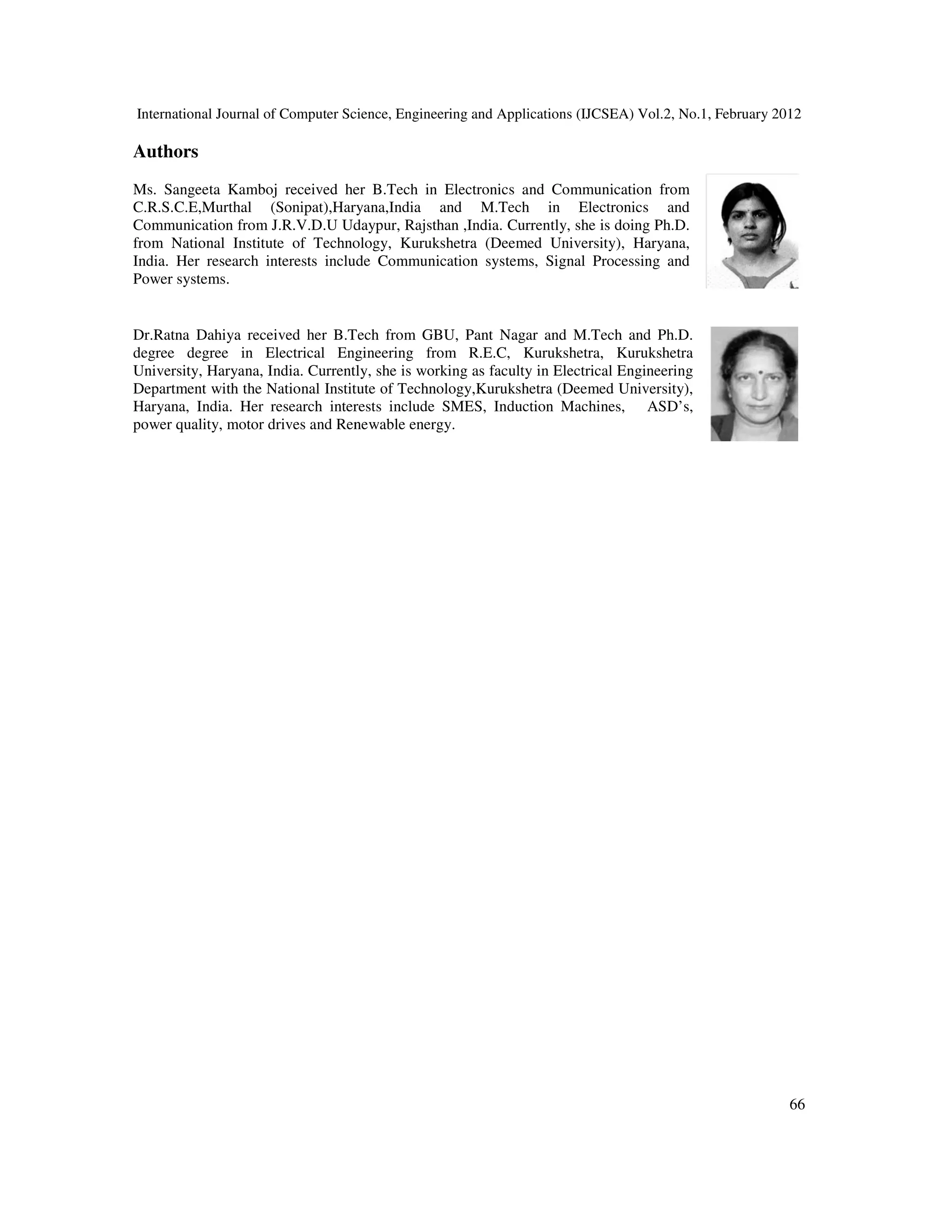
Thus error has been further reduced using HWT with LSPE method. The results obtained after
using HWT with LSPE method tend to have significantly less error when compared to output
from LSPE method. Thus accuracy of observed GPS altitude measurements has improved using
HWT with LSPE method as can be seen from figure 11.
Figure 11. Effect of Haar wavelet on estimated altitude measurements resulting from LSPE method
International Journal of Computer Science, Engineering and Applications (IJCSEA) Vol.2, No.1, February 2012
65
Thus use of Wavelet analysis to further reduce errors in estimated GPS altitude measurements
resulting from LSPE method gives better accuracy of raw GPS altitude measurements taken for
overhead conductor sag measurement in power line.
V. CONCLUSION
It can be concluded that Web based system may be used for online overhead conductor sag
measurement of power transmission line using GPS at substation. It is concluded from the test
results that user can access GPS data transmitted using TCP/IP for overhead conductor sag
measurement at anywhere in the world using internet connection. The LSPE and HWT with
LSPE method have been used to improve accuracy of GPS altitude measurements. These
methods reduce error significantly. Better results are found using HWT method if it is used to
process estimated GPS altitude measurements resulting from LSPE method. The DGPS receiver
may also be used to get better accuracy as compared to handheld GPS receiver.
ACKNOWLEDGEMENT
We acknowledge the cooperation of Assistant Executive Engineer Hansraj, HVPNL, Faridabad,
Haryana, India to carry out work.
REFERENCES
[1] Chris Mensah – Bonsu, Ubaldo Fernandez Krekeler, Gerald Thomas Heydt, Yuri Hoverson, John
Schilleci, Baj. A. Agarwal, “Application of the Global Positioning System to the Measurement of
Overhead Power Transmission Conductor Sag”, IEEE Transactions on Power Delivery, Vol. 17, No.
1. pp 273 – 278, January 2002.
[2] Peter H.Dana, “Global Positioning System(GPS) Time Dissemination for Real Time applications”,
Real Time Systems, pp 9-46, 1997.
[3] T. Pratt, C. Bostain, J. Allnutt, Satellite communication, Singapore: John Wiley & Sons, 2005.
[4] “Introduction to the Global Positioning System for GIS and TRAVERSE”, Corvallis
Microtechnology, Inc. 413 S.W. Jefferson Avenue Corvallis, U.S. Publication, June, 1996.
[5] B. J. Cory, P. F. Gale, "Satellites for Power System Applications”, IEE Power Engineering Journal,
Vol. 7, No. 5, October 1993.
[6] Z. Q. Bo, G. Weller, F. Jiang, Q. X. Yang, “Application of GPS Based Fault Location Scheme for
Distribution System”, POWERCON, Vol. 1, pp. 53-57, 1998.
[7] Muruganandham, P.R.Mukesh, “Real Time Web based Vehicle Tracking using GPS”, World
Academy of Science, Engineering and Technology, 2010.
[8] Alberto J., “VideoMon Mobile – Vehicle Monitoring System Based On Video, GPS, GSM/GPRS/3G
AND GOOGLE MAPS”, Patent PI0605735-7A2,17 November 2006.
[9] S.Kamboj, R.Dahiya, “Real Time Sag Measurement of Overhead Conductor for 11KV Power Line
using Global Positioning system”,IJSAT,Vol.1,No.3,May2011.
[10] S. Kamboj, R. Dahiya, “Evaluation of DTLR of Power Distribution Line from Sag Measured using
GPS”, IEEE conference, ICEAS, 28-30Dec. 2011, Bhuneshwar, India.
International Journal of Computer Science, Engineering and Applications (IJCSEA) Vol.2, No.1, February 2012
Authors
Ms. Sangeeta Kamboj received her B.Tech in Electronics and Communication from
C.R.S.C.E,Murthal (Sonipat),Haryana,India and M.Tech in Electronics and
Communication from J.R.V.D.U Udaypur, Rajsthan ,India. Currently, she is doing Ph.D.
from National Institute of Technology, Kurukshetra (Deemed University), Haryana,
India. Her research interests include Communication systems, Signal Processing and
Power systems.
Dr.Ratna Dahiya received her B.Tech from GBU, Pant Nagar and M.Tech and Ph.D.
degree degree in Electrical Engineering from R.E.C, Kurukshetra, Kurukshetra
University, Haryana, India. Currently, she is working as faculty in Electrical Engineering
Department with the National Institute of Technology,Kurukshetra (Deemed University),
Haryana, India. Her research interests include SMES, Induction Machines, ASD
power quality, motor drives and Renewable
International Journal of Computer Science, Engineering and Applications (IJCSEA) Vol.2, No.1, February 2012
Ms. Sangeeta Kamboj received her B.Tech in Electronics and Communication from
C.R.S.C.E,Murthal (Sonipat),Haryana,India and M.Tech in Electronics and
Communication from J.R.V.D.U Udaypur, Rajsthan ,India. Currently, she is doing Ph.D.
from National Institute of Technology, Kurukshetra (Deemed University), Haryana,
India. Her research interests include Communication systems, Signal Processing and
Dr.Ratna Dahiya received her B.Tech from GBU, Pant Nagar and M.Tech and Ph.D.
degree degree in Electrical Engineering from R.E.C, Kurukshetra, Kurukshetra
University, Haryana, India. Currently, she is working as faculty in Electrical Engineering
Department with the National Institute of Technology,Kurukshetra (Deemed University),
Haryana, India. Her research interests include SMES, Induction Machines, ASD’s,
and Renewable energy.
International Journal of Computer Science, Engineering and Applications (IJCSEA) Vol.2, No.1, February 2012
66

REAL TIME WEB BASED SYSTEM FOR OBSERVING SAG AT SUBSTATION

  • 1.
    International Journal ofComputer Science, Engineering and Applications (IJCSEA) Vol.2, No.1, February 2012 DOI : 10.5121/ijcsea.2012.2106 55 REAL TIME WEB BASED SYSTEM FOR OBSERVING SAG AT SUBSTATION Sangeeta Kambojଵ and Dr. Ratna Dahiyaଶ 1 Research Scholar, National Institute of Technology Kurukshetra - 136119, Haryana, India http://www.nitkkr.ac.in/ 2 Faculty, National Institute of Technology Kurukshetra- 136119, Haryana, India http://www.nitkkr.ac.in/ ABSTRACT The paper describes the designing of web based system for transmission of GPS measurements so that power system operator may monitor overhead conductor sag of power transmission line at substation in real time. The testing results of transmission of GPS measurements from 11KV power transmission line to substation have also been discussed in detail. Raw GPS measurements are not so accurate that these are usable for overhead conductor sag evaluation. The estimated GPS altitude measurements obtained using signal processing techniques such as Least Square Parameter Estimation(LSPE) and Haar Wavelet Transform (HWT) with LSPE are also presented in this paper. KEYWORDS GPS, LSPE method, Wavelet Analysis, Web Server, Overhead conductor sag, NMEA0183. I. INTRODUCTION GPS is satellite based radio positioning and navigation system. It provides position in three dimension and time information to users worldwide with twenty four hours a day [2]. It was declared operational for civilian users in December 1993. The developments in applications of GPS over last 10 years have done at higher rate than advancements in realization of GPS constellation. It is maintained by the United States government and every user can freely access this with a GPS receiver. According to W. Wooden, the detailed definition of GPS is “The Navstar GPS is an all-weather, space based navigation system under development by the Department of Defense to satisfy the requirements for the military forces to accurately determine their position, velocity, and time in common reference system, anywhere on or near earth on a continuous basis”. A GPS receiver calculates its position by precisely timing the signals sent by GPS satellites. There may be visible more than four satellites but only four satellites are used in position calculation of GPS receiver [3, 9].The application market for vehicular tracking and
  • 2.
    International Journal ofComputer Science, Engineering and Applications (IJCSEA) Vol.2, No.1, February 2012 56 monitoring, digital video processing, recording and transmission is nowadays considered one of the most promising in the security area [8]. Tracking systems were first developed for the shipping industry because they wanted to determine where each vehicle was at any given time. But nowadays Automatic Vehicle Location system has been used which transmit the vehicle location information in real time. Real time vehicular tracking system incorporates a hardware device installed in the vehicle and a remote Tracking server [7]. The ability of GPS Technology to provide time synchronization in order of nanoseconds over wide area has opened up the usage of GPS in electric power systems for its reliable and secure operation [5, 6]. The most concerned issue about GPS application in measurement of overhead conductor sag is its accuracy. There are several factors that affect the accuracy of GPS [4]. Various signal processing techniques such as LSPE method and HWT with LSPE to improve accuracy of GPS measurements are used in the paper. In the paper test system for GPS data transmission to Web Server at 66KV Grid Substation Idgah, sector6, Faridabad has been designed. The testing results of GPS data transmission from pole of overhead conductor of 11KV Public Health Feeder, sector 6, Faridabad to substation for sag measurement are also shown in the paper. II. WEB BASED SYSTEM DESIGN AND IMPLEMENTATION The overhead conductor position is determined using GPS and transmission mechanism could be a satellite, terrestrial radio or cellular connection from overhead conductor to a radio receiver, satellite or nearby cell tower of power substation. The main aim of the transmission of GPS data from overhead conductor to remotely located server is as follows: • Exploring GPS based sag observation at substation for monitoring purposes. • Designing System for GPS data transmission through TCP/IP with following features. • Acquisition of overhead conductor’s position in terms of latitude, longitude and altitude after specified interval of time at control room of substation. • Transmission of GPS data provided by GPS receiver to be placed on overhead conductor to Web Server so that authorized users can access the GPS data via website over the internet. Overall Web Based System is partitioned into two major design units: 1. On-Overhead Conductor Unit 2. Remote Server/Control Room of Substation 1. On-Overhead Conductor Unit This is major part of the system. It is responsible for acquiring the current position of overhead conductor (latitude, longitude and altitude). This unit is also responsible for transmitting the current position of overhead conductor to Web Server located anywhere in the world. The current position of overhead conductor provided by GPS receiver needs to be processed using any GPS logging software. Thus current position of overhead conductor provided by GPS receiver is transferred to NMEA/GPS logger software through serial interface via Bluetooth link. GPS receiver can also provide other information such as time of GPS fix, status of GPS fix and
  • 3.
    International Journal ofComputer Science, Engineering and Applications (IJCSEA) Vol.2, No.1, February 2012 57 number of satellites used to compute current location information. GPS fix means last reported location. For sag measuring purposes only altitude of overhead conductor is required. When all required information is extracted and processed, it needs to be transmitted to remote server which will be able to display this information to end user. For real time observation of overhead conductor sag of power transmission lines, reliable data transmission to remote server is very important. Wireless network is required for transmission of logged file to remote server. Existing TCP/IP network is selected to transmit the logged file to remote server because of broad coverage of this network. For transmission of logged file over internet through TCP/IP Modem is used. The logged file is synchronized with FTP Server. The figure 1 shows basic block diagram of On-Overhead Conductor Unit. Figure 1. Block Diagram of On-Overhead Conductor Unit
  • 4.
    International Journal ofComputer Science, Engineering and Applications (IJCSEA) Vol.2, No.1, February 2012 58 2. Remote Server/Control Room of Substation In this case remote server is at control room of 66KV Grid Substation Idgah, sector6, Faridabad, Haryana, India. At this substation GPS data has been received for observation of overhead conductor sag of 11KV Public health feeder. To receive logged file from FTP Server, Modem at laptop of substation is used. Remote Server has a Reliance Netconnect Modem attached to laptop that receive logged file from FTP server (as transmission of logged file to FTP server discussed in previous section) and send these file to Web server through serial port as shown in figure 2. Figure2. Block Diagram of Web Server/Control Room of Substation Since Web server will be accessible over the internet, thus access of logged file from On- Overhead Conductor Unit must be restricted to authorized users only.
  • 5.
    International Journal ofComputer Science, Engineering and Applications (IJCSEA) Vol.2, No.1, February 2012 59 Figure3. Conceptual representation of GPS data transmission to Web Server for overhead conductor sag measurement From Web server logged file is downloaded to laptop. But raw GPS data is not so accurate that it can be used directly for overhead conductor sag measurement. Therefore post processing of GPS data has been required to enhance the accuracy of raw GPS data. The communication between On-Overhead Conductor Unit and Remote Server/Control Room of Substation uses the TCP/IP protocol as shown in figure 3. III. SYSTEM TESTING System design needs to be verified by testing after integration of all components of the system. After integrating all components, system is tested. A. Testing On-Overhead Conductor Unit For testing purpose 11KV Public health feeder having span length of 60m, sector 6, Faridabad, Haryana, India is considered from where GPS data has been transmitted for overhead conductor sag measurement to remote server. After placing GPS Receiver along with polymer insulator at pole of this line and GPS receiver powered on, data is collected from GPS receiver BT359 as given in figure 4. The output provided by GPS receiver is in NMEA format. This output provided by GPS receiver is given to leaptop placed on earth below respective line via Bluetooth link. The Bluetooth device used at leaptop’s COM port should be compatible with Bluetooth of GPS receiver. In the output shown in figure 4 GGA means GPS System Fix, GSA means GPS DOP and Active Satellites, GSV is GPS Satellites in View and RMC is Minimum GPS/Transit Data.
  • 6.
    International Journal ofComputer Science, Engineering and Applications (IJCSEA) Vol.2, No.1, February 2012 60 The NMEA/GPS data logging software installed at leaptop extract the required information and processed it to log file as shown in figure 5. Figure4. Output of GPS Receiver Figure5. Logging of GPS data
  • 7.
    International Journal ofComputer Science, Engineering and Applications (IJCSEA) Vol.2, No.1, February 2012 61 The figure 6 presents synchronization of logged file with FTP server in real time. As change in file is observed, file on FTP server is also changed immediately. The figure 7 shows the change of logged file. Figure6. Message Window showing GPS data Synchronization Figure7. Message Window showing change of logged file
  • 8.
    International Journal ofComputer Science, Engineering and Applications (IJCSEA) Vol.2, No.1, February 2012 62 B. Testing Remote Server/Control Room of Substation In order to test server, laptop is configured to act as a server. The following figure8 presents that how logged file uploading to FTP server. Figure8. Pointing out logged file uploading to FTP server IV. RESULTS AND DISCUSSION A. Observation of Raw Altitude Measurements Obtained using GPS The altitude of conductor has also been measured physically from the earth and the altitude of earth from mean sea level is added to it. The altitude of earth above mean sea level (Faridabad) is 198m (Pre surveyed position by Survey of India). It gives the physical measured (actual) altitude of the conductor for the estimation of error. The altitude of conductor measured physically from the earth is 8.1m. In this case the physical measured altitude of conductor is 206.1m. The altitude measurements obtained from GPS are compared with the physical altitude measurements of conductor. The physical measured altitude and raw altitude of overhead conductor measured using GPS at pole of line are presented in figure 9.
  • 9.
    International Journal ofComputer Science, Engineering and Applications (IJCSEA) Vol.2, No.1, February 2012 63 Figure9. Raw GPS altitude measurements at Pole B. Processing of Altitude measurements obtained using GPS In the raw altitude measurements obtained using GPS as shown in figure 9 error has been experienced with respect to its physical measured altitude of conductor. The error in altitude measurements obtained using GPS has been reduced with various signal processing techniques such as LSPE method and HWT with LSPE method [10]. As raw GPS altitude measurements has been processed using LSPE method, error in raw altitude measurements obtained using GPS has been reduced to greater extent. The figure10 depicts processed altitude measurements of conductor obtained using GPS resulting from LSPE method at pole. It has been observed that an maximum absolute error of 6.1m in raw altitude measurements obtained using GPS technique has been reduced to error of 0.2m after using LSPE method . It can be seen from figure 10. Also it can be observed from figure 10 that the estimated altitude measurements obtained using GPS resulting from LSPE method doesn’t very much close to physical measured altitude of conductor. This could be due to further error in estimated altitude measurements obtained using GPS resulting from LSPE method.
  • 10.
    International Journal ofComputer Science, Engineering and Applications (IJCSEA) Vol.2, No.1, February 2012 64 Figure 10. Effect of LSPE method on raw altitude measurements Thus error has been further reduced using HWT with LSPE method. The results obtained after using HWT with LSPE method tend to have significantly less error when compared to output from LSPE method. Thus accuracy of observed GPS altitude measurements has improved using HWT with LSPE method as can be seen from figure 11. Figure 11. Effect of Haar wavelet on estimated altitude measurements resulting from LSPE method
  • 11.
    International Journal ofComputer Science, Engineering and Applications (IJCSEA) Vol.2, No.1, February 2012 65 Thus use of Wavelet analysis to further reduce errors in estimated GPS altitude measurements resulting from LSPE method gives better accuracy of raw GPS altitude measurements taken for overhead conductor sag measurement in power line. V. CONCLUSION It can be concluded that Web based system may be used for online overhead conductor sag measurement of power transmission line using GPS at substation. It is concluded from the test results that user can access GPS data transmitted using TCP/IP for overhead conductor sag measurement at anywhere in the world using internet connection. The LSPE and HWT with LSPE method have been used to improve accuracy of GPS altitude measurements. These methods reduce error significantly. Better results are found using HWT method if it is used to process estimated GPS altitude measurements resulting from LSPE method. The DGPS receiver may also be used to get better accuracy as compared to handheld GPS receiver. ACKNOWLEDGEMENT We acknowledge the cooperation of Assistant Executive Engineer Hansraj, HVPNL, Faridabad, Haryana, India to carry out work. REFERENCES [1] Chris Mensah – Bonsu, Ubaldo Fernandez Krekeler, Gerald Thomas Heydt, Yuri Hoverson, John Schilleci, Baj. A. Agarwal, “Application of the Global Positioning System to the Measurement of Overhead Power Transmission Conductor Sag”, IEEE Transactions on Power Delivery, Vol. 17, No. 1. pp 273 – 278, January 2002. [2] Peter H.Dana, “Global Positioning System(GPS) Time Dissemination for Real Time applications”, Real Time Systems, pp 9-46, 1997. [3] T. Pratt, C. Bostain, J. Allnutt, Satellite communication, Singapore: John Wiley & Sons, 2005. [4] “Introduction to the Global Positioning System for GIS and TRAVERSE”, Corvallis Microtechnology, Inc. 413 S.W. Jefferson Avenue Corvallis, U.S. Publication, June, 1996. [5] B. J. Cory, P. F. Gale, "Satellites for Power System Applications”, IEE Power Engineering Journal, Vol. 7, No. 5, October 1993. [6] Z. Q. Bo, G. Weller, F. Jiang, Q. X. Yang, “Application of GPS Based Fault Location Scheme for Distribution System”, POWERCON, Vol. 1, pp. 53-57, 1998. [7] Muruganandham, P.R.Mukesh, “Real Time Web based Vehicle Tracking using GPS”, World Academy of Science, Engineering and Technology, 2010. [8] Alberto J., “VideoMon Mobile – Vehicle Monitoring System Based On Video, GPS, GSM/GPRS/3G AND GOOGLE MAPS”, Patent PI0605735-7A2,17 November 2006. [9] S.Kamboj, R.Dahiya, “Real Time Sag Measurement of Overhead Conductor for 11KV Power Line using Global Positioning system”,IJSAT,Vol.1,No.3,May2011. [10] S. Kamboj, R. Dahiya, “Evaluation of DTLR of Power Distribution Line from Sag Measured using GPS”, IEEE conference, ICEAS, 28-30Dec. 2011, Bhuneshwar, India.
  • 12.
    International Journal ofComputer Science, Engineering and Applications (IJCSEA) Vol.2, No.1, February 2012 Authors Ms. Sangeeta Kamboj received her B.Tech in Electronics and Communication from C.R.S.C.E,Murthal (Sonipat),Haryana,India and M.Tech in Electronics and Communication from J.R.V.D.U Udaypur, Rajsthan ,India. Currently, she is doing Ph.D. from National Institute of Technology, Kurukshetra (Deemed University), Haryana, India. Her research interests include Communication systems, Signal Processing and Power systems. Dr.Ratna Dahiya received her B.Tech from GBU, Pant Nagar and M.Tech and Ph.D. degree degree in Electrical Engineering from R.E.C, Kurukshetra, Kurukshetra University, Haryana, India. Currently, she is working as faculty in Electrical Engineering Department with the National Institute of Technology,Kurukshetra (Deemed University), Haryana, India. Her research interests include SMES, Induction Machines, ASD power quality, motor drives and Renewable International Journal of Computer Science, Engineering and Applications (IJCSEA) Vol.2, No.1, February 2012 Ms. Sangeeta Kamboj received her B.Tech in Electronics and Communication from C.R.S.C.E,Murthal (Sonipat),Haryana,India and M.Tech in Electronics and Communication from J.R.V.D.U Udaypur, Rajsthan ,India. Currently, she is doing Ph.D. from National Institute of Technology, Kurukshetra (Deemed University), Haryana, India. Her research interests include Communication systems, Signal Processing and Dr.Ratna Dahiya received her B.Tech from GBU, Pant Nagar and M.Tech and Ph.D. degree degree in Electrical Engineering from R.E.C, Kurukshetra, Kurukshetra University, Haryana, India. Currently, she is working as faculty in Electrical Engineering Department with the National Institute of Technology,Kurukshetra (Deemed University), Haryana, India. Her research interests include SMES, Induction Machines, ASD’s, and Renewable energy. International Journal of Computer Science, Engineering and Applications (IJCSEA) Vol.2, No.1, February 2012 66