Flat and Nested distributed transaction
What are Distributed Transactions?
Distributed Transactions are those that involve more than one
server.
A client transaction becomes distributed if it invokes operations
in several different servers.
There are two different ways that distributed transactions can
be structured as:
• Flat Transaction
• Nested Transaction
 In the general case, a transaction, whether flat or nested, will
access objects located in several different computers . We use
the term distributed transaction to refer to a flat or nested
transaction that accesses objects managed by multiple servers.
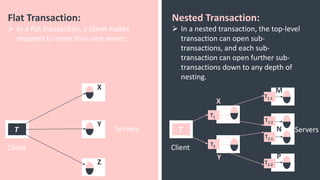
Flat Transaction:
 In a flat transaction, a client makes
requests to more than one server.
Nested Transaction:
 In a nested transaction, the top-level
transaction can open sub-
transactions, and each sub-
transaction can open further sub-
transactions down to any depth of
nesting.
T
X
Y
Z
Client
Servers T
T1
T2
T1.1
T1.2
T2.1
T2.2
Client
Servers
X
Y
N
M
P
 In figure, transaction T is a flat
transaction that invokes operations on
objects in servers X, Y and Z.
 A flat client transaction completes each
of its requests before going on to the
next one. Therefore, each transaction
accesses servers’ objects sequentially.
When servers use locking, a transaction
can only be waiting for one object at a
time.
 Figure shows a client transaction T that
opens two sub transactions, T1 and T2,
which access objects at servers X and Y.
 The sub transactions T1 and T2 open
further sub transactions T1.1, T1.2,
T2.1, and T2.2, which access objects at
servers M, N and P.
 In the nested case, sub transactions at
the same level can run concurrently, so
T1 and T2 are concurrent, and as they
invoke objects in different servers, they
can run in parallel.
 The four sub transactions T1.1, T1.2,
T2.1 and T2.2 also run concurrently.
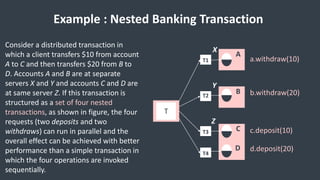
Example : Nested Banking Transaction
Consider a distributed transaction in
which a client transfers $10 from account
A to C and then transfers $20 from B to
D. Accounts A and B are at separate
servers X and Y and accounts C and D are
at same server Z. If this transaction is
structured as a set of four nested
transactions, as shown in figure, the four
requests (two deposits and two
withdraws) can run in parallel and the
overall effect can be achieved with better
performance than a simple transaction in
which the four operations are invoked
sequentially.
T
T1
T2
T3
T4
a.withdraw(10)
b.withdraw(20)
c.deposit(10)
d.deposit(20)
A
B
C
D
X
Y
Z
Summary
In the most general case, a client’s transaction will request operations on objects in several
different servers. A distributed transaction is any transaction whose activity involves several
different servers. A nested transaction structure may be used to allow additional concurrency
and independent committing by the servers in a distributed transaction.
C
Prepared by : Mohit Kothari
Sap id : 53004180013
Class : M.Sc.I.T,Part 1, Semester 1
Subject : Distributed System

Distributed transaction

  • 1.
    Flat and Nesteddistributed transaction What are Distributed Transactions? Distributed Transactions are those that involve more than one server. A client transaction becomes distributed if it invokes operations in several different servers. There are two different ways that distributed transactions can be structured as: • Flat Transaction • Nested Transaction  In the general case, a transaction, whether flat or nested, will access objects located in several different computers . We use the term distributed transaction to refer to a flat or nested transaction that accesses objects managed by multiple servers.
  • 2.
    Flat Transaction:  Ina flat transaction, a client makes requests to more than one server. Nested Transaction:  In a nested transaction, the top-level transaction can open sub- transactions, and each sub- transaction can open further sub- transactions down to any depth of nesting. T X Y Z Client Servers T T1 T2 T1.1 T1.2 T2.1 T2.2 Client Servers X Y N M P
  • 3.
     In figure,transaction T is a flat transaction that invokes operations on objects in servers X, Y and Z.  A flat client transaction completes each of its requests before going on to the next one. Therefore, each transaction accesses servers’ objects sequentially. When servers use locking, a transaction can only be waiting for one object at a time.  Figure shows a client transaction T that opens two sub transactions, T1 and T2, which access objects at servers X and Y.  The sub transactions T1 and T2 open further sub transactions T1.1, T1.2, T2.1, and T2.2, which access objects at servers M, N and P.  In the nested case, sub transactions at the same level can run concurrently, so T1 and T2 are concurrent, and as they invoke objects in different servers, they can run in parallel.  The four sub transactions T1.1, T1.2, T2.1 and T2.2 also run concurrently.
  • 4.
    Example : NestedBanking Transaction Consider a distributed transaction in which a client transfers $10 from account A to C and then transfers $20 from B to D. Accounts A and B are at separate servers X and Y and accounts C and D are at same server Z. If this transaction is structured as a set of four nested transactions, as shown in figure, the four requests (two deposits and two withdraws) can run in parallel and the overall effect can be achieved with better performance than a simple transaction in which the four operations are invoked sequentially. T T1 T2 T3 T4 a.withdraw(10) b.withdraw(20) c.deposit(10) d.deposit(20) A B C D X Y Z
  • 5.
    Summary In the mostgeneral case, a client’s transaction will request operations on objects in several different servers. A distributed transaction is any transaction whose activity involves several different servers. A nested transaction structure may be used to allow additional concurrency and independent committing by the servers in a distributed transaction. C Prepared by : Mohit Kothari Sap id : 53004180013 Class : M.Sc.I.T,Part 1, Semester 1 Subject : Distributed System