SUB-SKILLS OF
READING
SUB-SKILLS OF
READING
PRAFULLA KUMAR
GOCHHAYAT
PRAFULLA KUMAR
GOCHHAYAT
WHAT IS SKILL ?
WHY IS READING A COMPOSITE SKILL ?
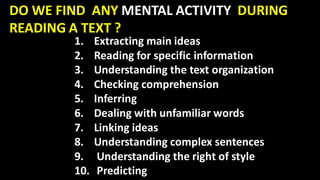
DO WE FIND ANY MENTAL ACTIVITY DURING
READING A TEXT ?
1. Extracting main ideas
2. Reading for specific information
3. Understanding the text organization
4. Checking comprehension
5. Inferring
6. Dealing with unfamiliar words
7. Linking ideas
8. Understanding complex sentences
9. Understanding the right of style
10. Predicting
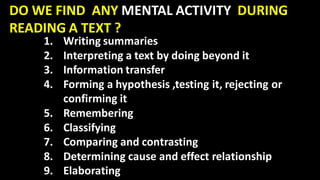
DO WE FIND ANY MENTAL ACTIVITY DURING
READING A TEXT ?
1. Writing summaries
2. Interpreting a text by doing beyond it
3. Information transfer
4. Forming a hypothesis ,testing it, rejecting or
confirming it
5. Remembering
6. Classifying
7. Comparing and contrasting
8. Determining cause and effect relationship
9. Elaborating
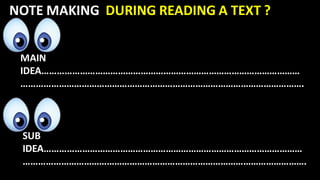
NOTE MAKING DURING READING A TEXT ?
MAIN
IDEA…………………………………………………………………………………………
………………………………………………………………………………………………….
SUB
IDEA…………………………………………………………………………………………
………………………………………………………………………………………………….
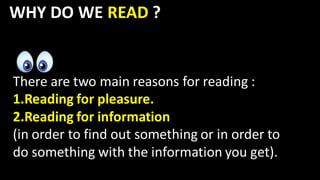
WHY DO WE READ ?
There are two main reasons for reading :
1.Reading for pleasure.
2.Reading for information
(in order to find out something or in order to
do something with the information you get).
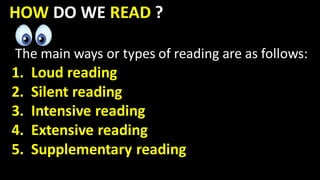
HOW DO WE READ ?
The main ways or types of reading are as follows:
1. Loud reading
2. Silent reading
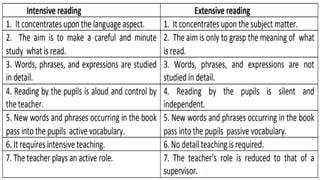
3. Intensive reading
4. Extensive reading
5. Supplementary reading
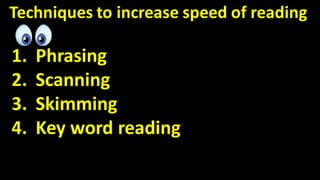
Techniques to increase speed of reading
1. Phrasing
2. Scanning
3. Skimming
4. Key word reading
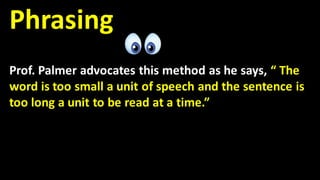
Phrasing
Prof. Palmer advocates this method as he says, “ The
word is too small a unit of speech and the sentence is
too long a unit to be read at a time.”
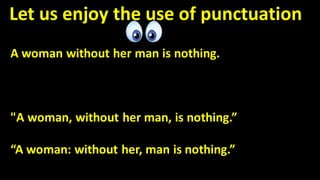
Let us enjoy the use of punctuation
A woman without her man is nothing.
"A woman, without her man, is nothing.”
“A woman: without her, man is nothing.”
Scanning
Scanning refers to the ability to locate specific information or
facts as quickly as possible.
a) A specific point or fact in a text
b) A formulae in a text,
c) A word in a dictionary,
d) Train or television schedules,
e) Any reference or bibliographical list,
f) Examination results, or
g) Any notes/ questions/ remarks at the end of the
text.
Skimming
It refers to the process of reading a text or passage in order
to get rough idea of what the text or passage is all about.
1. What is the overall purpose of the text?
2. What is the central idea or theme?
3. What does the author intent to do? (describe,
instruct, report, narrate, explain, argue, persuade,
illustrate and so on)
4. What are the main points of the text?
KEY WORD READING
It refers to the process of reading a text or passage in order
to get rough idea of what the text or passage is all about.
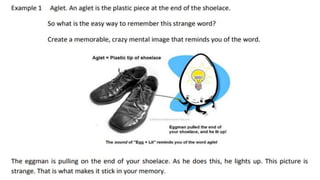
The key word method is an effective system for
remembering definitions, learning foreign language
vocabulary, and more. Any two pieces of information can be
linked together in your memory using this method .
WHAT IS READING COMPREHENSION?
Understanding a written text means extracting the
required information from it.
a) Consider the text as a whole, its title, accompanying
pictures or diagrams, the paragraphs and make guesses
about what the text is about.
b) Skim through the text a first time to see if your
hypotheses were right. Then ask yourself a number of
questions about the contents of the text.
c) Read the text again, more slowly and carefully this time,
trying to understand as much as you can and trying to
answer the questions you asked yourself.
GLOBAL COMPREHENSION?
Global comprehension means understanding the general meaning of
what you are reading. It can be compared to selective
comprehension, which means understanding specific information in
the text, and detailed comprehension, which means understanding
everything. Global, selective and detailed comprehensions have
parallels with the three reading skills of skimming, scanning and
intensive reading.
Example
The learners have listened to a story and now try to recreate it by
putting jumbled sentences into the correct order.
LOCAL COMPREHENSION?
a) Local comprehension is one of the skills, that helps to read a
piece of text intensively to extract specific information from the
text. Local comprehension skill is also called the intensive
reading skill
b) Local comprehension/intensive reading is the skill of reading a
piece of text closely or intensely for the purpose of extracting
specific information from the text.
INFERENTIAL COMPREHENSION?
a) Inferential comprehension requires the reader/viewer to draw on their prior
knowledge of a topic and identify relevant text clues (words, images, sounds) to
make an inference.
Inferential comprehensionis the ability to process written information and understand the
underlying meaning of the text. This information is then used to infer or determine deeper
meaning that is not explicitly stated. Inferential comprehensionrequires readers to:
1. combine ideas
2. draw conclusions
3. interpret and evaluate information
4. identify tone and voice.
A higher and more complex level of comprehension involves critical analysis which requires
readers to:
1. be critical
2. form opinions
3. identify authors' points of view and attitudes
4. identify and consider the authority of texts and their messages
5. infer motives of characters and themes.
PREDICTION COMPREHENSION?
a) Predicting is an essential reading strategy. It allows
learners to utilize info from the text to anticipate what
will happen in the story. When making predictions,
learners envision what will come next in the text, based
on their prior knowledge. Predicting encourages kids to
think ahead and ask questions actively.
EVALUATIVE COMPREHENSION?
Evaluative comprehension requires the reader to
move beyond the text to consider what they
think and believe in relation to the message in
the text.
THANK YOU
TECHNIQUES OF TEACHING READING
Evaluative comprehension requires the reader to
move beyond the text to consider what they
think and believe in relation to the message in
the text.

New Microsoft PowerPoint Presentation.pdf

  • 1.
    SUB-SKILLS OF READING SUB-SKILLS OF READING PRAFULLAKUMAR GOCHHAYAT PRAFULLA KUMAR GOCHHAYAT
  • 2.
    WHAT IS SKILL? WHY IS READING A COMPOSITE SKILL ?
  • 3.
    DO WE FINDANY MENTAL ACTIVITY DURING READING A TEXT ? 1. Extracting main ideas 2. Reading for specific information 3. Understanding the text organization 4. Checking comprehension 5. Inferring 6. Dealing with unfamiliar words 7. Linking ideas 8. Understanding complex sentences 9. Understanding the right of style 10. Predicting
  • 4.
    DO WE FINDANY MENTAL ACTIVITY DURING READING A TEXT ? 1. Writing summaries 2. Interpreting a text by doing beyond it 3. Information transfer 4. Forming a hypothesis ,testing it, rejecting or confirming it 5. Remembering 6. Classifying 7. Comparing and contrasting 8. Determining cause and effect relationship 9. Elaborating
  • 5.
    NOTE MAKING DURINGREADING A TEXT ? MAIN IDEA………………………………………………………………………………………… …………………………………………………………………………………………………. SUB IDEA………………………………………………………………………………………… ………………………………………………………………………………………………….
  • 6.
    WHY DO WEREAD ? There are two main reasons for reading : 1.Reading for pleasure. 2.Reading for information (in order to find out something or in order to do something with the information you get).
  • 7.
    HOW DO WEREAD ? The main ways or types of reading are as follows: 1. Loud reading 2. Silent reading 3. Intensive reading 4. Extensive reading 5. Supplementary reading
  • 9.
    Techniques to increasespeed of reading 1. Phrasing 2. Scanning 3. Skimming 4. Key word reading
  • 10.
    Phrasing Prof. Palmer advocatesthis method as he says, “ The word is too small a unit of speech and the sentence is too long a unit to be read at a time.”
  • 11.
    Let us enjoythe use of punctuation A woman without her man is nothing. "A woman, without her man, is nothing.” “A woman: without her, man is nothing.”
  • 12.
    Scanning Scanning refers tothe ability to locate specific information or facts as quickly as possible. a) A specific point or fact in a text b) A formulae in a text, c) A word in a dictionary, d) Train or television schedules, e) Any reference or bibliographical list, f) Examination results, or g) Any notes/ questions/ remarks at the end of the text.
  • 13.
    Skimming It refers tothe process of reading a text or passage in order to get rough idea of what the text or passage is all about. 1. What is the overall purpose of the text? 2. What is the central idea or theme? 3. What does the author intent to do? (describe, instruct, report, narrate, explain, argue, persuade, illustrate and so on) 4. What are the main points of the text?
  • 14.
    KEY WORD READING Itrefers to the process of reading a text or passage in order to get rough idea of what the text or passage is all about. The key word method is an effective system for remembering definitions, learning foreign language vocabulary, and more. Any two pieces of information can be linked together in your memory using this method .
  • 16.
    WHAT IS READINGCOMPREHENSION? Understanding a written text means extracting the required information from it. a) Consider the text as a whole, its title, accompanying pictures or diagrams, the paragraphs and make guesses about what the text is about. b) Skim through the text a first time to see if your hypotheses were right. Then ask yourself a number of questions about the contents of the text. c) Read the text again, more slowly and carefully this time, trying to understand as much as you can and trying to answer the questions you asked yourself.
  • 17.
    GLOBAL COMPREHENSION? Global comprehensionmeans understanding the general meaning of what you are reading. It can be compared to selective comprehension, which means understanding specific information in the text, and detailed comprehension, which means understanding everything. Global, selective and detailed comprehensions have parallels with the three reading skills of skimming, scanning and intensive reading. Example The learners have listened to a story and now try to recreate it by putting jumbled sentences into the correct order.
  • 18.
    LOCAL COMPREHENSION? a) Localcomprehension is one of the skills, that helps to read a piece of text intensively to extract specific information from the text. Local comprehension skill is also called the intensive reading skill b) Local comprehension/intensive reading is the skill of reading a piece of text closely or intensely for the purpose of extracting specific information from the text.
  • 19.
    INFERENTIAL COMPREHENSION? a) Inferentialcomprehension requires the reader/viewer to draw on their prior knowledge of a topic and identify relevant text clues (words, images, sounds) to make an inference. Inferential comprehensionis the ability to process written information and understand the underlying meaning of the text. This information is then used to infer or determine deeper meaning that is not explicitly stated. Inferential comprehensionrequires readers to: 1. combine ideas 2. draw conclusions 3. interpret and evaluate information 4. identify tone and voice. A higher and more complex level of comprehension involves critical analysis which requires readers to: 1. be critical 2. form opinions 3. identify authors' points of view and attitudes 4. identify and consider the authority of texts and their messages 5. infer motives of characters and themes.
  • 20.
    PREDICTION COMPREHENSION? a) Predictingis an essential reading strategy. It allows learners to utilize info from the text to anticipate what will happen in the story. When making predictions, learners envision what will come next in the text, based on their prior knowledge. Predicting encourages kids to think ahead and ask questions actively.
  • 21.
    EVALUATIVE COMPREHENSION? Evaluative comprehensionrequires the reader to move beyond the text to consider what they think and believe in relation to the message in the text.
  • 22.
  • 23.
    TECHNIQUES OF TEACHINGREADING Evaluative comprehension requires the reader to move beyond the text to consider what they think and believe in relation to the message in the text.