Narrative Writing as a 
Student-Centered Approach to 
Learning the Process of Science 
Eunbae Lee 
University of Georgia
Overview 
 Narrative writing as a way of learning the 
processes of science 
 Qualitative study on students’ experiences on 
research narratives in a college science 
course 
 The role of autonomy, relatedness, and 
competence in research narratives 
 Development of reusable design propositions 
for student-centered research narratives
Student-Centered Learning 
 Student assume the major responsibility for 
using a variety of resources and tools to 
navigate through the process of reaching 
the individually identified learning goals 
(Land & Hannafin, 2012)
Self-Determination Theory 
(Ryan & Deci, 2000) 
Experience of 
• Autonomy 
•Competence 
• Relatedness 
Fosters 
• Volition 
•Motivation 
• Engagement 
Result in 
• Enhanced 
performance 
• Persistence 
•Creativity
Writing in Science Education 
 Constructing new knowledge by establishing 
connections between prior knowledge about 
the topic and knowledge about discourse 
processes and goals 
 Reflection and expression of learned material in 
meaningful organizations 
 Examined for flaws, revised, reorganized, and 
combined with additional research, or 
discarded 
(MacKenzie & Gardner, 2006; Madigan, 1987; Moore, 1994; Bereiter & Scardamalia, 1987; 
(Hayes & Flower, 1986;Alamargot & Chanquoy, 2001; Hayes, 1996)
Narrative Writing 
Different from typical science 
reports 
Story with drama and 
characters 
(Clopton, 2011).
Research Narratives 
 Student-centered Learning 
 Identify a scientist 
 Interview the scientist 
 Learn about the research project 
 Write a narrative 
 Main goal: To understand the process of 
science 
 Other goals: 
 Identify graduate and career mentors 
 Public outreach: Communicate science in a 
plain language to the general public
Purpose of Study 
 To understand students’ experiences with 
research narratives 
 To examine the role of autonomy, 
relatedness, and competence in 
students’ engagement and performance 
in college-level, student-centered science 
education
Research Questions 
1. What are students’ experiences when 
engaged in science research narratives in 
college-level, student-centered science 
learning environments? 
 Steps to completion 
 Perceptions 
 Resources and guidance 
 Difficulty 
 Students’ recommendations
Research Questions 
 To what extent do autonomy support, 
competence, relatedness, and autonomous 
self-regulation influence students’ 
performances on the research narratives?
Research Method 
 Participants: A college science course 
 Design 
 Participant observations 
 Student interviews 
 Instructor interviews 
 Document Analysis 
 Student questionnaire 
 Learning Climate Questionnaire 
 Self-Regulation Questionnaire 
 Intrinsic Motivation Inventory 
 Analysis: Thematic Analysis and Correlation analysis
Steps to Completion 
 Identified researcher based on their interests 
 Referenced the researcher’s websites, blogs, 
news and magazine articles, and scholarly 
publications 
 Semi-structured phone interviews 
 Follow-up emails for details while writing 
 Incorporated story telling techniques (e.g., an 
arc, humor, villains) 
 Revised the first draft based on feedback 
received from the instructor and peers
Students said 
 My focus was the research. … So when writing it, I 
did introduction to the topic. And then I just kind 
of went and tried to play along with the order for 
research and what it has led to. (Matthew, 62-69) 
 And then I've kind of organized her answers to the 
question. I wrote it up. So, when I was writing I tried 
to make it into a story and kind of make it blend in 
with topics of research I wanted to get into. How 
actually I would do that in the field and give the 
reader a good sense of what it would be actually 
like to do the research. (Daniel, 12-14 
 I focused on the person and her life choices to get 
her where she was in her research. (Jessica 93-94) 
 I made him more of a super hero than he made 
himself seem. (Nettie, 159)
Useful Guidance 
1. Feedback on the First Draft 
2. Opportunity to Revise 
3. Rubrics 
4. Instructions provided in the syllabus 
5. Peer Review 
6. Example 
7. Self-Critique 
8. Individual Discussions with the Instructor
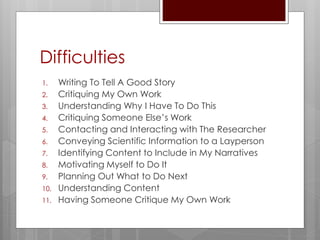
Difficulties 
1. Writing To Tell A Good Story 
2. Critiquing My Own Work 
3. Understanding Why I Have To Do This 
4. Critiquing Someone Else’s Work 
5. Contacting and Interacting with The Researcher 
6. Conveying Scientific Information to a Layperson 
7. Identifying Content to Include in My Narratives 
8. Motivating Myself to Do It 
9. Planning Out What to Do Next 
10. Understanding Content 
11. Having Someone Critique My Own Work
Perceptions: Least Helpful 
 Research Narratives 
 Textbook 
 Lecture Exam 
 Online Lecture 
 Reading Quiz 
 Amphibian Inventory 
 Instructional Lab 
 Lab Exam 
 Live Lecture
Perception: Autonomy 
 Especially with narratives, how we got to choose 
and how we got to research. So, there was a lot of 
freedom there. … I think I would prefer how it was 
with more freedom. So you get to choose the 
topic you get to write about. So you are not stuck 
with something you are not interested in. (Daniel, 
125-129) 
 I liked how it was open-ended. You can choose 
whatever you want. You turn it in this time well set 
out towards the end of the semester. (Leila, 127- 
128) You have the creative liberty. You can take it 
wherever. (Leila, 149)
Perception: Students’ take away 
 Public outreach: You have to communicate to 
the public good things about the field. So I think 
the point of this is to be able to take science and 
present it in a way that is interesting to someone 
who is not from science. (Jessica, 73-75) 
 Connection with current research and 
researchers: I guess it was to get experience 
reading and learning about new research and 
making contact with people. (David, 81) 
 Enhanced personal engagement: The other part 
of it was to get you more interested in this field 
and make it related to something you personally 
care about if you were not science majors. Which 
is the part that appealed to me. (Leila, 82-83)
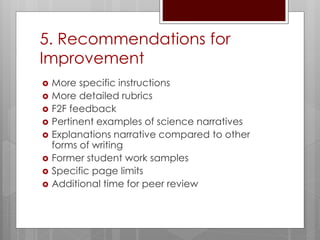
5. Recommendations for 
Improvement 
 More specific instructions 
 More detailed rubrics 
 F2F feedback 
 Pertinent examples of science narratives 
 Explanations narrative compared to other 
forms of writing 
 Former student work samples 
 Specific page limits 
 Additional time for peer review
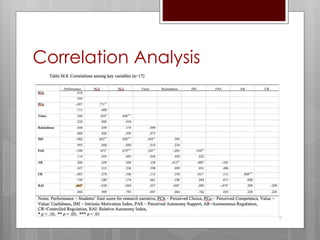
RQ2: Self-Determination on 
Performance and Engagement 
 Experience of autonomy, relatedness, 
competence, and perceived autonomy 
support from the instructor had no effect on 
students’ performance on the research 
narratives 
 Autonomous self-regulation had a marginal 
effect on the students’ performance. (p=.06) 
 Experience of autonomy have some positive 
effect on their motivation to do well on the 
research narratives
Correlation Analysis 
 I would recommend having this assignment 
again. (Matthew, 10) 
 I don't know I would recommend this for 
future classes. (David, 76) 
 I wasn't that excited about this assignment. 
It was a lot more difficult for me to try to 
approach creative writing and took a lot of 
energy on wanting to do it. (Sarah, 128-130)
Limitations 
 N=17 
 Documenting students lived experience 
during the process 
 Review of instructor feedback to students
Processes 
of science 
Research 
Narratives 
Outreach 
Mentor 
Communi-cation 
Self-knowledge
Future Implications
Eunbae Lee 
leee@uga.edu

Narrative Writing for Science Learning

  • 1.
    Narrative Writing asa Student-Centered Approach to Learning the Process of Science Eunbae Lee University of Georgia
  • 2.
    Overview  Narrativewriting as a way of learning the processes of science  Qualitative study on students’ experiences on research narratives in a college science course  The role of autonomy, relatedness, and competence in research narratives  Development of reusable design propositions for student-centered research narratives
  • 3.
    Student-Centered Learning Student assume the major responsibility for using a variety of resources and tools to navigate through the process of reaching the individually identified learning goals (Land & Hannafin, 2012)
  • 4.
    Self-Determination Theory (Ryan& Deci, 2000) Experience of • Autonomy •Competence • Relatedness Fosters • Volition •Motivation • Engagement Result in • Enhanced performance • Persistence •Creativity
  • 5.
    Writing in ScienceEducation  Constructing new knowledge by establishing connections between prior knowledge about the topic and knowledge about discourse processes and goals  Reflection and expression of learned material in meaningful organizations  Examined for flaws, revised, reorganized, and combined with additional research, or discarded (MacKenzie & Gardner, 2006; Madigan, 1987; Moore, 1994; Bereiter & Scardamalia, 1987; (Hayes & Flower, 1986;Alamargot & Chanquoy, 2001; Hayes, 1996)
  • 6.
    Narrative Writing Differentfrom typical science reports Story with drama and characters (Clopton, 2011).
  • 7.
    Research Narratives Student-centered Learning  Identify a scientist  Interview the scientist  Learn about the research project  Write a narrative  Main goal: To understand the process of science  Other goals:  Identify graduate and career mentors  Public outreach: Communicate science in a plain language to the general public
  • 8.
    Purpose of Study  To understand students’ experiences with research narratives  To examine the role of autonomy, relatedness, and competence in students’ engagement and performance in college-level, student-centered science education
  • 9.
    Research Questions 1.What are students’ experiences when engaged in science research narratives in college-level, student-centered science learning environments?  Steps to completion  Perceptions  Resources and guidance  Difficulty  Students’ recommendations
  • 10.
    Research Questions To what extent do autonomy support, competence, relatedness, and autonomous self-regulation influence students’ performances on the research narratives?
  • 11.
    Research Method Participants: A college science course  Design  Participant observations  Student interviews  Instructor interviews  Document Analysis  Student questionnaire  Learning Climate Questionnaire  Self-Regulation Questionnaire  Intrinsic Motivation Inventory  Analysis: Thematic Analysis and Correlation analysis
  • 12.
    Steps to Completion  Identified researcher based on their interests  Referenced the researcher’s websites, blogs, news and magazine articles, and scholarly publications  Semi-structured phone interviews  Follow-up emails for details while writing  Incorporated story telling techniques (e.g., an arc, humor, villains)  Revised the first draft based on feedback received from the instructor and peers
  • 13.
    Students said My focus was the research. … So when writing it, I did introduction to the topic. And then I just kind of went and tried to play along with the order for research and what it has led to. (Matthew, 62-69)  And then I've kind of organized her answers to the question. I wrote it up. So, when I was writing I tried to make it into a story and kind of make it blend in with topics of research I wanted to get into. How actually I would do that in the field and give the reader a good sense of what it would be actually like to do the research. (Daniel, 12-14  I focused on the person and her life choices to get her where she was in her research. (Jessica 93-94)  I made him more of a super hero than he made himself seem. (Nettie, 159)
  • 14.
    Useful Guidance 1.Feedback on the First Draft 2. Opportunity to Revise 3. Rubrics 4. Instructions provided in the syllabus 5. Peer Review 6. Example 7. Self-Critique 8. Individual Discussions with the Instructor
  • 15.
    Difficulties 1. WritingTo Tell A Good Story 2. Critiquing My Own Work 3. Understanding Why I Have To Do This 4. Critiquing Someone Else’s Work 5. Contacting and Interacting with The Researcher 6. Conveying Scientific Information to a Layperson 7. Identifying Content to Include in My Narratives 8. Motivating Myself to Do It 9. Planning Out What to Do Next 10. Understanding Content 11. Having Someone Critique My Own Work
  • 16.
    Perceptions: Least Helpful  Research Narratives  Textbook  Lecture Exam  Online Lecture  Reading Quiz  Amphibian Inventory  Instructional Lab  Lab Exam  Live Lecture
  • 17.
    Perception: Autonomy Especially with narratives, how we got to choose and how we got to research. So, there was a lot of freedom there. … I think I would prefer how it was with more freedom. So you get to choose the topic you get to write about. So you are not stuck with something you are not interested in. (Daniel, 125-129)  I liked how it was open-ended. You can choose whatever you want. You turn it in this time well set out towards the end of the semester. (Leila, 127- 128) You have the creative liberty. You can take it wherever. (Leila, 149)
  • 18.
    Perception: Students’ takeaway  Public outreach: You have to communicate to the public good things about the field. So I think the point of this is to be able to take science and present it in a way that is interesting to someone who is not from science. (Jessica, 73-75)  Connection with current research and researchers: I guess it was to get experience reading and learning about new research and making contact with people. (David, 81)  Enhanced personal engagement: The other part of it was to get you more interested in this field and make it related to something you personally care about if you were not science majors. Which is the part that appealed to me. (Leila, 82-83)
  • 19.
    5. Recommendations for Improvement  More specific instructions  More detailed rubrics  F2F feedback  Pertinent examples of science narratives  Explanations narrative compared to other forms of writing  Former student work samples  Specific page limits  Additional time for peer review
  • 20.
    RQ2: Self-Determination on Performance and Engagement  Experience of autonomy, relatedness, competence, and perceived autonomy support from the instructor had no effect on students’ performance on the research narratives  Autonomous self-regulation had a marginal effect on the students’ performance. (p=.06)  Experience of autonomy have some positive effect on their motivation to do well on the research narratives
  • 21.
    Correlation Analysis I would recommend having this assignment again. (Matthew, 10)  I don't know I would recommend this for future classes. (David, 76)  I wasn't that excited about this assignment. It was a lot more difficult for me to try to approach creative writing and took a lot of energy on wanting to do it. (Sarah, 128-130)
  • 22.
    Limitations  N=17  Documenting students lived experience during the process  Review of instructor feedback to students
  • 23.
    Processes of science Research Narratives Outreach Mentor Communi-cation Self-knowledge
  • 24.
  • 25.

Editor's Notes

  • #2 This study systemically examines ways to promote the understanding of science processes by writing a research narrative in college-level science education.
  • #5 Self-determination Theory suggests that individual’s experience of autonomy, competence, and relatedness fosters the most volitional and high quality forms of motivation and engagement for activities, including enhanced performance, persistence, and creativity. (Ryan & Deci, 2000)
  • #6  Writing in general has been widely recognized as a powerful tool to stimulate thinking and enhance science learning. Writing is a complex cognitive task that supports constructing new knowledge by establishing connections between prior knowledge about the topic and knowledge about discourse processes and goals (Bereiter & Scardamalia, 1987)
  • #7 how the research process is comprised of theory, making predictions, data collection and analysis, and testing the predictions, and discussion. The second objective is to expose students to the broader community of science and to the bigger and wider perspectives of a variety of researchers. The third objective is for students to explore careers related to science, network with professionals, and maintain the connections.
  • #9 However, little is understood about the students’ experiences engaged in narrative writing in science education, especially in student-centered learning environments.
  • #13 Students integrated story telling techniques which are described in the rubric by incorporating a rising action, climax, falling action, and conclusion; by developing a theme or a character; and by infusing humor into the narrative. Some were very accommodating and timely, while others were not very responsive, because they were out of town or busy with other things. Students asked about how the researcher became interested in the area, what made the researcher do what he or she does now, how the researcher conducted a scientific research project, what difficulties were experienced along the way and how they were overcome, what funny things happened in the process, and what are their projected directions for the future.
  • #22 Participants identified the research narrative as the least helpful out of the following components of the course, whereas the other student-centered learning activity, the instructional lab, was one of the top three most helpful activities.
  • #24 Engaging students in writing a research narrative holds the potential for teaching the process of science while students have meaningful conversations with a scientist about his or her lived experience of conducting scientific research, conduct a student-centered inquiry into the scientist’s research project, and communicate their science knowledge to a lay audience. The findings from this study inform science educators and instructional designers in the education community the systemic design and implementation of narratives as a way to teach the processes of science and promote student-centered learning in science education.