RESEARCH DATA SERVICE AT THE
UNIVERSITY OF EDINBURGH
Robin Rice
Data Librarian and Head of
Research Data Support
r.rice@ed.ac.uk
@sparrowbarley (Twitter)
www.ed.ac.uk/is/research-data-
service
http://datablog.is.ed.ac.uk
OVERVIEW
• Open Science and FAIR data as rationales for RDM
• The University’s Research Data Management Policy
• UoE (IS) Research Data Service: a lifecycle approach
• Maturity models and strategies
• The UoE RDM Roadmap
• Skills and staffing
• Your experiences / queries / comments
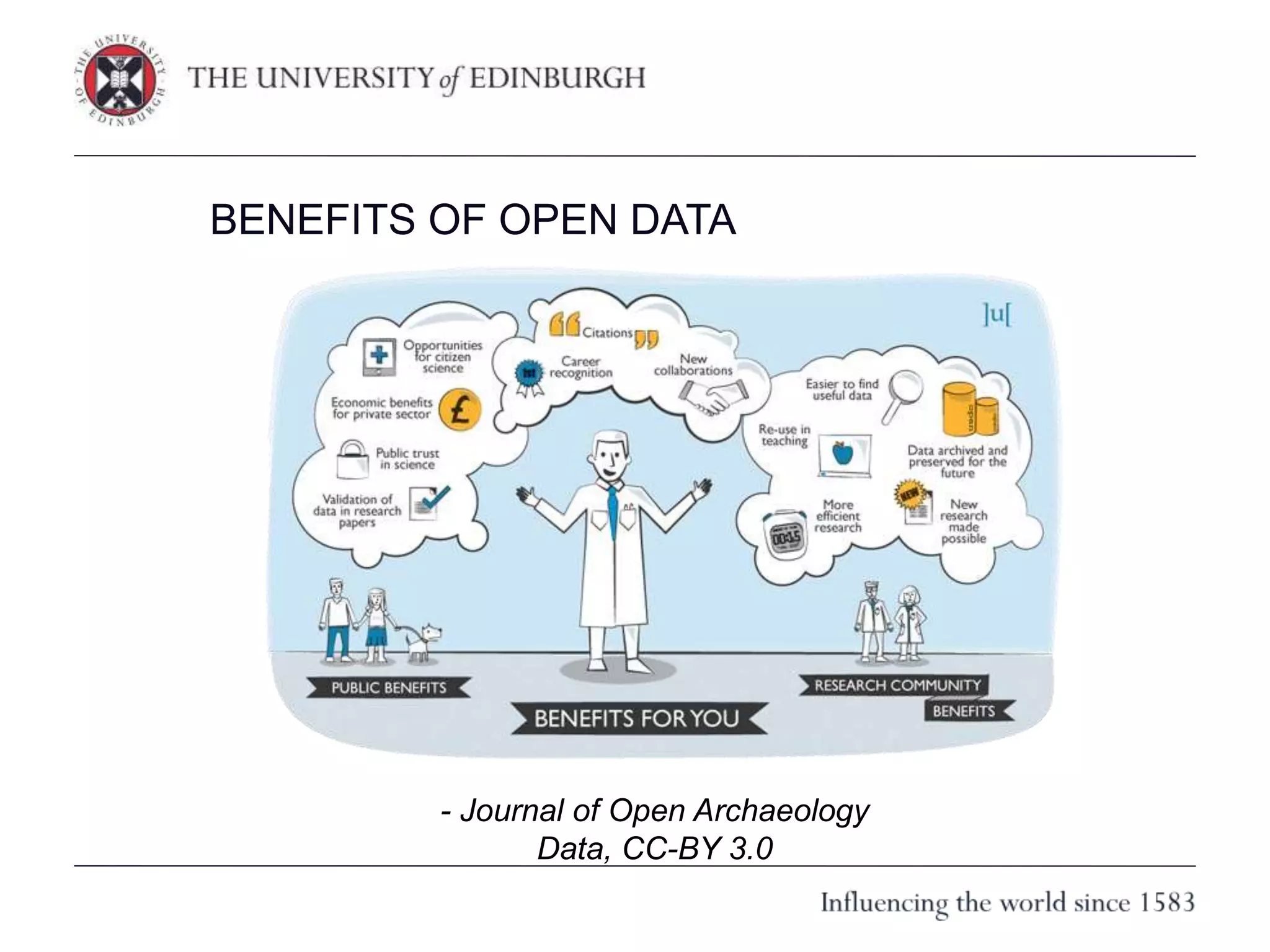
BENEFITS OF OPEN DATA
- Journal of Open Archaeology
Data, CC-BY 3.0
• Data that contain no personal or disclosive information, e.g.
anonymised.
• Open data are usually licensed under an open licence such as a
Creative Commons Licence (http://wiki.creativecommons.org) and
users do not need to register to access the data.
• Such data can be shared openly without any restrictions.
5
OPEN DATA
6
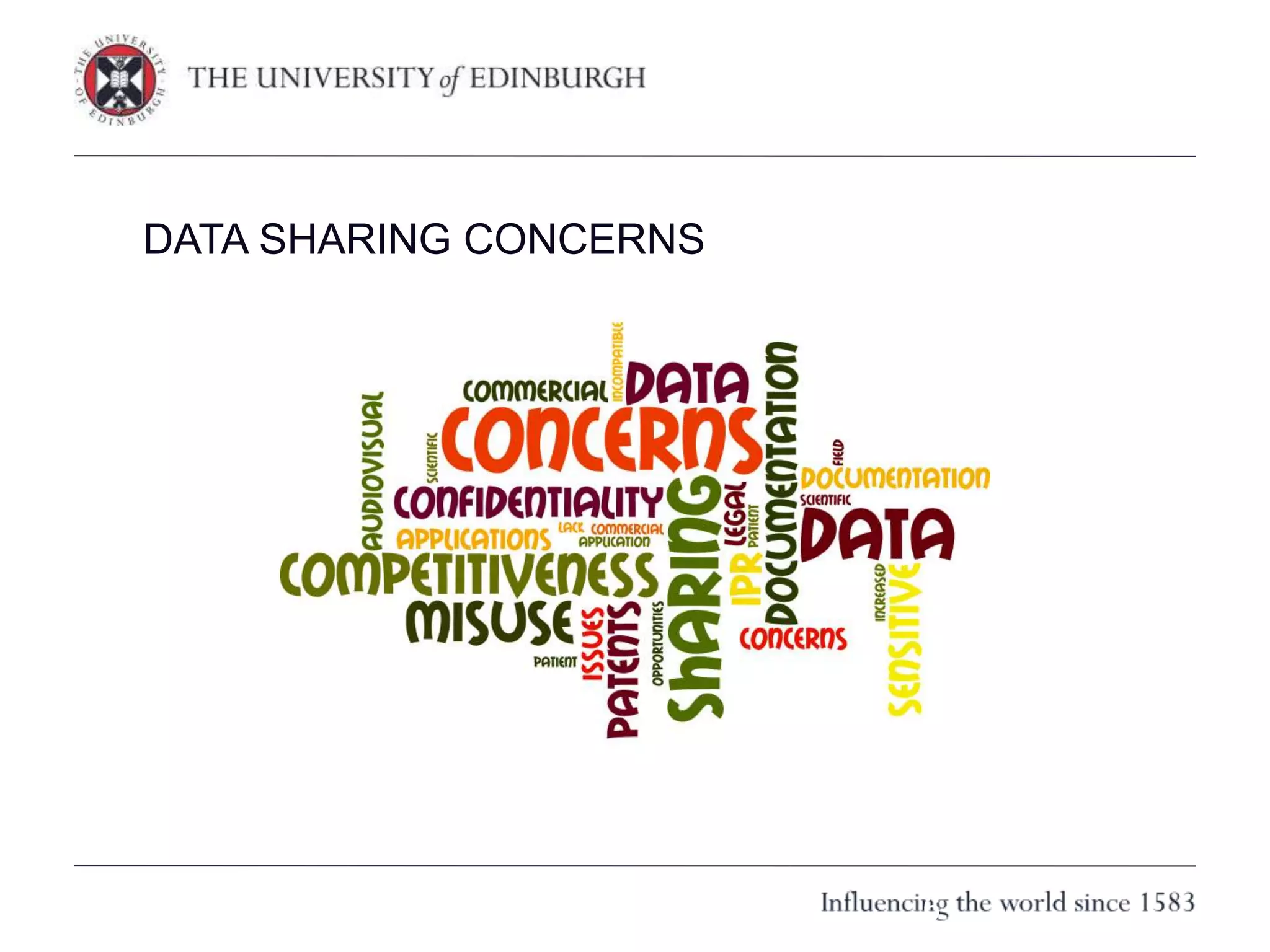
DATA SHARING CONCERNS
• Plan for sharing (via a Data Management Plan).
• Don’t collect personal information that’s not
needed.
• Principle of informed consent: get consent to
share data.
• Attribute, anonymize, or aggregate individual’s
data.
• Document all data processing (inside & outside
analysis package).
7
WHAT CAN A RESEARCHER DO TO BE ABLE TO
SHARE?
FAIR PARADIGM: OPEN BY DEFAULT
• FINDABLE: “Metadata and data should be easy to find for both
humans and computers. Machine-readable metadata are essential for
automatic discovery of datasets and services.”
• ACCESSIBLE: “Once the user finds the required data, she/he
needs to know how can they be accessed, possibly including
authentication and authorisation.”
• INTEROPERABLE: “The data usually need to be integrated
with other data. In addition, the data need to interoperate with
applications or workflows for analysis, storage, and processing.”
• REUSABLE: “The ultimate goal of FAIR is to optimise the reuse of
data. To achieve this, metadata and data should be well-described so
that they can be replicated and/or combined in different settings.”
UNIVERSITY’S RDM POLICY (MAY, 2011)
https://www.ed.ac.uk/is/
research-data-policy/
Policy by Nick Youngson CC BY-SA 3.0 Alpha Stock
Images
• Commitment to
research integrity,
DMPs, open data
• Articulates clear
responsibilities of the
researcher and of the
institution
9
UoE Research Data Service = Tools and support for
working across the data lifecycle
10
https://www.ed.ac.uk/is/research
-data-service
Tools and Support Description
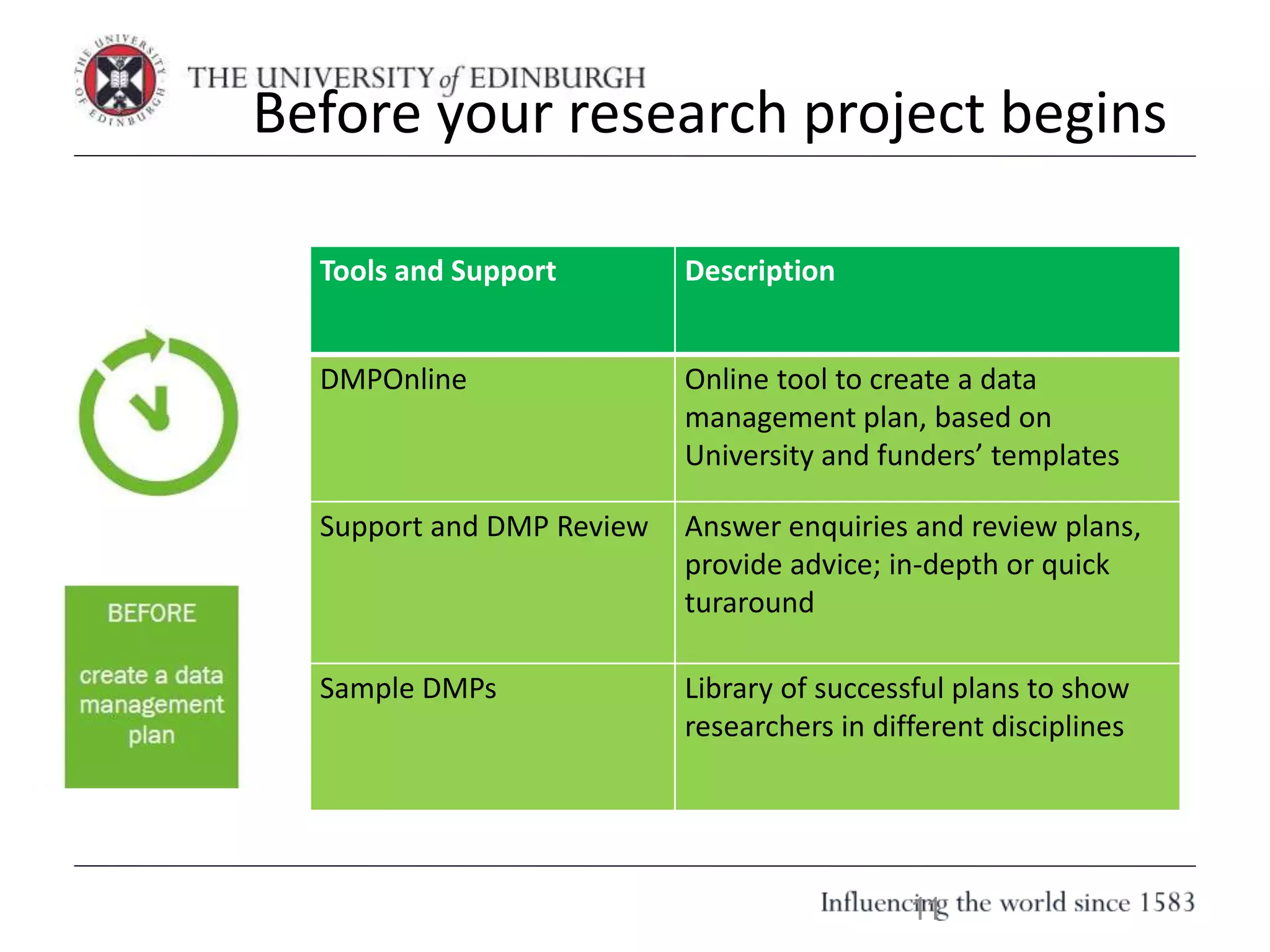
DMPOnline Online tool to create a data
management plan, based on
University and funders’ templates
Support and DMP Review Answer enquiries and review plans,
provide advice; in-depth or quick
turaround
Sample DMPs Library of successful plans to show
researchers in different disciplines
Before your research project begins
11
Tools and Support Description
Finding data ‘Finding data’ portal and data librarian
consultancy; help with accessing / purchase
of datasets or data subscriptions
Active data storage (DataStore) Central, backed up storage for all researchers
- individual and shared spaces
Sensitive data
(Data Safe Haven)
New, secure facility for working with sensitive
data on remote server. We are pursuing ISO
27001 security certification
Code versioning (Subversion,
Gitlab)
Private or public software code storage and
management. Documents all code and allows
rollback to prior versions
Collaboration and data sync’ing
(DataSync)
Open source tool to allow external partners
to access your research data
Electronic Lab Notebook
(RSpace)
Data management for laboratory based
research; interoperable with local systems
During your research project
12
Tools and Support Description
Open Access data repository
(DataShare)
Allows researchers to share
data publicly and preserve for
long-term
Long-term retention
(DataVault)
Deposit datasets for a specified
retention period (for example,
10 years), immutable copy
Data asset register through the
University CRIS (Pure for
datasets)
Record a description of your
dataset along with your
publications and research
projects
After your research project is finished
13
Tools and Support Description
General RDM support Answer enquiries by email, phone or
appointment; track through helpdesk system
Online training (MANTRA
and RDMS MOOC)
Learn online at your own pace or with a cohort
of peers through our open educational
resources
Scheduled and bespoke
training
Sign up for a scheduled workshop or request a
special training session for your research group
Research Data Service
website
All the tools and support in one place,
increasingly self-serve
Blog and promotional
materials
New developments on our Research Data Blog.
Service video and brochure
Dealing with Data annual
event & workshop series
Annual conference of researchers talking about
their data challenges and solutions
Research Data Workshop
series in various settings
Compact, catered networking events for
researchers to engage with the service & each
other about challenging topics
Training and support throughout your project
A MATURITY MODEL FOR RDM SERVICES
Cox, A. et al. “Developments in Research Data Management in Academic
Libraries: Towards an Understanding of Research Data Service Maturity”
Journal of the Association for Information, Science and Technology -
September 2017 p. 2191. DOI: 10.1002/asi
RDM ROADMAP (LIVING DOCUMENT)
Frank da Silva on Flickr CC BY-
NC-ND 2.0
Academic-led steering group
governs the service
1st, August 2012 –May 2015:
Rollout and consolidation
2nd, September 2015 – July
2016: Transition, programme to
service
3rd, August 2017-July 2020:
User journey, filling gaps
32 prioritised objectives
with actions and
deliverables
STAFF FUNDED BY DEDICATED RDM
ALLOCATION
• Senior staff: data librarian and two team leaders –
librarian or equivalent background, Masters and PhD
• 1 p/t Research Data Support Officer – trainer background
• 3 (2.5 FTE) Research Data Support Assistants (research
backgrounds, subject Masters and PhD)
• IT infrastructure manager and 2 IT systems engineers
• 1.5 software engineers
VALUED SKILLS AND PRIORITIES IN RDM
SERVICES (A. COX, ET AL)
Cox, A. et al. “Developments in Research Data Management in Academic Libraries:
Towards an Understanding of Research Data Service Maturity” JOURNAL OF THE
ASSOCIATION FOR INFORMATION SCIENCE AND TECHNOLOGY - September 2017
p. 2191. DOI: 10.1002/asi
• “Personal Attributes” - most highly rated category overall (70%
respondents ranked Very important +)
• “Library Skills” - lowest rated category (40%)
• Top 5 items: “Developing relationships with researchers,
faculty, etc.”; “Oral communication and presentation skills”;
“Teamwork and interpersonal skills”; “Written communication
skills”; and “One-on-one consultation or instruction.”
• Bottom 5 items: “PhD or doctoral degree”; “Professional
memberships”; “Cataloging”; “Graduate degree in a [subject
discipline]”; & “Collection dev’t.”
SOFT SKILLS HIGHLY RATED IN A STUDY OF
LIBRARIANS DOING DATA-RELATED WORK
Federer, Lisa. (2018). Defining data librarianship: A survey of competencies, skills, and training.
Journal of the Medical Library Association. 106. 10.5195/JMLA.2018.306.
THANKS AND SORRY ABOUT THE RAIN
What are your thoughts / questions?

Research Data Service at the University of Edinburgh

  • 1.
    RESEARCH DATA SERVICEAT THE UNIVERSITY OF EDINBURGH Robin Rice Data Librarian and Head of Research Data Support r.rice@ed.ac.uk @sparrowbarley (Twitter) www.ed.ac.uk/is/research-data- service http://datablog.is.ed.ac.uk
  • 2.
    OVERVIEW • Open Scienceand FAIR data as rationales for RDM • The University’s Research Data Management Policy • UoE (IS) Research Data Service: a lifecycle approach • Maturity models and strategies • The UoE RDM Roadmap • Skills and staffing • Your experiences / queries / comments
  • 4.
    BENEFITS OF OPENDATA - Journal of Open Archaeology Data, CC-BY 3.0
  • 5.
    • Data thatcontain no personal or disclosive information, e.g. anonymised. • Open data are usually licensed under an open licence such as a Creative Commons Licence (http://wiki.creativecommons.org) and users do not need to register to access the data. • Such data can be shared openly without any restrictions. 5 OPEN DATA
  • 6.
  • 7.
    • Plan forsharing (via a Data Management Plan). • Don’t collect personal information that’s not needed. • Principle of informed consent: get consent to share data. • Attribute, anonymize, or aggregate individual’s data. • Document all data processing (inside & outside analysis package). 7 WHAT CAN A RESEARCHER DO TO BE ABLE TO SHARE?
  • 8.
    FAIR PARADIGM: OPENBY DEFAULT • FINDABLE: “Metadata and data should be easy to find for both humans and computers. Machine-readable metadata are essential for automatic discovery of datasets and services.” • ACCESSIBLE: “Once the user finds the required data, she/he needs to know how can they be accessed, possibly including authentication and authorisation.” • INTEROPERABLE: “The data usually need to be integrated with other data. In addition, the data need to interoperate with applications or workflows for analysis, storage, and processing.” • REUSABLE: “The ultimate goal of FAIR is to optimise the reuse of data. To achieve this, metadata and data should be well-described so that they can be replicated and/or combined in different settings.”
  • 9.
    UNIVERSITY’S RDM POLICY(MAY, 2011) https://www.ed.ac.uk/is/ research-data-policy/ Policy by Nick Youngson CC BY-SA 3.0 Alpha Stock Images • Commitment to research integrity, DMPs, open data • Articulates clear responsibilities of the researcher and of the institution 9
  • 10.
    UoE Research DataService = Tools and support for working across the data lifecycle 10 https://www.ed.ac.uk/is/research -data-service
  • 11.
    Tools and SupportDescription DMPOnline Online tool to create a data management plan, based on University and funders’ templates Support and DMP Review Answer enquiries and review plans, provide advice; in-depth or quick turaround Sample DMPs Library of successful plans to show researchers in different disciplines Before your research project begins 11
  • 12.
    Tools and SupportDescription Finding data ‘Finding data’ portal and data librarian consultancy; help with accessing / purchase of datasets or data subscriptions Active data storage (DataStore) Central, backed up storage for all researchers - individual and shared spaces Sensitive data (Data Safe Haven) New, secure facility for working with sensitive data on remote server. We are pursuing ISO 27001 security certification Code versioning (Subversion, Gitlab) Private or public software code storage and management. Documents all code and allows rollback to prior versions Collaboration and data sync’ing (DataSync) Open source tool to allow external partners to access your research data Electronic Lab Notebook (RSpace) Data management for laboratory based research; interoperable with local systems During your research project 12
  • 13.
    Tools and SupportDescription Open Access data repository (DataShare) Allows researchers to share data publicly and preserve for long-term Long-term retention (DataVault) Deposit datasets for a specified retention period (for example, 10 years), immutable copy Data asset register through the University CRIS (Pure for datasets) Record a description of your dataset along with your publications and research projects After your research project is finished 13
  • 14.
    Tools and SupportDescription General RDM support Answer enquiries by email, phone or appointment; track through helpdesk system Online training (MANTRA and RDMS MOOC) Learn online at your own pace or with a cohort of peers through our open educational resources Scheduled and bespoke training Sign up for a scheduled workshop or request a special training session for your research group Research Data Service website All the tools and support in one place, increasingly self-serve Blog and promotional materials New developments on our Research Data Blog. Service video and brochure Dealing with Data annual event & workshop series Annual conference of researchers talking about their data challenges and solutions Research Data Workshop series in various settings Compact, catered networking events for researchers to engage with the service & each other about challenging topics Training and support throughout your project
  • 15.
    A MATURITY MODELFOR RDM SERVICES Cox, A. et al. “Developments in Research Data Management in Academic Libraries: Towards an Understanding of Research Data Service Maturity” Journal of the Association for Information, Science and Technology - September 2017 p. 2191. DOI: 10.1002/asi
  • 16.
    RDM ROADMAP (LIVINGDOCUMENT) Frank da Silva on Flickr CC BY- NC-ND 2.0 Academic-led steering group governs the service 1st, August 2012 –May 2015: Rollout and consolidation 2nd, September 2015 – July 2016: Transition, programme to service 3rd, August 2017-July 2020: User journey, filling gaps 32 prioritised objectives with actions and deliverables
  • 17.
    STAFF FUNDED BYDEDICATED RDM ALLOCATION • Senior staff: data librarian and two team leaders – librarian or equivalent background, Masters and PhD • 1 p/t Research Data Support Officer – trainer background • 3 (2.5 FTE) Research Data Support Assistants (research backgrounds, subject Masters and PhD) • IT infrastructure manager and 2 IT systems engineers • 1.5 software engineers
  • 18.
    VALUED SKILLS ANDPRIORITIES IN RDM SERVICES (A. COX, ET AL) Cox, A. et al. “Developments in Research Data Management in Academic Libraries: Towards an Understanding of Research Data Service Maturity” JOURNAL OF THE ASSOCIATION FOR INFORMATION SCIENCE AND TECHNOLOGY - September 2017 p. 2191. DOI: 10.1002/asi
  • 19.
    • “Personal Attributes”- most highly rated category overall (70% respondents ranked Very important +) • “Library Skills” - lowest rated category (40%) • Top 5 items: “Developing relationships with researchers, faculty, etc.”; “Oral communication and presentation skills”; “Teamwork and interpersonal skills”; “Written communication skills”; and “One-on-one consultation or instruction.” • Bottom 5 items: “PhD or doctoral degree”; “Professional memberships”; “Cataloging”; “Graduate degree in a [subject discipline]”; & “Collection dev’t.” SOFT SKILLS HIGHLY RATED IN A STUDY OF LIBRARIANS DOING DATA-RELATED WORK Federer, Lisa. (2018). Defining data librarianship: A survey of competencies, skills, and training. Journal of the Medical Library Association. 106. 10.5195/JMLA.2018.306.
  • 20.
    THANKS AND SORRYABOUT THE RAIN What are your thoughts / questions?

Editor's Notes

  • #9 “The principles refer to three types of entities: data (or any digital object), metadata (information about that digital object), and infrastructure. For instance, principle F4 defines that both metadata and data are registered or indexed in a searchable resource (the infrastructure component).” https://www.go-fair.org/fair-principles/
  • #17 1st, August 2012 –May 2015: Rollout and consolidation of primary services (active storage, open repository); minimally meeting funders’ requirements 2nd, September 2015 – July 2016: Transition from RDM programme to Research Data Service; training programme & DMP support 3rd, August 2017-July 2020: Filling known gaps through major development projects, increasing usage beyond early adopters, tuning the user journey