RDM PROGRAMME @ EDINBURGH 
- an institutional approach 
Stuart Macdonald 
RDM Service Coordinator 
University of Edinburgh 
stuart.macdonald@ed.ac.uk 
“Directions for Research Data Management in UK Universities” Workshop, University of Cambridge, 6 
November 2014
University of Edinburgh RDM Policy 
 University of Edinburgh is one of the 
first Universities in UK to adopt a 
policy for managing research data: 
http://www.ed.ac.uk/is/research-data- 
policy 
 The policy was approved by the 
University Court on 16 May 2011. 
 It’s acknowledged that this is an 
aspirational policy and that 
implementation will take some 
years.
Governance 
An RDM Policy Implementation Committee was set up by the 
VP of Knowledge Management charged with delivering 
services that will meet RDM policy objectives: 
• Membership from across Information Services 
• Iterate with researchers to ensure services meet the needs of researchers 
The VP also established a Steering Committee led by 
Prof. Peter Clarke with members of the Research Committee 
from the 3 colleges, IS, and the Research Office (ERI). 
Their role is to: 
• Provide oversight to the activity of the Implementation Committee 
• Ensure services meet researcher requirements without harming research 
competitiveness
Policy Implementation 
RDM Programme in 3 phases: 
• Phase 0: August 2012 – August 2013: Planning phase, with some 
pilot activity and early deliverables. 
• Phase 1: September 2013 – May 2014: Initial rollout of primary 
services. 
• Phase 2: June 2014 – May 2015: Continued rollout; maturation of 
services. 
Full details of the programme is available at: 
http://edin.ac/1eE3sav
RDM Services and Support 
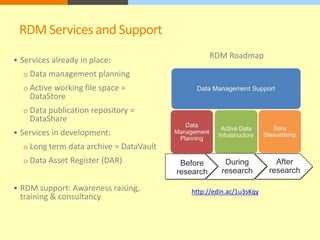
 Services already in place: 
o Data management planning 
o Active working file space = 
DataStore 
o Data publication repository = 
DataShare 
 Services in development: 
o Long term data archive = DataVault 
o Data Asset Register (DAR) 
 RDM support: Awareness raising, 
training & consultancy 
RDM Roadmap 
Before 
research 
During 
research 
http://edin.ac/1u3sKqy 
After 
research
Research Data Management Planning 
Performed at the conceptual stage before research data are 
created (what, where, who, how) 
Customised instance of DCC’s DMPonline toolkit for University of 
Edinburgh use: 
• Funders DMP templates 
• Local (non-funder) DMP template 
• Institutional guidance (storage, services, support) 
• Piloting customised guidance (for funders and schools) end of Jan. 2015 
Tailored DMP assistance for researchers submitting research 
proposals (F-2-F)
DMP Support 
• Academic Support Librarians have received RDM training, including 
training on writing Data Management Plans. 
• Research Administrators staff have received training to provide support 
at the grant application stage across the 3 Colleges. 
• ERI staff will be receiving RDM training. 
• Tailored DMP courses for research staff and PGRs are being delivered. 
• MANTRA also has a module on DMP for self-paced learning. 
• General DMP queries can be sent to the IS Helpline who will direct them 
as appropriate.
DataStore 
 Facility to store data that are actively used in current research activities 
 Provision: 1.6PB storage initially 
 0.5 TB (500GB) per researchers, PGR upwards 
 Up to 0.25TB of each allocation can be used for “shared” group storage 
 Cost of extra storage: £200 per TB per year= 1TB primary storage, 10 days online file history, 
60 days backup, DR copy 
 Infrastructure in place. Allocation of space devolved to IT departments of respective 
Schools overseen by Heads of IT from each College. 
DataShare 
 Edinburgh DataShare is the University’s open access multi-disciplinary data repository: 
http://datashare.is.ed.ac.uk 
 It assists researchers disseminate their research, get credit for their data collection efforts, 
and preserve their data for the long-term. 
 It can help researchers comply with funder requirements to preserve and share your data 
and complies with Edinburgh’s RDM Policy
Data Vault 
 Safe, private, store of data that is only accessible by the data creator or their 
representative 
 Secure storage: File security; Storage security; Additional security: encryption 
 Long term assurance 
 Automatic versioning 
Data Asset Register (DAR) 
 A catalogue of data assets produced by University of Edinburgh researchers 
 A key component of the University of Edinburgh RDM systems 
 Will give researchers a single place to record the existence of the data assets they 
produce for discovery, access, and re-use as appropriate. 
 Paper proposing the adoption of PURE as the University’s DAR provisionally accepted 
the RDM Steering Committee (Oct. 2014)
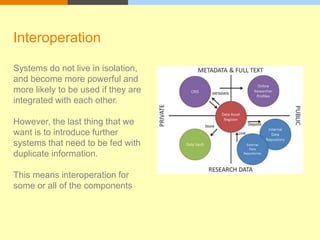
Interoperation 
Systems do not live in isolation, 
and become more powerful and 
more likely to be used if they are 
integrated with each other. 
However, the last thing that we 
want is to introduce further 
systems that need to be fed with 
duplicate information. 
This means interoperation for 
some or all of the components
RDM Support 
Making the most of local support! 
• RDM team will work with the Research Administrators in each School. 
• Academic Support Librarians (who represent each of the 22 Schools). 
• IT staff in each School. 
• ERI staff. They will be receiving RDM training. 
• Each School’s Ethics Committee 
• Bespoke RDM email address or queries can be sent to the Helpline who 
will direct them as appropriate.
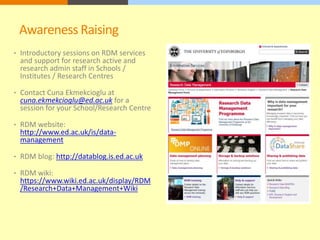
Awareness Raising 
• Introductory sessions on RDM services 
and support for research active and 
research admin staff in Schools / 
Institutes / Research Centres 
• Contact Cuna Ekmekcioglu at 
cuna.ekmekcioglu@ed.ac.uk for a 
session for your School/Research Centre 
• RDM website: 
http://www.ed.ac.uk/is/data-management 
• RDM blog: http://datablog.is.ed.ac.uk 
• RDM wiki: 
https://www.wiki.ed.ac.uk/display/RDM 
/Research+Data+Management+Wiki
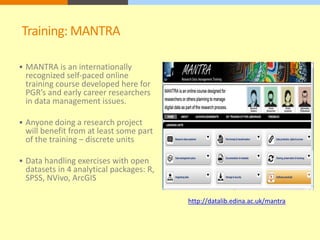
Training: MANTRA 
 MANTRA is an internationally 
recognized self-paced online 
training course developed here for 
PGR’s and early career researchers 
in data management issues. 
 Anyone doing a research project 
will benefit from at least some part 
of the training – discrete units 
 Data handling exercises with open 
datasets in 4 analytical packages: R, 
SPSS, NVivo, ArcGIS 
http://datalib.edina.ac.uk/mantra
Training: Tailored Courses 
 A range of training programmes on 
research data management (RDM) 
in the form of workshops, power 
sessions, seminars and drop in 
sessions to help researchers with 
research data management issues 
 http://www.ed.ac.uk/schools-departments/ 
information-services/research-support/ 
data-management/rdm-training 
 Creating a data management plan for 
your grant application 
 Research Data Management 
Programme at the University of 
Edinburgh 
 Good practice in Research Data 
Management 
 Handling data using SPSS 
 Handling data with ArcGIS 
http://edin.ac/1kRMPv3 

RDM Programme resourcing & staffing 
RDM Programme: 
Funded internally (c. £1.2 Million) 
75% - infrastructure / storage 
25% - staffing (recurrent for 3 years) 
MANTRA and DataShare – originally Jisc project funding 
2014 DCC RDM Survey* - 90% of institutions used internal 
funding for new appointments in RDM, for training for 
infrastructure 
* Digital Curation Centre's 2014 RDM Strategy to Action Survey: 
https://zenodo.org/collection/user-dcc-rdm-2014
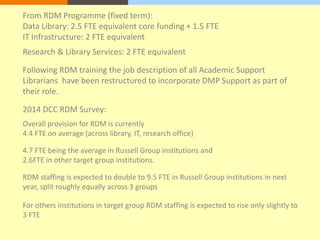
From RDM Programme (fixed term): 
Data Library: 2.5 FTE equivalent core funding + 1.5 FTE 
IT Infrastructure: 2 FTE equivalent 
Research & Library Services: 2 FTE equivalent 
Following RDM training the job description of all Academic Support 
Librarians have been restructured to incorporate DMP Support as part of 
their role. 
2014 DCC RDM Survey: 
Overall provision for RDM is currently 
4.4 FTE on average (across library, IT, research office) 
4.7 FTE being the average in Russell Group institutions and 
2.6FTE in other target group institutions. 
RDM staffing is expected to double to 9.5 FTE in Russell Group institutions in next 
year, split roughly equally across 3 groups 
For others institutions in target group RDM staffing is expected to rise only slightly to 
3 FTE
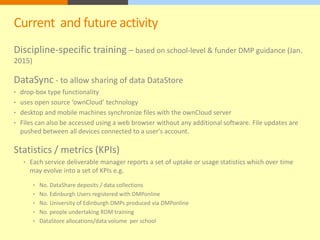
Current and future activity 
Discipline-specific training – based on school-level & funder DMP guidance (Jan. 
2015) 
DataSync - to allow sharing of data DataStore 
• drop-box type functionality 
• uses open source ‘ownCloud’ technology 
• desktop and mobile machines synchronize files with the ownCloud server 
• Files can also be accessed using a web browser without any additional software. File updates are 
pushed between all devices connected to a user's account. 
Statistics / metrics (KPIs) 
• Each service deliverable manager reports a set of uptake or usage statistics which over time 
may evolve into a set of KPIs e.g. 
• No. DataShare deposits / data collections 
• No. Edinburgh Users registered with DMPonline 
• No. University of Edinburgh DMPs produced via DMPonline 
• No. people undertaking RDM training 
• DataStore allocations/data volume per school
Service interoperations: 
DataShare (also DataStore & Data Vault) with Research Space 
Electronic Lab Notebooks 
DSpace GITHUB plugin* - allows software to be archived from GitHub (or 
similar) source code repository into DataShare, which can then be assigned a DOI to 
facilitate citation - using the SWORD deposit protocol 
Policies: 
DatStore De-allocation policy detailing responsibilities and 
storage costs for ‘orphaned data’ - pending approval by Steering 
Committee 
* http://blog.stuartlewis.com/2014/09/09/github-to-repository-deposit/
THANK YOU! 
Acknowledgements: 
Dr. Cuna Ekmekcioglu (Research & Learning Services) 
Sarah Jones (Digital Curation Centre) 
Stuart Lewis (Research & Learning Services) 
Kerry Miller (Research & Learning Services) 
Robin Rice (EDINA & Data Library) 
Dr. Orlando Richards (IT Infrastructure) 
Dr. John Scally (Library and Collections) 
Tony Weir (IT Infrastructure)

RDM Programme @ Edinburgh

  • 1.
    RDM PROGRAMME @EDINBURGH - an institutional approach Stuart Macdonald RDM Service Coordinator University of Edinburgh stuart.macdonald@ed.ac.uk “Directions for Research Data Management in UK Universities” Workshop, University of Cambridge, 6 November 2014
  • 2.
    University of EdinburghRDM Policy  University of Edinburgh is one of the first Universities in UK to adopt a policy for managing research data: http://www.ed.ac.uk/is/research-data- policy  The policy was approved by the University Court on 16 May 2011.  It’s acknowledged that this is an aspirational policy and that implementation will take some years.
  • 3.
    Governance An RDMPolicy Implementation Committee was set up by the VP of Knowledge Management charged with delivering services that will meet RDM policy objectives: • Membership from across Information Services • Iterate with researchers to ensure services meet the needs of researchers The VP also established a Steering Committee led by Prof. Peter Clarke with members of the Research Committee from the 3 colleges, IS, and the Research Office (ERI). Their role is to: • Provide oversight to the activity of the Implementation Committee • Ensure services meet researcher requirements without harming research competitiveness
  • 4.
    Policy Implementation RDMProgramme in 3 phases: • Phase 0: August 2012 – August 2013: Planning phase, with some pilot activity and early deliverables. • Phase 1: September 2013 – May 2014: Initial rollout of primary services. • Phase 2: June 2014 – May 2015: Continued rollout; maturation of services. Full details of the programme is available at: http://edin.ac/1eE3sav
  • 5.
    RDM Services andSupport  Services already in place: o Data management planning o Active working file space = DataStore o Data publication repository = DataShare  Services in development: o Long term data archive = DataVault o Data Asset Register (DAR)  RDM support: Awareness raising, training & consultancy RDM Roadmap Before research During research http://edin.ac/1u3sKqy After research
  • 6.
    Research Data ManagementPlanning Performed at the conceptual stage before research data are created (what, where, who, how) Customised instance of DCC’s DMPonline toolkit for University of Edinburgh use: • Funders DMP templates • Local (non-funder) DMP template • Institutional guidance (storage, services, support) • Piloting customised guidance (for funders and schools) end of Jan. 2015 Tailored DMP assistance for researchers submitting research proposals (F-2-F)
  • 7.
    DMP Support •Academic Support Librarians have received RDM training, including training on writing Data Management Plans. • Research Administrators staff have received training to provide support at the grant application stage across the 3 Colleges. • ERI staff will be receiving RDM training. • Tailored DMP courses for research staff and PGRs are being delivered. • MANTRA also has a module on DMP for self-paced learning. • General DMP queries can be sent to the IS Helpline who will direct them as appropriate.
  • 8.
    DataStore  Facilityto store data that are actively used in current research activities  Provision: 1.6PB storage initially  0.5 TB (500GB) per researchers, PGR upwards  Up to 0.25TB of each allocation can be used for “shared” group storage  Cost of extra storage: £200 per TB per year= 1TB primary storage, 10 days online file history, 60 days backup, DR copy  Infrastructure in place. Allocation of space devolved to IT departments of respective Schools overseen by Heads of IT from each College. DataShare  Edinburgh DataShare is the University’s open access multi-disciplinary data repository: http://datashare.is.ed.ac.uk  It assists researchers disseminate their research, get credit for their data collection efforts, and preserve their data for the long-term.  It can help researchers comply with funder requirements to preserve and share your data and complies with Edinburgh’s RDM Policy
  • 9.
    Data Vault Safe, private, store of data that is only accessible by the data creator or their representative  Secure storage: File security; Storage security; Additional security: encryption  Long term assurance  Automatic versioning Data Asset Register (DAR)  A catalogue of data assets produced by University of Edinburgh researchers  A key component of the University of Edinburgh RDM systems  Will give researchers a single place to record the existence of the data assets they produce for discovery, access, and re-use as appropriate.  Paper proposing the adoption of PURE as the University’s DAR provisionally accepted the RDM Steering Committee (Oct. 2014)
  • 10.
    Interoperation Systems donot live in isolation, and become more powerful and more likely to be used if they are integrated with each other. However, the last thing that we want is to introduce further systems that need to be fed with duplicate information. This means interoperation for some or all of the components
  • 11.
    RDM Support Makingthe most of local support! • RDM team will work with the Research Administrators in each School. • Academic Support Librarians (who represent each of the 22 Schools). • IT staff in each School. • ERI staff. They will be receiving RDM training. • Each School’s Ethics Committee • Bespoke RDM email address or queries can be sent to the Helpline who will direct them as appropriate.
  • 12.
    Awareness Raising •Introductory sessions on RDM services and support for research active and research admin staff in Schools / Institutes / Research Centres • Contact Cuna Ekmekcioglu at cuna.ekmekcioglu@ed.ac.uk for a session for your School/Research Centre • RDM website: http://www.ed.ac.uk/is/data-management • RDM blog: http://datablog.is.ed.ac.uk • RDM wiki: https://www.wiki.ed.ac.uk/display/RDM /Research+Data+Management+Wiki
  • 13.
    Training: MANTRA MANTRA is an internationally recognized self-paced online training course developed here for PGR’s and early career researchers in data management issues.  Anyone doing a research project will benefit from at least some part of the training – discrete units  Data handling exercises with open datasets in 4 analytical packages: R, SPSS, NVivo, ArcGIS http://datalib.edina.ac.uk/mantra
  • 14.
    Training: Tailored Courses  A range of training programmes on research data management (RDM) in the form of workshops, power sessions, seminars and drop in sessions to help researchers with research data management issues  http://www.ed.ac.uk/schools-departments/ information-services/research-support/ data-management/rdm-training  Creating a data management plan for your grant application  Research Data Management Programme at the University of Edinburgh  Good practice in Research Data Management  Handling data using SPSS  Handling data with ArcGIS http://edin.ac/1kRMPv3 
  • 15.
    RDM Programme resourcing& staffing RDM Programme: Funded internally (c. £1.2 Million) 75% - infrastructure / storage 25% - staffing (recurrent for 3 years) MANTRA and DataShare – originally Jisc project funding 2014 DCC RDM Survey* - 90% of institutions used internal funding for new appointments in RDM, for training for infrastructure * Digital Curation Centre's 2014 RDM Strategy to Action Survey: https://zenodo.org/collection/user-dcc-rdm-2014
  • 16.
    From RDM Programme(fixed term): Data Library: 2.5 FTE equivalent core funding + 1.5 FTE IT Infrastructure: 2 FTE equivalent Research & Library Services: 2 FTE equivalent Following RDM training the job description of all Academic Support Librarians have been restructured to incorporate DMP Support as part of their role. 2014 DCC RDM Survey: Overall provision for RDM is currently 4.4 FTE on average (across library, IT, research office) 4.7 FTE being the average in Russell Group institutions and 2.6FTE in other target group institutions. RDM staffing is expected to double to 9.5 FTE in Russell Group institutions in next year, split roughly equally across 3 groups For others institutions in target group RDM staffing is expected to rise only slightly to 3 FTE
  • 17.
    Current and futureactivity Discipline-specific training – based on school-level & funder DMP guidance (Jan. 2015) DataSync - to allow sharing of data DataStore • drop-box type functionality • uses open source ‘ownCloud’ technology • desktop and mobile machines synchronize files with the ownCloud server • Files can also be accessed using a web browser without any additional software. File updates are pushed between all devices connected to a user's account. Statistics / metrics (KPIs) • Each service deliverable manager reports a set of uptake or usage statistics which over time may evolve into a set of KPIs e.g. • No. DataShare deposits / data collections • No. Edinburgh Users registered with DMPonline • No. University of Edinburgh DMPs produced via DMPonline • No. people undertaking RDM training • DataStore allocations/data volume per school
  • 18.
    Service interoperations: DataShare(also DataStore & Data Vault) with Research Space Electronic Lab Notebooks DSpace GITHUB plugin* - allows software to be archived from GitHub (or similar) source code repository into DataShare, which can then be assigned a DOI to facilitate citation - using the SWORD deposit protocol Policies: DatStore De-allocation policy detailing responsibilities and storage costs for ‘orphaned data’ - pending approval by Steering Committee * http://blog.stuartlewis.com/2014/09/09/github-to-repository-deposit/
  • 19.
    THANK YOU! Acknowledgements: Dr. Cuna Ekmekcioglu (Research & Learning Services) Sarah Jones (Digital Curation Centre) Stuart Lewis (Research & Learning Services) Kerry Miller (Research & Learning Services) Robin Rice (EDINA & Data Library) Dr. Orlando Richards (IT Infrastructure) Dr. John Scally (Library and Collections) Tony Weir (IT Infrastructure)

Editor's Notes

  • #4 Funders have policies, responsibilities fall to the university as well as the researcher Researchers are mobile Institution and researcher must work together, define the responsibilities Awareness raising within university of practicalties
  • #7 What data will be collected or created? How the data will be documented and described? Where the data will be stored? Who will be responsible for data security and backup? Which data will be shared and/or preserved? How the data will be shared and with whom?