Creating a Data Management 
Plan for your Research 
EPFL Workshop 
Lausaunne, 28 Oct 2014 
Robin Rice, Laine Ruus 
EDINA and Data Library
Course content 
• What is a Data Management Plan? 
• Benefits and drivers 
• What do Funders want? 
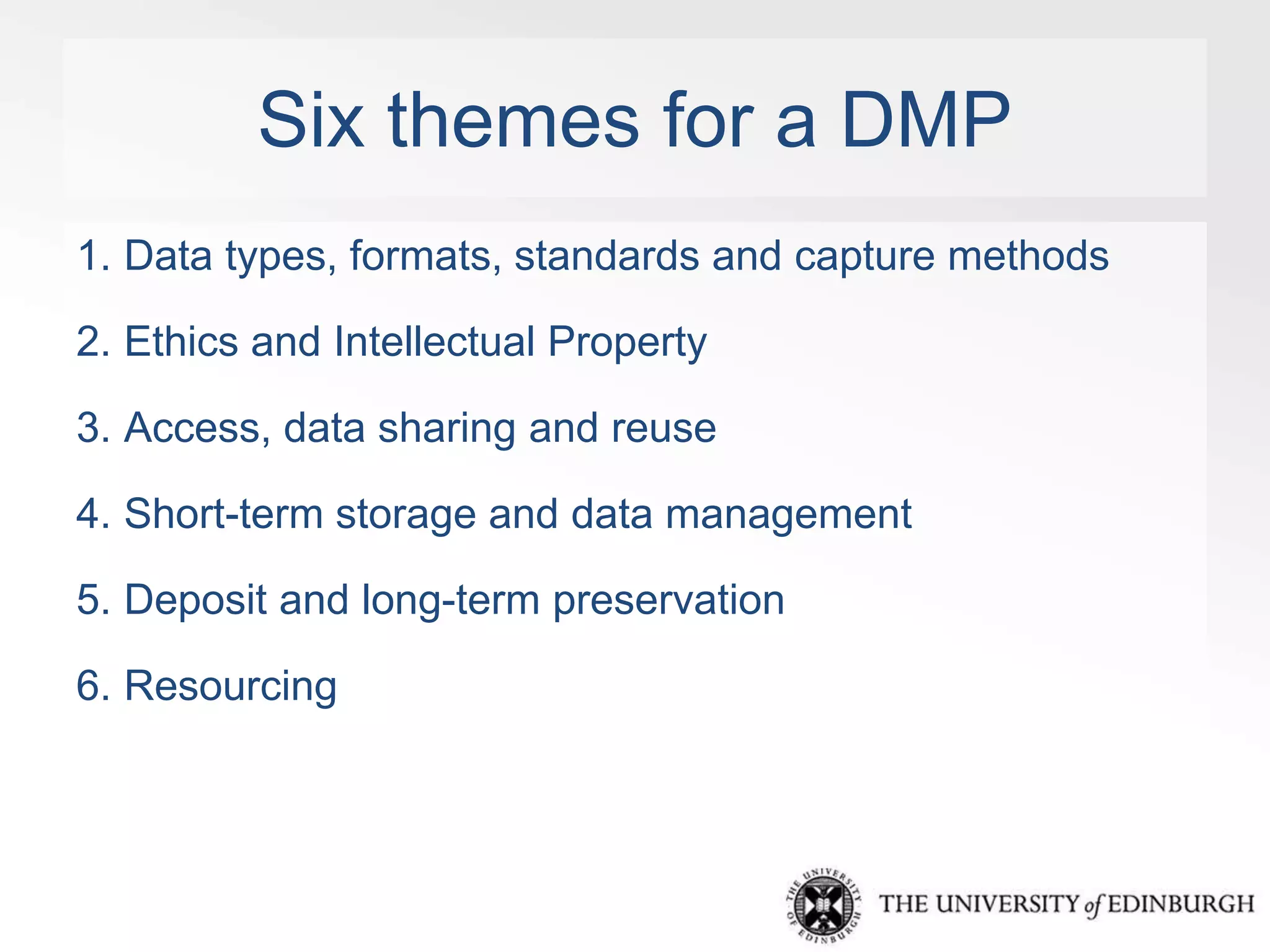
• Six themes for a DMP 
Exercise: Peer Review a DMP 
• Support for Data Management Planning 
• Top Tips for creating a DMP
What is a DMP? 
DMPs are written at the start of a project to define: 
• What data will be collected or created? 
• How the data will be documented and described? 
• Where the data will be stored? 
• Who will be responsible for data security and backup? 
• Which data will be shared and/or preserved? 
• How the data will be shared and with whom?
Benefits 
Developing DMPs can help you to: 
• Make informed decisions to anticipate & avoid problems. 
• Avoid duplication, data loss and security breaches. 
• Develop procedures early on for consistency. 
• Ensure data are accurate, complete, reliable and secure. 
• Save time and effort to make your lives easier. 
• Plan to share data early on and increase impact.
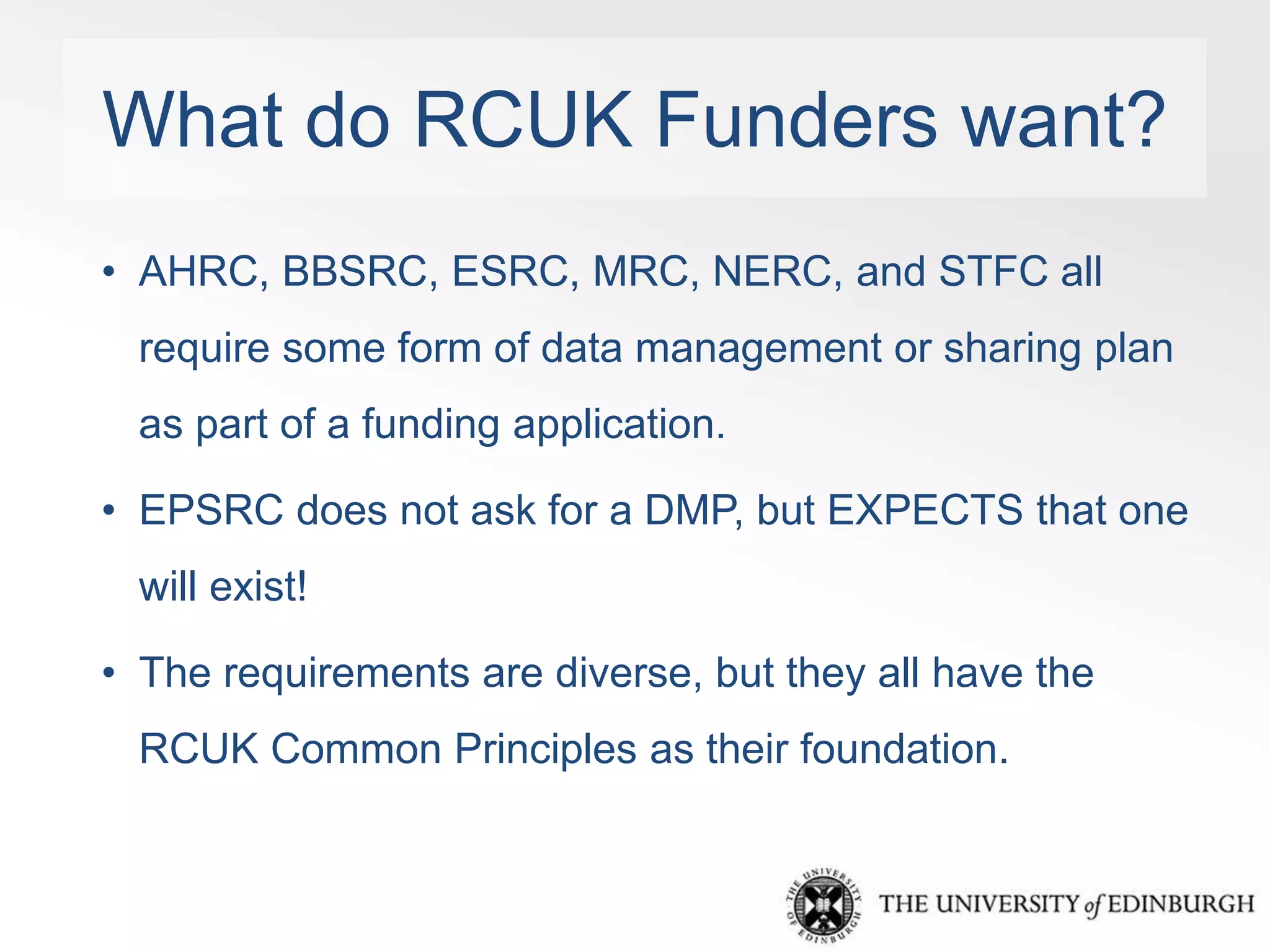
What do RCUK Funders want? 
• AHRC, BBSRC, ESRC, MRC, NERC, and STFC all 
require some form of data management or sharing plan 
as part of a funding application. 
• EPSRC does not ask for a DMP, but EXPECTS that one 
will exist! 
• The requirements are diverse, but they all have the 
RCUK Common Principles as their foundation.
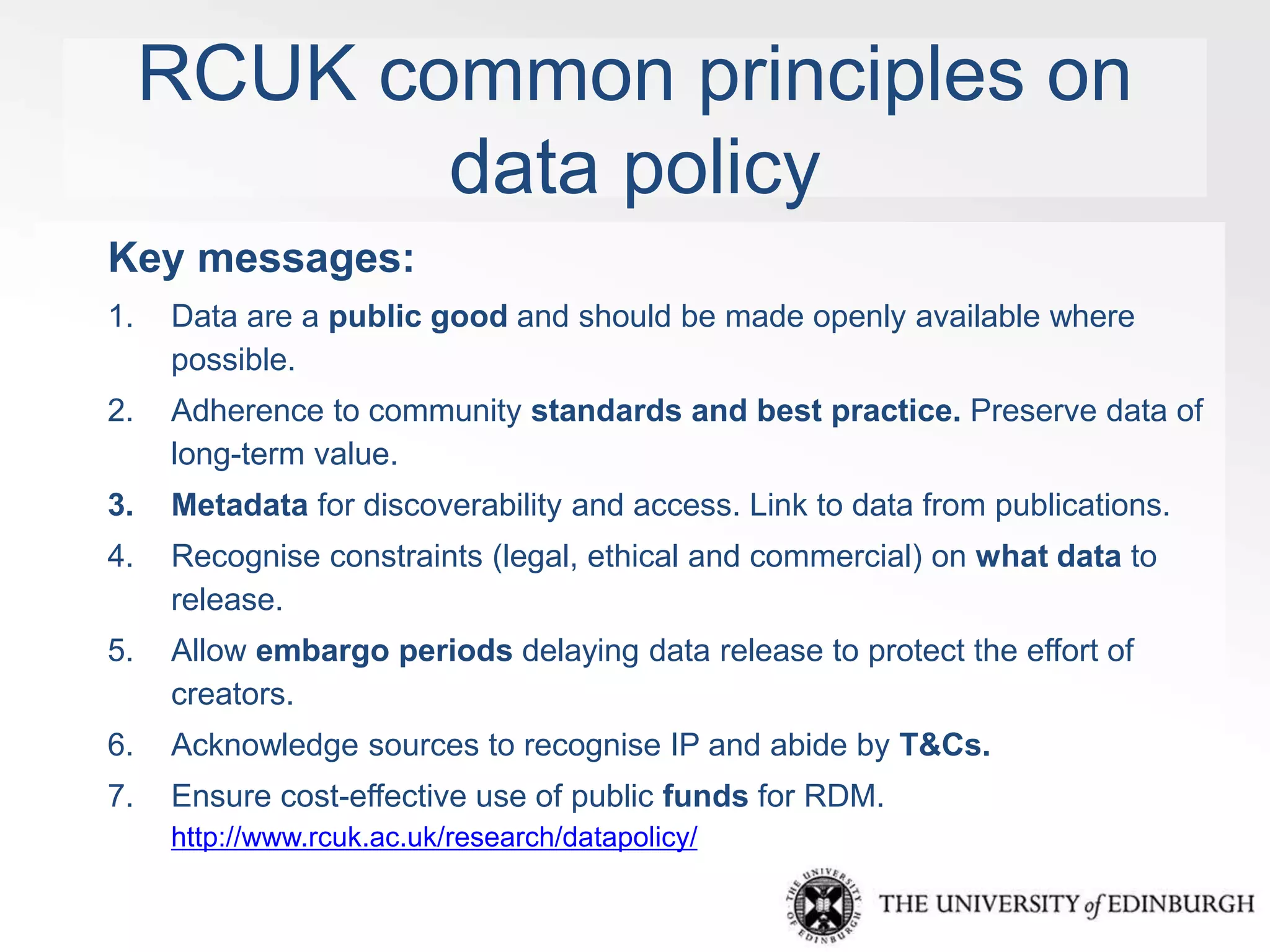
RCUK common principles on 
data policy 
Key messages: 
1. Data are a public good and should be made openly available where 
possible. 
2. Adherence to community standards and best practice. Preserve data of 
long-term value. 
3. Metadata for discoverability and access. Link to data from publications. 
4. Recognise constraints (legal, ethical and commercial) on what data to 
release. 
5. Allow embargo periods delaying data release to protect the effort of 
creators. 
6. Acknowledge sources to recognise IP and abide by T&Cs. 
7. Ensure cost-effective use of public funds for RDM. 
http://www.rcuk.ac.uk/research/datapolicy/
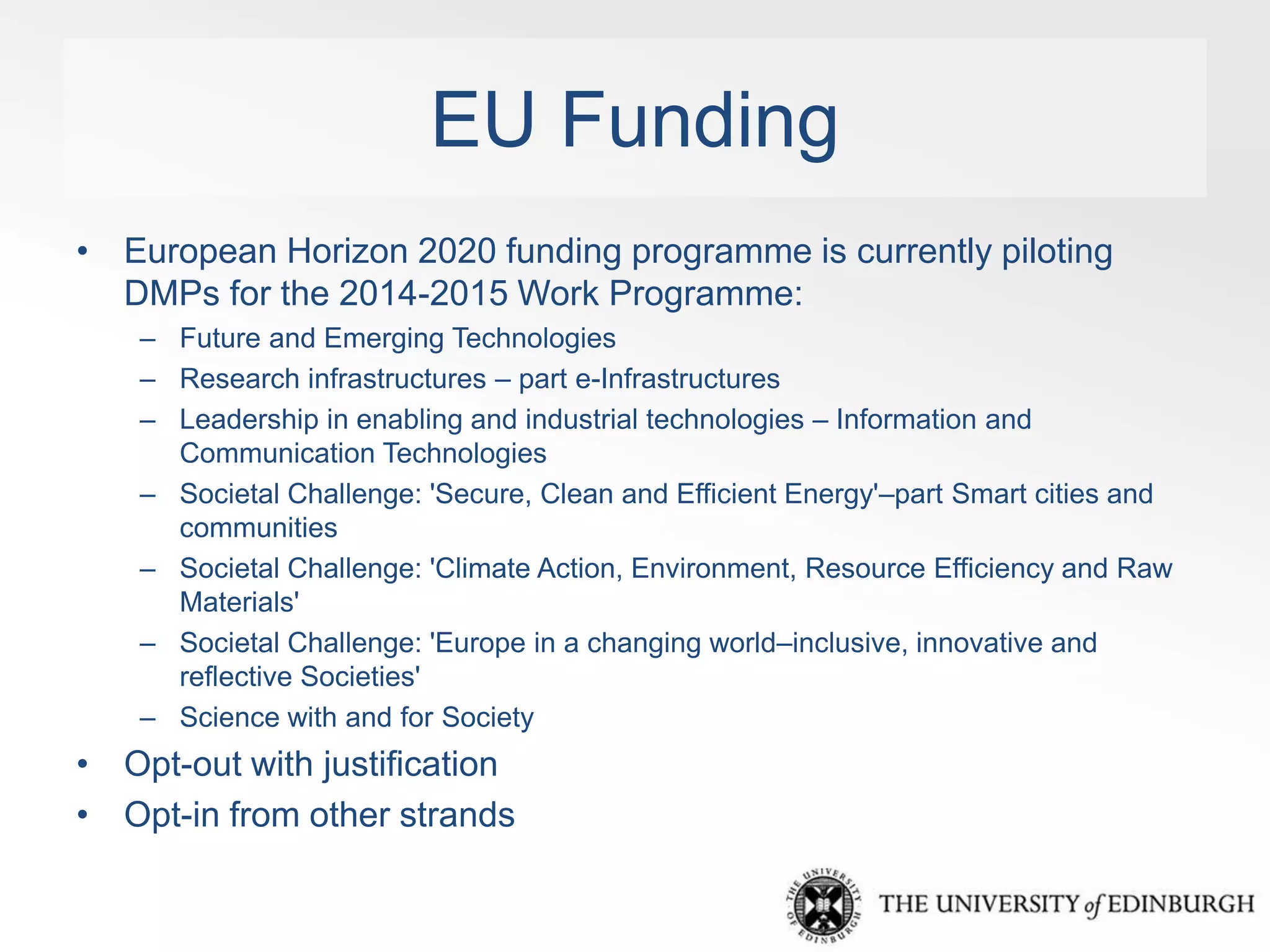
EU Funding 
• European Horizon 2020 funding programme is currently piloting 
DMPs for the 2014-2015 Work Programme: 
– Future and Emerging Technologies 
– Research infrastructures – part e-Infrastructures 
– Leadership in enabling and industrial technologies – Information and 
Communication Technologies 
– Societal Challenge: 'Secure, Clean and Efficient Energy'–part Smart cities and 
communities 
– Societal Challenge: 'Climate Action, Environment, Resource Efficiency and Raw 
Materials' 
– Societal Challenge: 'Europe in a changing world–inclusive, innovative and 
reflective Societies' 
– Science with and for Society 
• Opt-out with justification 
• Opt-in from other strands
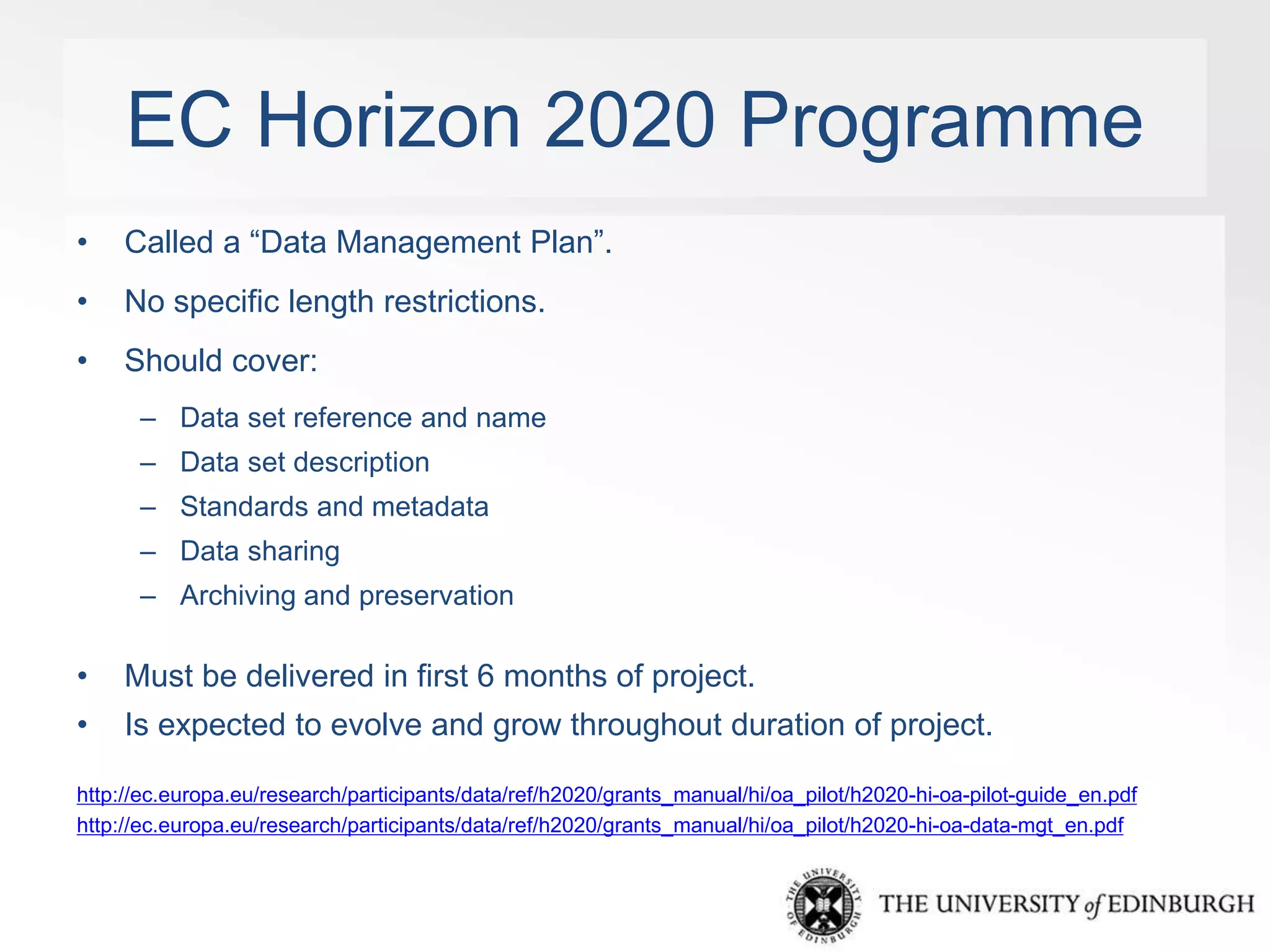
EC Horizon 2020 Programme 
• Called a “Data Management Plan”. 
• No specific length restrictions. 
• Should cover: 
– Data set reference and name 
– Data set description 
– Standards and metadata 
– Data sharing 
– Archiving and preservation 
• Must be delivered in first 6 months of project. 
• Is expected to evolve and grow throughout duration of project. 
http://ec.europa.eu/research/participants/data/ref/h2020/grants_manual/hi/oa_pilot/h2020-hi-oa-pilot-guide_en.pdf 
http://ec.europa.eu/research/participants/data/ref/h2020/grants_manual/hi/oa_pilot/h2020-hi-oa-data-mgt_en.pdf
Six themes for a DMP 
1. Data types, formats, standards and capture methods 
2. Ethics and Intellectual Property 
3. Access, data sharing and reuse 
4. Short-term storage and data management 
5. Deposit and long-term preservation 
6. Resourcing
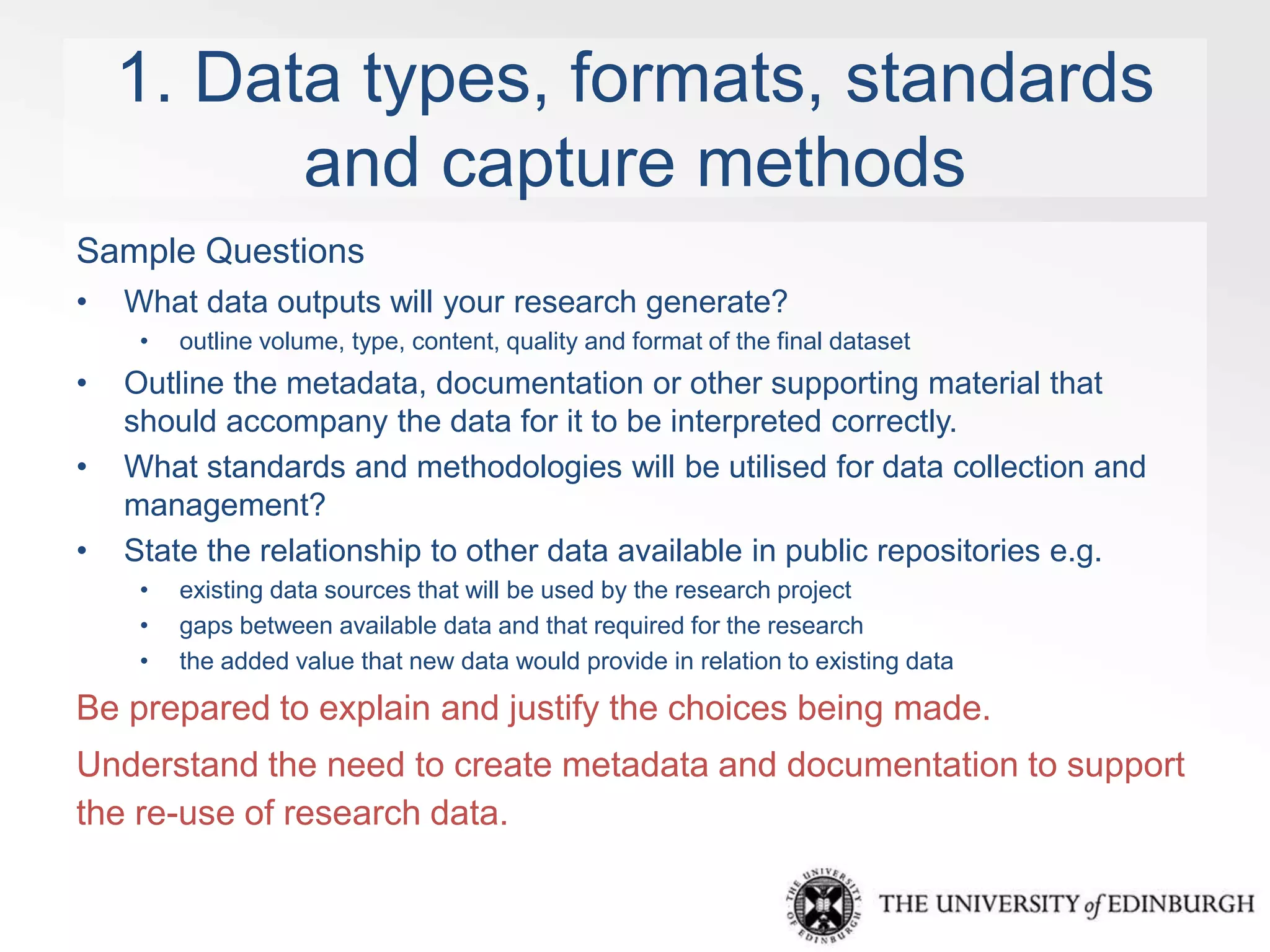
1. Data types, formats, standards 
and capture methods 
Sample Questions 
• What data outputs will your research generate? 
• outline volume, type, content, quality and format of the final dataset 
• Outline the metadata, documentation or other supporting material that 
should accompany the data for it to be interpreted correctly. 
• What standards and methodologies will be utilised for data collection and 
management? 
• State the relationship to other data available in public repositories e.g. 
• existing data sources that will be used by the research project 
• gaps between available data and that required for the research 
• the added value that new data would provide in relation to existing data 
Be prepared to explain and justify the choices being made. 
Understand the need to create metadata and documentation to support 
the re-use of research data.
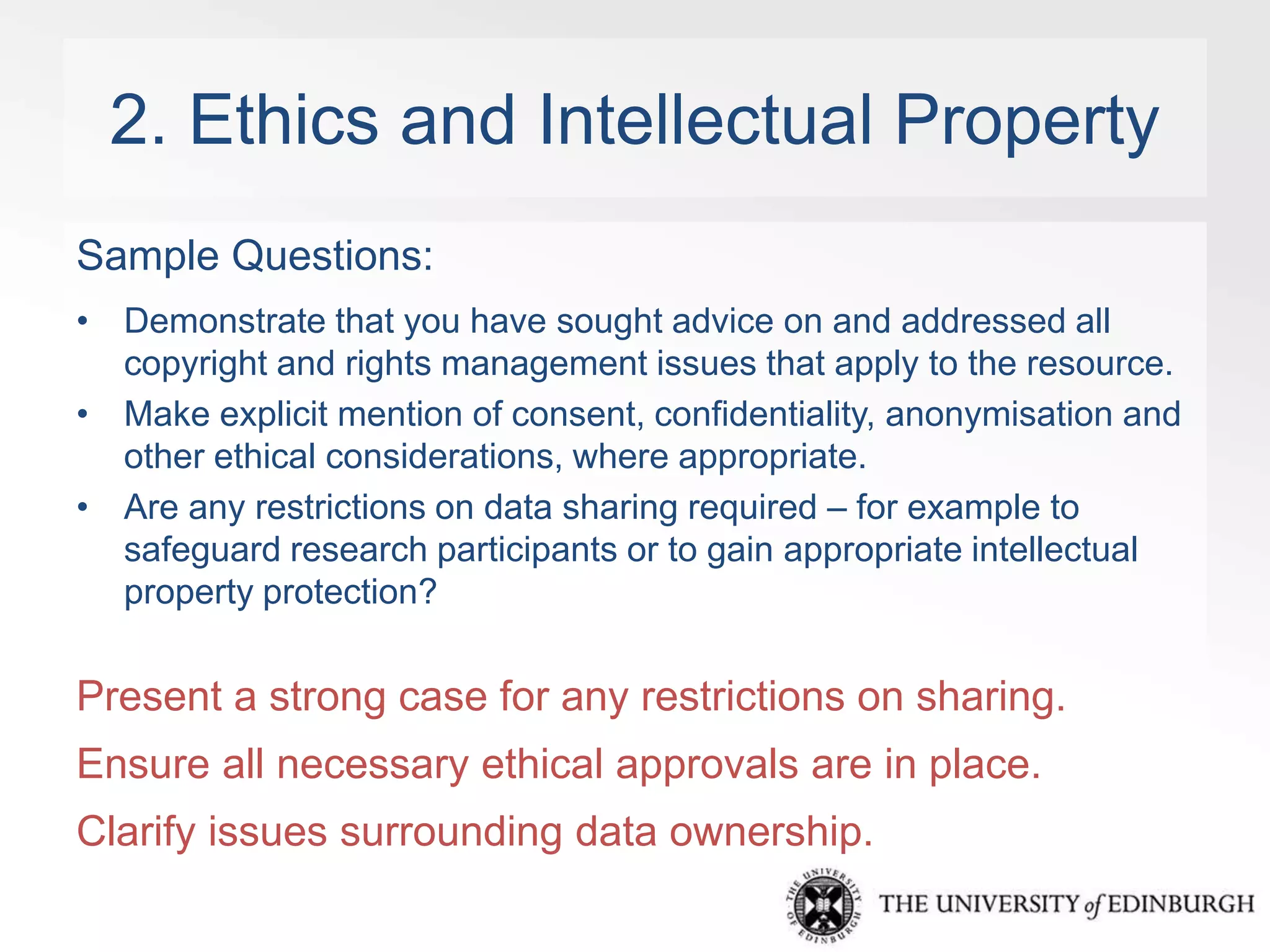
2. Ethics and Intellectual Property 
Sample Questions: 
• Demonstrate that you have sought advice on and addressed all 
copyright and rights management issues that apply to the resource. 
• Make explicit mention of consent, confidentiality, anonymisation and 
other ethical considerations, where appropriate. 
• Are any restrictions on data sharing required – for example to 
safeguard research participants or to gain appropriate intellectual 
property protection? 
Present a strong case for any restrictions on sharing. 
Ensure all necessary ethical approvals are in place. 
Clarify issues surrounding data ownership.
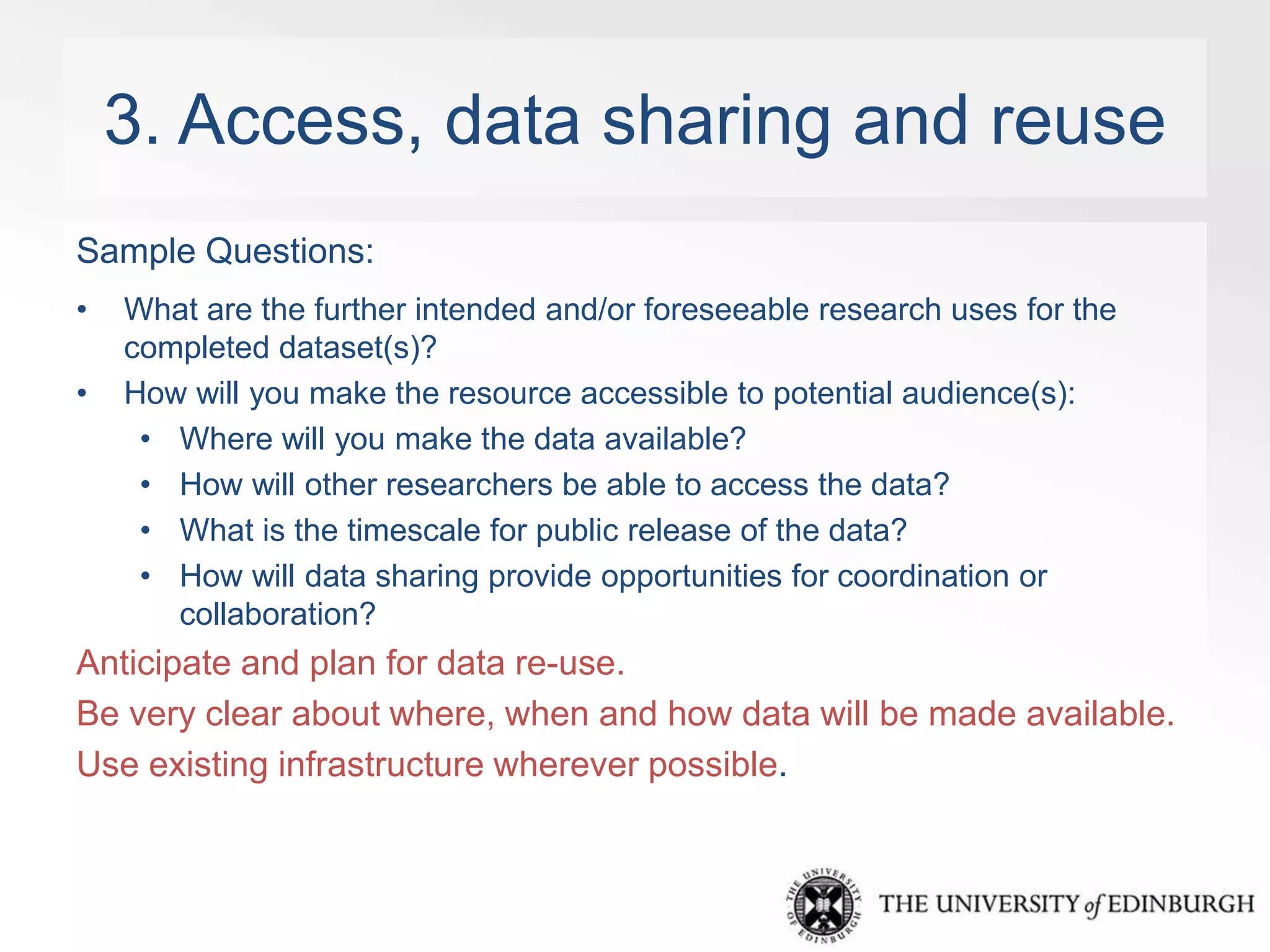
3. Access, data sharing and reuse 
Sample Questions: 
• What are the further intended and/or foreseeable research uses for the 
completed dataset(s)? 
• How will you make the resource accessible to potential audience(s): 
• Where will you make the data available? 
• How will other researchers be able to access the data? 
• What is the timescale for public release of the data? 
• How will data sharing provide opportunities for coordination or 
collaboration? 
Anticipate and plan for data re-use. 
Be very clear about where, when and how data will be made available. 
Use existing infrastructure wherever possible.
4. Short-term storage and data 
management 
Sample Questions: 
• Describe the planned quality assurance and back-up procedures 
[security/storage]. 
• Specify the responsibilities for data management and curation within 
research teams at all participating institutions. 
• Define data management support. 
Consider the practicalities. 
Apply appropriate levels of data management.
5. Deposit and long-term 
preservation 
Sample Questions: 
• Identify which of the data sets produced are considered to be of 
long-term value. 
• Outline the plans for preparing and documenting data for 
preservation and sharing. 
• Explain your archiving/preservation plan to ensure the long-term 
value of key datasets. 
Select data of long-term value. 
Safeguard the data behind the publications. 
Assure that data will remain accessible.
6. Resourcing 
Sample Questions: 
• What resources will you require to deliver your plan? 
• Outline additional hardware, software and technical expertise, 
support and training that is likely to be required and how it will be 
acquired. 
Outline and justify costs. 
Be realistic about the human time and effort required. 
Show that funds will be used efficiently and effectively.
Supporting researchers with DMPs 
Types of support UoE provides: 
• Guidelines and templates on what to include in plans 
• Example answers, guidance and links to local support 
• A library of successful DMPs to reuse 
• Training courses and guidance websites 
• Tailored consultancy services 
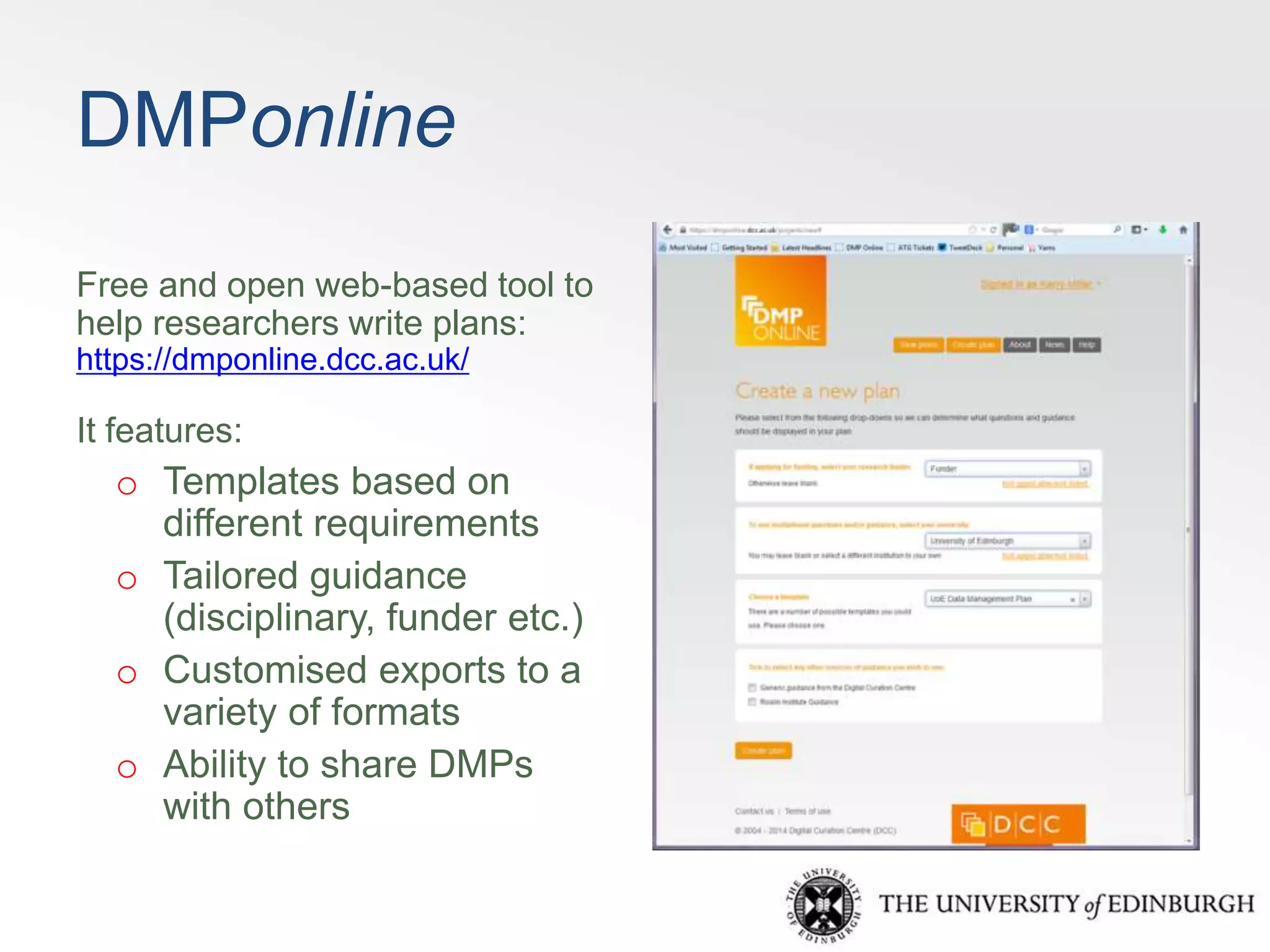
• Customised DMPonline: https://dmponline.dcc.ac.uk/
Exercise: Peer Review a DMP 
• Breaking into groups of 4-5, look over the sample data management 
plans. A copy of the ESRC/ESDS data management plan guidance 
for peer reviewers has been provided for reference. 
• Assuming the role of ESRC bid reviewers, each group should 
consider whether the sample data management plans provide 
sufficient detail to enable the plans to be effectively assessed as 
part of a bid. Would you need more information in some areas to be 
able to determine how well the Principal Investigator will be 
managing their data? 
• Groups will have 20 minutes to review the sample data management 
plans and related documents. Each group will be asked to report 
back on areas where additional information would be needed by 
reviewers to make an informed assessment.
DMPonline 
Free and open web-based tool to 
help researchers write plans: 
https://dmponline.dcc.ac.uk/ 
It features: 
o Templates based on 
different requirements 
o Tailored guidance 
(disciplinary, funder etc.) 
o Customised exports to a 
variety of formats 
o Ability to share DMPs 
with others
Top tips 
• Keep it simple, short and specific. 
• Avoid jargon. 
• Seek advice - consult and collaborate. 
• Base plans on available skills and support. 
• Make sure implementation is feasible. 
• Justify any resources or restrictions needed.
But remember… 
• Start early – don’t wait until the last minute! 
• The plan will - and should - change over the life 
of project. It is a living document. 
• Get into the habit of updating the plan with 
regular project updates. 
• Use the plan as a communication tool – with 
partners, funders and yourself.
Questions? 
Feel free to contact us: 
R.Rice@ed.ac.uk 
Laine.Ruus@ed.ac.uk 
With special acknowledgement to Cuna Ekmekcioglu

Creating a Data Management Plan for your Research

  • 1.
    Creating a DataManagement Plan for your Research EPFL Workshop Lausaunne, 28 Oct 2014 Robin Rice, Laine Ruus EDINA and Data Library
  • 2.
    Course content •What is a Data Management Plan? • Benefits and drivers • What do Funders want? • Six themes for a DMP Exercise: Peer Review a DMP • Support for Data Management Planning • Top Tips for creating a DMP
  • 3.
    What is aDMP? DMPs are written at the start of a project to define: • What data will be collected or created? • How the data will be documented and described? • Where the data will be stored? • Who will be responsible for data security and backup? • Which data will be shared and/or preserved? • How the data will be shared and with whom?
  • 4.
    Benefits Developing DMPscan help you to: • Make informed decisions to anticipate & avoid problems. • Avoid duplication, data loss and security breaches. • Develop procedures early on for consistency. • Ensure data are accurate, complete, reliable and secure. • Save time and effort to make your lives easier. • Plan to share data early on and increase impact.
  • 5.
    What do RCUKFunders want? • AHRC, BBSRC, ESRC, MRC, NERC, and STFC all require some form of data management or sharing plan as part of a funding application. • EPSRC does not ask for a DMP, but EXPECTS that one will exist! • The requirements are diverse, but they all have the RCUK Common Principles as their foundation.
  • 6.
    RCUK common principleson data policy Key messages: 1. Data are a public good and should be made openly available where possible. 2. Adherence to community standards and best practice. Preserve data of long-term value. 3. Metadata for discoverability and access. Link to data from publications. 4. Recognise constraints (legal, ethical and commercial) on what data to release. 5. Allow embargo periods delaying data release to protect the effort of creators. 6. Acknowledge sources to recognise IP and abide by T&Cs. 7. Ensure cost-effective use of public funds for RDM. http://www.rcuk.ac.uk/research/datapolicy/
  • 7.
    EU Funding •European Horizon 2020 funding programme is currently piloting DMPs for the 2014-2015 Work Programme: – Future and Emerging Technologies – Research infrastructures – part e-Infrastructures – Leadership in enabling and industrial technologies – Information and Communication Technologies – Societal Challenge: 'Secure, Clean and Efficient Energy'–part Smart cities and communities – Societal Challenge: 'Climate Action, Environment, Resource Efficiency and Raw Materials' – Societal Challenge: 'Europe in a changing world–inclusive, innovative and reflective Societies' – Science with and for Society • Opt-out with justification • Opt-in from other strands
  • 8.
    EC Horizon 2020Programme • Called a “Data Management Plan”. • No specific length restrictions. • Should cover: – Data set reference and name – Data set description – Standards and metadata – Data sharing – Archiving and preservation • Must be delivered in first 6 months of project. • Is expected to evolve and grow throughout duration of project. http://ec.europa.eu/research/participants/data/ref/h2020/grants_manual/hi/oa_pilot/h2020-hi-oa-pilot-guide_en.pdf http://ec.europa.eu/research/participants/data/ref/h2020/grants_manual/hi/oa_pilot/h2020-hi-oa-data-mgt_en.pdf
  • 9.
    Six themes fora DMP 1. Data types, formats, standards and capture methods 2. Ethics and Intellectual Property 3. Access, data sharing and reuse 4. Short-term storage and data management 5. Deposit and long-term preservation 6. Resourcing
  • 10.
    1. Data types,formats, standards and capture methods Sample Questions • What data outputs will your research generate? • outline volume, type, content, quality and format of the final dataset • Outline the metadata, documentation or other supporting material that should accompany the data for it to be interpreted correctly. • What standards and methodologies will be utilised for data collection and management? • State the relationship to other data available in public repositories e.g. • existing data sources that will be used by the research project • gaps between available data and that required for the research • the added value that new data would provide in relation to existing data Be prepared to explain and justify the choices being made. Understand the need to create metadata and documentation to support the re-use of research data.
  • 11.
    2. Ethics andIntellectual Property Sample Questions: • Demonstrate that you have sought advice on and addressed all copyright and rights management issues that apply to the resource. • Make explicit mention of consent, confidentiality, anonymisation and other ethical considerations, where appropriate. • Are any restrictions on data sharing required – for example to safeguard research participants or to gain appropriate intellectual property protection? Present a strong case for any restrictions on sharing. Ensure all necessary ethical approvals are in place. Clarify issues surrounding data ownership.
  • 12.
    3. Access, datasharing and reuse Sample Questions: • What are the further intended and/or foreseeable research uses for the completed dataset(s)? • How will you make the resource accessible to potential audience(s): • Where will you make the data available? • How will other researchers be able to access the data? • What is the timescale for public release of the data? • How will data sharing provide opportunities for coordination or collaboration? Anticipate and plan for data re-use. Be very clear about where, when and how data will be made available. Use existing infrastructure wherever possible.
  • 13.
    4. Short-term storageand data management Sample Questions: • Describe the planned quality assurance and back-up procedures [security/storage]. • Specify the responsibilities for data management and curation within research teams at all participating institutions. • Define data management support. Consider the practicalities. Apply appropriate levels of data management.
  • 14.
    5. Deposit andlong-term preservation Sample Questions: • Identify which of the data sets produced are considered to be of long-term value. • Outline the plans for preparing and documenting data for preservation and sharing. • Explain your archiving/preservation plan to ensure the long-term value of key datasets. Select data of long-term value. Safeguard the data behind the publications. Assure that data will remain accessible.
  • 15.
    6. Resourcing SampleQuestions: • What resources will you require to deliver your plan? • Outline additional hardware, software and technical expertise, support and training that is likely to be required and how it will be acquired. Outline and justify costs. Be realistic about the human time and effort required. Show that funds will be used efficiently and effectively.
  • 16.
    Supporting researchers withDMPs Types of support UoE provides: • Guidelines and templates on what to include in plans • Example answers, guidance and links to local support • A library of successful DMPs to reuse • Training courses and guidance websites • Tailored consultancy services • Customised DMPonline: https://dmponline.dcc.ac.uk/
  • 17.
    Exercise: Peer Reviewa DMP • Breaking into groups of 4-5, look over the sample data management plans. A copy of the ESRC/ESDS data management plan guidance for peer reviewers has been provided for reference. • Assuming the role of ESRC bid reviewers, each group should consider whether the sample data management plans provide sufficient detail to enable the plans to be effectively assessed as part of a bid. Would you need more information in some areas to be able to determine how well the Principal Investigator will be managing their data? • Groups will have 20 minutes to review the sample data management plans and related documents. Each group will be asked to report back on areas where additional information would be needed by reviewers to make an informed assessment.
  • 18.
    DMPonline Free andopen web-based tool to help researchers write plans: https://dmponline.dcc.ac.uk/ It features: o Templates based on different requirements o Tailored guidance (disciplinary, funder etc.) o Customised exports to a variety of formats o Ability to share DMPs with others
  • 19.
    Top tips •Keep it simple, short and specific. • Avoid jargon. • Seek advice - consult and collaborate. • Base plans on available skills and support. • Make sure implementation is feasible. • Justify any resources or restrictions needed.
  • 20.
    But remember… •Start early – don’t wait until the last minute! • The plan will - and should - change over the life of project. It is a living document. • Get into the habit of updating the plan with regular project updates. • Use the plan as a communication tool – with partners, funders and yourself.
  • 21.
    Questions? Feel freeto contact us: R.Rice@ed.ac.uk Laine.Ruus@ed.ac.uk With special acknowledgement to Cuna Ekmekcioglu