Experiences of running an
institutional data repository
Stuart Lewis
Deputy Director, Library & University Collections
.@stuartlewis
Pauline Ward
Data Library Assistant
.@PaulineDataWard
Otevřené repozitáře 2016
Experiences of running an institutional data repository
1. The context – The University of Edinburgh
2. The theory – Reasons for Research Data Management
3. The policy – Local and national policies
4. The programme – An overview of the Research Data Service
5. The practice – The DataShare repository
2
The context 3
The University of Edinburgh
• The context to our work:
• Edinburgh is the capital city of Scotland
• The University of Edinburgh is Scotland’s largest university
• A large thriving research-led University: 35,258 students, 13,272 staff
• Breadth of research disciplines across three colleges:
• Humanities and Social Science
• Science and Engineering
• Medicine and Veterinary Medicine
4
The University of Edinburgh
• Information Services Group at the University of Edinburgh - CIO
• Library & University Collections
• User Services
• IT Infrastructure
• IT Applications
• Learning Teaching and Web
• Digital Curation Centre and EDINA
5
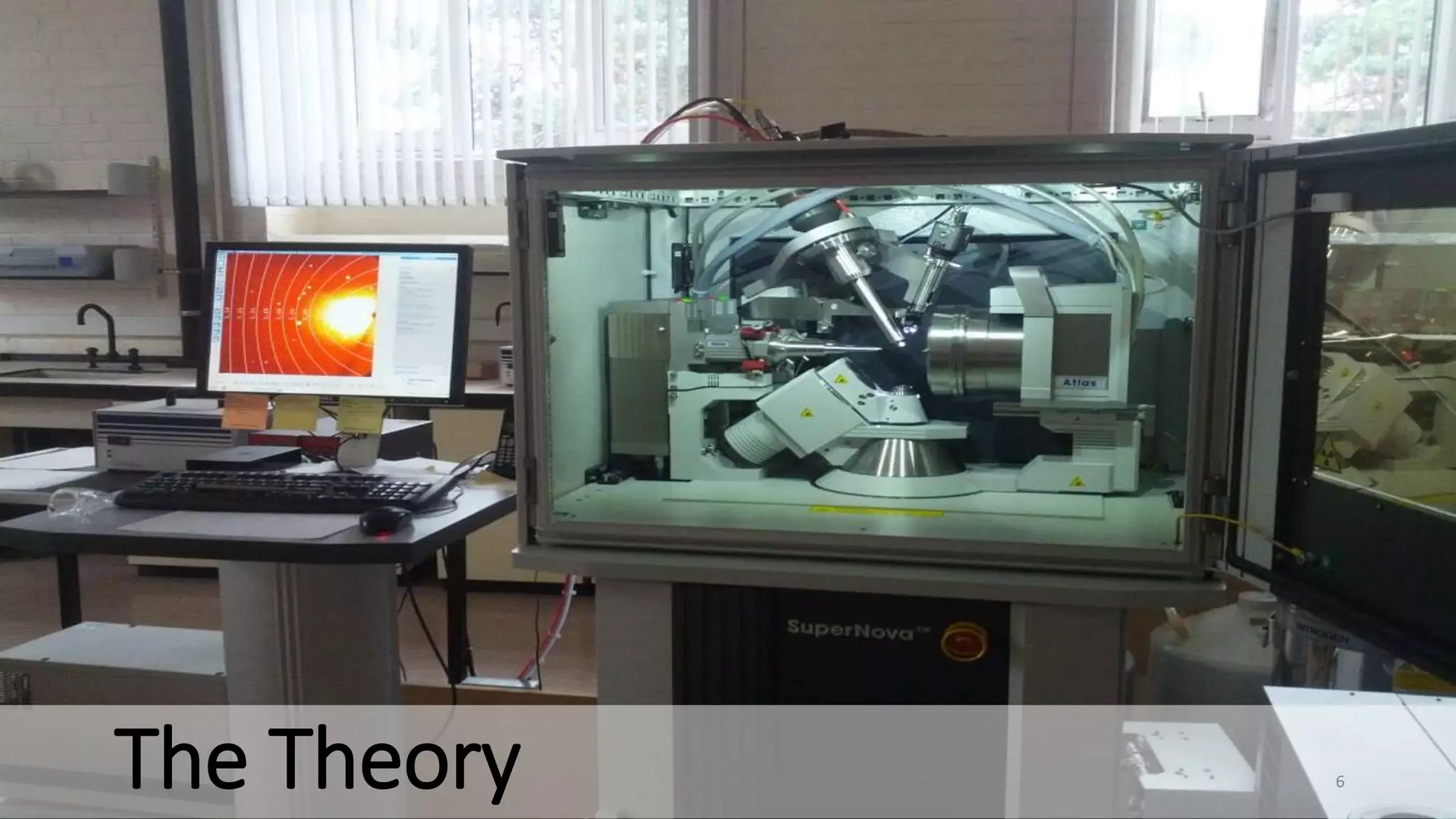
The Theory 6
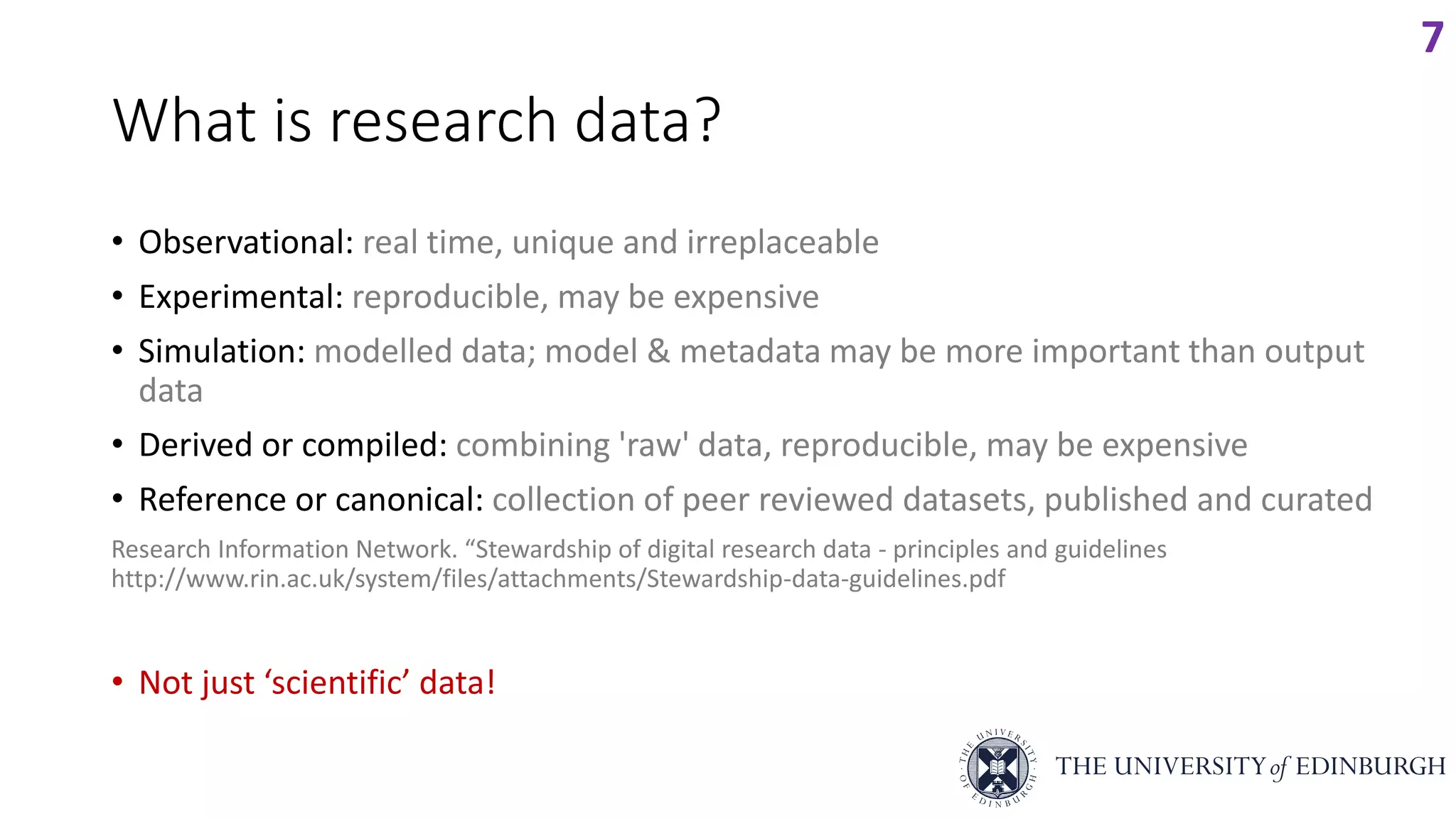
What is research data?
• Observational: real time, unique and irreplaceable
• Experimental: reproducible, may be expensive
• Simulation: modelled data; model & metadata may be more important than output
data
• Derived or compiled: combining 'raw' data, reproducible, may be expensive
• Reference or canonical: collection of peer reviewed datasets, published and curated
Research Information Network. “Stewardship of digital research data - principles and guidelines
http://www.rin.ac.uk/system/files/attachments/Stewardship-data-guidelines.pdf
• Not just ‘scientific’ data!
7
Why manage research data?
• Benefits to different groups…
8
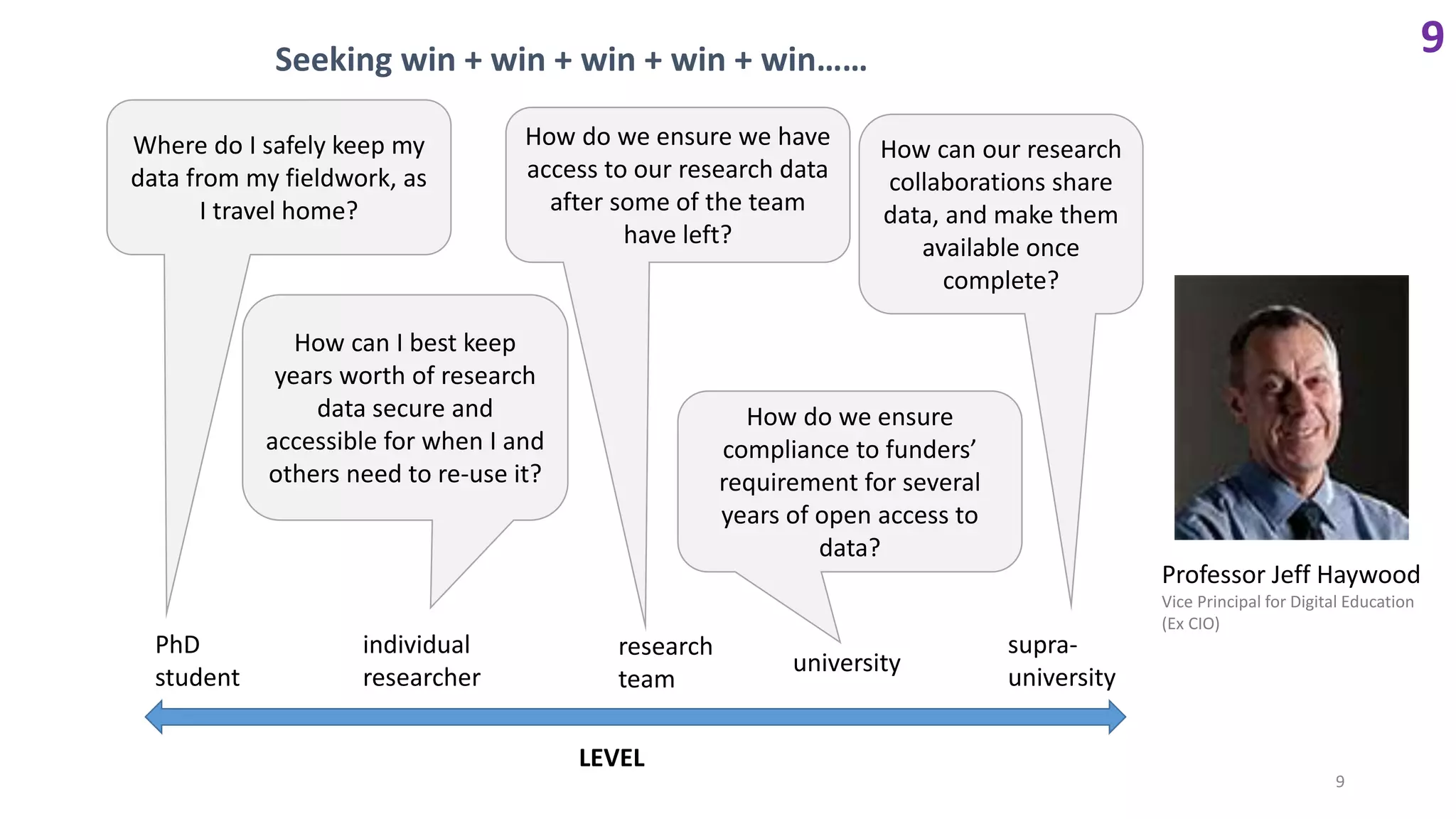
LEVEL
PhD
student
university
research
team
individual
researcher
supra-
university
Where do I safely keep my
data from my fieldwork, as
I travel home?
How can I best keep
years worth of research
data secure and
accessible for when I and
others need to re-use it?
How do we ensure
compliance to funders’
requirement for several
years of open access to
data?
How do we ensure we have
access to our research data
after some of the team
have left?
How can our research
collaborations share
data, and make them
available once
complete?
Seeking win + win + win + win + win……
Professor Jeff Haywood
Vice Principal for Digital Education
(Ex CIO)
9
9
Why manage research data?
• Benefits to different groups…
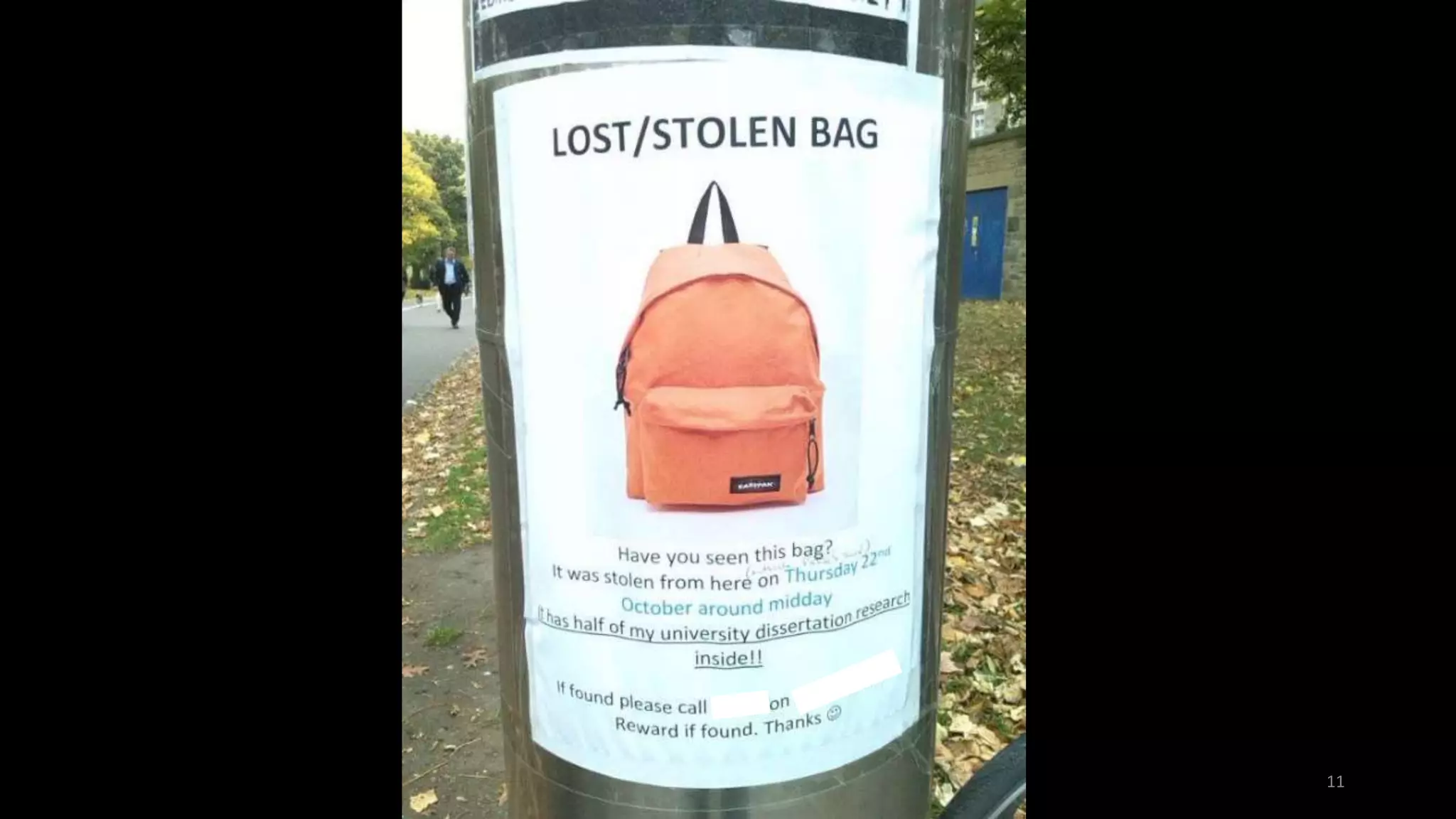
• If for no other reason, access to my own data!
A true story....
10
11
The Policy 12
Research Data Management Policies
• Growing policy support for Research Data Management
• University of Edinburgh Policy – May 2011
• UK RCUK Research Councils
• EC Horizon 2020 pilot
• Many other research funders
13
Research Data Management Policies
• University of Edinburgh Policy
• First institutional RDM policy in the UK
• Approved by Senatus Academicus in May 2011
• http://www.ed.ac.uk/information-services/about/policies-and-regulations/research-data-policy
• An aspirational policy
• “It is acknowledged that this is an aspirational policy,
and that implementation will take some years.”
• Assigns responsibilities
14
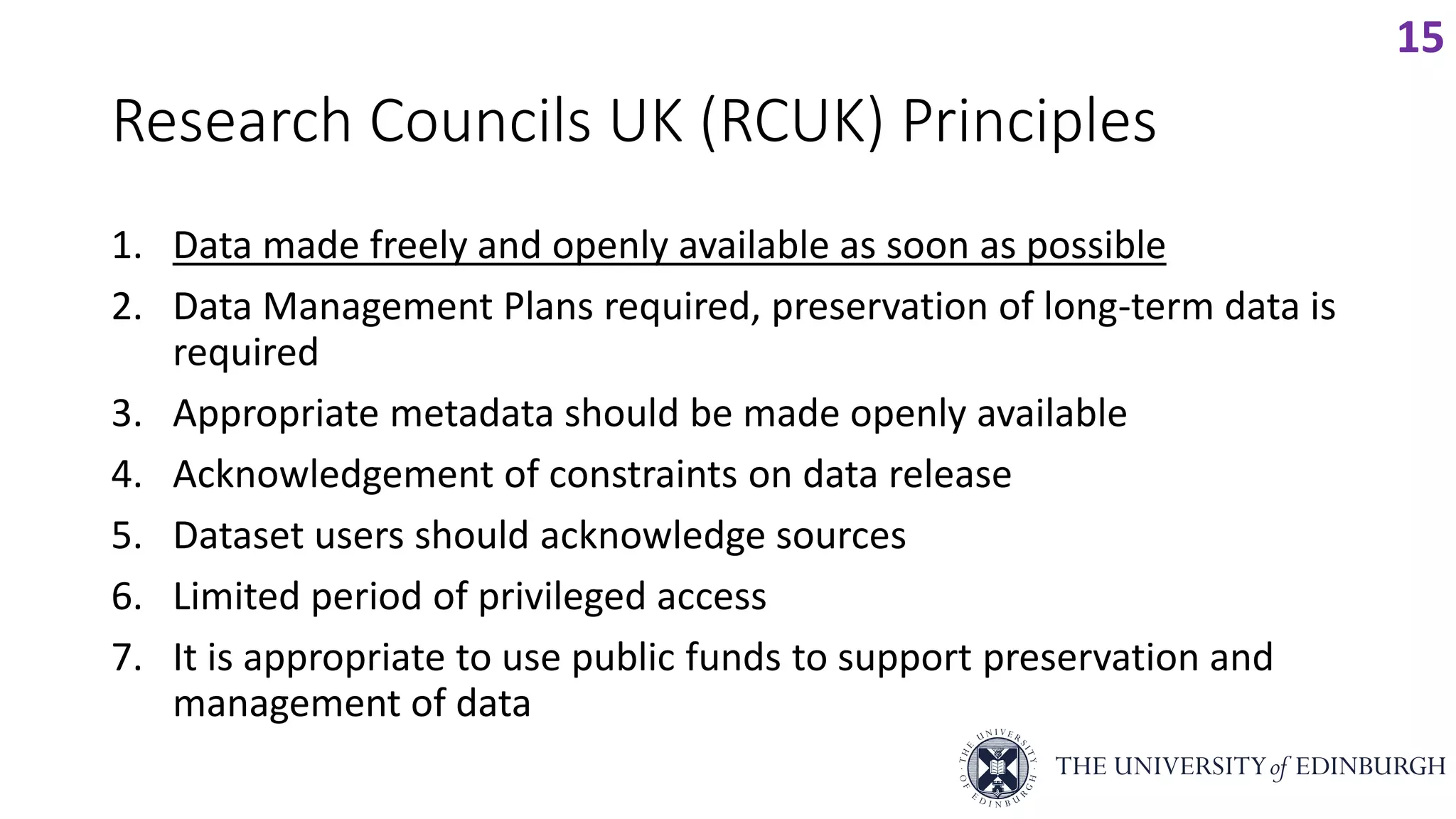
Research Councils UK (RCUK) Principles
1. Data made freely and openly available as soon as possible
2. Data Management Plans required, preservation of long-term data is
required
3. Appropriate metadata should be made openly available
4. Acknowledgement of constraints on data release
5. Dataset users should acknowledge sources
6. Limited period of privileged access
7. It is appropriate to use public funds to support preservation and
management of data
15
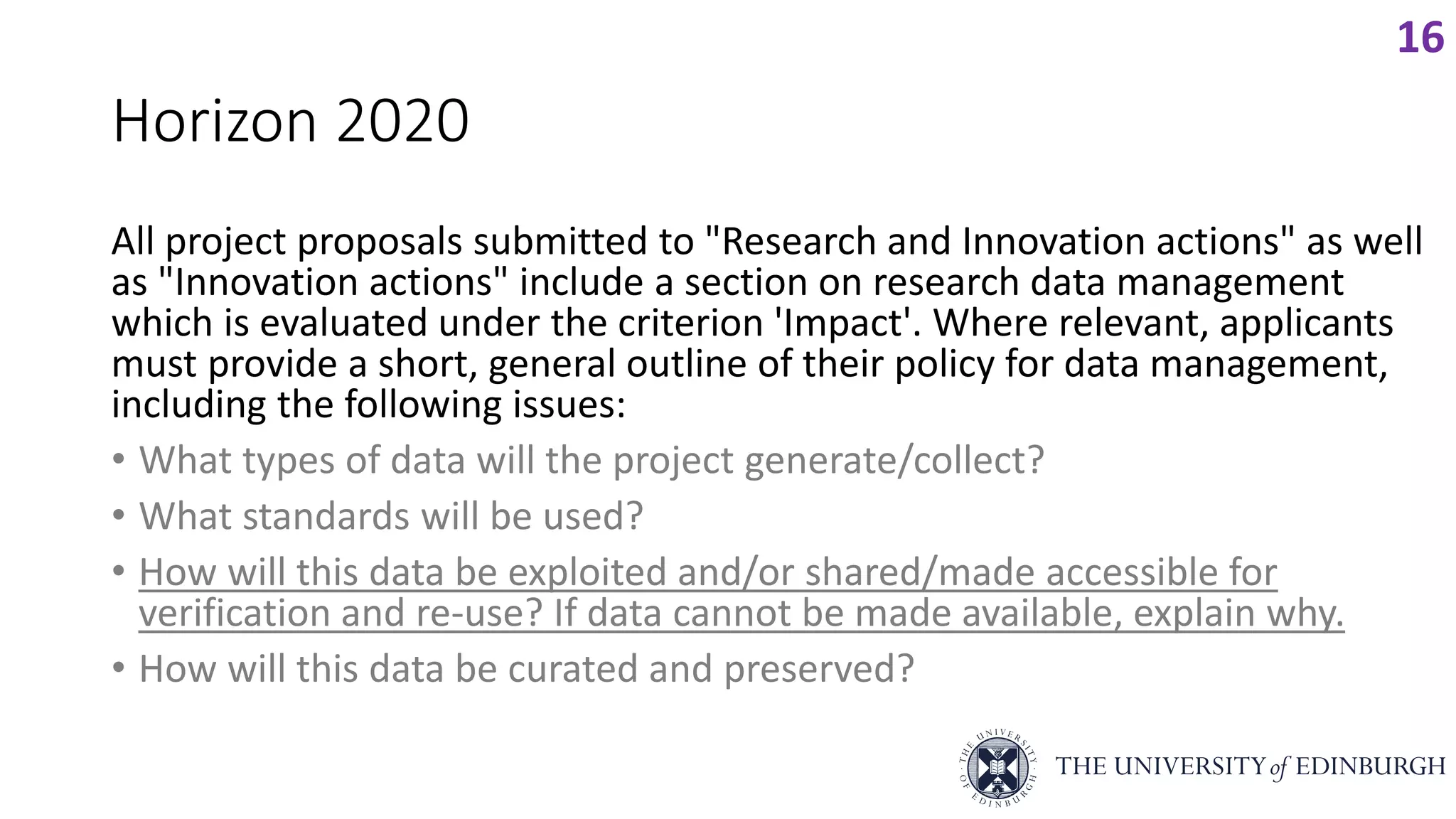
Horizon 2020
All project proposals submitted to "Research and Innovation actions" as well
as "Innovation actions" include a section on research data management
which is evaluated under the criterion 'Impact'. Where relevant, applicants
must provide a short, general outline of their policy for data management,
including the following issues:
• What types of data will the project generate/collect?
• What standards will be used?
• How will this data be exploited and/or shared/made accessible for
verification and re-use? If data cannot be made available, explain why.
• How will this data be curated and preserved?
16
The Programme 17
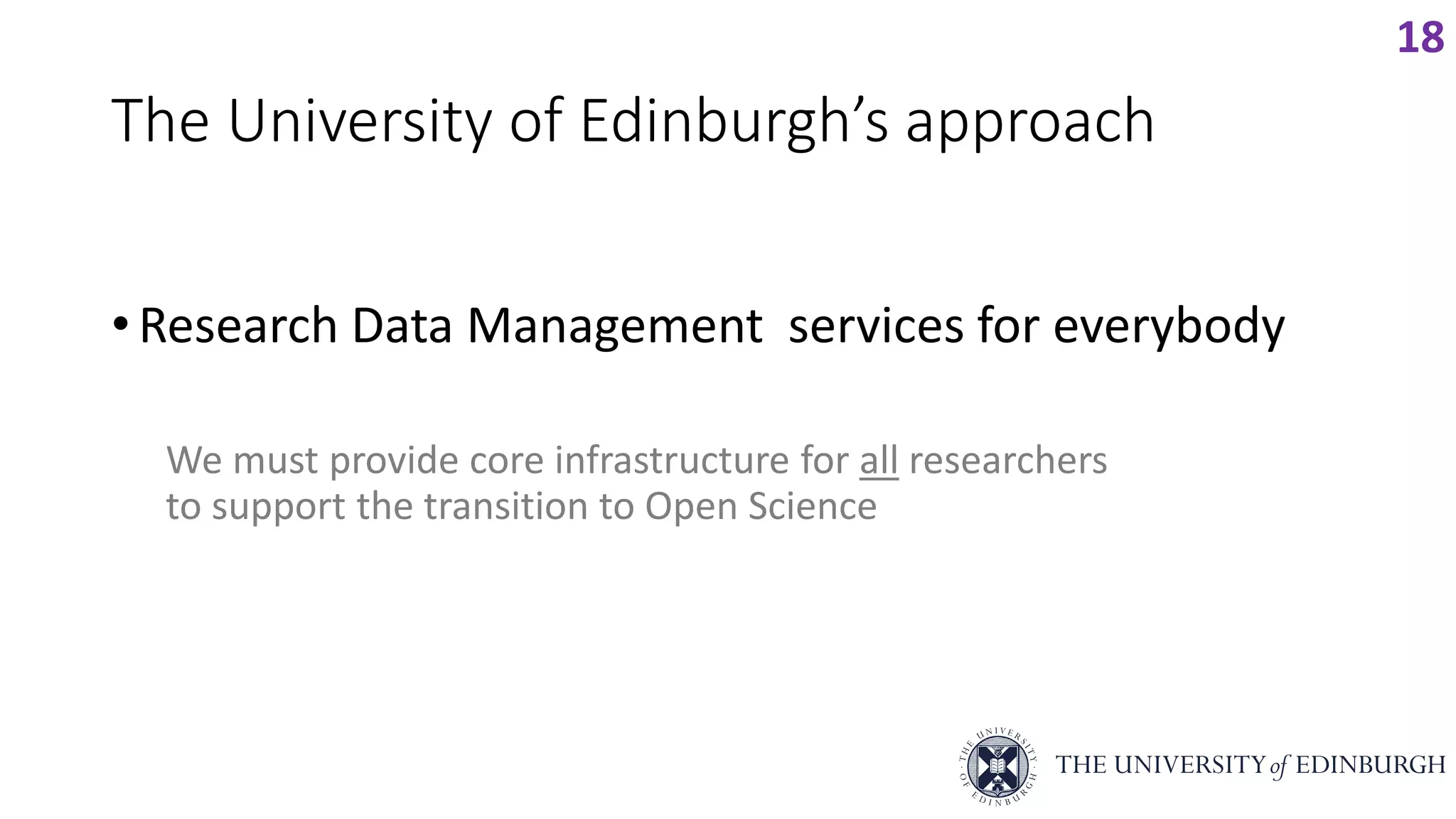
The University of Edinburgh’s approach
• Research Data Management services for everybody
We must provide core infrastructure for all researchers
to support the transition to Open Science
18
University of Edinburgh RDM Programme
• Planning a Research Data Management Service:
• Research Data Management Programme
• Delivered by Information Services
• Supported by central funding
• Phase 1: August 2012 to May 2015
• Phase 2: June 2015 to July 2016
• RDM Roadmap:
http://www.ed.ac.uk/information-services/about/strategy-planning/rdm-roadmap
19
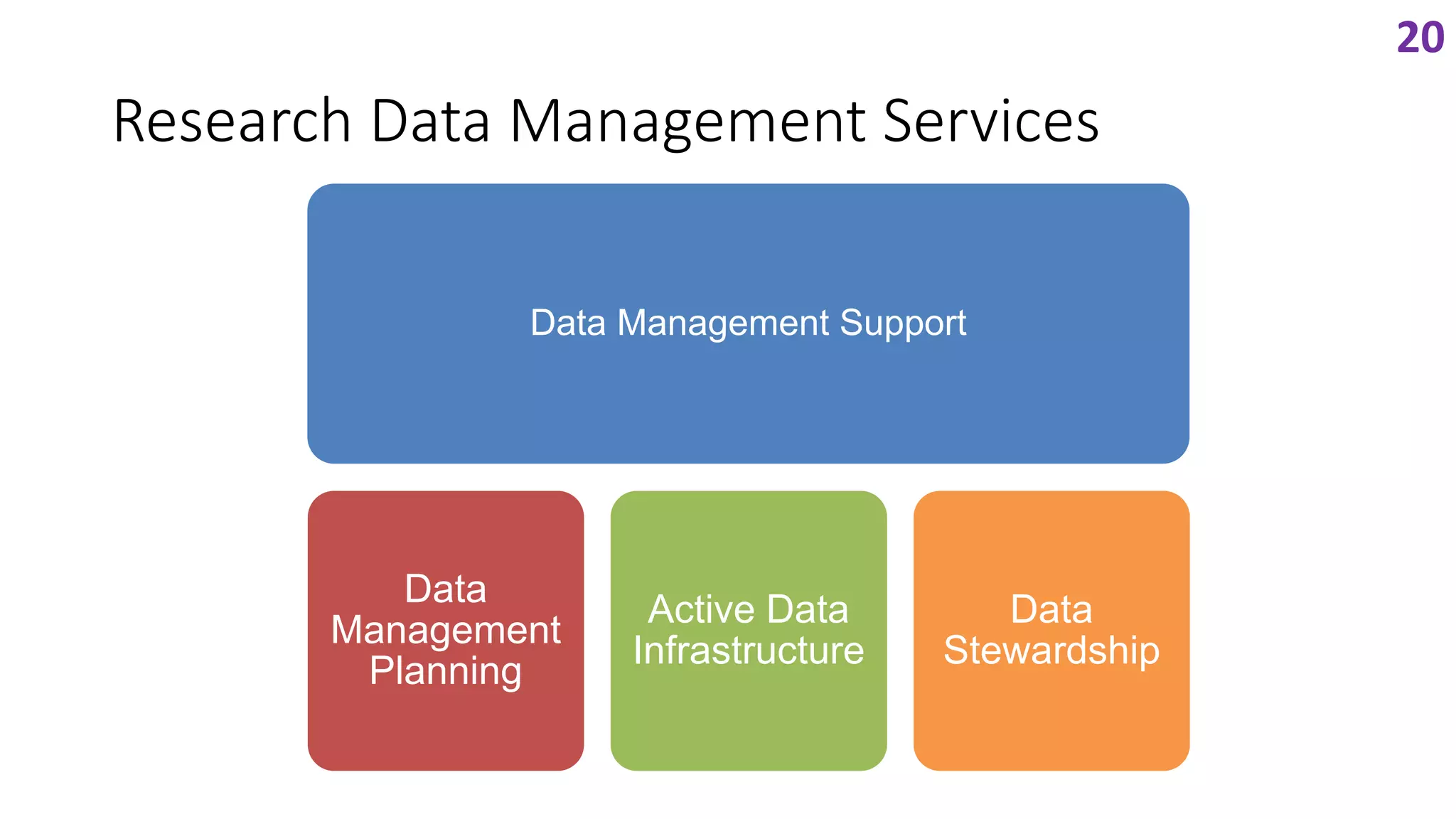
Research Data Management Services
Data Management Support
Data
Management
Planning
Active Data
Infrastructure
Data
Stewardship
20
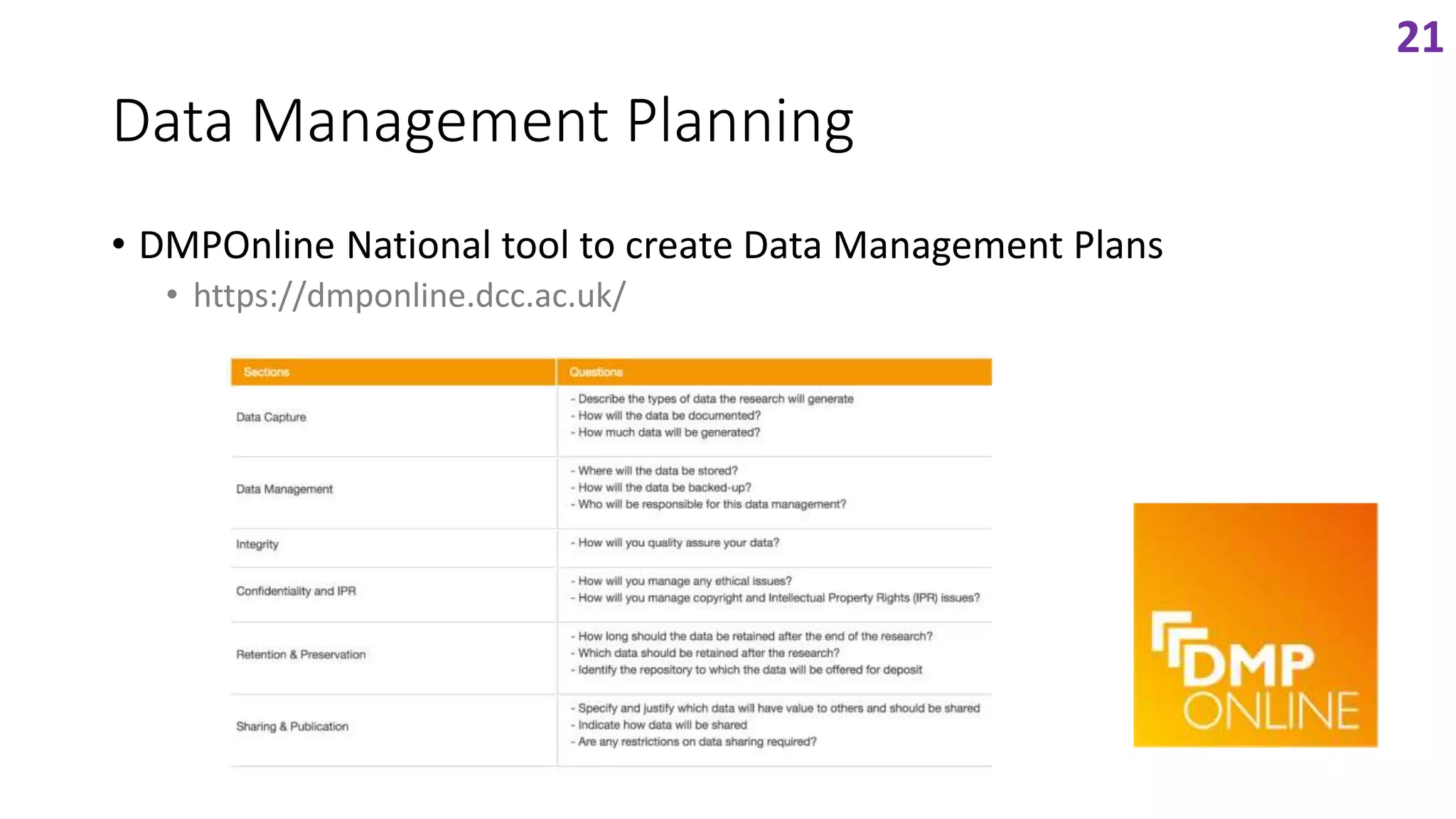
Data Management Planning
• DMPOnline National tool to create Data Management Plans
• https://dmponline.dcc.ac.uk/
21
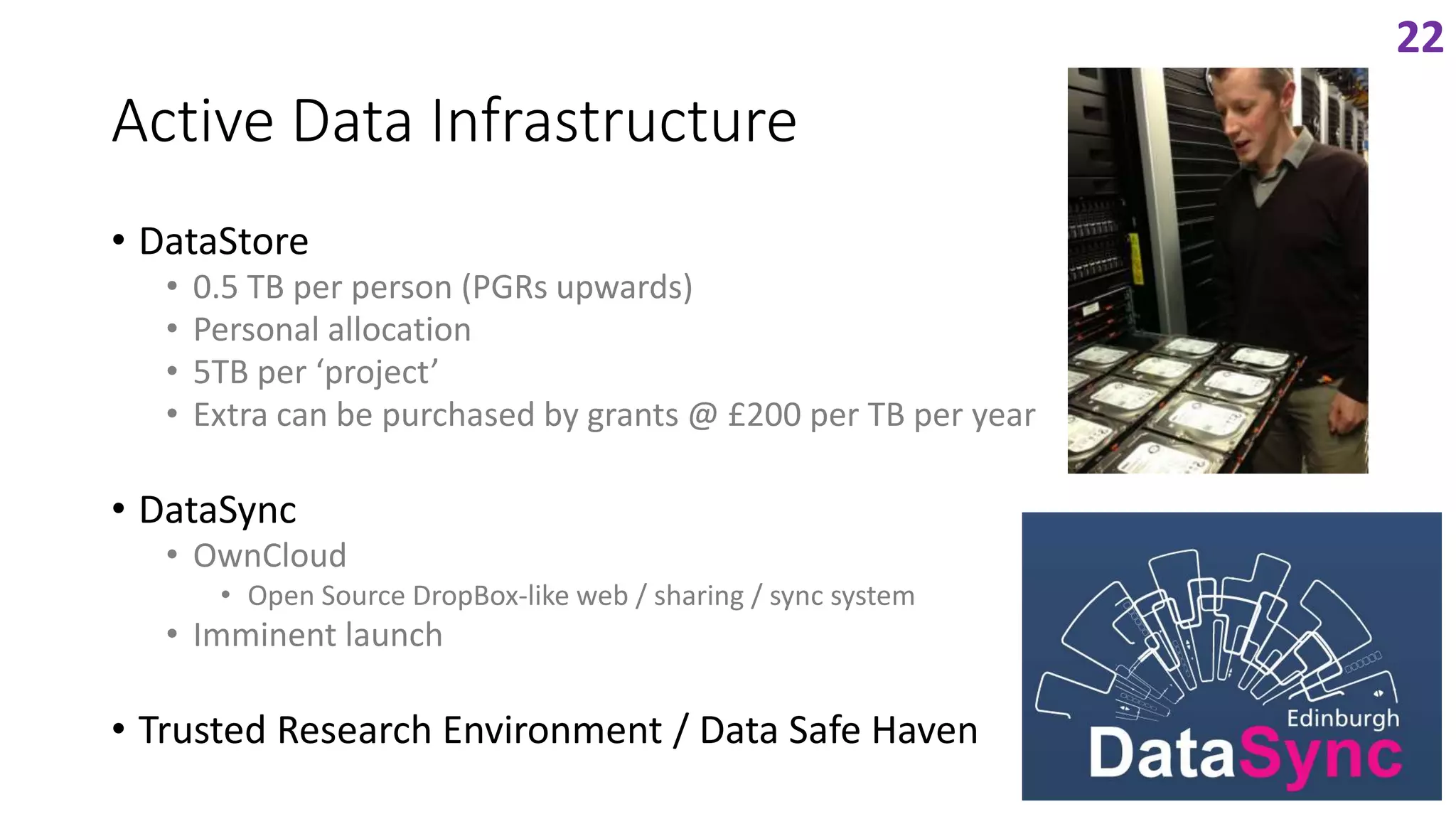
Active Data Infrastructure
• DataStore
• 0.5 TB per person (PGRs upwards)
• Personal allocation
• 5TB per ‘project’
• Extra can be purchased by grants @ £200 per TB per year
• DataSync
• OwnCloud
• Open Source DropBox-like web / sharing / sync system
• Imminent launch
• Trusted Research Environment / Data Safe Haven
22
Data Stewardship
• PURE
• Current Research Information System (CRIS)
• Records research outputs (papers, grants, equipment, awards, datasets, etc)
• Allows datasets to be described, and linked to if shared online
• Person A, was awarded Grant B,
which funded Equipment C,
which created data D,
which generated paper E
23
Data Stewardship
• DataVault
• Long term archival storage.
• Move data from DataStore.
• In development
• With University of Manchester
• Sponsored by Jisc
• http://datavaultplatform.org/
24
Data Stewardship
• DataShare
• Online open data repository
• Uses the DSpace open source repository platform
• Creates DOIs for datasets
• Data Seal of Approval (DSA)
• http://datashare.is.ed.ac.uk/
25
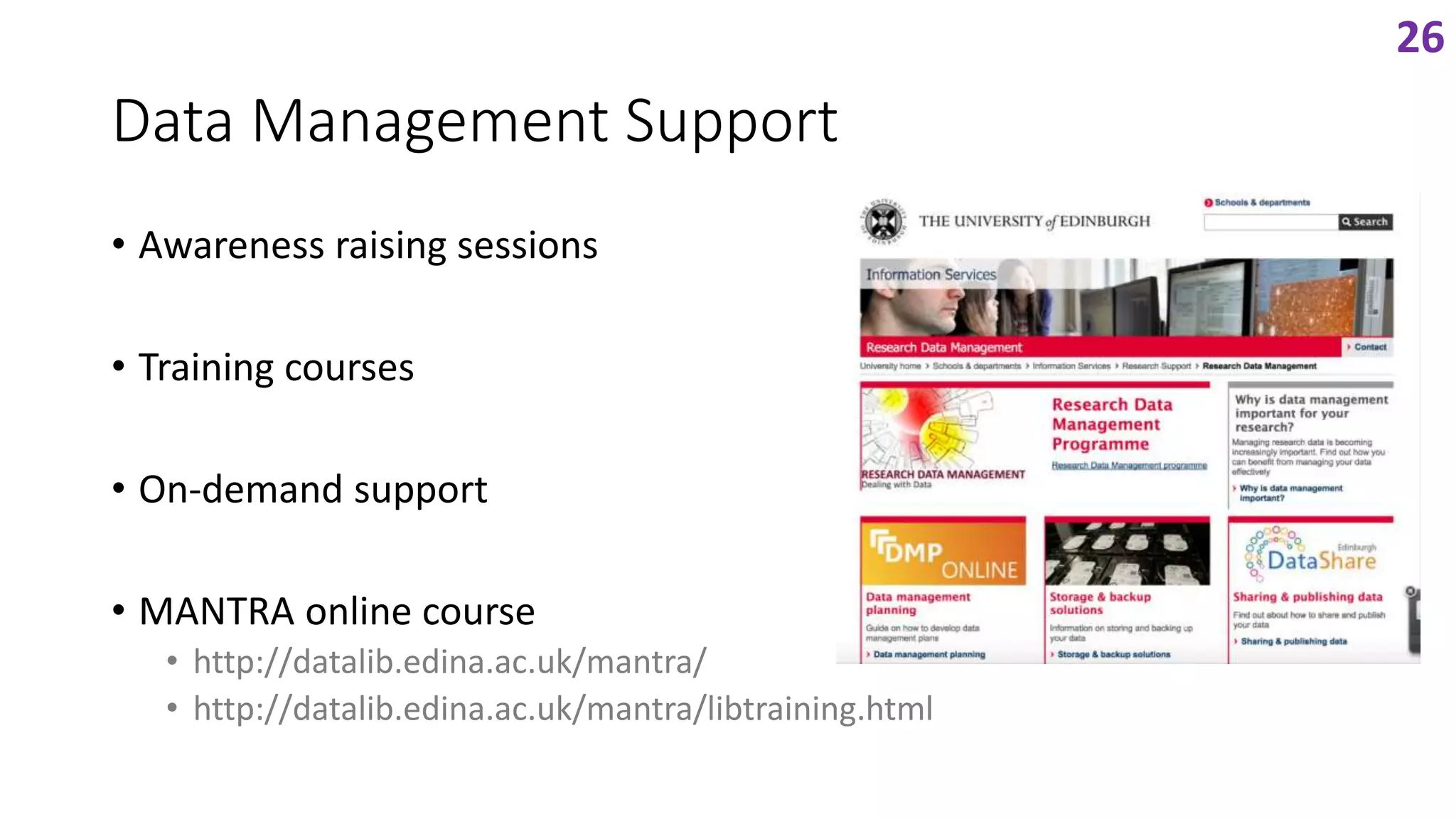
Data Management Support
• Awareness raising sessions
• Training courses
• On-demand support
• MANTRA online course
• http://datalib.edina.ac.uk/mantra/
• http://datalib.edina.ac.uk/mantra/libtraining.html
26
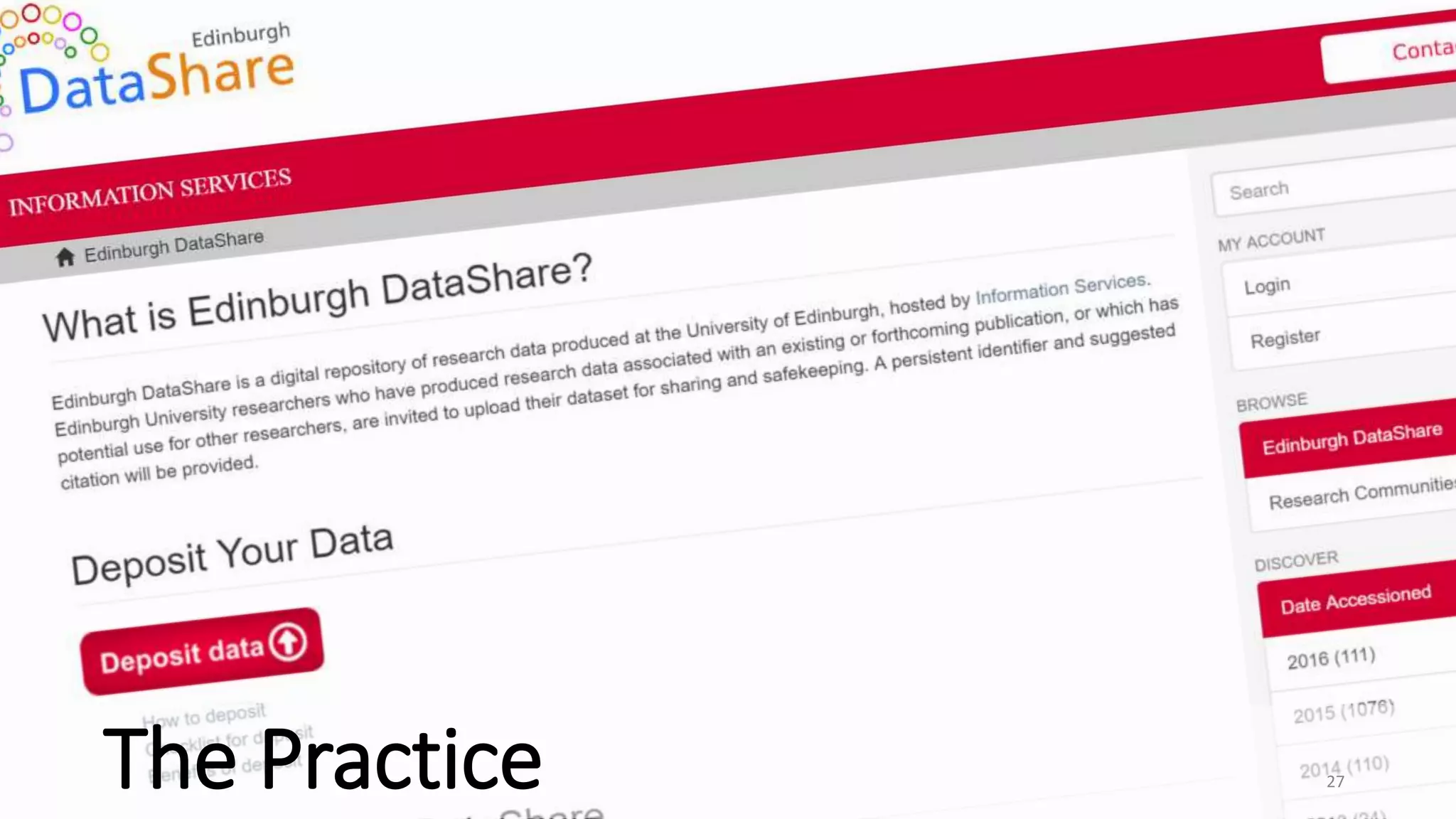
The Practice 27
DataShare
• DataShare is an institutional repository which allows University of
Edinburgh researchers to share their data online.
• It uses the DSpace open source repository system.
28
DataShare History
• Created in 2009 as part of a project to assess whether traditional
institutional repository software could handle data.
• Is now the catch-all repository for data which either does not have an
appropriate disciplinary repository or is too big or complex for the
disciplinary repository.
29
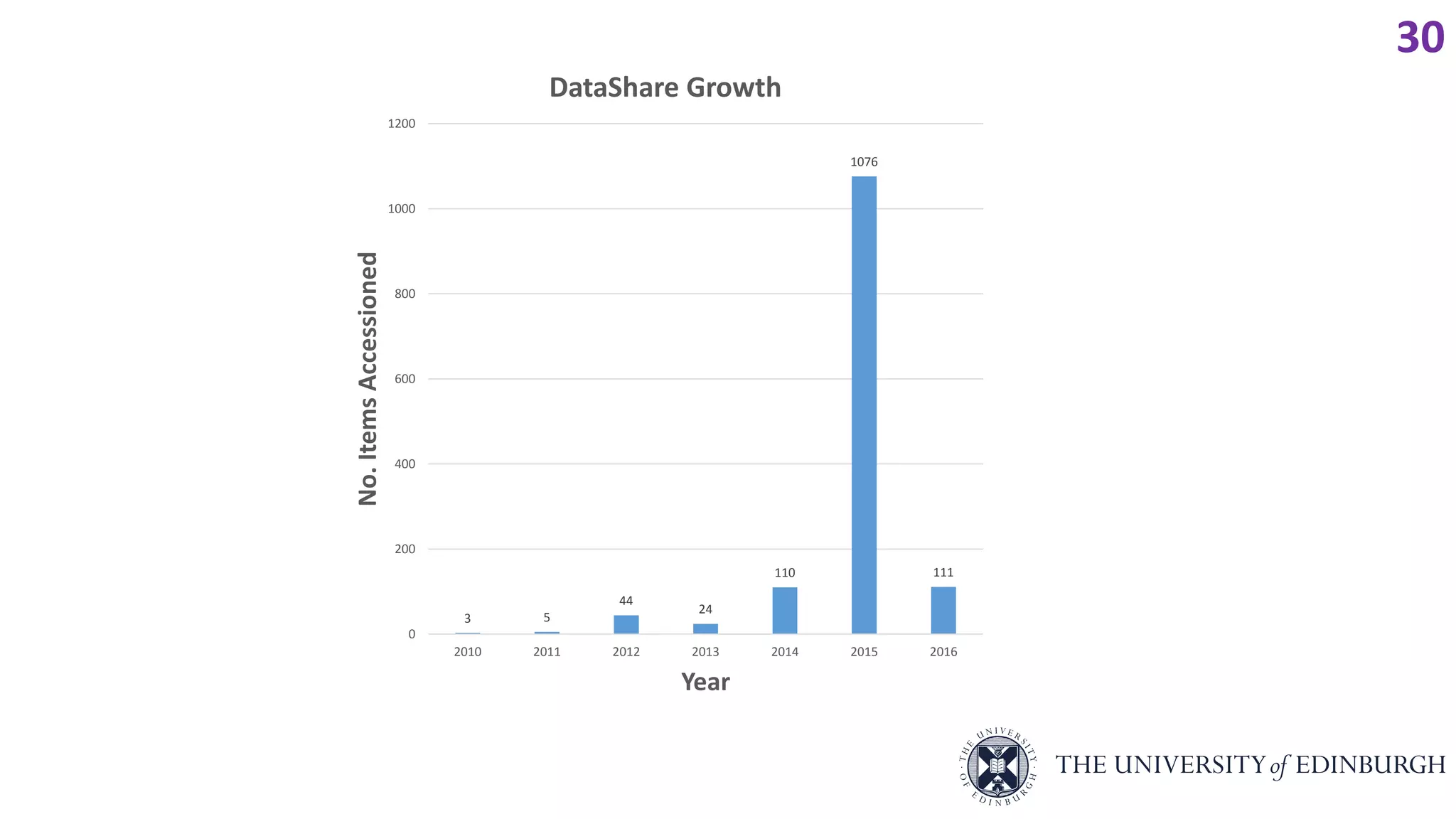
30
3 5
44
24
110
1076
111
0
200
400
600
800
1000
1200
2010 2011 2012 2013 2014 2015 2016
No.ItemsAccessioned
Year
DataShare Growth
Configuration of DSpace for DataShare
• The following configuration is applied to our DSpace instance
• Dublin Core metadata fields
• Look and feel / branding
31
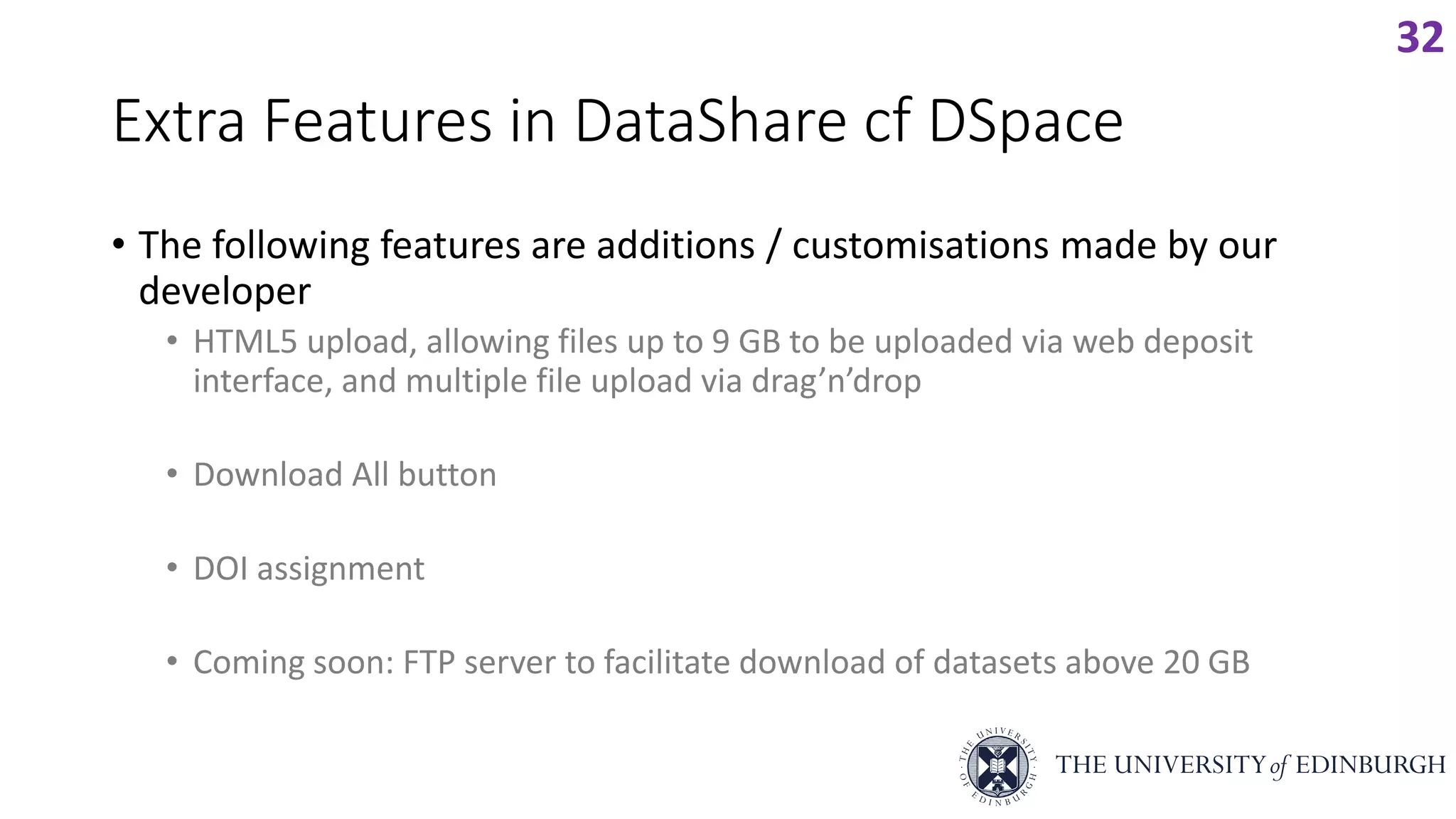
Extra Features in DataShare cf DSpace
• The following features are additions / customisations made by our
developer
• HTML5 upload, allowing files up to 9 GB to be uploaded via web deposit
interface, and multiple file upload via drag’n’drop
• Download All button
• DOI assignment
• Coming soon: FTP server to facilitate download of datasets above 20 GB
32
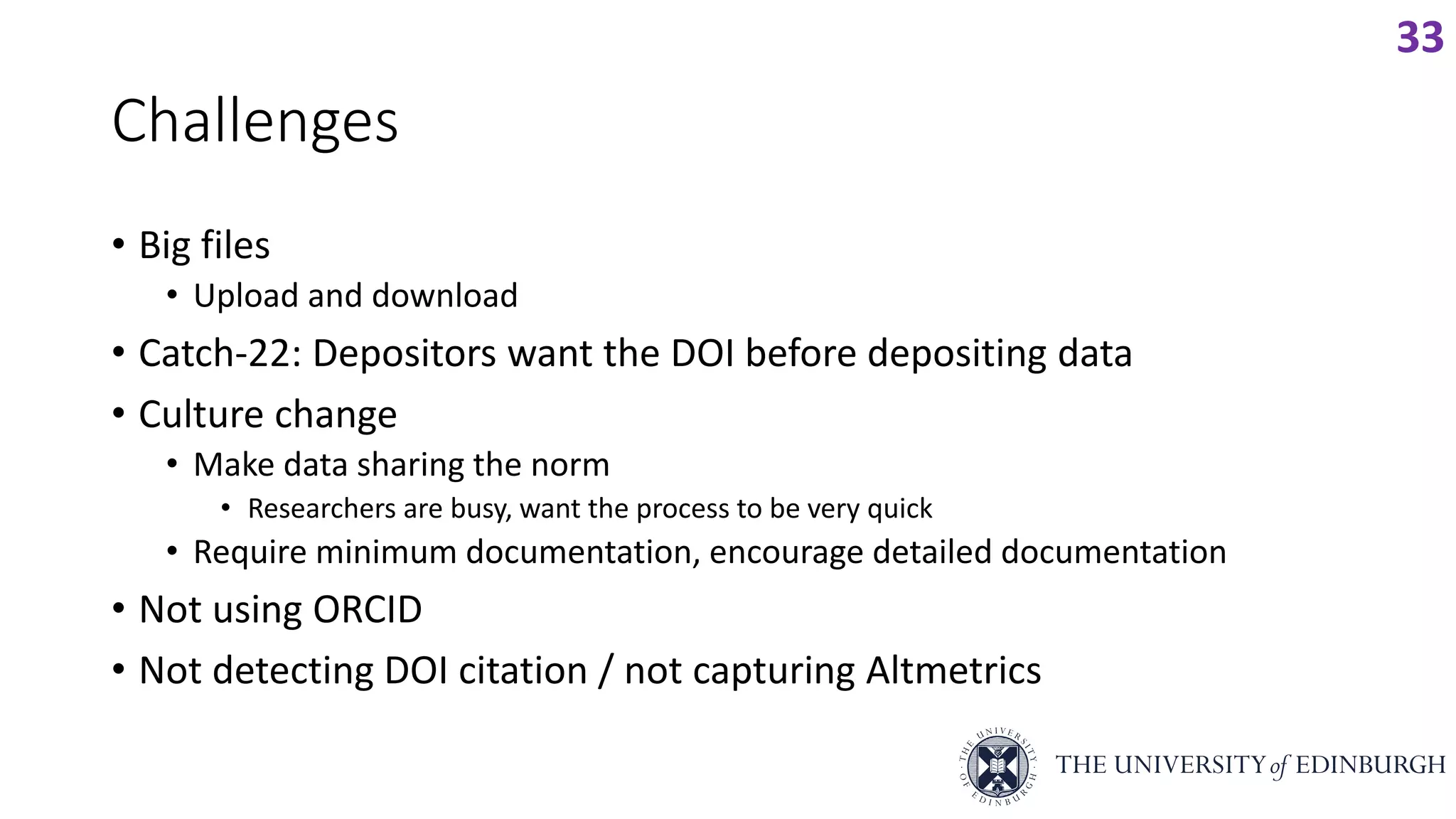
Challenges
• Big files
• Upload and download
• Catch-22: Depositors want the DOI before depositing data
• Culture change
• Make data sharing the norm
• Researchers are busy, want the process to be very quick
• Require minimum documentation, encourage detailed documentation
• Not using ORCID
• Not detecting DOI citation / not capturing Altmetrics
33
stuart.lewis@ed.ac.uk pauline.ward@ed.ac.uk
Děkuji mnohokrát!
Experiences of running an
institutional data repository

AKVS - Edinburgh Data Repository Experiences June 2016

  • 1.
    Experiences of runningan institutional data repository Stuart Lewis Deputy Director, Library & University Collections .@stuartlewis Pauline Ward Data Library Assistant .@PaulineDataWard
  • 2.
    Otevřené repozitáře 2016 Experiencesof running an institutional data repository 1. The context – The University of Edinburgh 2. The theory – Reasons for Research Data Management 3. The policy – Local and national policies 4. The programme – An overview of the Research Data Service 5. The practice – The DataShare repository 2
  • 3.
  • 4.
    The University ofEdinburgh • The context to our work: • Edinburgh is the capital city of Scotland • The University of Edinburgh is Scotland’s largest university • A large thriving research-led University: 35,258 students, 13,272 staff • Breadth of research disciplines across three colleges: • Humanities and Social Science • Science and Engineering • Medicine and Veterinary Medicine 4
  • 5.
    The University ofEdinburgh • Information Services Group at the University of Edinburgh - CIO • Library & University Collections • User Services • IT Infrastructure • IT Applications • Learning Teaching and Web • Digital Curation Centre and EDINA 5
  • 6.
  • 7.
    What is researchdata? • Observational: real time, unique and irreplaceable • Experimental: reproducible, may be expensive • Simulation: modelled data; model & metadata may be more important than output data • Derived or compiled: combining 'raw' data, reproducible, may be expensive • Reference or canonical: collection of peer reviewed datasets, published and curated Research Information Network. “Stewardship of digital research data - principles and guidelines http://www.rin.ac.uk/system/files/attachments/Stewardship-data-guidelines.pdf • Not just ‘scientific’ data! 7
  • 8.
    Why manage researchdata? • Benefits to different groups… 8
  • 9.
    LEVEL PhD student university research team individual researcher supra- university Where do Isafely keep my data from my fieldwork, as I travel home? How can I best keep years worth of research data secure and accessible for when I and others need to re-use it? How do we ensure compliance to funders’ requirement for several years of open access to data? How do we ensure we have access to our research data after some of the team have left? How can our research collaborations share data, and make them available once complete? Seeking win + win + win + win + win…… Professor Jeff Haywood Vice Principal for Digital Education (Ex CIO) 9 9
  • 10.
    Why manage researchdata? • Benefits to different groups… • If for no other reason, access to my own data! A true story.... 10
  • 11.
  • 12.
  • 13.
    Research Data ManagementPolicies • Growing policy support for Research Data Management • University of Edinburgh Policy – May 2011 • UK RCUK Research Councils • EC Horizon 2020 pilot • Many other research funders 13
  • 14.
    Research Data ManagementPolicies • University of Edinburgh Policy • First institutional RDM policy in the UK • Approved by Senatus Academicus in May 2011 • http://www.ed.ac.uk/information-services/about/policies-and-regulations/research-data-policy • An aspirational policy • “It is acknowledged that this is an aspirational policy, and that implementation will take some years.” • Assigns responsibilities 14
  • 15.
    Research Councils UK(RCUK) Principles 1. Data made freely and openly available as soon as possible 2. Data Management Plans required, preservation of long-term data is required 3. Appropriate metadata should be made openly available 4. Acknowledgement of constraints on data release 5. Dataset users should acknowledge sources 6. Limited period of privileged access 7. It is appropriate to use public funds to support preservation and management of data 15
  • 16.
    Horizon 2020 All projectproposals submitted to "Research and Innovation actions" as well as "Innovation actions" include a section on research data management which is evaluated under the criterion 'Impact'. Where relevant, applicants must provide a short, general outline of their policy for data management, including the following issues: • What types of data will the project generate/collect? • What standards will be used? • How will this data be exploited and/or shared/made accessible for verification and re-use? If data cannot be made available, explain why. • How will this data be curated and preserved? 16
  • 17.
  • 18.
    The University ofEdinburgh’s approach • Research Data Management services for everybody We must provide core infrastructure for all researchers to support the transition to Open Science 18
  • 19.
    University of EdinburghRDM Programme • Planning a Research Data Management Service: • Research Data Management Programme • Delivered by Information Services • Supported by central funding • Phase 1: August 2012 to May 2015 • Phase 2: June 2015 to July 2016 • RDM Roadmap: http://www.ed.ac.uk/information-services/about/strategy-planning/rdm-roadmap 19
  • 20.
    Research Data ManagementServices Data Management Support Data Management Planning Active Data Infrastructure Data Stewardship 20
  • 21.
    Data Management Planning •DMPOnline National tool to create Data Management Plans • https://dmponline.dcc.ac.uk/ 21
  • 22.
    Active Data Infrastructure •DataStore • 0.5 TB per person (PGRs upwards) • Personal allocation • 5TB per ‘project’ • Extra can be purchased by grants @ £200 per TB per year • DataSync • OwnCloud • Open Source DropBox-like web / sharing / sync system • Imminent launch • Trusted Research Environment / Data Safe Haven 22
  • 23.
    Data Stewardship • PURE •Current Research Information System (CRIS) • Records research outputs (papers, grants, equipment, awards, datasets, etc) • Allows datasets to be described, and linked to if shared online • Person A, was awarded Grant B, which funded Equipment C, which created data D, which generated paper E 23
  • 24.
    Data Stewardship • DataVault •Long term archival storage. • Move data from DataStore. • In development • With University of Manchester • Sponsored by Jisc • http://datavaultplatform.org/ 24
  • 25.
    Data Stewardship • DataShare •Online open data repository • Uses the DSpace open source repository platform • Creates DOIs for datasets • Data Seal of Approval (DSA) • http://datashare.is.ed.ac.uk/ 25
  • 26.
    Data Management Support •Awareness raising sessions • Training courses • On-demand support • MANTRA online course • http://datalib.edina.ac.uk/mantra/ • http://datalib.edina.ac.uk/mantra/libtraining.html 26
  • 27.
  • 28.
    DataShare • DataShare isan institutional repository which allows University of Edinburgh researchers to share their data online. • It uses the DSpace open source repository system. 28
  • 29.
    DataShare History • Createdin 2009 as part of a project to assess whether traditional institutional repository software could handle data. • Is now the catch-all repository for data which either does not have an appropriate disciplinary repository or is too big or complex for the disciplinary repository. 29
  • 30.
    30 3 5 44 24 110 1076 111 0 200 400 600 800 1000 1200 2010 20112012 2013 2014 2015 2016 No.ItemsAccessioned Year DataShare Growth
  • 31.
    Configuration of DSpacefor DataShare • The following configuration is applied to our DSpace instance • Dublin Core metadata fields • Look and feel / branding 31
  • 32.
    Extra Features inDataShare cf DSpace • The following features are additions / customisations made by our developer • HTML5 upload, allowing files up to 9 GB to be uploaded via web deposit interface, and multiple file upload via drag’n’drop • Download All button • DOI assignment • Coming soon: FTP server to facilitate download of datasets above 20 GB 32
  • 33.
    Challenges • Big files •Upload and download • Catch-22: Depositors want the DOI before depositing data • Culture change • Make data sharing the norm • Researchers are busy, want the process to be very quick • Require minimum documentation, encourage detailed documentation • Not using ORCID • Not detecting DOI citation / not capturing Altmetrics 33
  • 34.