Engaging researchers in
RDM & Open Data at
Edinburgh University
Robin Rice
EDINA and Data Library
Information Services
University of Edinburgh
#RECODE, Riga, Latvia: 1st July, 2014
Overview
• UoE RDM Policy regarding open data
• Data lifecycle & our RDM Programme
• Data Library – supporting re-use of data
• Edinburgh DataShare – institutional data repository
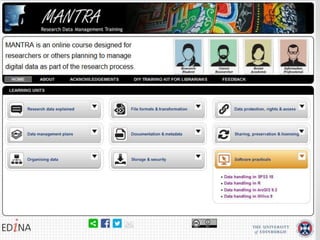
• MANTRA – online course about RDM
• Benchmark: DCC 2014 UK survey results - RDM
services in place
• Challenges in RDM support & open data advocacy
• Benchmark: DCC 2014 UK survey results – Obstacles
in supporting RDM
UoE RDM Policy &
Open Access to Data
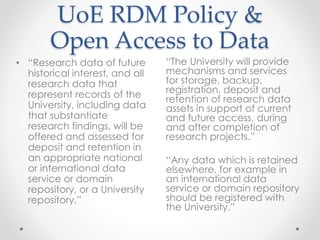
“The University will provide
mechanisms and services
for storage, backup,
registration, deposit and
retention of research data
assets in support of current
and future access, during
and after completion of
research projects.”
“Any data which is retained
elsewhere, for example in
an international data
service or domain repository
should be registered with
the University.”
• “Research data of future
historical interest, and all
research data that
represent records of the
University, including data
that substantiate
research findings, will be
offered and assessed for
deposit and retention in
an appropriate national
or international data
service or domain
repository, or a University
repository.”
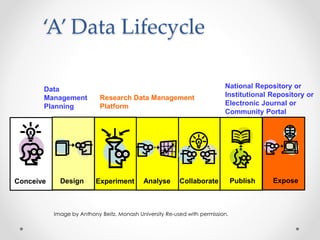
‘A’ Data Lifecycle
Image by Anthony Beitz, Monash University Re-used with permission.
CollaborateConceive Design Experiment Publish ExposeAnalyseDesign
Data
Management
Planning
Expose
National Repository or
Institutional Repository or
Electronic Journal or
Community Portal
Research Data Management
Platform
CollaborateExperiment PublishAnalyse
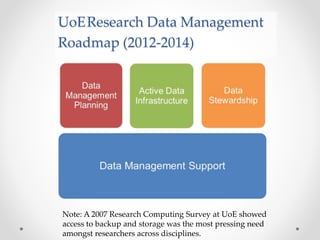
UoEResearch Data Management
Roadmap (2012-2014)
Note: A 2007 Research Computing Survey at UoE showed
access to backup and storage was the most pressing need
amongst researchers across disciplines.
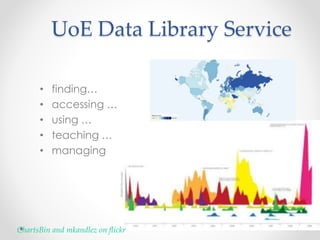
UoE Data Library Service
• finding…
• accessing …
• using …
• teaching …
• managing
ChartsBin and mkandlez on flickr
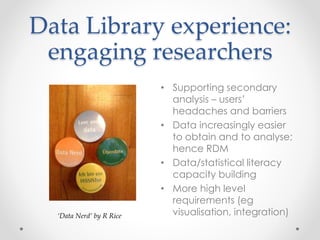
Data Library experience:
engaging researchers
• Supporting secondary
analysis – users’
headaches and barriers
• Data increasingly easier
to obtain and to analyse;
hence RDM
• Data/statistical literacy
capacity building
• More high level
requirements (eg
visualisation, integration)‘Data Nerd’ by R Rice
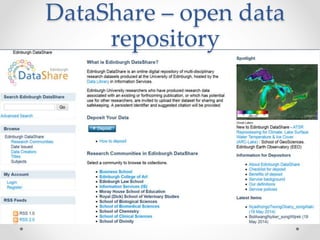
DataShare – open data
repository
DataShare experience:
engaging researchers
• Woo early adopters;
gather good reputation
• Focus on benefits
• Keep developing it to
meet more user
needs/expectations
• Save the time of
depositors BUT
• Keep the end-user in
mind (QA)
• Set policies to avoid
‘mission creep’
RETAIN AS IS, by R Rice
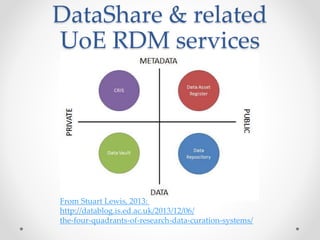
From Stuart Lewis, 2013:
http://datablog.is.ed.ac.uk/2013/12/06/
the-four-quadrants-of-research-data-curation-systems/
DataShare & related
UoE RDM services
MANTRA experience:
engaging researchers
• Bringing MANTRA into
classroom setting
• Disciplinary-specific vs
generic RDM training
• Open vs closed:
(Inter)national reach vs
institutional reach
• Self-assessment vs for-
credit course
• Librarians like it (even)
more
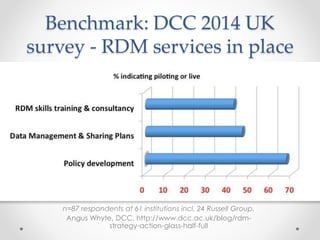
Benchmark: DCC 2014 UK
survey - RDM services in place
n=87 respondents at 61 institutions incl. 24 Russell Group.
Angus Whyte, DCC, http://www.dcc.ac.uk/blog/rdm-
strategy-action-glass-half-full
Challenges in RDM
support & advocacy
• Reaching critical mass of students and academics
at point of need (timing, priorities, scheduling)
• ‘Turnaround time’ in writing data management
plans
• Identifying ‘RDM’ requests at helpdesk; proper
routing to expert support
• Costing intensive data services & in-depth support
in grants
• Getting balance right for private and open data
o Incentivising sharing
• Working ‘upstream’ in research process is hard
DCC 2014 UK survey results
Obstacles to RDM provision (Table 8) % (n=87)
Lack of appropriate staff resources and infrastructure 71%
Availability of funding 64%
Low priority for researchers 56%
Lack of relevant accepted standards 38%
Lack of knowledge of appropriate solutions 36%
Lack of appropriate skills and expertise to implement solutions 34%
Low priority for management 23%
“Pre‐release Briefing 1” [email], 23 April 2014. Angus Whyte, Diana Sisu, DCC.
Thanks to RECODE
• Email: R.Rice@ed.ac.uk
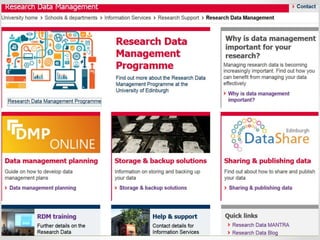
• RDM Website: www.ed.ac.uk/is/data-management
• Data Library: www.ed.ac.uk/is/data-library
• Blog: http://datablog.is.ed.ac.uk
• DCC 2014 UK Survey Results:
http://www.dcc.ac.uk/blog/rdm-2014-survey

Engaging researchers in RDM & Open Data at Edinburgh University

  • 1.
    Engaging researchers in RDM& Open Data at Edinburgh University Robin Rice EDINA and Data Library Information Services University of Edinburgh #RECODE, Riga, Latvia: 1st July, 2014
  • 2.
    Overview • UoE RDMPolicy regarding open data • Data lifecycle & our RDM Programme • Data Library – supporting re-use of data • Edinburgh DataShare – institutional data repository • MANTRA – online course about RDM • Benchmark: DCC 2014 UK survey results - RDM services in place • Challenges in RDM support & open data advocacy • Benchmark: DCC 2014 UK survey results – Obstacles in supporting RDM
  • 3.
    UoE RDM Policy& Open Access to Data “The University will provide mechanisms and services for storage, backup, registration, deposit and retention of research data assets in support of current and future access, during and after completion of research projects.” “Any data which is retained elsewhere, for example in an international data service or domain repository should be registered with the University.” • “Research data of future historical interest, and all research data that represent records of the University, including data that substantiate research findings, will be offered and assessed for deposit and retention in an appropriate national or international data service or domain repository, or a University repository.”
  • 4.
    ‘A’ Data Lifecycle Imageby Anthony Beitz, Monash University Re-used with permission. CollaborateConceive Design Experiment Publish ExposeAnalyseDesign Data Management Planning Expose National Repository or Institutional Repository or Electronic Journal or Community Portal Research Data Management Platform CollaborateExperiment PublishAnalyse
  • 5.
    UoEResearch Data Management Roadmap(2012-2014) Note: A 2007 Research Computing Survey at UoE showed access to backup and storage was the most pressing need amongst researchers across disciplines.
  • 7.
    UoE Data LibraryService • finding… • accessing … • using … • teaching … • managing ChartsBin and mkandlez on flickr
  • 8.
    Data Library experience: engagingresearchers • Supporting secondary analysis – users’ headaches and barriers • Data increasingly easier to obtain and to analyse; hence RDM • Data/statistical literacy capacity building • More high level requirements (eg visualisation, integration)‘Data Nerd’ by R Rice
  • 9.
    DataShare – opendata repository
  • 10.
    DataShare experience: engaging researchers •Woo early adopters; gather good reputation • Focus on benefits • Keep developing it to meet more user needs/expectations • Save the time of depositors BUT • Keep the end-user in mind (QA) • Set policies to avoid ‘mission creep’ RETAIN AS IS, by R Rice
  • 11.
    From Stuart Lewis,2013: http://datablog.is.ed.ac.uk/2013/12/06/ the-four-quadrants-of-research-data-curation-systems/ DataShare & related UoE RDM services
  • 13.
    MANTRA experience: engaging researchers •Bringing MANTRA into classroom setting • Disciplinary-specific vs generic RDM training • Open vs closed: (Inter)national reach vs institutional reach • Self-assessment vs for- credit course • Librarians like it (even) more
  • 14.
    Benchmark: DCC 2014UK survey - RDM services in place n=87 respondents at 61 institutions incl. 24 Russell Group. Angus Whyte, DCC, http://www.dcc.ac.uk/blog/rdm- strategy-action-glass-half-full
  • 15.
    Challenges in RDM support& advocacy • Reaching critical mass of students and academics at point of need (timing, priorities, scheduling) • ‘Turnaround time’ in writing data management plans • Identifying ‘RDM’ requests at helpdesk; proper routing to expert support • Costing intensive data services & in-depth support in grants • Getting balance right for private and open data o Incentivising sharing • Working ‘upstream’ in research process is hard
  • 16.
    DCC 2014 UKsurvey results Obstacles to RDM provision (Table 8) % (n=87) Lack of appropriate staff resources and infrastructure 71% Availability of funding 64% Low priority for researchers 56% Lack of relevant accepted standards 38% Lack of knowledge of appropriate solutions 36% Lack of appropriate skills and expertise to implement solutions 34% Low priority for management 23% “Pre‐release Briefing 1” [email], 23 April 2014. Angus Whyte, Diana Sisu, DCC.
  • 17.
    Thanks to RECODE •Email: R.Rice@ed.ac.uk • RDM Website: www.ed.ac.uk/is/data-management • Data Library: www.ed.ac.uk/is/data-library • Blog: http://datablog.is.ed.ac.uk • DCC 2014 UK Survey Results: http://www.dcc.ac.uk/blog/rdm-2014-survey

Editor's Notes

  • #6 Planning: Support and services for planning activities that are typically performed before research data is collected or created AD Infra: Facilities to store data that are actively used in current research activities, to provide access to that storage, and tools to assist in working with the data Stewardship: Tools and services to aid in the description, deposit, and on-going management of completed research data outputs …
  • #8 “I need to analyse some data for a project, but all I can find are published papers with tables and graphs, not the original data source.” Accessing … “I’ve found the data I need, but I’m not sure how to gain access to it.” Using … “I’ve got the data I need, but I’m having problems analysing it in my chosen software.” Teaching … “I need a dataset that shows the distribution of mobile phone use to engage my students.”
  • #13 Openly licensed online learning self-paced course in RDM for postgrads and early career researchers Grounded in three disciplines, working with post-graduate schools Video stories from researchers in variety of settings Data handling exercises in four software analysis packages http://datalib.edina.ac.uk/mantra
  • #15 87 respondents came from 61 institutions; 37% of the 163 listed by the Higher Education Statistics Agency. They included 100% of the Russell Group, and 55% of the 45 universities that cross our research income threshold but are not in the Russell Group (i.e. 71% of our target group in all).