Database Management Systems
Session 6
TRANSACTIONS MANAGEMENT AND
CONCURRENCY CONTROL
Lecturer: Ms. Esther Kimani
1
Definition
A transaction is a series of actions carried out by
a single user or application program, which must
be treated as a single logical unit of work. It
results from the execution of a user program
delimited by statements (or function calls) of the
form begin transactions and end transactions.
2
Properties Of Transactions
(i) Atomicity
• It is the all or nothing property.
• Either all the operations of the transactions are reflected in
the database properly or none are. This means that a
transaction is an indivisible unit.
(ii) Consistency
• Execution of a transaction in isolation preserves the
consistency of the database. So a transaction will normally
transform a database from one consistent state to another
consistent state.
3
Properties Of Transactions
(iii) Isolation (Independent)
• Transaction execute independently of one another i.e. even though
multiple transactions may execute concurrently the system
quantities that for ever pair of transactions Ti and Tj it appears to Ti
that either Tj finished execution after Ti started or Tj started
execution after Ti finished each transactions is unaware of other
transactions executing concurrently in the system.
(iv) Durability /Persistence
• The effects of a successfully completed (committed) transaction are
permanently recorded in the database and cannot be undone.
• These properties are usually referred to as ACID properties.
4
Interference between Concurrent transactions
Concurrency transactions can present the
following problems among others.
(i) Lost update problem
(ii) Uncommitted dependency problem
(iii) Inconsistency analysis problem
5
Interference between Concurrent transactions
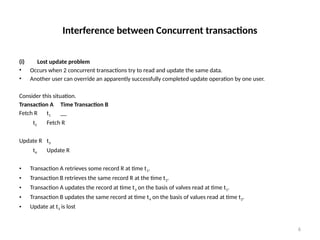
(i) Lost update problem
• Occurs when 2 concurrent transactions try to read and update the same data.
• Another user can override an apparently successfully completed update operation by one user.
Consider this situation.
Transaction A Time Transaction B
Fetch R t1 __
t2 Fetch R
Update R t3
t4 Update R
• Transaction A retrieves some record R at time t1.
• Transaction B retrieves the same record R at the time t2.
• Transaction A updates the record at time t3 on the basis of valves read at time t1.
• Transaction B updates the same record at time t4 on the basis of values read at time t2.
• Update at t3 is lost
6
Interference between Concurrent transactions
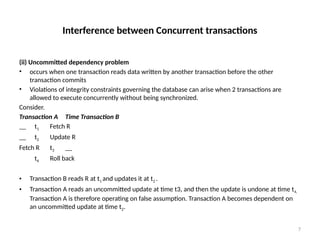
(ii) Uncommitted dependency problem
• occurs when one transaction reads data written by another transaction before the other
transaction commits
• Violations of integrity constraints governing the database can arise when 2 transactions are
allowed to execute concurrently without being synchronized.
Consider.
Transaction A Time Transaction B
__ t1 Fetch R
__ t2 Update R
Fetch R t3 __
t4 Roll back
• Transaction B reads R at t1 and updates it at t2 .
• Transaction A reads an uncommitted update at time t3, and then the update is undone at time t4.
Transaction A is therefore operating on false assumption. Transaction A becomes dependent on
an uncommitted update at time t2.
7
Interference between Concurrent transactions
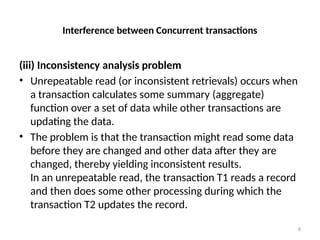
(iii) Inconsistency analysis problem
• Unrepeatable read (or inconsistent retrievals) occurs when
a transaction calculates some summary (aggregate)
function over a set of data while other transactions are
updating the data.
• The problem is that the transaction might read some data
before they are changed and other data after they are
changed, thereby yielding inconsistent results.
In an unrepeatable read, the transaction T1 reads a record
and then does some other processing during which the
transaction T2 updates the record.
8
Concurrency Control Techniques
There are 3 basic concurrency control
techniques:
• (i) Locking Method
• (ii) Time Stamp Method
• (iii) Optimistic Method
9
Concurrency Control Techniques
(i) Locking Method
A lock guarantees exclusive use of data item to a
current transaction. Transaction T1 does not have
access to a data item that is currently used by
transaction T2. A transaction acquires a lock prior
to data access. The lock is released (Unlock) when
the transaction is completed so that another
transaction can lock the data item for its exclusive
use.
10
Concurrency Control Techniques
(i) Locking Method
• Shared Locks
• These are used during read operations since read operations
cannot conflict. More than one transaction is permitted to
hold read locks simultaneously of the same data item.
•
• Exclusive Locks (White Locks)
• These give a transaction exclusive access to a data item. As
long as a transaction holds an exclusive lock no other
transaction can read or update that data item.
11
Concurrency Control Techniques
(i) Locking Method
• 2-Phase locking
• To ensure serialisability the 2- phase locking protocol defines how transaction acquire
and relinquish locks. 2-phase locking guarantees serialisability but it does not prevent
deadlocks. The 2-phases are:
•
• Growing phase in which a transaction acquires all the required locks without unlocking
any data. Once all the locks have been acquired the transaction is in its locked point.
• Stinking phase in which a transaction releases all locks and cannot obtain any new lock.
•
• Rules governing the 2-Phase protocol are:
• 2 transactions cannot have conflicting locks
• No unlock operation can precede an unlock operation in the same transaction.
• No data is affected until all locks are obtained i.e. until the transaction is in the locked
point.
12
Deadlocks
• It is used when 2 transactions T1 and T2 exist in the
following modes:
• T1 = access data items X and Y
• T2 = access data item Y and X
• If T1 has not unlocked Y then T2 cannot begin.
• If T2 has not unlocked data item X, T1 cannot continue.
• Consequently T1 and T2 wait indefinitely each waiting
for the other to unlock the required data item. Such a
deadlock is known as deadly embrace.
13
Techniques to Control Deadlocks
Deadlock Prevention
• A transaction requesting a new lock is aborted if there is a possibility that a dead lock can occur. If the
transaction is aborted, all the changes made by this transaction are rolled back and all locks obtained by
the transaction are released. The transaction is then rescheduled for execution. Deadlock prevention works
because it avoids the conditions that lead to deadlock.
Deadlock Detection
• The DBMS periodically tests the database for deadlocks. If the deadlock is found one of the transactions
(the "victim”) is aborted (rolled back and restarted) and the other transaction continues.
Deadlock Avoidance
• The transaction must obtain all the locks it needs before it can be executed. This technique avoids rolled up
of conflicting transactions by requiring that locks be obtained in successions, but the serial lock assignment
increase action response times.
Conclusion:
• The best deadlock control method depends on the database environment, if the probability is low,
deadlock detection is recommended, if probability is high, deadlock prevention is recommended and if
response time is not high on the system priority list deadlock avoidance might be employed.
14
Concurrency Control Techniques
(ii) Time Stamping Method
• The time stamping approach, to schedule concurrent
transactions assign a global unique time stamp to
each transaction. The time stamp value uses an
explicit order in which transactions are submitted to
the DBMS. The stamps must have 2 properties;
1. Uniqueness - which assures that no equal time stamp values
can exist.
2. Monotonicity - which assures that time stamp values always
increase.
15
Concurrency Control Techniques
(ii) Time Stamping Method
• All database operations read and write within the same
transaction must have the same time stamp. The DBMS executes
conflicting operations in the time stamp order thereby ensuring
serialisability of the transactions.
• If 2 transactions conflict, one is often stopped, re-scheduled and
assigned a new time stamp value. The main draw back of time
stamping approach is that each value stored in the database
requires 2 additional time- stamp fields, one for the last time the
field was read and one for the last update. Time stamping thus
increases the memory needs and the databases.
16
Concurrency Control Techniques
(iii) Optimistic Methods
The optimistic approach is based on the
assumption that the majority of database
operations do not conflict. The optimistic
approach does not require locking or time
stamping techniques; instead a transaction is
executed without restrictions until it is committed.
In this approach, each transaction moves through
2 or 3 phases; read, validation and write phase.
17
Concurrency Control Techniques
(iii) Optimistic Methods
Read Phase
• The transaction reads the database, executes the needed computations and makes
the updates to private copy of the database values. All update operations of the
transaction are recorded in a temporary update file, which is not accessed by the
remaining transactions.
Validation Phase
• The transaction is validated to ensure that the changes made will not affect the
integrity and consistency of the database. If a validation phase is negative, the
transaction is restarted and the changes are discarded.
Write Phase
• The changes are permanently applied (written) to the database.
Conclusion
• The optimistic approach is acceptable for mostly read or query database system that
require very few update transactions.
18

DBMS Session 6 Transactions Management and Concurrency Control.pptx

  • 1.
    Database Management Systems Session6 TRANSACTIONS MANAGEMENT AND CONCURRENCY CONTROL Lecturer: Ms. Esther Kimani 1
  • 2.
    Definition A transaction isa series of actions carried out by a single user or application program, which must be treated as a single logical unit of work. It results from the execution of a user program delimited by statements (or function calls) of the form begin transactions and end transactions. 2
  • 3.
    Properties Of Transactions (i)Atomicity • It is the all or nothing property. • Either all the operations of the transactions are reflected in the database properly or none are. This means that a transaction is an indivisible unit. (ii) Consistency • Execution of a transaction in isolation preserves the consistency of the database. So a transaction will normally transform a database from one consistent state to another consistent state. 3
  • 4.
    Properties Of Transactions (iii)Isolation (Independent) • Transaction execute independently of one another i.e. even though multiple transactions may execute concurrently the system quantities that for ever pair of transactions Ti and Tj it appears to Ti that either Tj finished execution after Ti started or Tj started execution after Ti finished each transactions is unaware of other transactions executing concurrently in the system. (iv) Durability /Persistence • The effects of a successfully completed (committed) transaction are permanently recorded in the database and cannot be undone. • These properties are usually referred to as ACID properties. 4
  • 5.
    Interference between Concurrenttransactions Concurrency transactions can present the following problems among others. (i) Lost update problem (ii) Uncommitted dependency problem (iii) Inconsistency analysis problem 5
  • 6.
    Interference between Concurrenttransactions (i) Lost update problem • Occurs when 2 concurrent transactions try to read and update the same data. • Another user can override an apparently successfully completed update operation by one user. Consider this situation. Transaction A Time Transaction B Fetch R t1 __ t2 Fetch R Update R t3 t4 Update R • Transaction A retrieves some record R at time t1. • Transaction B retrieves the same record R at the time t2. • Transaction A updates the record at time t3 on the basis of valves read at time t1. • Transaction B updates the same record at time t4 on the basis of values read at time t2. • Update at t3 is lost 6
  • 7.
    Interference between Concurrenttransactions (ii) Uncommitted dependency problem • occurs when one transaction reads data written by another transaction before the other transaction commits • Violations of integrity constraints governing the database can arise when 2 transactions are allowed to execute concurrently without being synchronized. Consider. Transaction A Time Transaction B __ t1 Fetch R __ t2 Update R Fetch R t3 __ t4 Roll back • Transaction B reads R at t1 and updates it at t2 . • Transaction A reads an uncommitted update at time t3, and then the update is undone at time t4. Transaction A is therefore operating on false assumption. Transaction A becomes dependent on an uncommitted update at time t2. 7
  • 8.
    Interference between Concurrenttransactions (iii) Inconsistency analysis problem • Unrepeatable read (or inconsistent retrievals) occurs when a transaction calculates some summary (aggregate) function over a set of data while other transactions are updating the data. • The problem is that the transaction might read some data before they are changed and other data after they are changed, thereby yielding inconsistent results. In an unrepeatable read, the transaction T1 reads a record and then does some other processing during which the transaction T2 updates the record. 8
  • 9.
    Concurrency Control Techniques Thereare 3 basic concurrency control techniques: • (i) Locking Method • (ii) Time Stamp Method • (iii) Optimistic Method 9
  • 10.
    Concurrency Control Techniques (i)Locking Method A lock guarantees exclusive use of data item to a current transaction. Transaction T1 does not have access to a data item that is currently used by transaction T2. A transaction acquires a lock prior to data access. The lock is released (Unlock) when the transaction is completed so that another transaction can lock the data item for its exclusive use. 10
  • 11.
    Concurrency Control Techniques (i)Locking Method • Shared Locks • These are used during read operations since read operations cannot conflict. More than one transaction is permitted to hold read locks simultaneously of the same data item. • • Exclusive Locks (White Locks) • These give a transaction exclusive access to a data item. As long as a transaction holds an exclusive lock no other transaction can read or update that data item. 11
  • 12.
    Concurrency Control Techniques (i)Locking Method • 2-Phase locking • To ensure serialisability the 2- phase locking protocol defines how transaction acquire and relinquish locks. 2-phase locking guarantees serialisability but it does not prevent deadlocks. The 2-phases are: • • Growing phase in which a transaction acquires all the required locks without unlocking any data. Once all the locks have been acquired the transaction is in its locked point. • Stinking phase in which a transaction releases all locks and cannot obtain any new lock. • • Rules governing the 2-Phase protocol are: • 2 transactions cannot have conflicting locks • No unlock operation can precede an unlock operation in the same transaction. • No data is affected until all locks are obtained i.e. until the transaction is in the locked point. 12
  • 13.
    Deadlocks • It isused when 2 transactions T1 and T2 exist in the following modes: • T1 = access data items X and Y • T2 = access data item Y and X • If T1 has not unlocked Y then T2 cannot begin. • If T2 has not unlocked data item X, T1 cannot continue. • Consequently T1 and T2 wait indefinitely each waiting for the other to unlock the required data item. Such a deadlock is known as deadly embrace. 13
  • 14.
    Techniques to ControlDeadlocks Deadlock Prevention • A transaction requesting a new lock is aborted if there is a possibility that a dead lock can occur. If the transaction is aborted, all the changes made by this transaction are rolled back and all locks obtained by the transaction are released. The transaction is then rescheduled for execution. Deadlock prevention works because it avoids the conditions that lead to deadlock. Deadlock Detection • The DBMS periodically tests the database for deadlocks. If the deadlock is found one of the transactions (the "victim”) is aborted (rolled back and restarted) and the other transaction continues. Deadlock Avoidance • The transaction must obtain all the locks it needs before it can be executed. This technique avoids rolled up of conflicting transactions by requiring that locks be obtained in successions, but the serial lock assignment increase action response times. Conclusion: • The best deadlock control method depends on the database environment, if the probability is low, deadlock detection is recommended, if probability is high, deadlock prevention is recommended and if response time is not high on the system priority list deadlock avoidance might be employed. 14
  • 15.
    Concurrency Control Techniques (ii)Time Stamping Method • The time stamping approach, to schedule concurrent transactions assign a global unique time stamp to each transaction. The time stamp value uses an explicit order in which transactions are submitted to the DBMS. The stamps must have 2 properties; 1. Uniqueness - which assures that no equal time stamp values can exist. 2. Monotonicity - which assures that time stamp values always increase. 15
  • 16.
    Concurrency Control Techniques (ii)Time Stamping Method • All database operations read and write within the same transaction must have the same time stamp. The DBMS executes conflicting operations in the time stamp order thereby ensuring serialisability of the transactions. • If 2 transactions conflict, one is often stopped, re-scheduled and assigned a new time stamp value. The main draw back of time stamping approach is that each value stored in the database requires 2 additional time- stamp fields, one for the last time the field was read and one for the last update. Time stamping thus increases the memory needs and the databases. 16
  • 17.
    Concurrency Control Techniques (iii)Optimistic Methods The optimistic approach is based on the assumption that the majority of database operations do not conflict. The optimistic approach does not require locking or time stamping techniques; instead a transaction is executed without restrictions until it is committed. In this approach, each transaction moves through 2 or 3 phases; read, validation and write phase. 17
  • 18.
    Concurrency Control Techniques (iii)Optimistic Methods Read Phase • The transaction reads the database, executes the needed computations and makes the updates to private copy of the database values. All update operations of the transaction are recorded in a temporary update file, which is not accessed by the remaining transactions. Validation Phase • The transaction is validated to ensure that the changes made will not affect the integrity and consistency of the database. If a validation phase is negative, the transaction is restarted and the changes are discarded. Write Phase • The changes are permanently applied (written) to the database. Conclusion • The optimistic approach is acceptable for mostly read or query database system that require very few update transactions. 18