KERNEL MODULES&PROCESS
MANAGEMENT
B.Sakthibala,
l.M.sc(cs)
KERNEL MODULES
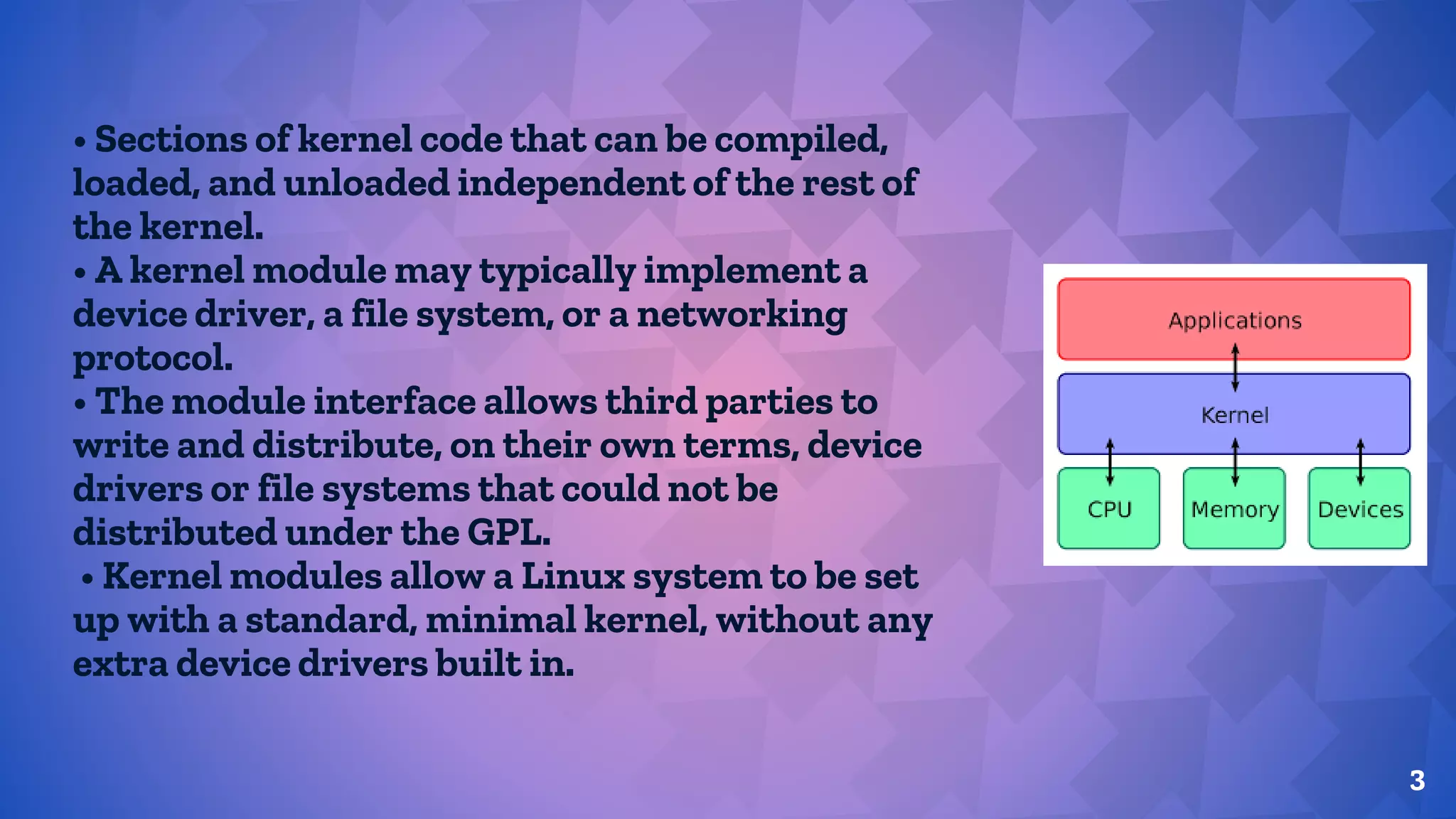
• Sections of kernel code that can be compiled,
loaded, and unloaded independent of the rest of
the kernel.
• A kernel module may typically implement a
device driver, a file system, or a networking
protocol.
• The module interface allows third parties to
write and distribute, on their own terms, device
drivers or file systems that could not be
distributed under the GPL.
• Kernel modules allow a Linux system to be set
up with a standard, minimal kernel, without any
extra device drivers built in.
3
• Three components to Linux module support:
– module management
– driver registration
– conflict resolution
“
Module Management
• Supports loading modules into memory and
letting them talk to the rest of the kernel.
• Module loading is split into two separate
sections:
– Managing sections of module code in kernel
memory
– Handling symbols that modules are allowed
to reference 5
⇨ • The module requestor manages loading
requested, but currently unloaded, modules;
it also regularly queries the kernel to see
whether a dynamically loaded module is still
in use, and will unload it when it is no longer
actively needed.
6
Driver Registration
• Allows modules to tell the rest of the kernel that a new
driver has become available.
• The kernel maintains dynamic tables of all known
drivers, and provides a set of routines to allow drivers to
be added to or removed from these tables at any time.
7
• Registration tables include the
following items:
– Device drivers
– File systems
– Network protocols
– Binary format
8
Conflict Resolution
A mechanism that allows different device
drivers to reserve hardware resources and
to protect those resources from accidental
use by another driver.
9
• The conflict resolution module aims to:
– Prevent modules from clashing over access to
hardware resources
– Prevent autoprobes from interfering with existing
device drivers
– Resolve conflicts with multiple drivers trying to access
the same hardware
10
PROCESS MANAGEMENT
11
12
• UNIX process management separates the
creation of processes and the running of a
new program into two distinct operations.
– The fork system call creates a new
process.
– A new program is run after a call to
execve.
13
• Under UNIX, a process encompasses
all the information that the operating
system must maintain to track the
context of a single execution of a
single program.
• Under Linux, process properties fall
into three groups: the process’s
identity, environment, and context.
14
Process identity
Process ID (PID). The unique identifier for the process;
used to specify processes to the operating system
when an application makes a system call to signal,
modify, or wait for another process.
• Credentials. Each process must have an associated
user ID and one or more group IDs that determine the
process’s rights to access system resources and files.
• Personality. Not traditionally found on UNIX systems,
but under Linux each process has an associated
personality identifier that can slightly modify the
semantics of certain system calls.
Used primarily by emulation libraries to request that
system calls be compatible with certain specific flavors
of UNIX.
15
Process Environment
16
• The process’s environment is inherited from its
parent, and is composed of two null-terminated
vectors:
– The argument vector lists the command-line
arguments used to invoke the running program;
conventionally starts with the name of the program
itself
– The environment vector is a list of “NAME=VALUE”
pairs that associates named environment variables
with arbitrary textual values.
Process Context
• The (constantly changing) state of a running
program at any one point in time.
• The scheduling context is the most important part of
the process context; it is the information that the
scheduler needs to suspend and restart the process
• The kernel maintains accounting information about
the resources currently being consumed by each
process, and the total resources consumed by the
process in its lifetime so far.
17
18
Process Context (cont’d)
• Whereas the file table lists the existing open files, the file-
system context applies to requests to open new files. The
current root and default directories to be used for new file
searches are stored here.
• The signal-handler table defines the routine in the
process’s address space to be called when specific signals
arrive.
• The virtual-memory context of a process describes the full
contents of its private address space.
Processes and Threads
19
Linux uses the same internal representation for
processes and threads; a thread is simply a new
process that happens to share the same address
space as its parent.
• A distinction is only made when a new thread is
created by the clone system call.
– fork creates a new process with its own entirely new
process context
– clone creates a new process with its own identity,
but that is allowed to share the data structures of its
parent
20

Operating system

  • 1.
  • 2.
  • 3.
    • Sections ofkernel code that can be compiled, loaded, and unloaded independent of the rest of the kernel. • A kernel module may typically implement a device driver, a file system, or a networking protocol. • The module interface allows third parties to write and distribute, on their own terms, device drivers or file systems that could not be distributed under the GPL. • Kernel modules allow a Linux system to be set up with a standard, minimal kernel, without any extra device drivers built in. 3
  • 4.
    • Three componentsto Linux module support: – module management – driver registration – conflict resolution
  • 5.
    “ Module Management • Supportsloading modules into memory and letting them talk to the rest of the kernel. • Module loading is split into two separate sections: – Managing sections of module code in kernel memory – Handling symbols that modules are allowed to reference 5
  • 6.
    ⇨ • Themodule requestor manages loading requested, but currently unloaded, modules; it also regularly queries the kernel to see whether a dynamically loaded module is still in use, and will unload it when it is no longer actively needed. 6
  • 7.
    Driver Registration • Allowsmodules to tell the rest of the kernel that a new driver has become available. • The kernel maintains dynamic tables of all known drivers, and provides a set of routines to allow drivers to be added to or removed from these tables at any time. 7
  • 8.
    • Registration tablesinclude the following items: – Device drivers – File systems – Network protocols – Binary format 8
  • 9.
    Conflict Resolution A mechanismthat allows different device drivers to reserve hardware resources and to protect those resources from accidental use by another driver. 9
  • 10.
    • The conflictresolution module aims to: – Prevent modules from clashing over access to hardware resources – Prevent autoprobes from interfering with existing device drivers – Resolve conflicts with multiple drivers trying to access the same hardware 10
  • 11.
  • 12.
    12 • UNIX processmanagement separates the creation of processes and the running of a new program into two distinct operations. – The fork system call creates a new process. – A new program is run after a call to execve.
  • 13.
    13 • Under UNIX,a process encompasses all the information that the operating system must maintain to track the context of a single execution of a single program. • Under Linux, process properties fall into three groups: the process’s identity, environment, and context.
  • 14.
    14 Process identity Process ID(PID). The unique identifier for the process; used to specify processes to the operating system when an application makes a system call to signal, modify, or wait for another process. • Credentials. Each process must have an associated user ID and one or more group IDs that determine the process’s rights to access system resources and files.
  • 15.
    • Personality. Nottraditionally found on UNIX systems, but under Linux each process has an associated personality identifier that can slightly modify the semantics of certain system calls. Used primarily by emulation libraries to request that system calls be compatible with certain specific flavors of UNIX. 15
  • 16.
    Process Environment 16 • Theprocess’s environment is inherited from its parent, and is composed of two null-terminated vectors: – The argument vector lists the command-line arguments used to invoke the running program; conventionally starts with the name of the program itself – The environment vector is a list of “NAME=VALUE” pairs that associates named environment variables with arbitrary textual values.
  • 17.
    Process Context • The(constantly changing) state of a running program at any one point in time. • The scheduling context is the most important part of the process context; it is the information that the scheduler needs to suspend and restart the process • The kernel maintains accounting information about the resources currently being consumed by each process, and the total resources consumed by the process in its lifetime so far. 17
  • 18.
    18 Process Context (cont’d) •Whereas the file table lists the existing open files, the file- system context applies to requests to open new files. The current root and default directories to be used for new file searches are stored here. • The signal-handler table defines the routine in the process’s address space to be called when specific signals arrive. • The virtual-memory context of a process describes the full contents of its private address space.
  • 19.
    Processes and Threads 19 Linuxuses the same internal representation for processes and threads; a thread is simply a new process that happens to share the same address space as its parent. • A distinction is only made when a new thread is created by the clone system call. – fork creates a new process with its own entirely new process context – clone creates a new process with its own identity, but that is allowed to share the data structures of its parent
  • 20.