Jenn Riley
Metadata Librarian
Indiana University
Digital Library Program
“The Semantic Web is not a separate
Web but an extension of the current
one, in which information is given well-
defined meaning, better enabling
computers and people to work in
cooperation.”
Berners-Lee, Tim, James Hendler and Ora Lassila. (May
2001). “The Semantic Web.” Scientific American 284(5).
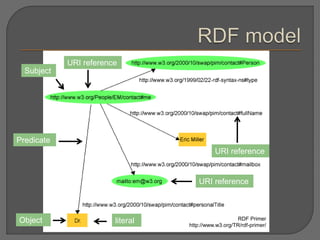
Subject
Object
Predicate
URI reference
URI reference
literal RDF Primer
http://www.w3.org/TR/rdf-primer/
URI reference
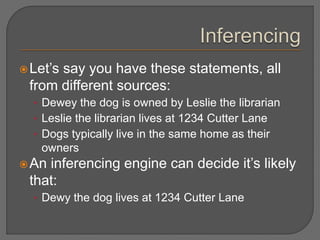
Let’s say you have these statements, all
from different sources:
• Dewey the dog is owned by Leslie the librarian
• Leslie the librarian lives at 1234 Cutter Lane
• Dogs typically live in the same home as their
owners
An inferencing engine can decide it’s likely
that:
• Dewy the dog lives at 1234 Cutter Lane
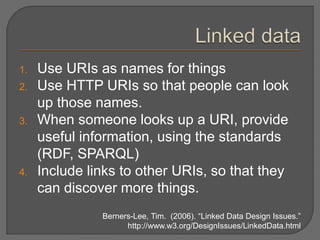
1. Use URIs as names for things
2. Use HTTP URIs so that people can look
up those names.
3. When someone looks up a URI, provide
useful information, using the standards
(RDF, SPARQL)
4. Include links to other URIs, so that they
can discover more things.
Berners-Lee, Tim. (2006). “Linked Data Design Issues.”
http://www.w3.org/DesignIssues/LinkedData.html
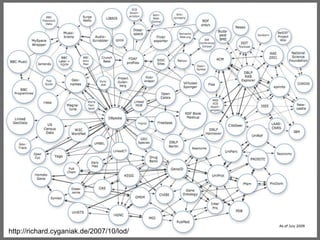
http://richard.cyganiak.de/2007/10/lod/
id.loc.gov
VIAF
Hungarian National Library
German National Library
Royal Library of Sweden
(at least)
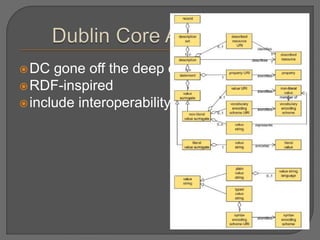
DC gone off the deep end
RDF-inspired
include interoperability levels
Why is it so hard for library-types
to wrap our brains around all of
this?
The underlying model of DCAM,
RDF, and the Semantic Web has
some significant differences from
the models we’re used to.
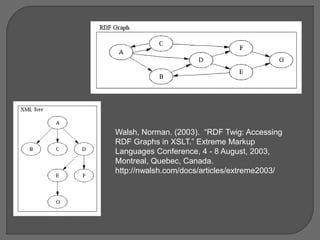
Walsh, Norman. (2003). “RDF Twig: Accessing
RDF Graphs in XSLT.” Extreme Markup
Languages Conference, 4 - 8 August, 2003,
Montreal, Quebec, Canada.
http://nwalsh.com/docs/articles/extreme2003/
Diagram of classes/subclasses,
properties/subproperties
RDF Schema ≠ XML Schema
Elements aren’t properties
Rdf thinks of element “vocabularies” tho
libraries think of them not like cvs
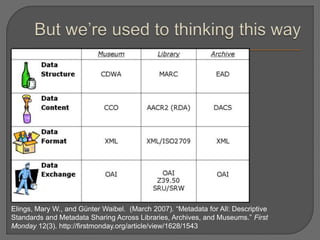
Elings, Mary W., and Günter Waibel. (March 2007). “Metadata for All: Descriptive
Standards and Metadata Sharing Across Libraries, Archives, and Museums.” First
Monday 12(3). http://firstmonday.org/article/view/1628/1543
How do you know what properties/classes
have been defined so you can re-use
them?
Dcap’s using FRBR – no overlap
v/frbr – what’s not rdf-able from xml
Rda use of this stuff
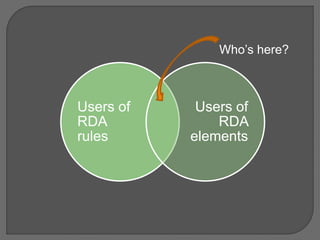
Users of
RDA
rules
Users of
RDA
elements
Who’s here?
Potential ≠ Success
So what do we do now?
(Do we even need
to do anything?)
(Or are new and revised
XML formats going to be
enough?)
Balance building infrastructure
with facilitating production
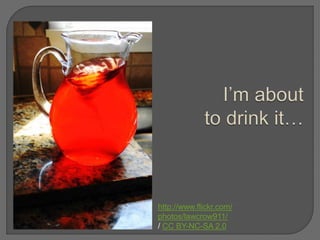
http://www.flickr.com/
photos/lawcrow911/
/ CC BY-NC-SA 2.0
 URIs are good
 Relegating information to notes comes back
to bite you
 Libraries are already making tentative
investments in this area
 But…
• We have trouble accepting things “not invented here”
• DC 1:1 principle ran into problems in practice
• Systems never evolved to handle the more functional
metadata structures we planned
Blacklight/VuFind/etc.
• We have more control over these discovery
systems than we’ve had, well, ever
• They’re getting a lot of press, support, and funding
• They can show off in concrete ways what’s
possible if our data is in better shape
???????????????????????
RDA as Linked Data, RDF properties
• This one I’m not so sure of
Can we define our models deeply
enough that both graph and tree
renderings are possible?
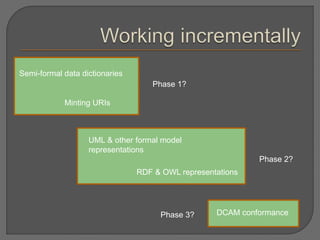
Semi-formal data dictionaries
UML & other formal model
representations
RDF & OWL representations
DCAM conformance
Phase 1?
Phase 2?
Phase 3?
Minting URIs
Dcam possible changes
Participate in the dcmi discussion
• Push the theory towards practice
Rdf/a behind web pages – show
cushman? Asho?
Participate in the linking open data
community project?
http://www.flickr.com/photos/mararie/ / CC BY-SA 2.0
How Much to Semanticize? Looking at the future of Library Data and the Semantic Web

How Much to Semanticize? Looking at the future of Library Data and the Semantic Web

  • 1.
    Jenn Riley Metadata Librarian IndianaUniversity Digital Library Program
  • 2.
    “The Semantic Webis not a separate Web but an extension of the current one, in which information is given well- defined meaning, better enabling computers and people to work in cooperation.” Berners-Lee, Tim, James Hendler and Ora Lassila. (May 2001). “The Semantic Web.” Scientific American 284(5).
  • 3.
    Subject Object Predicate URI reference URI reference literalRDF Primer http://www.w3.org/TR/rdf-primer/ URI reference
  • 4.
    Let’s say youhave these statements, all from different sources: • Dewey the dog is owned by Leslie the librarian • Leslie the librarian lives at 1234 Cutter Lane • Dogs typically live in the same home as their owners An inferencing engine can decide it’s likely that: • Dewy the dog lives at 1234 Cutter Lane
  • 5.
    1. Use URIsas names for things 2. Use HTTP URIs so that people can look up those names. 3. When someone looks up a URI, provide useful information, using the standards (RDF, SPARQL) 4. Include links to other URIs, so that they can discover more things. Berners-Lee, Tim. (2006). “Linked Data Design Issues.” http://www.w3.org/DesignIssues/LinkedData.html
  • 6.
  • 7.
    id.loc.gov VIAF Hungarian National Library GermanNational Library Royal Library of Sweden (at least)
  • 8.
    DC gone offthe deep end RDF-inspired include interoperability levels
  • 9.
    Why is itso hard for library-types to wrap our brains around all of this? The underlying model of DCAM, RDF, and the Semantic Web has some significant differences from the models we’re used to.
  • 11.
    Walsh, Norman. (2003).“RDF Twig: Accessing RDF Graphs in XSLT.” Extreme Markup Languages Conference, 4 - 8 August, 2003, Montreal, Quebec, Canada. http://nwalsh.com/docs/articles/extreme2003/
  • 13.
  • 14.
    RDF Schema ≠XML Schema
  • 15.
    Elements aren’t properties Rdfthinks of element “vocabularies” tho libraries think of them not like cvs
  • 16.
    Elings, Mary W.,and Günter Waibel. (March 2007). “Metadata for All: Descriptive Standards and Metadata Sharing Across Libraries, Archives, and Museums.” First Monday 12(3). http://firstmonday.org/article/view/1628/1543
  • 17.
    How do youknow what properties/classes have been defined so you can re-use them? Dcap’s using FRBR – no overlap v/frbr – what’s not rdf-able from xml Rda use of this stuff
  • 18.
  • 19.
  • 20.
    So what dowe do now? (Do we even need to do anything?) (Or are new and revised XML formats going to be enough?)
  • 21.
    Balance building infrastructure withfacilitating production
  • 22.
  • 23.
     URIs aregood  Relegating information to notes comes back to bite you  Libraries are already making tentative investments in this area  But… • We have trouble accepting things “not invented here” • DC 1:1 principle ran into problems in practice • Systems never evolved to handle the more functional metadata structures we planned
  • 24.
    Blacklight/VuFind/etc. • We havemore control over these discovery systems than we’ve had, well, ever • They’re getting a lot of press, support, and funding • They can show off in concrete ways what’s possible if our data is in better shape ??????????????????????? RDA as Linked Data, RDF properties • This one I’m not so sure of
  • 25.
    Can we defineour models deeply enough that both graph and tree renderings are possible?
  • 26.
    Semi-formal data dictionaries UML& other formal model representations RDF & OWL representations DCAM conformance Phase 1? Phase 2? Phase 3? Minting URIs
  • 27.
    Dcam possible changes Participatein the dcmi discussion • Push the theory towards practice Rdf/a behind web pages – show cushman? Asho? Participate in the linking open data community project?
  • 28.