BY: RONAK KUMAWAT (17IC58)
ProcessSafetyManagement
Introduction - What is ProcessSafety?
 Process Safety is a disciplined framework for managing the integrity of
operating systems and processes handling hazardous substances by
applying good design principles, engineering, and operatingpractices.
Processsafety is everyone’s responsibility
Continuousimprovement
Away of thinking andacting
It is a culture.
ProcessSafetyManagement
 It deals with the prevention and control of incidents that have the
potential to release hazardous materials or energy. Such incidents can
cause toxic effects, fire, or explosion and could ultimately result in
serious injuries, property damage, lost production, and environmental
impact.
 Process safety needs to be considered seperately from occupational
safety.
ProcessSafetyManagement
 ProcessSafety is avery common and usedtopic in the chemical industry.
According to CCPS,an incident is reported asaprocesssafety incident ifit
meets all four criteria (process involvement, above minimum reporting
threshold, location and acuterelease).
 Although power plant industry doesn’t handlehazardous chemicals as
much aschemical, petrochemical or refining industry, it hasthe same
equipments which canbe the source of similar accidentssuchas:
Boilers, Tanks, Cooling towers, Reactors, etc.
ProcessSafetyManagement
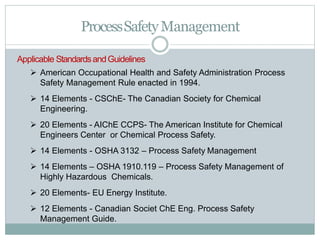
Applicable StandardsandGuidelines
 American Occupational Health and Safety Administration Process
Safety Management Rule enacted in 1994.
 14 Elements - CSChE- The Canadian Society for Chemical
Engineering.
 20 Elements - AIChE CCPS- The American Institute for Chemical
Engineers Center or Chemical Process Safety.
 14 Elements - OSHA 3132 – Process Safety Management
 14 Elements – OSHA 1910.119 – Process Safety Management of
Highly Hazardous Chemicals.
 20 Elements- EU Energy Institute.
 12 Elements - Canadian Societ ChE Eng. Process Safety
Management Guide.
ProcessSafetyManagement
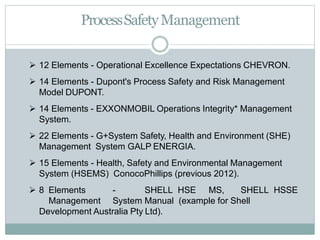
 12 Elements - Operational Excellence Expectations CHEVRON.
 14 Elements - Dupont's Process Safety and Risk Management
Model DUPONT.
 14 Elements - EXXONMOBIL Operations Integrity* Management
System.
 22 Elements - G+System Safety, Health and Environment (SHE)
Management System GALP ENERGIA.
 15 Elements - Health, Safety and Environmental Management
System (HSEMS) ConocoPhillips (previous 2012).
 8 Elements - SHELL HSE MS, SHELL HSSE
Management System Manual (example for Shell
Development Australia Pty Ltd).
 8 Elements - OGP Report 210 EP Forum - Guidelines for the
Development and Application of Health, Safety and Environmental.
 13 Elements - Safety & Environmental Management System
(SEMS) - Offshore EU US Bureau of Ocean Energy Management,
Regulation and Enforcement's (BOEMRE) new regulation [30 CFR
250] - API RP 75
ProcessSafetyManagement
Applicable Standardsand Guidelines - Comparison
OSHA ENERGYINSTITUTE AIChE CCPS SEVESO
Employee
involvement.
Staff participation. Staff participation. Theorganization andstaff.
Process hazard
analysis.
Hazardsidentification
and risk assessment.
Hazardsidentification and
risk assessment.
Identification and
assessmentof major-
accident hazards.
Change
management.
Change
management and
Project
management.
Changemanagement. Adaptation of the
modifications.
Safety review of
pre-setting up.
Operational
availability and start-
up processes.
Operational availability. Exploitation control.
Planningand
responseagainst
emergencies.
Emergency
preparedne
ss.
Emergency management. Planning of emergency
situations.
OSHA ENERGY INSTITUTE AIChE CCPS SEVESO
Process safety
information.
Documentation, records
and knowledge
management.
Processes knowledge
management.
Exploitation control.
Contractors. Contractors and
providers, selection and
management.
Contractors management. Theorganization andstaff.
Complianceaudits. Audit, guarantee,
management review
and intervention.
Audits.
Management review and
continuous improvement.
Actions and indicators.
Monitoring of
set objectives.
Audit andreview.
Incidents
investigation.
Incidents investigation
and investigation.
Incidents investigation. Monitoring of set
objectives.
8
ProcessSafetyManagement
OSHA ENERGY INSTITUTE AIChE CCPS SEVESO
Work permit Work control, work
(non-routine work permit and risk
authorizations). management of
tasks.
Operating Operating manualsand
procedures. procedures.
Mechanical Inspection and
integrity. maintenance.
Employee training. Recruitment, hiring and
skills and health
and safety
assurance.
Leadership, commitment
and responsibility.
Safeworking practices. Explotation control.
Planning of
emergency
situations.
Operating procedures. Explotation control.
Mechanical integrity
and reliability.
Explotation control.
Training and
assurance
performance.
Competencein
process safety.
Theorganization and
staff. Planning of
emergency situations.
Monitoring of set
objectives.
Processsafety culture. Theorganization and staff.
9
ProcessSafetyManagement
OSHA ENERGY INSTITUTE AIChE CCPS SEVESO
Trade secrets. -
- Identification and
compliance with laws
and regulations.
- Communication with
interested parties.
Operating Monitoring of
procedures. operational variables
Operating and relays.
instructions.
-
Compliance with
standards.
Communication with
interested parties.
Monitoring of the
operation.
-
Explotation control.
Monitoring of set
objectives.
Theorganization and
staff.
Explotation control.
10
ProcessSafetyManagement
OSHA ENERGYINSTITUTE AIChE CCPS SEVESO
- Operational - -
interfacestracking.
- Regulations and - -
practices.
- Management of - -
critical elementsfor
safety.
11
ProcessSafetyManagement
Componentsof ProcessSafetyManagement
Process SafetyInformation
Process HazardAnalysis
Training
Contractors
Pre-Start up SafetyReview
MechanicalIntegrity
Hot-work Permit
OperatingProcedures
Management ofChange
EmployeeParticipation
IncidentInvestigation
EmergencyPlanningand
Response
ComplianceAudits
ProcessSafety Information
To be assesedin processhazard analysis and management of change,following
information should beconsiderd:
• Processand instrumentation diagrams (P&I).
• Block or simplified diagrams of the process, flowdiagrams.
• Diagramsof electrical installations.
• Alist of criticalcomponents.
• Massand energy balances.
• Acceptable upper and lower limits for variables and any deviationsfrom
variables.
• Asafety data sheet of the substances
• Theclassification of electrical areas.
• Designand layout relief and ventilation systems.
• Specifications for pipes andequipment.
• Adescription of the interlock and shutdownsystems.
ProcessSafetyManagement
maintenance and special
 Operating conditions
 Start-ups, stops,
situations
 Previous incidents
 ProcessHazards
HazardAnalysis
Hazard identification and evaluation is contemplated at
every stage of the plant’s operations, from the initial
project to the day it is decommissioned. This includes
identifying the potential dangers associatedwith
ProcessSafetyManagement
HazardAnalysis
 Potential accidents and their consequencescaused
by;
 Failure of monitoring, controls,alarms,
interlocks, ESD
 Human factors
 External events
 Failure of safety managementsystem
In every 5 yearsaprocesshazard analysis should be
developed.
ProcessSafetyManagement
Operating Procedures
Theoperating instructions must cover all possible operativestages:
 Start-up
 All phasesof normal operations, including testing, maintenanceand
inspection
 Detection ofand responseto, departures from normal operating conditions.
 Temporary or specialoperations
 Operation under maintenanceconditions.
 Normal shutdown
 Emergencyoperations including shutdown.
 Decommissioning
Most of the accidentsoccurduring non-routineoperations.
ProcessSafetyManagement
Operating Procedures
Operatinglimits:
 Consequencesof deviation, and
 Stepsrequired to correct or avoiddeviation.
Safety and healthconsiderations:
 Properties of, and hazardspresented by, the chemicals used in theprocess;
 Precautions necessaryto prevent exposure, including engineeringcontrols,
administrative controls, and personal protective equipment;
 Control measures to be taken if physical contact or airborne exposure occurs;
 Quality control for raw materials and control ofhazardous chemical inventory
levels; and
 Anyspecial or uniquehazards.
 Safety systems(e.g., interlocks, detection or suppression systems)and their
functions.
ProcessSafetyManagement
Employee Participation
Consult with employees and their representatives on the development and
conduct of hazard assessmentsand the development of chemical accident
prevention plans and provide accessto these and other records requiredunder
the standard.
 Develop awritten participation plan
 Consult with employees on PHAand PSMdevelopment
 Provide to employees accessto PSMinformation
ProcessSafetyManagement
Training
Ensure contractors and contract employees are
provided with appropriate information and
training.
 Identify the training needs ofemployees
 Identify the trainingperods
 Training plans
 Evaluation of eEffectivenessof training
ProcessSafetyManagement
Refesher Training: Refresher training must be
provided at least every three years, or more often
if necessary, to each employee involved in
operating a process to ensure that the employee
understands and adheres to the current operating
procedures of theprocess.
Training
Ininital training: PSM requires that each employee
presently involved in operating a process or a newly
assigned process must be trained in an overview of
the processand in its operating procedures.
ProcessSafetyManagement
Contractors
 When selecting a contractor, obtain and evaluate information regarding the
contract employer’s safety performance and programs. Inform contract
employers of the known potential fire, explosion, or toxic release hazards related
to the contractor’s work and theprocess
 Explain to contract employers the applicable
provisions of the emergency action plan
 Develop and implement safe work practices
to control the presence, entrance, and exit of contract employers
and contract employees in covered processareas
 Evaluate periodically the performance of contract employers in fulfilling their
obligations; and maintain a contract employee injury and illness log related to the
contractor’s work in the processareas.
ProcessSafetyManagement
Mechanical Integrity
 Written procedures to maintain ongoing integrity of processequipment.
 Establish a quality assurance program to ensure that initial process-related
equipment, maintenance materials, and spare parts are fabricated and
installed consistent with designspecifications
Piping
systems
Relief and
vent
systems
Emergency
shutdown
systems
Controls,
sensors,
alarmsand
interlocks
Pumps
ProcessSafetyManagement
Mechanical Integrity
Elements of a mechanical integrityprogram
Identify & categorizeequipments
Inspections & testsfrequency
Maintenance procedures
Training of maintenancepersonnel
Criteria for acceptable testresults
Documentation of manufacturer
recommendations
ProcessSafetyManagement
Pre-Start Up Safety Review
Prior to start-up or implementation of a significant change,followings should be
checked:
 Any documents which may be affected by the changemust have been modified
(procedures, instructions, etc.).
 Thestaff affected by the changemust have been adequately informed/trained.
 Themodified procedures must have been made available to the staffaffected.
 In the event of changesto the conditions of the activity, the relevant authorisations
must have been issued and the staff affectedinformed.
 There must be compliance with applicable laws and all the relevant authorisations
and licenses must have been obtained.
 That, where appropriate, findings from completed hazard assessmentsmust be taken
into consideration.
 That all safety systems must be fully operational
ProcessSafetyManagement
the safe
Followings are considered as«change»:
Management of Change
Management of change is key to safe design and maintaining
operations.
Eployees Installations Processes
Process
variables
Materials Equipments Procedures Software
Design
External
conditions
ProcessSafetyManagement
Management of Change
Written proceduresaddressing;
 Thetechnical basisfor the proposedchange,
 Impact of the changeonemployee safety and health,
 Modifications to operatingprocedures,
 Necessarytime period for thechange,and
 Authorization requirements for the proposedchange.
ProcessSafetyManagement
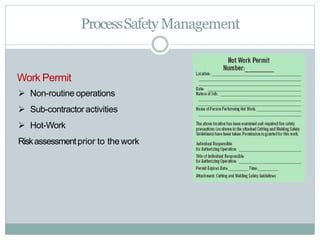
Work Permit
 Non-routine operations
 Sub-contractor activities
 Hot-Work
Riskassessmentprior to the work
ProcessSafetyManagement
findings to be reviewed by operating personnel and
modifications made, if appropriate.
 An investigation report must be prepared includingat
least:
 Date of incident,
 Date investigation began,
 Description of theincident,
 Factorsthat contributed tothe incident, and
 Recommendations resulting from the investigation.
Incident Investigation
Investigate every incident that results in or couldhave
resulted in a major accident in the workplace, with any
ProcessSafetyManagement
EmergencyPlanning and Response
Develop and implement an emergency action plan for
the entire plant. Train and educate employees and
contractors in emergency responseprocedures.
 Identify the emergencies
 Measures to prevent their negativeconsequences
 Identify the emergency responseteams
 Specific tactical procedures defining how to response
against the different kind ofaccidents
 Evacuation procedures
 Emergencydrills
 Reviewemergency plans
ProcessSafetyManagement
ComplianceAudits
 To be certain process safety management is effective,
employers must certify that they have evaluated
compliance with the provisions of PSM at least every three
years.
 This will verify that the procedures and practices
developed under the standard are adequate and are being
followed.
 The compliance audit must be conducted by at least one
person knowledgeable in the process and a report of the
findings of the audit must be developed and documented
noting deficiencies that havebeencorrected.
 The two most recent compliance audit reports must be
kept on file.
ProcessSafetyManagement
Thankyou…

Psm by Ronak

  • 1.
  • 2.
    ProcessSafetyManagement Introduction - Whatis ProcessSafety?  Process Safety is a disciplined framework for managing the integrity of operating systems and processes handling hazardous substances by applying good design principles, engineering, and operatingpractices. Processsafety is everyone’s responsibility Continuousimprovement Away of thinking andacting It is a culture.
  • 3.
    ProcessSafetyManagement  It dealswith the prevention and control of incidents that have the potential to release hazardous materials or energy. Such incidents can cause toxic effects, fire, or explosion and could ultimately result in serious injuries, property damage, lost production, and environmental impact.  Process safety needs to be considered seperately from occupational safety.
  • 4.
    ProcessSafetyManagement  ProcessSafety isavery common and usedtopic in the chemical industry. According to CCPS,an incident is reported asaprocesssafety incident ifit meets all four criteria (process involvement, above minimum reporting threshold, location and acuterelease).  Although power plant industry doesn’t handlehazardous chemicals as much aschemical, petrochemical or refining industry, it hasthe same equipments which canbe the source of similar accidentssuchas: Boilers, Tanks, Cooling towers, Reactors, etc.
  • 5.
    ProcessSafetyManagement Applicable StandardsandGuidelines  AmericanOccupational Health and Safety Administration Process Safety Management Rule enacted in 1994.  14 Elements - CSChE- The Canadian Society for Chemical Engineering.  20 Elements - AIChE CCPS- The American Institute for Chemical Engineers Center or Chemical Process Safety.  14 Elements - OSHA 3132 – Process Safety Management  14 Elements – OSHA 1910.119 – Process Safety Management of Highly Hazardous Chemicals.  20 Elements- EU Energy Institute.  12 Elements - Canadian Societ ChE Eng. Process Safety Management Guide.
  • 6.
    ProcessSafetyManagement  12 Elements- Operational Excellence Expectations CHEVRON.  14 Elements - Dupont's Process Safety and Risk Management Model DUPONT.  14 Elements - EXXONMOBIL Operations Integrity* Management System.  22 Elements - G+System Safety, Health and Environment (SHE) Management System GALP ENERGIA.  15 Elements - Health, Safety and Environmental Management System (HSEMS) ConocoPhillips (previous 2012).  8 Elements - SHELL HSE MS, SHELL HSSE Management System Manual (example for Shell Development Australia Pty Ltd).
  • 7.
     8 Elements- OGP Report 210 EP Forum - Guidelines for the Development and Application of Health, Safety and Environmental.  13 Elements - Safety & Environmental Management System (SEMS) - Offshore EU US Bureau of Ocean Energy Management, Regulation and Enforcement's (BOEMRE) new regulation [30 CFR 250] - API RP 75 ProcessSafetyManagement
  • 8.
    ProcessSafetyManagement Applicable Standardsand Guidelines- Comparison OSHA ENERGYINSTITUTE AIChE CCPS SEVESO Employee involvement. Staff participation. Staff participation. Theorganization andstaff. Process hazard analysis. Hazardsidentification and risk assessment. Hazardsidentification and risk assessment. Identification and assessmentof major- accident hazards. Change management. Change management and Project management. Changemanagement. Adaptation of the modifications. Safety review of pre-setting up. Operational availability and start- up processes. Operational availability. Exploitation control. Planningand responseagainst emergencies. Emergency preparedne ss. Emergency management. Planning of emergency situations.
  • 9.
    OSHA ENERGY INSTITUTEAIChE CCPS SEVESO Process safety information. Documentation, records and knowledge management. Processes knowledge management. Exploitation control. Contractors. Contractors and providers, selection and management. Contractors management. Theorganization andstaff. Complianceaudits. Audit, guarantee, management review and intervention. Audits. Management review and continuous improvement. Actions and indicators. Monitoring of set objectives. Audit andreview. Incidents investigation. Incidents investigation and investigation. Incidents investigation. Monitoring of set objectives. 8 ProcessSafetyManagement
  • 10.
    OSHA ENERGY INSTITUTEAIChE CCPS SEVESO Work permit Work control, work (non-routine work permit and risk authorizations). management of tasks. Operating Operating manualsand procedures. procedures. Mechanical Inspection and integrity. maintenance. Employee training. Recruitment, hiring and skills and health and safety assurance. Leadership, commitment and responsibility. Safeworking practices. Explotation control. Planning of emergency situations. Operating procedures. Explotation control. Mechanical integrity and reliability. Explotation control. Training and assurance performance. Competencein process safety. Theorganization and staff. Planning of emergency situations. Monitoring of set objectives. Processsafety culture. Theorganization and staff. 9 ProcessSafetyManagement
  • 11.
    OSHA ENERGY INSTITUTEAIChE CCPS SEVESO Trade secrets. - - Identification and compliance with laws and regulations. - Communication with interested parties. Operating Monitoring of procedures. operational variables Operating and relays. instructions. - Compliance with standards. Communication with interested parties. Monitoring of the operation. - Explotation control. Monitoring of set objectives. Theorganization and staff. Explotation control. 10 ProcessSafetyManagement
  • 12.
    OSHA ENERGYINSTITUTE AIChECCPS SEVESO - Operational - - interfacestracking. - Regulations and - - practices. - Management of - - critical elementsfor safety. 11 ProcessSafetyManagement
  • 13.
    ProcessSafetyManagement Componentsof ProcessSafetyManagement Process SafetyInformation ProcessHazardAnalysis Training Contractors Pre-Start up SafetyReview MechanicalIntegrity Hot-work Permit OperatingProcedures Management ofChange EmployeeParticipation IncidentInvestigation EmergencyPlanningand Response ComplianceAudits
  • 14.
    ProcessSafety Information To beassesedin processhazard analysis and management of change,following information should beconsiderd: • Processand instrumentation diagrams (P&I). • Block or simplified diagrams of the process, flowdiagrams. • Diagramsof electrical installations. • Alist of criticalcomponents. • Massand energy balances. • Acceptable upper and lower limits for variables and any deviationsfrom variables. • Asafety data sheet of the substances • Theclassification of electrical areas. • Designand layout relief and ventilation systems. • Specifications for pipes andequipment. • Adescription of the interlock and shutdownsystems. ProcessSafetyManagement
  • 15.
    maintenance and special Operating conditions  Start-ups, stops, situations  Previous incidents  ProcessHazards HazardAnalysis Hazard identification and evaluation is contemplated at every stage of the plant’s operations, from the initial project to the day it is decommissioned. This includes identifying the potential dangers associatedwith ProcessSafetyManagement
  • 16.
    HazardAnalysis  Potential accidentsand their consequencescaused by;  Failure of monitoring, controls,alarms, interlocks, ESD  Human factors  External events  Failure of safety managementsystem In every 5 yearsaprocesshazard analysis should be developed. ProcessSafetyManagement
  • 17.
    Operating Procedures Theoperating instructionsmust cover all possible operativestages:  Start-up  All phasesof normal operations, including testing, maintenanceand inspection  Detection ofand responseto, departures from normal operating conditions.  Temporary or specialoperations  Operation under maintenanceconditions.  Normal shutdown  Emergencyoperations including shutdown.  Decommissioning Most of the accidentsoccurduring non-routineoperations. ProcessSafetyManagement
  • 18.
    Operating Procedures Operatinglimits:  Consequencesofdeviation, and  Stepsrequired to correct or avoiddeviation. Safety and healthconsiderations:  Properties of, and hazardspresented by, the chemicals used in theprocess;  Precautions necessaryto prevent exposure, including engineeringcontrols, administrative controls, and personal protective equipment;  Control measures to be taken if physical contact or airborne exposure occurs;  Quality control for raw materials and control ofhazardous chemical inventory levels; and  Anyspecial or uniquehazards.  Safety systems(e.g., interlocks, detection or suppression systems)and their functions. ProcessSafetyManagement
  • 19.
    Employee Participation Consult withemployees and their representatives on the development and conduct of hazard assessmentsand the development of chemical accident prevention plans and provide accessto these and other records requiredunder the standard.  Develop awritten participation plan  Consult with employees on PHAand PSMdevelopment  Provide to employees accessto PSMinformation ProcessSafetyManagement
  • 20.
    Training Ensure contractors andcontract employees are provided with appropriate information and training.  Identify the training needs ofemployees  Identify the trainingperods  Training plans  Evaluation of eEffectivenessof training ProcessSafetyManagement
  • 21.
    Refesher Training: Refreshertraining must be provided at least every three years, or more often if necessary, to each employee involved in operating a process to ensure that the employee understands and adheres to the current operating procedures of theprocess. Training Ininital training: PSM requires that each employee presently involved in operating a process or a newly assigned process must be trained in an overview of the processand in its operating procedures. ProcessSafetyManagement
  • 22.
    Contractors  When selectinga contractor, obtain and evaluate information regarding the contract employer’s safety performance and programs. Inform contract employers of the known potential fire, explosion, or toxic release hazards related to the contractor’s work and theprocess  Explain to contract employers the applicable provisions of the emergency action plan  Develop and implement safe work practices to control the presence, entrance, and exit of contract employers and contract employees in covered processareas  Evaluate periodically the performance of contract employers in fulfilling their obligations; and maintain a contract employee injury and illness log related to the contractor’s work in the processareas. ProcessSafetyManagement
  • 23.
    Mechanical Integrity  Writtenprocedures to maintain ongoing integrity of processequipment.  Establish a quality assurance program to ensure that initial process-related equipment, maintenance materials, and spare parts are fabricated and installed consistent with designspecifications Piping systems Relief and vent systems Emergency shutdown systems Controls, sensors, alarmsand interlocks Pumps ProcessSafetyManagement
  • 24.
    Mechanical Integrity Elements ofa mechanical integrityprogram Identify & categorizeequipments Inspections & testsfrequency Maintenance procedures Training of maintenancepersonnel Criteria for acceptable testresults Documentation of manufacturer recommendations ProcessSafetyManagement
  • 25.
    Pre-Start Up SafetyReview Prior to start-up or implementation of a significant change,followings should be checked:  Any documents which may be affected by the changemust have been modified (procedures, instructions, etc.).  Thestaff affected by the changemust have been adequately informed/trained.  Themodified procedures must have been made available to the staffaffected.  In the event of changesto the conditions of the activity, the relevant authorisations must have been issued and the staff affectedinformed.  There must be compliance with applicable laws and all the relevant authorisations and licenses must have been obtained.  That, where appropriate, findings from completed hazard assessmentsmust be taken into consideration.  That all safety systems must be fully operational ProcessSafetyManagement
  • 26.
    the safe Followings areconsidered as«change»: Management of Change Management of change is key to safe design and maintaining operations. Eployees Installations Processes Process variables Materials Equipments Procedures Software Design External conditions ProcessSafetyManagement
  • 27.
    Management of Change Writtenproceduresaddressing;  Thetechnical basisfor the proposedchange,  Impact of the changeonemployee safety and health,  Modifications to operatingprocedures,  Necessarytime period for thechange,and  Authorization requirements for the proposedchange. ProcessSafetyManagement
  • 28.
    Work Permit  Non-routineoperations  Sub-contractor activities  Hot-Work Riskassessmentprior to the work ProcessSafetyManagement
  • 29.
    findings to bereviewed by operating personnel and modifications made, if appropriate.  An investigation report must be prepared includingat least:  Date of incident,  Date investigation began,  Description of theincident,  Factorsthat contributed tothe incident, and  Recommendations resulting from the investigation. Incident Investigation Investigate every incident that results in or couldhave resulted in a major accident in the workplace, with any ProcessSafetyManagement
  • 30.
    EmergencyPlanning and Response Developand implement an emergency action plan for the entire plant. Train and educate employees and contractors in emergency responseprocedures.  Identify the emergencies  Measures to prevent their negativeconsequences  Identify the emergency responseteams  Specific tactical procedures defining how to response against the different kind ofaccidents  Evacuation procedures  Emergencydrills  Reviewemergency plans ProcessSafetyManagement
  • 31.
    ComplianceAudits  To becertain process safety management is effective, employers must certify that they have evaluated compliance with the provisions of PSM at least every three years.  This will verify that the procedures and practices developed under the standard are adequate and are being followed.  The compliance audit must be conducted by at least one person knowledgeable in the process and a report of the findings of the audit must be developed and documented noting deficiencies that havebeencorrected.  The two most recent compliance audit reports must be kept on file. ProcessSafetyManagement
  • 32.