Root Cause Analysis Training Identifying True Root Causes of an Incident
Root Cause Analysis Incident Investigations Are Conducted To Prevent Recurrence Of An Unwanted Event Recognize root causes Identify preventive actions Implement changes to correct root causes Apply corrective actions to other areas of plant  (similar areas/equipment)  where corrective actions would be beneficial
What is a “root cause” anyway  ? A  root cause  is the lowest level  fact  that contributed to an incident
Identification of true root causes will allow us to put appropriate corrective actions in place to prevent recurrence Initial corrective actions are  reactive  – they immediately remedy a situation and are based on what we “think” happened After analyzing an incident, and finding the root causes,  proactive  corrective actions may be implemented Findings can be shared with other Rhodia sites Why are root causes so important ?
“ But we  already  know what happened” …  Do you really   ??? How many times have you heard …
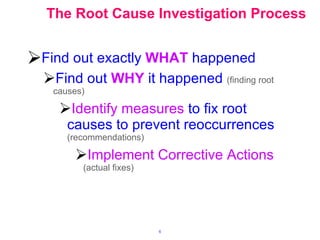
The Root Cause Investigation Process Find out exactly   WHAT   happened Find out   WHY   it happened   (finding root causes) Identify measures   to fix root causes to prevent reoccurrences   (recommendations) Implement Corrective Actions   (actual fixes)
You should not be spending the  same  amount of time on investigations for  all  incidents Look at the  actual  severity as well as the  potential  severity – for near misses as well as incidents Determine where a more detailed investigation is warranted, i.e., for medium or above actual  and  potential severity “ But Root Cause Analysis takes forever   … ”
Let’s use a logic-based approach How can we simplify the process  ??
The Process … Establish your investigation team  Collect all available information List  ALL  facts ( not judgments or interpretations ) surrounding the incident, regardless of whether you believe they contributed to the incident itself Start from the result of the incident, and work your way back, asking … WHY, WHY, WHY
The Team … Individual ( s )  involved in the incident Witnesses Supervisor of the area Someone who can facilitate the root  cause process Consider individuals with safety,  maintenance, operating backgrounds to assist
Information ...   List all facts whether they were directly or indirectly related to the incident Develop a time line listing all of the facts
INFORMATION GATHERING Should occur as soon as possible after the incident has occurred, after attending to immediate mitigation, injuries and securing the scene. Look for physical conditions  (housekeeping, equipment conditions, walking/working surfaces,  weather… Collect as much data as you can, even if you do not THINK it contributed to the incident – remember, it is harder to go back and try to recreate the “scene” or incident if you do not collect the data immediately Interview witnesses before individuals share stories and the actual “viewing” becomes tainted If possible, take pictures, or sketch the scene
Collection of Facts  --  Fact vs.“Fiction” Ensure “facts” are listed individually Facts should be written on separate pieces of paper or “Post-it  ” Notes for ease of working back from the incident to the true root causes  (it’s easier to move a piece of paper than to keep erasing …) Statements should be indicated as such, i.e., “John stated he was not in a hurry”, so you can revisit statements and facts if they do not seem to “fit together” in a logical sequence of events This is not a “blame” or “fault” session Do not list “interpretations” – construing of facts or info in a particular way  (i.e., the valve was faulty) Do not list “judgments” – opinions  (i.e., it was an unsafe ladder; the person was walking too fast) Working with FACTS will keep emotions to a minimum, allowing the team to accomplish their objectives
FACT  or  “Fiction” ??? He caught his foot on the skid The skid should not have been in the aisle The valve was leaking The ladder was defective The ladder should have been taken of service The rung was cracked He wasn’t paying attention to what he was doing She didn’t follow the procedure He slipped on an ice patch Could you tell the difference ?
Now What ? OK , we’ve assembled our team we’ve collected available information we’ve listed the facts NOW WHAT ???
THE SEARCH FOR ROOT CAUSES Start with the end result of the incident, working backward, asking “why did it happen?”  Is this the only reason? When you are satisfied you have answered all the “why’s” contributing to that fact, you may move on to the next one   An Event Can Not Be a Root Cause!
Why the “Why” Process ??   Carbon steel pipe leaked …  WHY Individual did not follow procedure …  WHY Corrosion …  WHY   (and, no, “because it’s acid” is not sufficient !!) Incompatibility issue …  WHY Poor communication about use of specific chemical being used …  WHY No system in place for updating pipes in MOC process …  WHY Some examples that may help  … You get the idea  …
The “Why” Process ...  things to think about Causal Factors Behaviors Conditions Management Control Consider SOP’s, permits, physical conditions, weather, similar incidents, maintenance records, witness statements, housekeeping  …
THE SEARCH FOR ROOT CAUSES Why ? Why ? Why ? Why? Why? Why? but   …   WHY ?
Every time you work back from a “result” or “single event”, ask if that “fact” alone was responsible, or other factors also had to be in place Do not move on until you are satisfied you have determined all contributing “causes” of that event Are we there yet ?
Some Chronic Challenges Stopping too soon – there may be multiple root causes Mistaking a symptom or result for a root cause Only identifying “things” because they are “easier” or “more comfortable” to correct The  Failure to Follow Procedure,  Operator Error ,   Leaking Pipe   …  root cause trap
  Chronic Challenges Root Causes Do Not Travel Alone … Stopping too soon Do not make the mistake of stopping the investigation after identifying only one root cause Keep an open mind, there may be multiple root causes REMEMBER  … An event cannot be a root cause
Chronic Challenges Investigations sometimes stop at the  Symptom Level  and do not identify root causes Treating symptoms does not fix root causes Another repeat incident will occur Distinguishing Between Symptoms and Root Causes As an example – “failure to follow procedure” is a symptom of something else – lack of training or understanding, willful issue, equipment change …
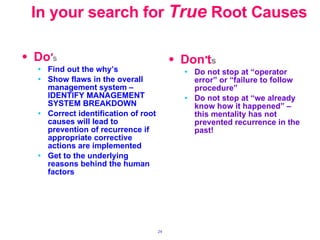
In your search for   True  Root Causes   Do ′ s Find out the why’s Show flaws in the overall management system – IDENTIFY MANAGEMENT SYSTEM BREAKDOWN Correct identification of root causes will lead to prevention of recurrence if appropriate corrective actions are implemented Get to the underlying reasons behind the human factors Don ′ t s Do not stop at “operator error” or “failure to follow procedure” Do not stop at “we already know how it happened” – this mentality has not prevented recurrence in the past!
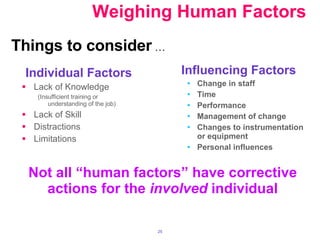
Weighing Human Factors Individual Factors Lack of Knowledge  (Insufficient training or understanding of the job) Lack of Skill  Distractions Limitations Influencing Factors Change in staff Time Performance  Management of change Changes to instrumentation or equipment Personal influences Not all “human factors” have corrective actions for the  involved  individual Things to consider  …
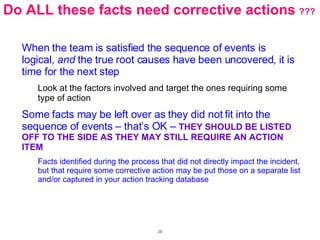
Do ALL these facts need corrective actions   ??? When the team is satisfied the sequence of events is logical,  and  the true root causes have been uncovered, it is time for the next step Look at the factors involved and target the ones requiring some type of action Some facts may be left over as they did not fit into the sequence of events – that’s OK –  THEY SHOULD BE LISTED OFF TO THE SIDE AS THEY MAY STILL REQUIRE AN ACTION ITEM Facts identified during the process that did not directly impact the incident, but that require some corrective action may be put those on a separate list and/or captured in your action tracking database
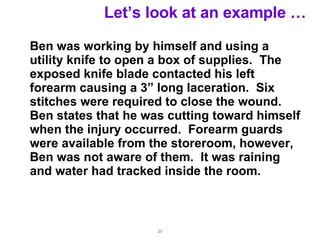
Let’s look at an example … Ben was working by himself and using a utility knife to open a box of supplies.  The exposed knife blade contacted his left forearm causing a 3” long laceration.  Six stitches were required to close the wound.  Ben states that he was cutting toward himself when the injury occurred.  Forearm guards were available from the storeroom, however, Ben was not aware of them. .  It was raining and water had tracked inside the room.
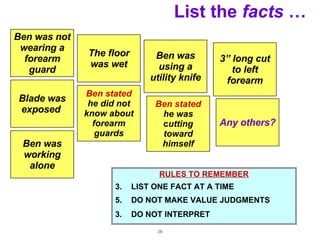
List the  facts  … RULES TO REMEMBER LIST ONE FACT AT A TIME DO NOT MAKE VALUE JUDGMENTS 3. DO NOT INTERPRET   3” long cut to left forearm Ben was using a utility knife Ben stated   he was   c utting toward himself Ben was not wearing a forearm guard Ben stated  he did not know about forearm guards Blade was exposed  Ben was working alone The floor was wet Any others?
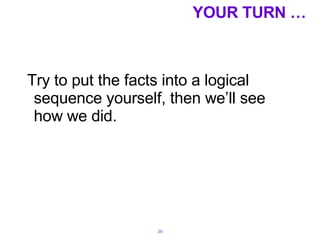
YOUR TURN … Try to put the facts into a logical sequence yourself, then we’ll see how we did.
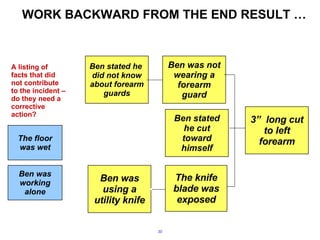
WORK BACKWARD FROM THE END RESULT … 3”  long cut to left forearm Ben stated he cut toward himself Ben was not wearing a forearm guard The knife blade was exposed A listing of facts that did not contribute to the incident – do they need a corrective action? Ben stated he  did not know about forearm guards Ben was using a utility knife The floor was wet Ben was working alone
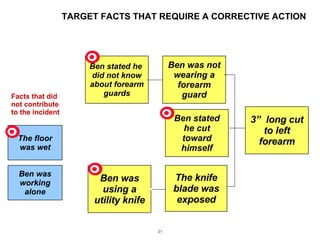
TARGET FACTS THAT REQUIRE A CORRECTIVE ACTION 3”  long cut to left forearm Ben stated he cut toward himself Ben was not wearing a forearm guard The knife blade was exposed Facts that did not contribute to the incident Ben stated he  did not know about forearm guards Ben was using a utility knife The floor was wet Ben was working alone
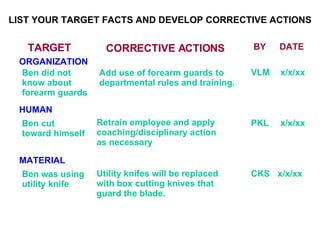
LIST YOUR TARGET FACTS AND DEVELOP CORRECTIVE ACTIONS TARGET CORRECTIVE ACTIONS BY DATE ORGANIZATION HUMAN MATERIAL Ben did not know about forearm guards Ben cut  toward himself Ben was using utility knife Add use of forearm guards to  departmental rules and training. VLM x/x/xx Retrain employee and apply  coaching/disciplinary action as necessary PKL x/x/xx Utility knifes will be replaced with box cutting knives that  guard the blade. CKS x/x/xx
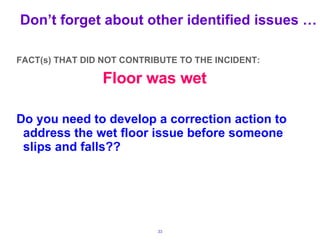
Don’t forget about other identified issues … FACT(s) THAT DID NOT CONTRIBUTE TO THE INCIDENT: Floor was wet Do you need to develop a correction action to address the wet floor issue before someone slips and falls??
If these had been in place,  could  the incident have occurred? If so, you have not identified all root causes and/or appropriate corrective actions Will these corrective actions prevent the same type of incident from occurring again? Are there other similar areas on site that should be addressed? Have  human factors  been identified as well as “things” ? (90-95% of incidents involve human factors) Look at your corrective actions and ask --
BY GEORGE, I THINK WE’VE GOT IT  !!! Have you captured all the facts? Root cause level has been reached  ALL root causes have been identified Symptoms not mistaken for root causes  All individual branches on logic tree are in agreement  Facts requiring corrective actions have been identified  Relevant management system issues have been identified  Physical conditions have been considered Behaviors to be addressed are included –  remember, 90-95% of incidents involve some type of human factor Corrective action recommendations approved and on an action list for implementation? Individuals assigned responsibility for corrective actions with time lines for completion Stopping Point --
Don’t Forget  … Enter your investigation report into the incident database Enter corrective actions into your action tracking database Go back and see if the corrective actions have really accomplished what they were supposed to Communicate  with your site and other Rhodia sites so learning’s can be shared Trend your incidents and near misses – they will help identify missed opportunities with your root cause analysis process

Causal Tree Analysis (Root Cause)

  • 1.
    Root Cause AnalysisTraining Identifying True Root Causes of an Incident
  • 2.
    Root Cause AnalysisIncident Investigations Are Conducted To Prevent Recurrence Of An Unwanted Event Recognize root causes Identify preventive actions Implement changes to correct root causes Apply corrective actions to other areas of plant (similar areas/equipment) where corrective actions would be beneficial
  • 3.
    What is a“root cause” anyway ? A root cause is the lowest level fact that contributed to an incident
  • 4.
    Identification of trueroot causes will allow us to put appropriate corrective actions in place to prevent recurrence Initial corrective actions are reactive – they immediately remedy a situation and are based on what we “think” happened After analyzing an incident, and finding the root causes, proactive corrective actions may be implemented Findings can be shared with other Rhodia sites Why are root causes so important ?
  • 5.
    “ But we already know what happened” … Do you really ??? How many times have you heard …
  • 6.
    The Root CauseInvestigation Process Find out exactly WHAT happened Find out WHY it happened (finding root causes) Identify measures to fix root causes to prevent reoccurrences (recommendations) Implement Corrective Actions (actual fixes)
  • 7.
    You should notbe spending the same amount of time on investigations for all incidents Look at the actual severity as well as the potential severity – for near misses as well as incidents Determine where a more detailed investigation is warranted, i.e., for medium or above actual and potential severity “ But Root Cause Analysis takes forever … ”
  • 8.
    Let’s use alogic-based approach How can we simplify the process ??
  • 9.
    The Process …Establish your investigation team Collect all available information List ALL facts ( not judgments or interpretations ) surrounding the incident, regardless of whether you believe they contributed to the incident itself Start from the result of the incident, and work your way back, asking … WHY, WHY, WHY
  • 10.
    The Team …Individual ( s ) involved in the incident Witnesses Supervisor of the area Someone who can facilitate the root cause process Consider individuals with safety, maintenance, operating backgrounds to assist
  • 11.
    Information ... List all facts whether they were directly or indirectly related to the incident Develop a time line listing all of the facts
  • 12.
    INFORMATION GATHERING Shouldoccur as soon as possible after the incident has occurred, after attending to immediate mitigation, injuries and securing the scene. Look for physical conditions (housekeeping, equipment conditions, walking/working surfaces, weather… Collect as much data as you can, even if you do not THINK it contributed to the incident – remember, it is harder to go back and try to recreate the “scene” or incident if you do not collect the data immediately Interview witnesses before individuals share stories and the actual “viewing” becomes tainted If possible, take pictures, or sketch the scene
  • 13.
    Collection of Facts -- Fact vs.“Fiction” Ensure “facts” are listed individually Facts should be written on separate pieces of paper or “Post-it  ” Notes for ease of working back from the incident to the true root causes (it’s easier to move a piece of paper than to keep erasing …) Statements should be indicated as such, i.e., “John stated he was not in a hurry”, so you can revisit statements and facts if they do not seem to “fit together” in a logical sequence of events This is not a “blame” or “fault” session Do not list “interpretations” – construing of facts or info in a particular way (i.e., the valve was faulty) Do not list “judgments” – opinions (i.e., it was an unsafe ladder; the person was walking too fast) Working with FACTS will keep emotions to a minimum, allowing the team to accomplish their objectives
  • 14.
    FACT or “Fiction” ??? He caught his foot on the skid The skid should not have been in the aisle The valve was leaking The ladder was defective The ladder should have been taken of service The rung was cracked He wasn’t paying attention to what he was doing She didn’t follow the procedure He slipped on an ice patch Could you tell the difference ?
  • 15.
    Now What ?OK , we’ve assembled our team we’ve collected available information we’ve listed the facts NOW WHAT ???
  • 16.
    THE SEARCH FORROOT CAUSES Start with the end result of the incident, working backward, asking “why did it happen?” Is this the only reason? When you are satisfied you have answered all the “why’s” contributing to that fact, you may move on to the next one An Event Can Not Be a Root Cause!
  • 17.
    Why the “Why”Process ?? Carbon steel pipe leaked … WHY Individual did not follow procedure … WHY Corrosion … WHY (and, no, “because it’s acid” is not sufficient !!) Incompatibility issue … WHY Poor communication about use of specific chemical being used … WHY No system in place for updating pipes in MOC process … WHY Some examples that may help … You get the idea …
  • 18.
    The “Why” Process... things to think about Causal Factors Behaviors Conditions Management Control Consider SOP’s, permits, physical conditions, weather, similar incidents, maintenance records, witness statements, housekeeping …
  • 19.
    THE SEARCH FORROOT CAUSES Why ? Why ? Why ? Why? Why? Why? but … WHY ?
  • 20.
    Every time youwork back from a “result” or “single event”, ask if that “fact” alone was responsible, or other factors also had to be in place Do not move on until you are satisfied you have determined all contributing “causes” of that event Are we there yet ?
  • 21.
    Some Chronic ChallengesStopping too soon – there may be multiple root causes Mistaking a symptom or result for a root cause Only identifying “things” because they are “easier” or “more comfortable” to correct The Failure to Follow Procedure, Operator Error , Leaking Pipe … root cause trap
  • 22.
    ChronicChallenges Root Causes Do Not Travel Alone … Stopping too soon Do not make the mistake of stopping the investigation after identifying only one root cause Keep an open mind, there may be multiple root causes REMEMBER … An event cannot be a root cause
  • 23.
    Chronic Challenges Investigationssometimes stop at the Symptom Level and do not identify root causes Treating symptoms does not fix root causes Another repeat incident will occur Distinguishing Between Symptoms and Root Causes As an example – “failure to follow procedure” is a symptom of something else – lack of training or understanding, willful issue, equipment change …
  • 24.
    In your searchfor True Root Causes Do ′ s Find out the why’s Show flaws in the overall management system – IDENTIFY MANAGEMENT SYSTEM BREAKDOWN Correct identification of root causes will lead to prevention of recurrence if appropriate corrective actions are implemented Get to the underlying reasons behind the human factors Don ′ t s Do not stop at “operator error” or “failure to follow procedure” Do not stop at “we already know how it happened” – this mentality has not prevented recurrence in the past!
  • 25.
    Weighing Human FactorsIndividual Factors Lack of Knowledge (Insufficient training or understanding of the job) Lack of Skill Distractions Limitations Influencing Factors Change in staff Time Performance Management of change Changes to instrumentation or equipment Personal influences Not all “human factors” have corrective actions for the involved individual Things to consider …
  • 26.
    Do ALL thesefacts need corrective actions ??? When the team is satisfied the sequence of events is logical, and the true root causes have been uncovered, it is time for the next step Look at the factors involved and target the ones requiring some type of action Some facts may be left over as they did not fit into the sequence of events – that’s OK – THEY SHOULD BE LISTED OFF TO THE SIDE AS THEY MAY STILL REQUIRE AN ACTION ITEM Facts identified during the process that did not directly impact the incident, but that require some corrective action may be put those on a separate list and/or captured in your action tracking database
  • 27.
    Let’s look atan example … Ben was working by himself and using a utility knife to open a box of supplies. The exposed knife blade contacted his left forearm causing a 3” long laceration. Six stitches were required to close the wound. Ben states that he was cutting toward himself when the injury occurred. Forearm guards were available from the storeroom, however, Ben was not aware of them. . It was raining and water had tracked inside the room.
  • 28.
    List the facts … RULES TO REMEMBER LIST ONE FACT AT A TIME DO NOT MAKE VALUE JUDGMENTS 3. DO NOT INTERPRET 3” long cut to left forearm Ben was using a utility knife Ben stated he was c utting toward himself Ben was not wearing a forearm guard Ben stated he did not know about forearm guards Blade was exposed Ben was working alone The floor was wet Any others?
  • 29.
    YOUR TURN …Try to put the facts into a logical sequence yourself, then we’ll see how we did.
  • 30.
    WORK BACKWARD FROMTHE END RESULT … 3” long cut to left forearm Ben stated he cut toward himself Ben was not wearing a forearm guard The knife blade was exposed A listing of facts that did not contribute to the incident – do they need a corrective action? Ben stated he did not know about forearm guards Ben was using a utility knife The floor was wet Ben was working alone
  • 31.
    TARGET FACTS THATREQUIRE A CORRECTIVE ACTION 3” long cut to left forearm Ben stated he cut toward himself Ben was not wearing a forearm guard The knife blade was exposed Facts that did not contribute to the incident Ben stated he did not know about forearm guards Ben was using a utility knife The floor was wet Ben was working alone
  • 32.
    LIST YOUR TARGETFACTS AND DEVELOP CORRECTIVE ACTIONS TARGET CORRECTIVE ACTIONS BY DATE ORGANIZATION HUMAN MATERIAL Ben did not know about forearm guards Ben cut toward himself Ben was using utility knife Add use of forearm guards to departmental rules and training. VLM x/x/xx Retrain employee and apply coaching/disciplinary action as necessary PKL x/x/xx Utility knifes will be replaced with box cutting knives that guard the blade. CKS x/x/xx
  • 33.
    Don’t forget aboutother identified issues … FACT(s) THAT DID NOT CONTRIBUTE TO THE INCIDENT: Floor was wet Do you need to develop a correction action to address the wet floor issue before someone slips and falls??
  • 34.
    If these hadbeen in place, could the incident have occurred? If so, you have not identified all root causes and/or appropriate corrective actions Will these corrective actions prevent the same type of incident from occurring again? Are there other similar areas on site that should be addressed? Have human factors been identified as well as “things” ? (90-95% of incidents involve human factors) Look at your corrective actions and ask --
  • 35.
    BY GEORGE, ITHINK WE’VE GOT IT !!! Have you captured all the facts? Root cause level has been reached ALL root causes have been identified Symptoms not mistaken for root causes All individual branches on logic tree are in agreement Facts requiring corrective actions have been identified Relevant management system issues have been identified Physical conditions have been considered Behaviors to be addressed are included – remember, 90-95% of incidents involve some type of human factor Corrective action recommendations approved and on an action list for implementation? Individuals assigned responsibility for corrective actions with time lines for completion Stopping Point --
  • 36.
    Don’t Forget … Enter your investigation report into the incident database Enter corrective actions into your action tracking database Go back and see if the corrective actions have really accomplished what they were supposed to Communicate with your site and other Rhodia sites so learning’s can be shared Trend your incidents and near misses – they will help identify missed opportunities with your root cause analysis process