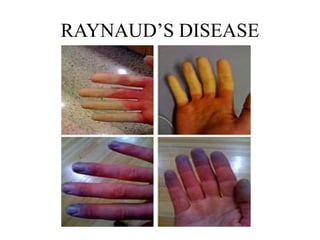
RAYNAUD’S DISEASE
Rohini Pandey
1st Year M.Sc Nursing
KGMU Institute of Nursing
CONTENTS
1. Introduction
2. Definition
3. Incidence & Prevalence
4. Classification of Raynaud’s Disease
5. Etiology & Risk Factors
6. Pathophysiology
7. Clinical feature
8. Diagnostic Evaluation
9. Management
INTRODUCTION
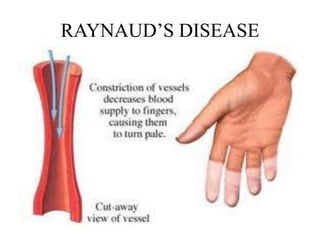
RAYNAUD’S DISEASE??
• Raynaud's is a rare disorder that affects the
arteries.
• Raynaud's is also called a disease, syndrome,
or phenomenon.
• Vasospasm, which is a narrowing of the blood
vessels.
• Vasospasm of the arteries reduces blood flow
to the fingers and toes.
• Also may occur at the tip of ears and nose.
RAYNAUD’S DISEASE
RAYNAUD’S DISEASE
CLASSIFICATION
• Primary Raynaud’s / Raynaud’s disease the
causes is not known.(idiopathic)
• Secondary Raynaud’s / Raynaud’s
phenomenon where the causes are known.
ETIOLOGY OF PRIMARY RAYNAUD’S
• Cold temperature
• Stress
• Blood vessels in spasm
ETIOLOGY OF SECONDARY RAYNAUD’S
 Scleroderma
 Lupus.
 Rheumatoid arthritis
 Sjogren's syndrome
 Diseases of the arteries.
 Carpal tunnel syndrome
 Repetitive actions
 Hand and foot injuries
 Exposure to certain chemicals
 Medicines
 Smoking
RISK FACTORS….
• PRIMARY RAYNAUD’S
 Gender
 Age
 Family history
 Living area climate
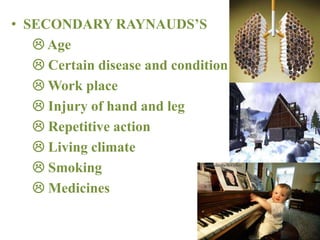
• SECONDARY RAYNAUDS’S
 Age
 Certain disease and condition
 Work place
 Injury of hand and leg
 Repetitive action
 Living climate
 Smoking
 Medicines
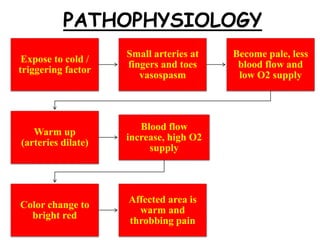
PATHOPHYSIOLOGY
Expose to cold /
triggering factor
Small arteries at
fingers and toes
vasospasm
Become pale, less
blood flow and
low O2 supply
Warm up
(arteries dilate)
Blood flow
increase, high O2
supply
Color change to
bright red
Affected area is
warm and
throbbing pain
CLINICAL MANIFESTATION
During the Raynaud’s attack, arteries become
narrow and no blood supply to the area, this
will cause :
 Turn pale or white and then blue.
 Feel numb, cold, or painful.
 Turn red, throb, tingle, burn, or feel numb
as blood flows back to the affected area.
INVESTIGATION
Cold Stimulation Test
Nail fold Capillaroscopy
Antinuclear antibody (ANA)
Erythrocyte sedimentation rate (ESR or "sed
rate")
C-reactive protein (CRP) tests
TREATMENT
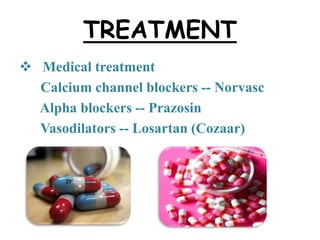
 Medical treatment
Calcium channel blockers -- Norvasc
Alpha blockers -- Prazosin
Vasodilators -- Losartan (Cozaar)
1. Patients with severe RP prone to ulceration
or large artery thrombotic events may be
prescribed Aspirin.
2. Prostaglandin Iloprost is used to manage
critical ischemia and Pulmonary
Hypertension in RP.
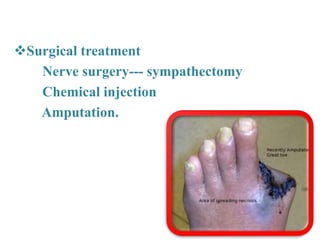
Surgical treatment
Nerve surgery--- sympathectomy
Chemical injection
Amputation.
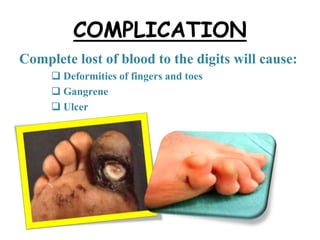
COMPLICATION
Complete lost of blood to the digits will cause:
 Deformities of fingers and toes
 Gangrene
 Ulcer
HEALTH EDUCATION
 Stop smoking
 Exercise
 Control stress
 Avoid caffeine
 Take care of feet and hand
 Dress warmly outdoors
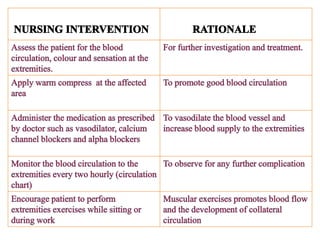
NURSING CARE PLAN
NURSING CARE PLAN
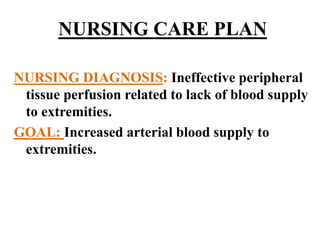
NURSING DIAGNOSIS: Ineffective peripheral
tissue perfusion related to lack of blood supply
to extremities.
GOAL: Increased arterial blood supply to
extremities.
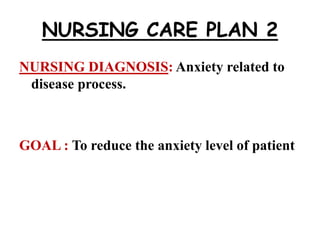
NURSING CARE PLAN 2
NURSING DIAGNOSIS: Anxiety related to
disease process.
GOAL : To reduce the anxiety level of patient
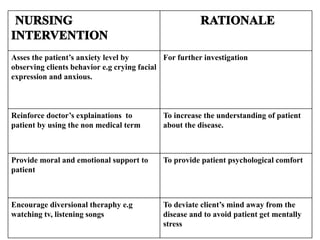
Asses the patient’s anxiety level by
observing clients behavior e.g crying facial
expression and anxious.
For further investigation
Reinforce doctor’s explainations to
patient by using the non medical term
To increase the understanding of patient
about the disease.
Provide moral and emotional support to
patient
To provide patient psychological comfort
Encourage diversional theraphy e.g
watching tv, listening songs
To deviate client’s mind away from the
disease and to avoid patient get mentally
stress
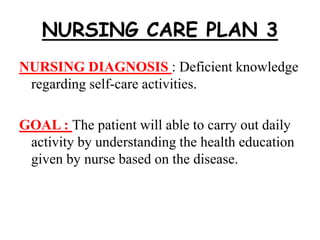
NURSING CARE PLAN 3
NURSING DIAGNOSIS : Deficient knowledge
regarding self-care activities.
GOAL : The patient will able to carry out daily
activity by understanding the health education
given by nurse based on the disease.
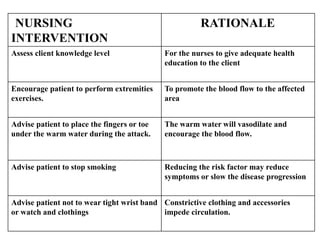
NURSING
INTERVENTION
RATIONALE
Assess client knowledge level For the nurses to give adequate health
education to the client
Encourage patient to perform extremities
exercises.
To promote the blood flow to the affected
area
Advise patient to place the fingers or toe
under the warm water during the attack.
The warm water will vasodilate and
encourage the blood flow.
Advise patient to stop smoking Reducing the risk factor may reduce
symptoms or slow the disease progression
Advise patient not to wear tight wrist band
or watch and clothings
Constrictive clothing and accessories
impede circulation.
Thank you

Raynauds

  • 1.
    RAYNAUD’S DISEASE Rohini Pandey 1stYear M.Sc Nursing KGMU Institute of Nursing
  • 2.
    CONTENTS 1. Introduction 2. Definition 3.Incidence & Prevalence 4. Classification of Raynaud’s Disease 5. Etiology & Risk Factors 6. Pathophysiology 7. Clinical feature 8. Diagnostic Evaluation 9. Management
  • 3.
  • 4.
    RAYNAUD’S DISEASE?? • Raynaud'sis a rare disorder that affects the arteries. • Raynaud's is also called a disease, syndrome, or phenomenon. • Vasospasm, which is a narrowing of the blood vessels. • Vasospasm of the arteries reduces blood flow to the fingers and toes. • Also may occur at the tip of ears and nose.
  • 5.
  • 6.
  • 7.
    CLASSIFICATION • Primary Raynaud’s/ Raynaud’s disease the causes is not known.(idiopathic) • Secondary Raynaud’s / Raynaud’s phenomenon where the causes are known.
  • 8.
    ETIOLOGY OF PRIMARYRAYNAUD’S • Cold temperature • Stress • Blood vessels in spasm
  • 9.
    ETIOLOGY OF SECONDARYRAYNAUD’S  Scleroderma  Lupus.  Rheumatoid arthritis  Sjogren's syndrome  Diseases of the arteries.  Carpal tunnel syndrome
  • 10.
     Repetitive actions Hand and foot injuries  Exposure to certain chemicals  Medicines  Smoking
  • 11.
    RISK FACTORS…. • PRIMARYRAYNAUD’S  Gender  Age  Family history  Living area climate
  • 12.
    • SECONDARY RAYNAUDS’S Age  Certain disease and condition  Work place  Injury of hand and leg  Repetitive action  Living climate  Smoking  Medicines
  • 13.
    PATHOPHYSIOLOGY Expose to cold/ triggering factor Small arteries at fingers and toes vasospasm Become pale, less blood flow and low O2 supply Warm up (arteries dilate) Blood flow increase, high O2 supply Color change to bright red Affected area is warm and throbbing pain
  • 14.
    CLINICAL MANIFESTATION During theRaynaud’s attack, arteries become narrow and no blood supply to the area, this will cause :  Turn pale or white and then blue.  Feel numb, cold, or painful.  Turn red, throb, tingle, burn, or feel numb as blood flows back to the affected area.
  • 15.
    INVESTIGATION Cold Stimulation Test Nailfold Capillaroscopy Antinuclear antibody (ANA) Erythrocyte sedimentation rate (ESR or "sed rate") C-reactive protein (CRP) tests
  • 16.
    TREATMENT  Medical treatment Calciumchannel blockers -- Norvasc Alpha blockers -- Prazosin Vasodilators -- Losartan (Cozaar)
  • 17.
    1. Patients withsevere RP prone to ulceration or large artery thrombotic events may be prescribed Aspirin. 2. Prostaglandin Iloprost is used to manage critical ischemia and Pulmonary Hypertension in RP.
  • 18.
    Surgical treatment Nerve surgery---sympathectomy Chemical injection Amputation.
  • 19.
    COMPLICATION Complete lost ofblood to the digits will cause:  Deformities of fingers and toes  Gangrene  Ulcer
  • 20.
    HEALTH EDUCATION  Stopsmoking  Exercise  Control stress  Avoid caffeine  Take care of feet and hand  Dress warmly outdoors
  • 21.
  • 22.
    NURSING CARE PLAN NURSINGDIAGNOSIS: Ineffective peripheral tissue perfusion related to lack of blood supply to extremities. GOAL: Increased arterial blood supply to extremities.
  • 24.
    NURSING CARE PLAN2 NURSING DIAGNOSIS: Anxiety related to disease process. GOAL : To reduce the anxiety level of patient
  • 25.
    Asses the patient’sanxiety level by observing clients behavior e.g crying facial expression and anxious. For further investigation Reinforce doctor’s explainations to patient by using the non medical term To increase the understanding of patient about the disease. Provide moral and emotional support to patient To provide patient psychological comfort Encourage diversional theraphy e.g watching tv, listening songs To deviate client’s mind away from the disease and to avoid patient get mentally stress
  • 26.
    NURSING CARE PLAN3 NURSING DIAGNOSIS : Deficient knowledge regarding self-care activities. GOAL : The patient will able to carry out daily activity by understanding the health education given by nurse based on the disease.
  • 27.
    NURSING INTERVENTION RATIONALE Assess client knowledgelevel For the nurses to give adequate health education to the client Encourage patient to perform extremities exercises. To promote the blood flow to the affected area Advise patient to place the fingers or toe under the warm water during the attack. The warm water will vasodilate and encourage the blood flow. Advise patient to stop smoking Reducing the risk factor may reduce symptoms or slow the disease progression Advise patient not to wear tight wrist band or watch and clothings Constrictive clothing and accessories impede circulation.
  • 28.