Presented by
Prajakta N Ghutke
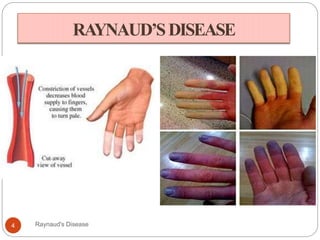
RAYNAUD’S DISEASE
 Raynaud's is a rare disorder that affects the
arteries.
 Raynaud's is also called a disease, syndrome, or
phenomenon.
 Vasospasm, which is a narrowing of the blood
vessels.
 Vasospasm of the arteries reduces blood flow to
the fingers and toes.
 Also may occur at the tip of ears andnose.
WHAT IS RAYNAUD’S DISEASE ???
2 Raynaud's Disease
Definition of Raynaud’s Disease
 Raynaud’s disease refers to a disorder in
which the fingers or toes suddenly
experience decreased blood circulation.
 It is characterized by repeated episodes of
color changes of the skin of digits on cold
exposure or emotional stress.
3 Raynaud's Disease
RAYNAUD’SDISEASE
4 Raynaud's Disease
CLASSIFICATION
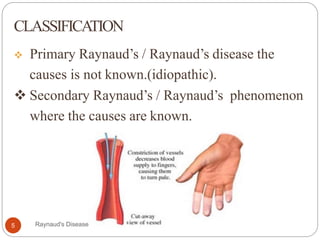
 Primary Raynaud’s / Raynaud’s disease the
causes is not known.(idiopathic).
 Secondary Raynaud’s / Raynaud’s phenomenon
where the causes are known.
5 Raynaud's Disease
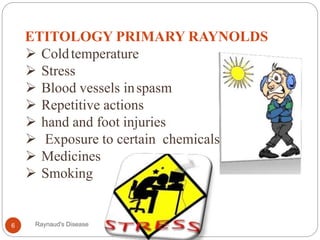
ETITOLOGY PRIMARY RAYNOLDS
 Coldtemperature
 Stress
 Blood vessels inspasm
 Repetitive actions
 hand and foot injuries
 Exposure to certain chemicals
 Medicines
 Smoking
6 Raynaud's Disease
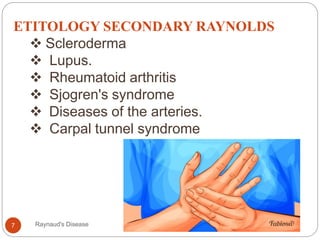
ETITOLOGY SECONDARY RAYNOLDS
 Scleroderma
 Lupus.
 Rheumatoid arthritis
 Sjogren's syndrome
 Diseases of the arteries.
 Carpal tunnel syndrome
7 Raynaud's Disease
RISKFACTORS
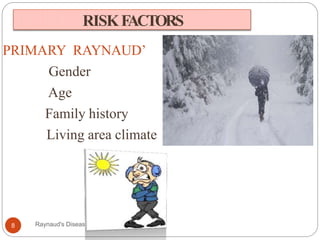
PRIMARY RAYNAUD’
Gender
Age
Family history
Living area climate
8 Raynaud's Disease
n
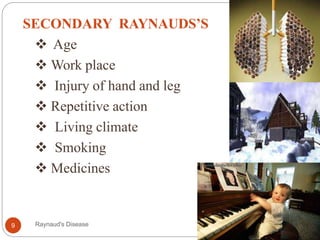
SECONDARY RAYNAUDS’S
 Age
 Work place
 Injury of hand and leg
 Repetitive action
 Living climate
 Smoking
 Medicines
9 Raynaud's Disease
PATHOPHYSIOLOGY
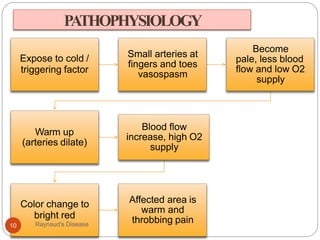
Expose to cold /
triggering factor
Small arteries at
fingers and toes
vasospasm
Become
pale, less blood
flow and low O2
supply
Warm up
(arteries dilate)
Blood flow
increase, high O2
supply
Color change to
bright red
Affected area is
warm and
throbbing pain10 Raynaud's Disease
CLINICAL MANIFESTATION
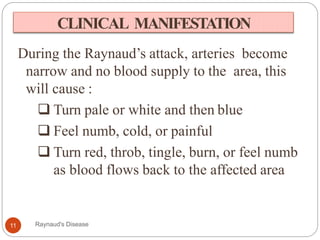
During the Raynaud’s attack, arteries become
narrow and no blood supply to the area, this
will cause :
 Turn pale or white and then blue
 Feel numb, cold, or painful
 Turn red, throb, tingle, burn, or feel numb
as blood flows back to the affected area
11 Raynaud's Disease
INVESTIGATION
 Cold Stimulation Test
 Nailfold Capillaroscopy
 Antinuclear antibody (ANA)
 Erythrocyte sedimentation rate (ESR or "sed
rate")
 C-reactive protein (CRP) tests
12 Raynaud's Disease
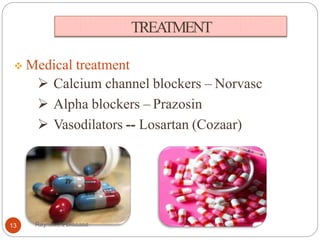
TREATMENT
 Medical treatment
 Calcium channel blockers – Norvasc
 Alpha blockers – Prazosin
 Vasodilators -- Losartan (Cozaar)
13 Raynaud's Disease
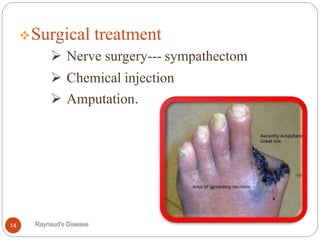
Surgical treatment
 Nerve surgery--- sympathectom
 Chemical injection
 Amputation.
14 Raynaud's Disease
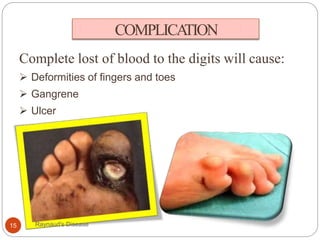
COMPLICATION
Complete lost of blood to the digits will cause:
 Deformities of fingers and toes
 Gangrene
 Ulcer
15 Raynaud's Disease
Nursing treatment
Raynaud's Disease16
 Give warm cloths to the patient
 Apply hot application
 Give comfortable position
 Lifestyle to minimize treatment
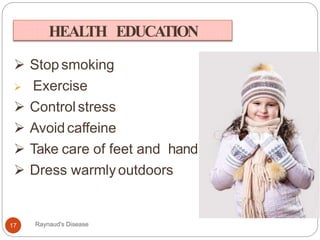
HEALTH EDUCATION
 Stop smoking
 Exercise
 Control stress
 Avoidcaffeine
 Take care of feet and hand
 Dress warmlyoutdoors
17 Raynaud's Disease
Nursing Diagnosis
Infective peripheral tissue perfusion related to lack of
blood supply to extremities.
Anxiety related to disease condition.
Pain at infection site related to disease condition.
Insomnia related to the hospitalization as evidenced by
verbalization.
Deficient knowledge regarding self care activities as
evidenced by verbalization.
18 Raynaud's Disease
Nursing Intervention-1
Assess the patient for the blood circulation , colour
and sensation at the extremities.
Apply warm compress at the affected area
Administer the medication as prescribed try doctor
such as vasodilator, calcium channel blockers and
alpha blockers.
Monitor the blood circulation to the extremities
every two hourly.
Encourage patient to perform extremities exercises
while sitting or during work.
19 Raynaud's Disease
Nursing Intervention-2
Assess the patient’s anxiety level by observing
clients behavior E.g. crying facial expression and
anxious.
Reinforce doctors explanations to patient by using
the non medical term.
Provide moral and emotional support to patient.
Encourage divisional therapy E.g. watching T.V,
Listening songs.
20 Raynaud's Disease
Nursing Intervention-3
Assess the general condition of the client.
Give comfortable position to the client.
Give medications to the client as prescribed by
doctor.
Provide dimensional therapy eg. Watching TV ,
listening songs.
21 Raynaud's Disease
Nursing Intervention-4
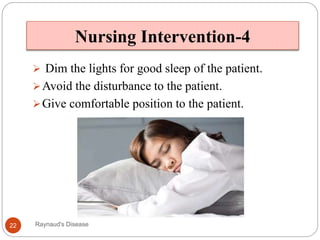
 Dim the lights for good sleep of the patient.
Avoid the disturbance to the patient.
Give comfortable position to the patient.
22 Raynaud's Disease
Nursing Intervention-5
Assess client knowledge level.
Encourage patient to perform extremities
exercise.
Advise patient to place the fingers or toe under
the warm water during the attack.
Advise patient to stop smoking.
Advise patient not to wear tight wrist band or
watch and clothing.
23 Raynaud's Disease
CONCLUSION
 Raynaud's sometimes is called a disease,
syndrome, or phenomenon.
 Its a narrowing of the blood vessels
 Vasospasm of the arteries reduces blood
flow to the fingers and toes.
 In people who have Raynaud's, the disorder
usually affects the fingers.
 In about 40 percent of people who have
Raynaud's, it affects the toes. Rarely, the
disorder affects the nose, ears, nipples, and
lips.24 Raynaud's Disease
 Has two type of raynaud that is primaryand
secondary Raynaud disease.
 In both types of Raynaud's, even mild orbrief
changes in temperature can cause Raynaud's
attacks.
 People with severe Raynaud's can develop
skin sores or gangrene from prolonged or
repeated Raynaud's attacks.
 It can be treated e.g. by placing the hand under
warm water to vasodilate
25 Raynaud's Disease
Bibliography
 http://www.nhlbi.nih.gov/health/dci/Diseases/
ray naud/ray_diagnosis.html
 http://www.medicalnewstoday.com/articles/17
67 13.php -Raynaud disease
 Brunner & Siddhartha's textbook of medical–
surgical nursing, 12th edition.
 Pearson International edition medical–
surgical nursing, 4th edition.
 Joyce.M & Jane Hokinson Hawks medical–
surgical nursing, 8th edition.
26 Raynaud's Disease
 thankyou
27 Raynaud's Disease

raynauld's disease

  • 1.
    Presented by Prajakta NGhutke RAYNAUD’S DISEASE
  • 2.
     Raynaud's isa rare disorder that affects the arteries.  Raynaud's is also called a disease, syndrome, or phenomenon.  Vasospasm, which is a narrowing of the blood vessels.  Vasospasm of the arteries reduces blood flow to the fingers and toes.  Also may occur at the tip of ears andnose. WHAT IS RAYNAUD’S DISEASE ??? 2 Raynaud's Disease
  • 3.
    Definition of Raynaud’sDisease  Raynaud’s disease refers to a disorder in which the fingers or toes suddenly experience decreased blood circulation.  It is characterized by repeated episodes of color changes of the skin of digits on cold exposure or emotional stress. 3 Raynaud's Disease
  • 4.
  • 5.
    CLASSIFICATION  Primary Raynaud’s/ Raynaud’s disease the causes is not known.(idiopathic).  Secondary Raynaud’s / Raynaud’s phenomenon where the causes are known. 5 Raynaud's Disease
  • 6.
    ETITOLOGY PRIMARY RAYNOLDS Coldtemperature  Stress  Blood vessels inspasm  Repetitive actions  hand and foot injuries  Exposure to certain chemicals  Medicines  Smoking 6 Raynaud's Disease
  • 7.
    ETITOLOGY SECONDARY RAYNOLDS Scleroderma  Lupus.  Rheumatoid arthritis  Sjogren's syndrome  Diseases of the arteries.  Carpal tunnel syndrome 7 Raynaud's Disease
  • 8.
  • 9.
    n SECONDARY RAYNAUDS’S  Age Work place  Injury of hand and leg  Repetitive action  Living climate  Smoking  Medicines 9 Raynaud's Disease
  • 10.
    PATHOPHYSIOLOGY Expose to cold/ triggering factor Small arteries at fingers and toes vasospasm Become pale, less blood flow and low O2 supply Warm up (arteries dilate) Blood flow increase, high O2 supply Color change to bright red Affected area is warm and throbbing pain10 Raynaud's Disease
  • 11.
    CLINICAL MANIFESTATION During theRaynaud’s attack, arteries become narrow and no blood supply to the area, this will cause :  Turn pale or white and then blue  Feel numb, cold, or painful  Turn red, throb, tingle, burn, or feel numb as blood flows back to the affected area 11 Raynaud's Disease
  • 12.
    INVESTIGATION  Cold StimulationTest  Nailfold Capillaroscopy  Antinuclear antibody (ANA)  Erythrocyte sedimentation rate (ESR or "sed rate")  C-reactive protein (CRP) tests 12 Raynaud's Disease
  • 13.
    TREATMENT  Medical treatment Calcium channel blockers – Norvasc  Alpha blockers – Prazosin  Vasodilators -- Losartan (Cozaar) 13 Raynaud's Disease
  • 14.
    Surgical treatment  Nervesurgery--- sympathectom  Chemical injection  Amputation. 14 Raynaud's Disease
  • 15.
    COMPLICATION Complete lost ofblood to the digits will cause:  Deformities of fingers and toes  Gangrene  Ulcer 15 Raynaud's Disease
  • 16.
    Nursing treatment Raynaud's Disease16 Give warm cloths to the patient  Apply hot application  Give comfortable position  Lifestyle to minimize treatment
  • 17.
    HEALTH EDUCATION  Stopsmoking  Exercise  Control stress  Avoidcaffeine  Take care of feet and hand  Dress warmlyoutdoors 17 Raynaud's Disease
  • 18.
    Nursing Diagnosis Infective peripheraltissue perfusion related to lack of blood supply to extremities. Anxiety related to disease condition. Pain at infection site related to disease condition. Insomnia related to the hospitalization as evidenced by verbalization. Deficient knowledge regarding self care activities as evidenced by verbalization. 18 Raynaud's Disease
  • 19.
    Nursing Intervention-1 Assess thepatient for the blood circulation , colour and sensation at the extremities. Apply warm compress at the affected area Administer the medication as prescribed try doctor such as vasodilator, calcium channel blockers and alpha blockers. Monitor the blood circulation to the extremities every two hourly. Encourage patient to perform extremities exercises while sitting or during work. 19 Raynaud's Disease
  • 20.
    Nursing Intervention-2 Assess thepatient’s anxiety level by observing clients behavior E.g. crying facial expression and anxious. Reinforce doctors explanations to patient by using the non medical term. Provide moral and emotional support to patient. Encourage divisional therapy E.g. watching T.V, Listening songs. 20 Raynaud's Disease
  • 21.
    Nursing Intervention-3 Assess thegeneral condition of the client. Give comfortable position to the client. Give medications to the client as prescribed by doctor. Provide dimensional therapy eg. Watching TV , listening songs. 21 Raynaud's Disease
  • 22.
    Nursing Intervention-4  Dimthe lights for good sleep of the patient. Avoid the disturbance to the patient. Give comfortable position to the patient. 22 Raynaud's Disease
  • 23.
    Nursing Intervention-5 Assess clientknowledge level. Encourage patient to perform extremities exercise. Advise patient to place the fingers or toe under the warm water during the attack. Advise patient to stop smoking. Advise patient not to wear tight wrist band or watch and clothing. 23 Raynaud's Disease
  • 24.
    CONCLUSION  Raynaud's sometimesis called a disease, syndrome, or phenomenon.  Its a narrowing of the blood vessels  Vasospasm of the arteries reduces blood flow to the fingers and toes.  In people who have Raynaud's, the disorder usually affects the fingers.  In about 40 percent of people who have Raynaud's, it affects the toes. Rarely, the disorder affects the nose, ears, nipples, and lips.24 Raynaud's Disease
  • 25.
     Has twotype of raynaud that is primaryand secondary Raynaud disease.  In both types of Raynaud's, even mild orbrief changes in temperature can cause Raynaud's attacks.  People with severe Raynaud's can develop skin sores or gangrene from prolonged or repeated Raynaud's attacks.  It can be treated e.g. by placing the hand under warm water to vasodilate 25 Raynaud's Disease
  • 26.
    Bibliography  http://www.nhlbi.nih.gov/health/dci/Diseases/ ray naud/ray_diagnosis.html http://www.medicalnewstoday.com/articles/17 67 13.php -Raynaud disease  Brunner & Siddhartha's textbook of medical– surgical nursing, 12th edition.  Pearson International edition medical– surgical nursing, 4th edition.  Joyce.M & Jane Hokinson Hawks medical– surgical nursing, 8th edition. 26 Raynaud's Disease
  • 27.