Rational Numbers
• A comprehensive presentation on Rational Numbers
• By: Shivam Singh
Introduction to Rational Numbers
• • A rational number is any number that can be expressed as a fraction p/q, where
p and q are integers and q ≠ 0.
• • Examples: 1/2, -3/4, 5, 0, 2.75 (since 2.75 = 11/4)
• • Rational numbers include integers, fractions, and terminating or repeating
decimals.
Properties of Rational Numbers
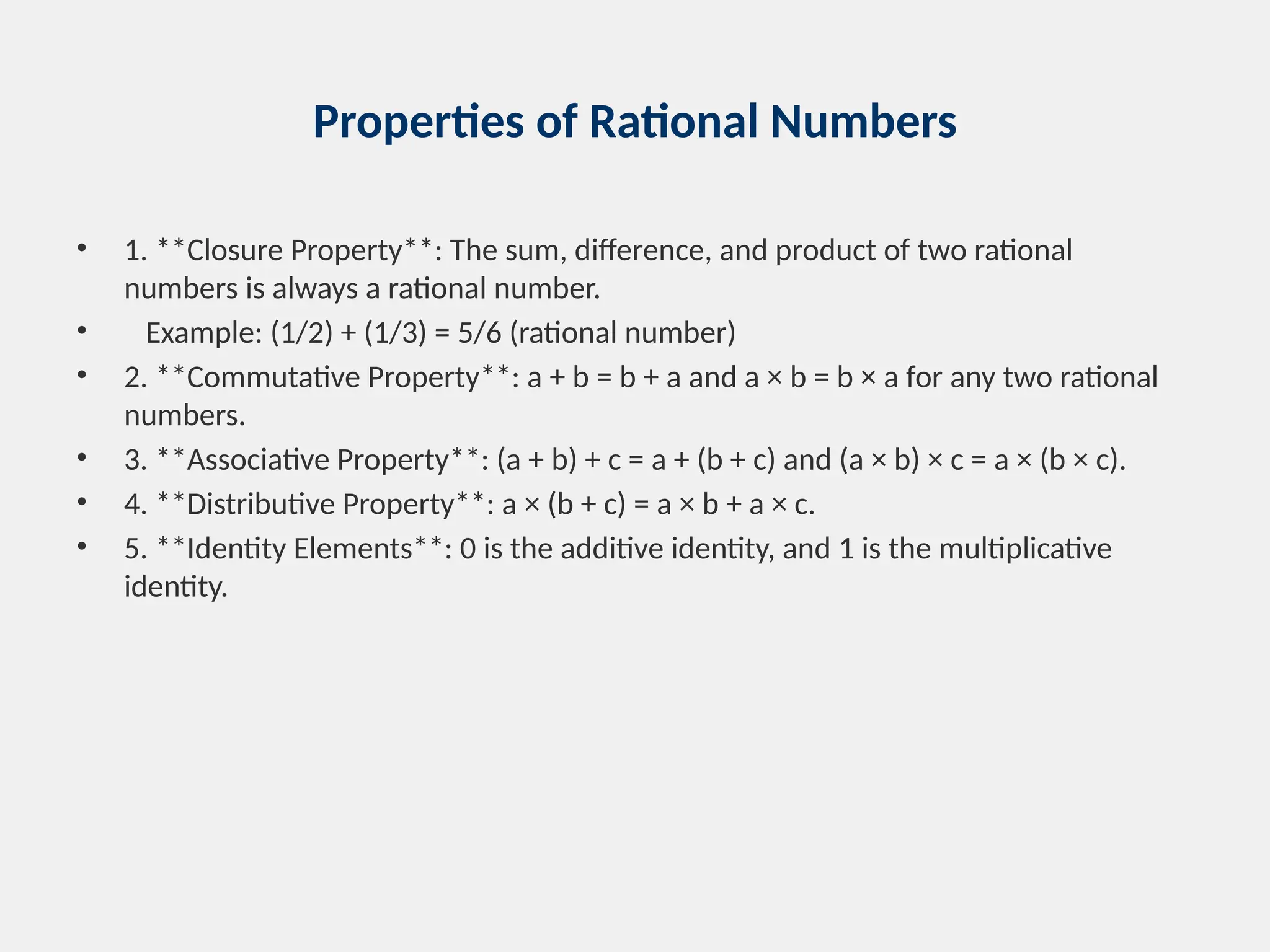
• 1. **Closure Property**: The sum, difference, and product of two rational
numbers is always a rational number.
• Example: (1/2) + (1/3) = 5/6 (rational number)
• 2. **Commutative Property**: a + b = b + a and a × b = b × a for any two rational
numbers.
• 3. **Associative Property**: (a + b) + c = a + (b + c) and (a × b) × c = a × (b × c).
• 4. **Distributive Property**: a × (b + c) = a × b + a × c.
• 5. **Identity Elements**: 0 is the additive identity, and 1 is the multiplicative
identity.
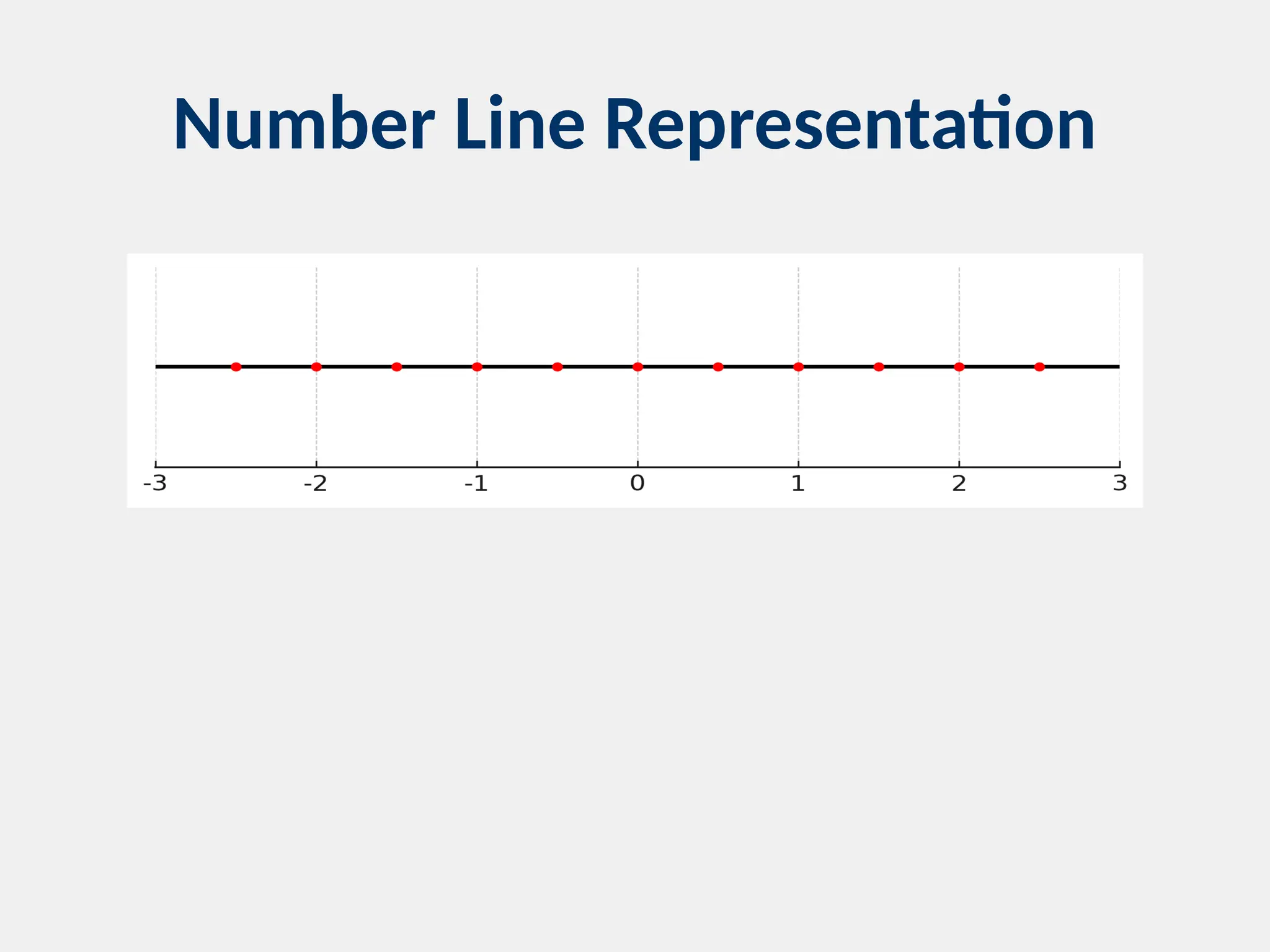
Representation on a Number Line
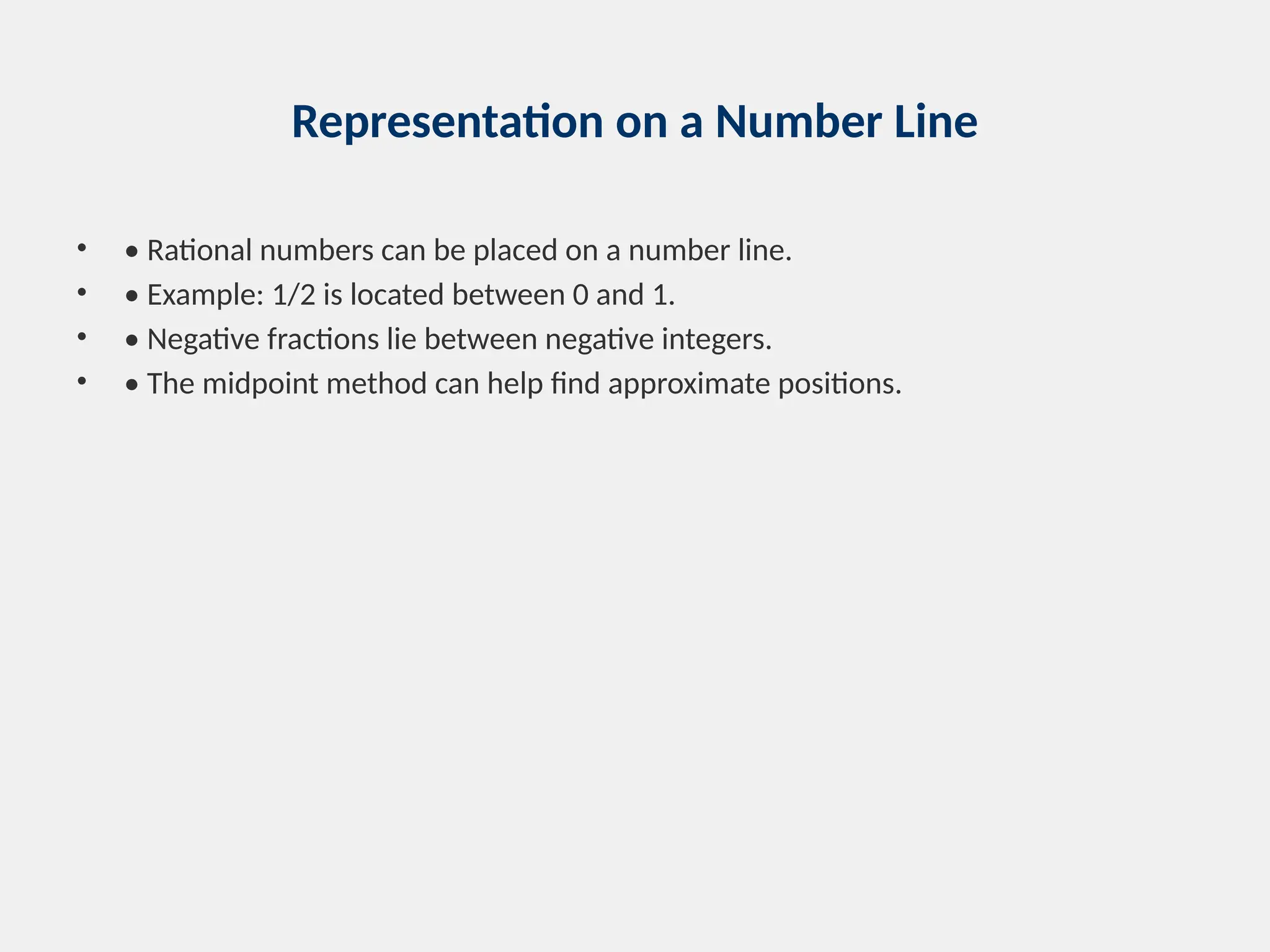
• • Rational numbers can be placed on a number line.
• • Example: 1/2 is located between 0 and 1.
• • Negative fractions lie between negative integers.
• • The midpoint method can help find approximate positions.
Standard Form of Rational Numbers
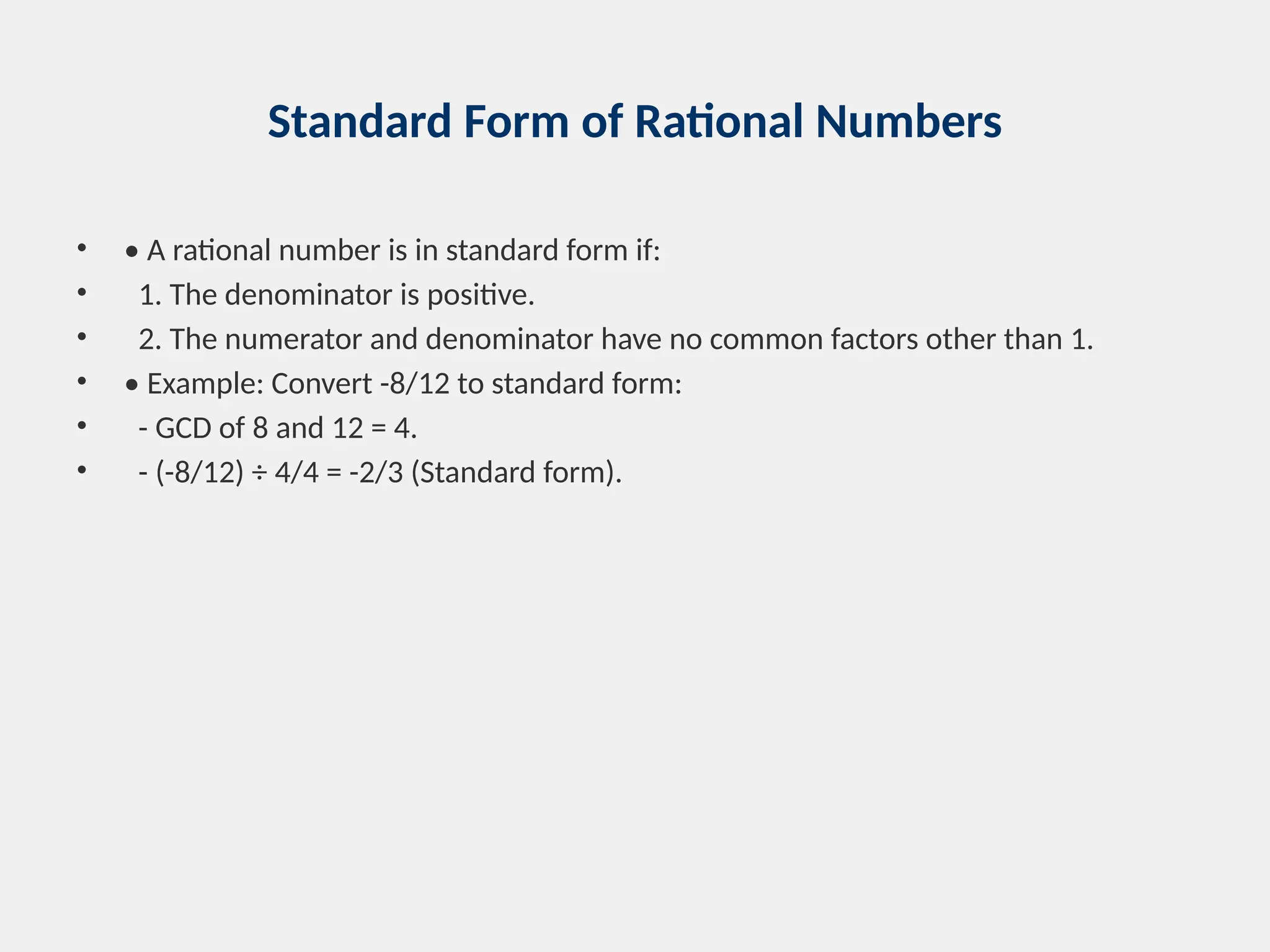
• • A rational number is in standard form if:
• 1. The denominator is positive.
• 2. The numerator and denominator have no common factors other than 1.
• • Example: Convert -8/12 to standard form:
• - GCD of 8 and 12 = 4.
• - (-8/12) ÷ 4/4 = -2/3 (Standard form).
Operations on Rational Numbers
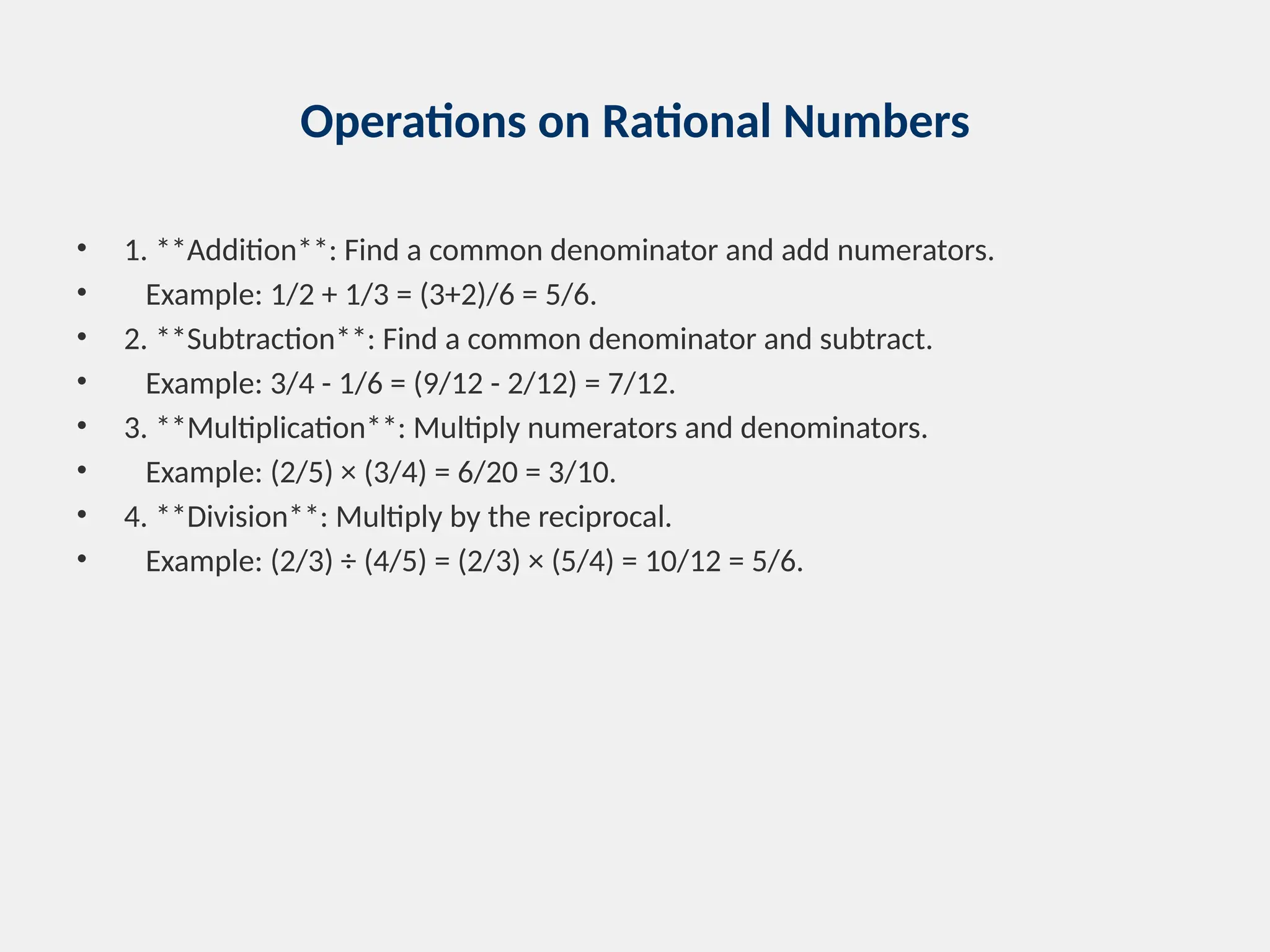
• 1. **Addition**: Find a common denominator and add numerators.
• Example: 1/2 + 1/3 = (3+2)/6 = 5/6.
• 2. **Subtraction**: Find a common denominator and subtract.
• Example: 3/4 - 1/6 = (9/12 - 2/12) = 7/12.
• 3. **Multiplication**: Multiply numerators and denominators.
• Example: (2/5) × (3/4) = 6/20 = 3/10.
• 4. **Division**: Multiply by the reciprocal.
• Example: (2/3) ÷ (4/5) = (2/3) × (5/4) = 10/12 = 5/6.
Comparison of Rational Numbers
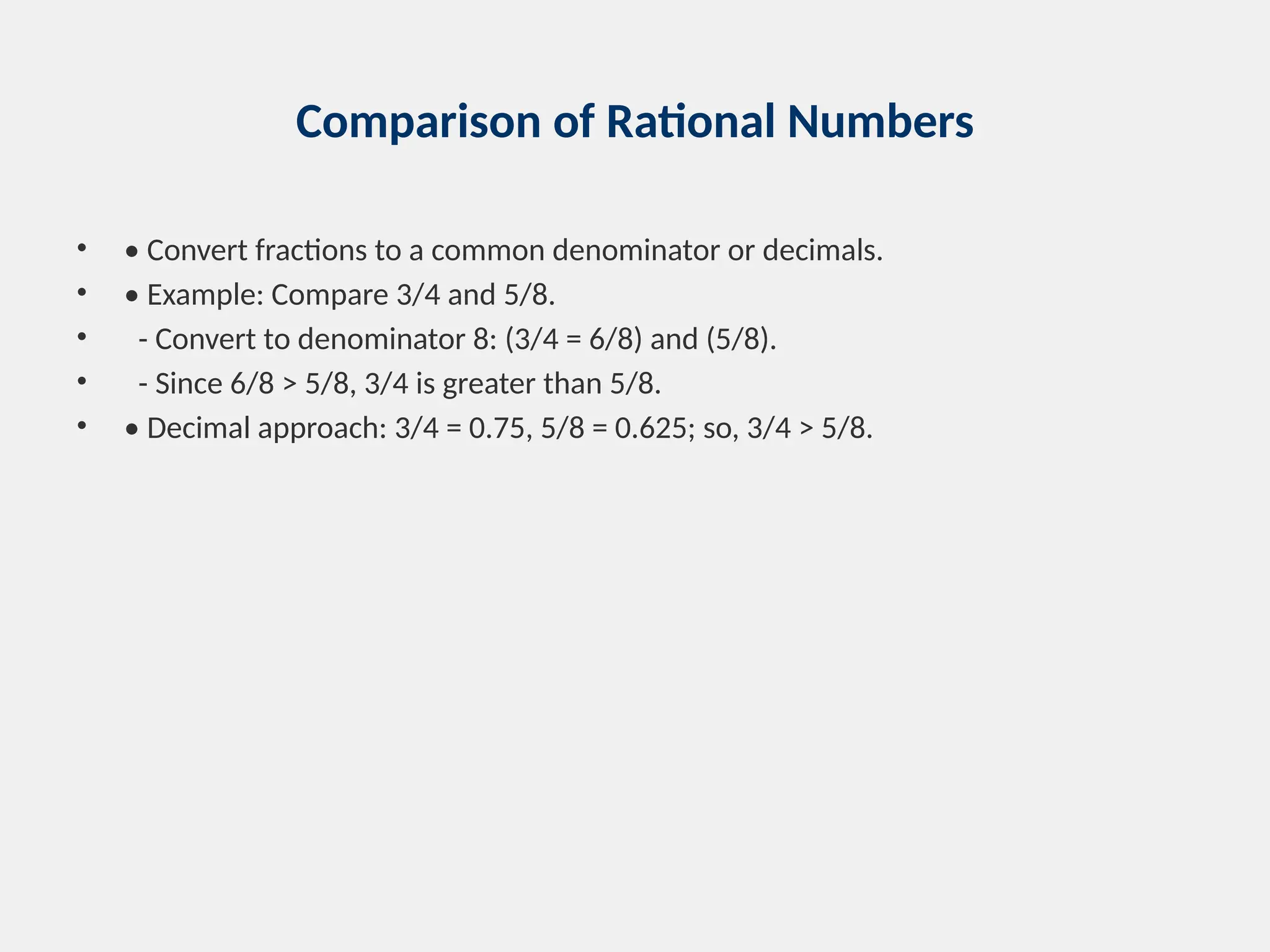
• • Convert fractions to a common denominator or decimals.
• • Example: Compare 3/4 and 5/8.
• - Convert to denominator 8: (3/4 = 6/8) and (5/8).
• - Since 6/8 > 5/8, 3/4 is greater than 5/8.
• • Decimal approach: 3/4 = 0.75, 5/8 = 0.625; so, 3/4 > 5/8.
Conversion of Decimals to Rational Numbers
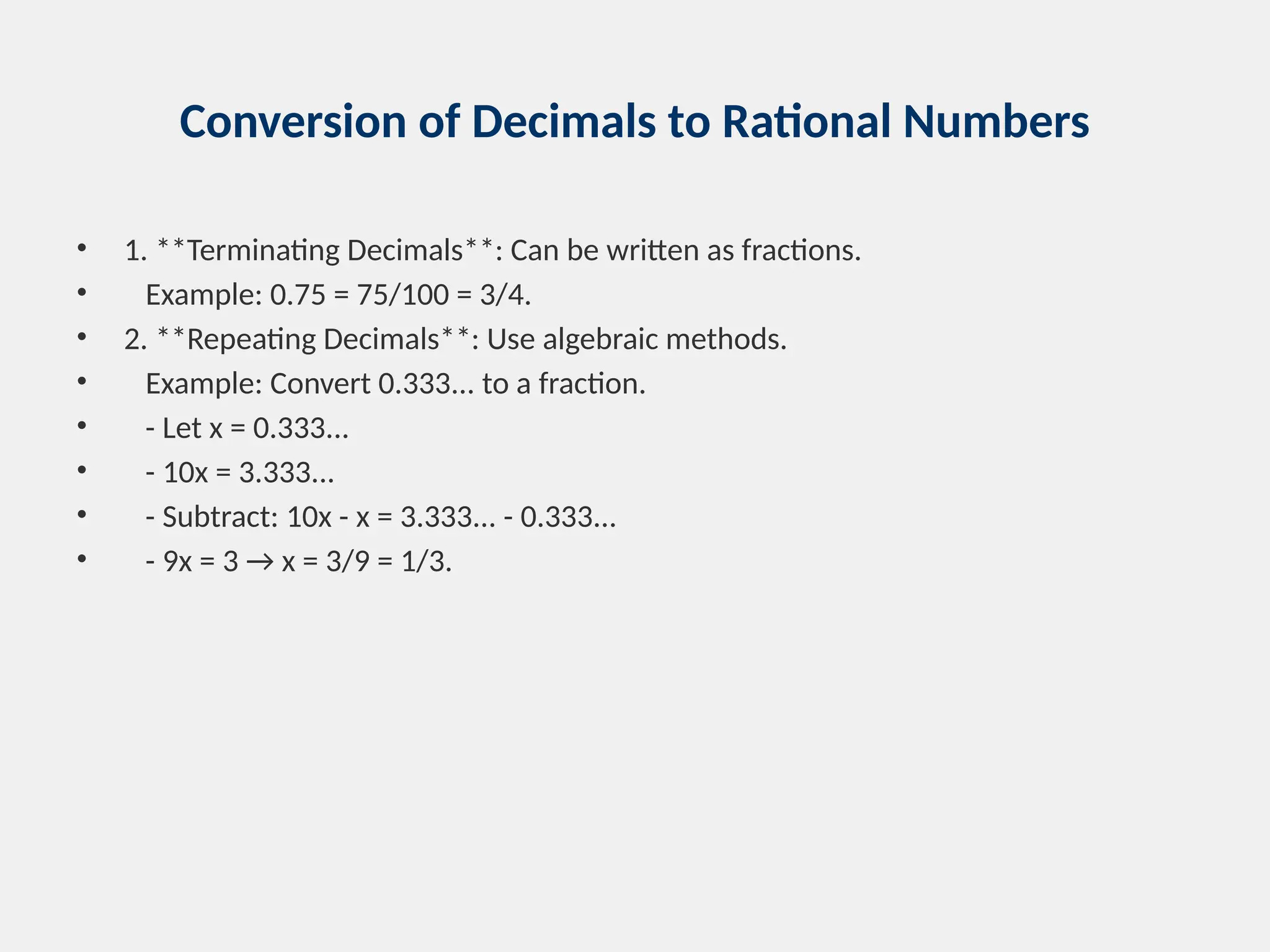
• 1. **Terminating Decimals**: Can be written as fractions.
• Example: 0.75 = 75/100 = 3/4.
• 2. **Repeating Decimals**: Use algebraic methods.
• Example: Convert 0.333... to a fraction.
• - Let x = 0.333...
• - 10x = 3.333...
• - Subtract: 10x - x = 3.333... - 0.333...
• - 9x = 3 → x = 3/9 = 1/3.
Applications of Rational Numbers
• • **Finance**: Interest rates, tax calculations, discounts.
• • **Measurements**: Cooking recipes, construction.
• • **Probability**: Representing chances of events.
• • **Ratios & Proportions**: Used in maps, models, and statistics.
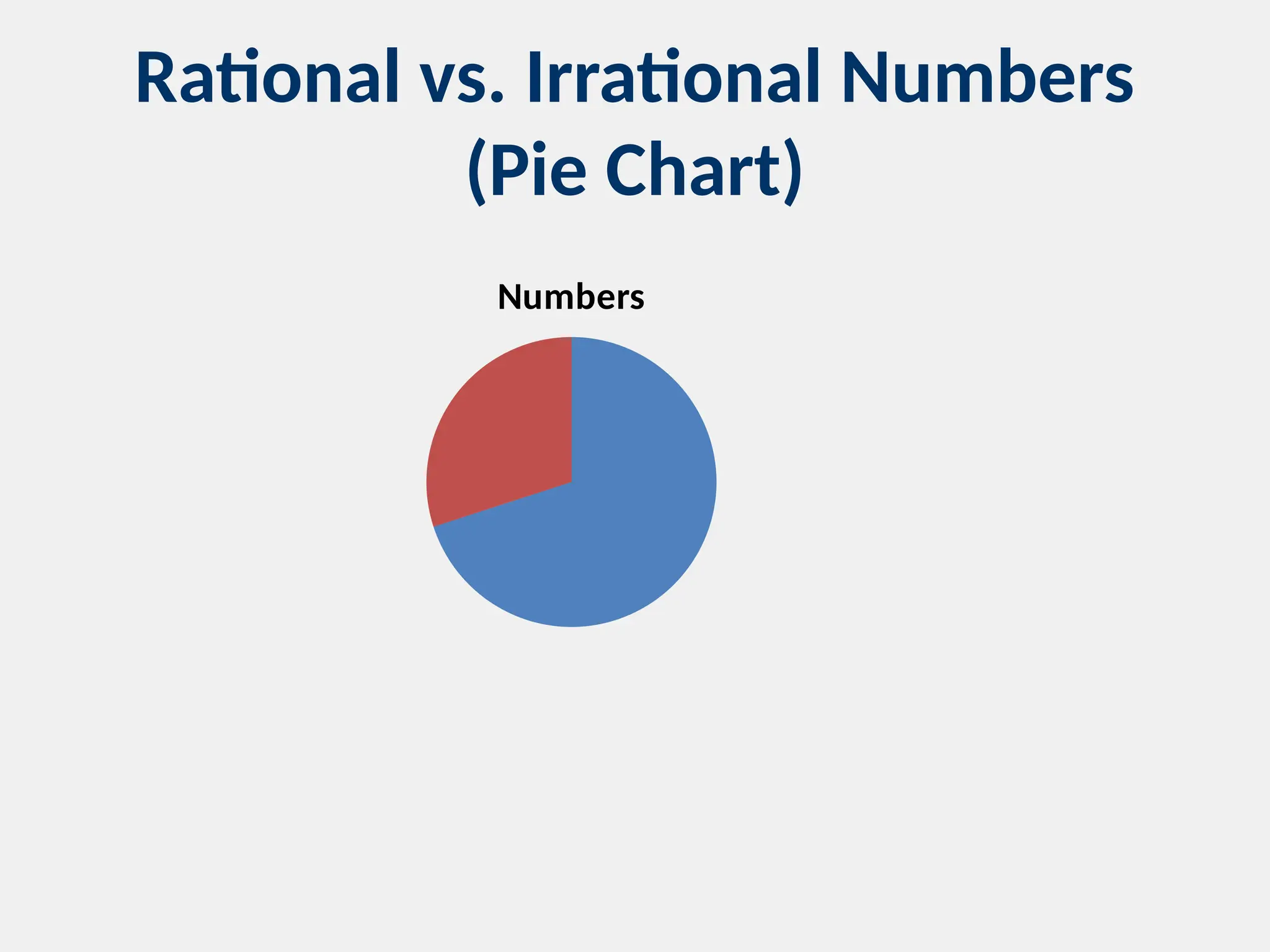
Rational vs. Irrational Numbers
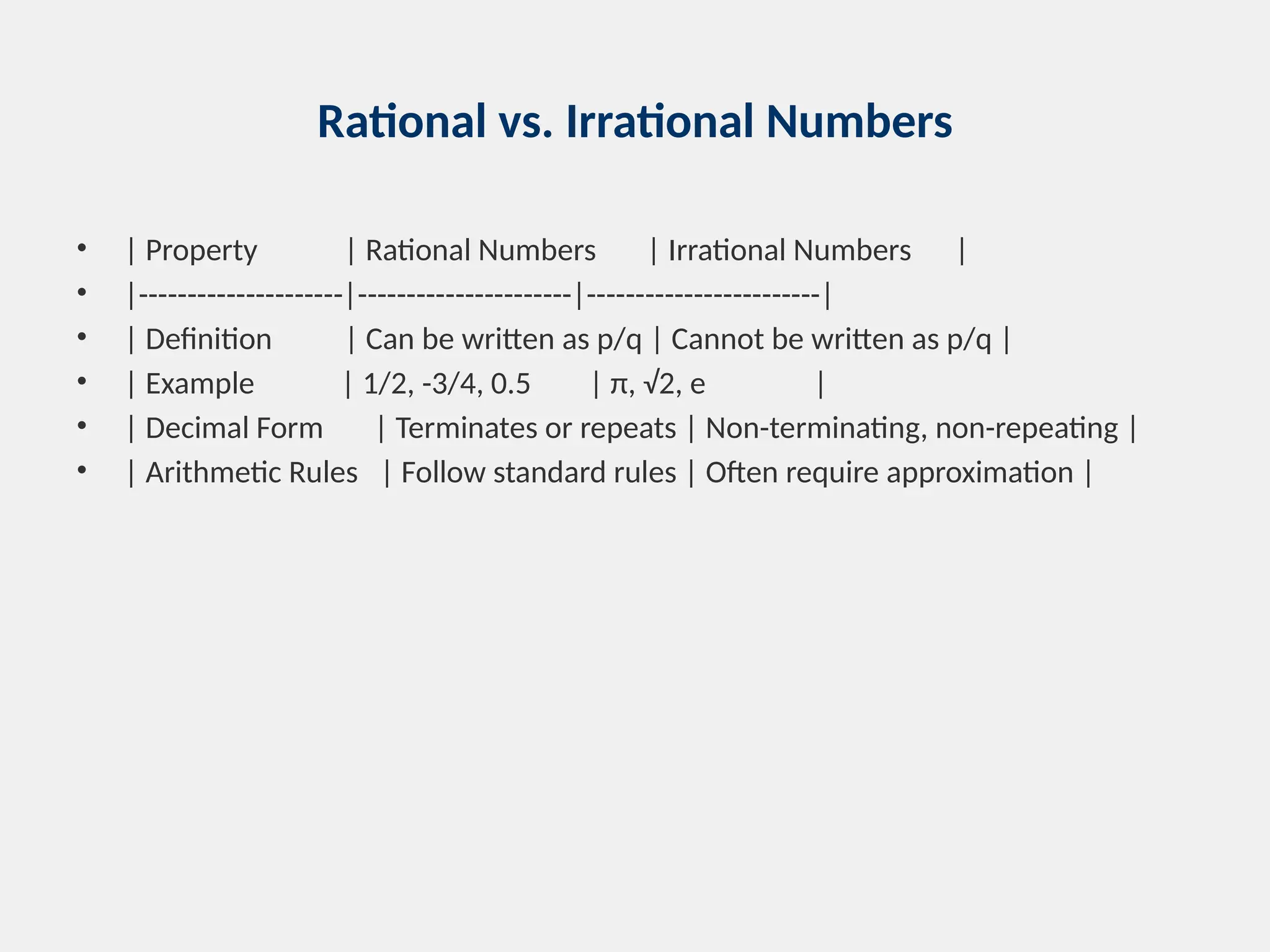
• | Property | Rational Numbers | Irrational Numbers |
• |---------------------|----------------------|------------------------|
• | Definition | Can be written as p/q | Cannot be written as p/q |
• | Example | 1/2, -3/4, 0.5 | π, √2, e |
• | Decimal Form | Terminates or repeats | Non-terminating, non-repeating |
• | Arithmetic Rules | Follow standard rules | Often require approximation |
Common Mistakes & Interesting Facts
• • **0 is a rational number** (0 = 0/1).
• • **Dividing by zero is undefined.**
• • **Not all decimals are rational.** Example: π = 3.141592...
• • **Multiplying rational numbers always gives a rational result.**
Conclusion & Summary
• • Rational numbers are essential in mathematics and daily life.
• • They follow predictable properties and rules.
• • Knowing how to compare, convert, and operate on them is useful in various
applications.
Number Line Representation
Rational vs. Irrational Numbers
(Pie Chart)
Numbers

Relational numbers in mathematics c.pptx

  • 1.
    Rational Numbers • Acomprehensive presentation on Rational Numbers • By: Shivam Singh
  • 2.
    Introduction to RationalNumbers • • A rational number is any number that can be expressed as a fraction p/q, where p and q are integers and q ≠ 0. • • Examples: 1/2, -3/4, 5, 0, 2.75 (since 2.75 = 11/4) • • Rational numbers include integers, fractions, and terminating or repeating decimals.
  • 3.
    Properties of RationalNumbers • 1. **Closure Property**: The sum, difference, and product of two rational numbers is always a rational number. • Example: (1/2) + (1/3) = 5/6 (rational number) • 2. **Commutative Property**: a + b = b + a and a × b = b × a for any two rational numbers. • 3. **Associative Property**: (a + b) + c = a + (b + c) and (a × b) × c = a × (b × c). • 4. **Distributive Property**: a × (b + c) = a × b + a × c. • 5. **Identity Elements**: 0 is the additive identity, and 1 is the multiplicative identity.
  • 4.
    Representation on aNumber Line • • Rational numbers can be placed on a number line. • • Example: 1/2 is located between 0 and 1. • • Negative fractions lie between negative integers. • • The midpoint method can help find approximate positions.
  • 5.
    Standard Form ofRational Numbers • • A rational number is in standard form if: • 1. The denominator is positive. • 2. The numerator and denominator have no common factors other than 1. • • Example: Convert -8/12 to standard form: • - GCD of 8 and 12 = 4. • - (-8/12) ÷ 4/4 = -2/3 (Standard form).
  • 6.
    Operations on RationalNumbers • 1. **Addition**: Find a common denominator and add numerators. • Example: 1/2 + 1/3 = (3+2)/6 = 5/6. • 2. **Subtraction**: Find a common denominator and subtract. • Example: 3/4 - 1/6 = (9/12 - 2/12) = 7/12. • 3. **Multiplication**: Multiply numerators and denominators. • Example: (2/5) × (3/4) = 6/20 = 3/10. • 4. **Division**: Multiply by the reciprocal. • Example: (2/3) ÷ (4/5) = (2/3) × (5/4) = 10/12 = 5/6.
  • 7.
    Comparison of RationalNumbers • • Convert fractions to a common denominator or decimals. • • Example: Compare 3/4 and 5/8. • - Convert to denominator 8: (3/4 = 6/8) and (5/8). • - Since 6/8 > 5/8, 3/4 is greater than 5/8. • • Decimal approach: 3/4 = 0.75, 5/8 = 0.625; so, 3/4 > 5/8.
  • 8.
    Conversion of Decimalsto Rational Numbers • 1. **Terminating Decimals**: Can be written as fractions. • Example: 0.75 = 75/100 = 3/4. • 2. **Repeating Decimals**: Use algebraic methods. • Example: Convert 0.333... to a fraction. • - Let x = 0.333... • - 10x = 3.333... • - Subtract: 10x - x = 3.333... - 0.333... • - 9x = 3 → x = 3/9 = 1/3.
  • 9.
    Applications of RationalNumbers • • **Finance**: Interest rates, tax calculations, discounts. • • **Measurements**: Cooking recipes, construction. • • **Probability**: Representing chances of events. • • **Ratios & Proportions**: Used in maps, models, and statistics.
  • 10.
    Rational vs. IrrationalNumbers • | Property | Rational Numbers | Irrational Numbers | • |---------------------|----------------------|------------------------| • | Definition | Can be written as p/q | Cannot be written as p/q | • | Example | 1/2, -3/4, 0.5 | π, √2, e | • | Decimal Form | Terminates or repeats | Non-terminating, non-repeating | • | Arithmetic Rules | Follow standard rules | Often require approximation |
  • 11.
    Common Mistakes &Interesting Facts • • **0 is a rational number** (0 = 0/1). • • **Dividing by zero is undefined.** • • **Not all decimals are rational.** Example: π = 3.141592... • • **Multiplying rational numbers always gives a rational result.**
  • 12.
    Conclusion & Summary •• Rational numbers are essential in mathematics and daily life. • • They follow predictable properties and rules. • • Knowing how to compare, convert, and operate on them is useful in various applications.
  • 13.
  • 14.
    Rational vs. IrrationalNumbers (Pie Chart) Numbers