By Shilpa Narang
Associate Professor
RATIO ANALYSIS
 Ratio analysis is the process
of determining and
interpreting numerical
relationship based on
financial statements.
 It is the technique of
interpretation of financial
statements with the help of
accounting ratios derived
from the balance sheet and
profit and loss account.
Classification Of Ratios
Liquidity Ratios
Solvency Ratios
Turnover Ratios
Profitability Ratios
LIQUIDITY RATIOS
I. Test Of Liquidity
How Solvent the Business is?
The liquidity ratios are used to test the short term solvency or
liquidity position of the business.
It enables to know whether short term liabilities can be paid out
of short term assets.
It indicates whether a firm has adequate working capital to carry
out routine business activity.
It is a valuable aid to management in checking the efficiency
with which working capital is being employed.
It is also of importance to shareholders and long term creditors
in determining to some extent the prospects of dividend and
interest payment.
Important Ratios In Test Of
Liquidity
Current ratio
Quick ratio
Cash ratio
Current Ratio
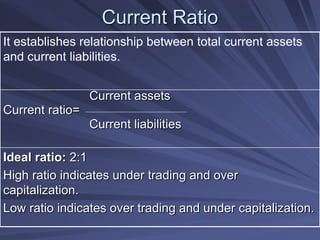
It establishes relationship between total current assets
and current liabilities.
Current assets
Current ratio=
Current liabilities
Ideal ratio: 2:1
High ratio indicates under trading and over
capitalization.
Low ratio indicates over trading and under capitalization.
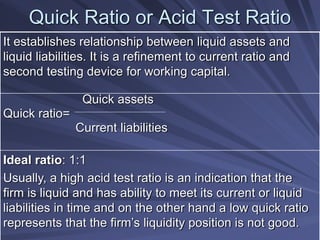
Quick Ratio or Acid Test Ratio
It establishes relationship between liquid assets and
liquid liabilities. It is a refinement to current ratio and
second testing device for working capital.
Quick assets
Quick ratio=
Current liabilities
Ideal ratio: 1:1
Usually, a high acid test ratio is an indication that the
firm is liquid and has ability to meet its current or liquid
liabilities in time and on the other hand a low quick ratio
represents that the firm’s liquidity position is not good.
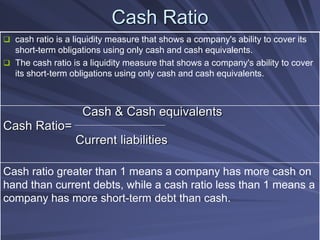
Cash Ratio
 cash ratio is a liquidity measure that shows a company's ability to cover its
short-term obligations using only cash and cash equivalents.
 The cash ratio is a liquidity measure that shows a company's ability to cover
its short-term obligations using only cash and cash equivalents.
Cash & Cash equivalents
Cash Ratio=
Current liabilities
Cash ratio greater than 1 means a company has more cash on
hand than current debts, while a cash ratio less than 1 means a
company has more short-term debt than cash.
How to improve the liquidity ratios?
If the ratio is low then the business
needs to bring more cash into the
business. It can do this in the following
ways:
selling under-used fixed assets
postponing planned investments
raising more share capital

Liquidity ratios.ppt

  • 1.
  • 2.
    RATIO ANALYSIS  Ratioanalysis is the process of determining and interpreting numerical relationship based on financial statements.  It is the technique of interpretation of financial statements with the help of accounting ratios derived from the balance sheet and profit and loss account.
  • 3.
    Classification Of Ratios LiquidityRatios Solvency Ratios Turnover Ratios Profitability Ratios
  • 4.
  • 5.
    I. Test OfLiquidity How Solvent the Business is? The liquidity ratios are used to test the short term solvency or liquidity position of the business. It enables to know whether short term liabilities can be paid out of short term assets. It indicates whether a firm has adequate working capital to carry out routine business activity. It is a valuable aid to management in checking the efficiency with which working capital is being employed. It is also of importance to shareholders and long term creditors in determining to some extent the prospects of dividend and interest payment.
  • 6.
    Important Ratios InTest Of Liquidity Current ratio Quick ratio Cash ratio
  • 7.
    Current Ratio It establishesrelationship between total current assets and current liabilities. Current assets Current ratio= Current liabilities Ideal ratio: 2:1 High ratio indicates under trading and over capitalization. Low ratio indicates over trading and under capitalization.
  • 8.
    Quick Ratio orAcid Test Ratio It establishes relationship between liquid assets and liquid liabilities. It is a refinement to current ratio and second testing device for working capital. Quick assets Quick ratio= Current liabilities Ideal ratio: 1:1 Usually, a high acid test ratio is an indication that the firm is liquid and has ability to meet its current or liquid liabilities in time and on the other hand a low quick ratio represents that the firm’s liquidity position is not good.
  • 9.
    Cash Ratio  cashratio is a liquidity measure that shows a company's ability to cover its short-term obligations using only cash and cash equivalents.  The cash ratio is a liquidity measure that shows a company's ability to cover its short-term obligations using only cash and cash equivalents. Cash & Cash equivalents Cash Ratio= Current liabilities Cash ratio greater than 1 means a company has more cash on hand than current debts, while a cash ratio less than 1 means a company has more short-term debt than cash.
  • 10.
    How to improvethe liquidity ratios? If the ratio is low then the business needs to bring more cash into the business. It can do this in the following ways: selling under-used fixed assets postponing planned investments raising more share capital